Molecular Representations
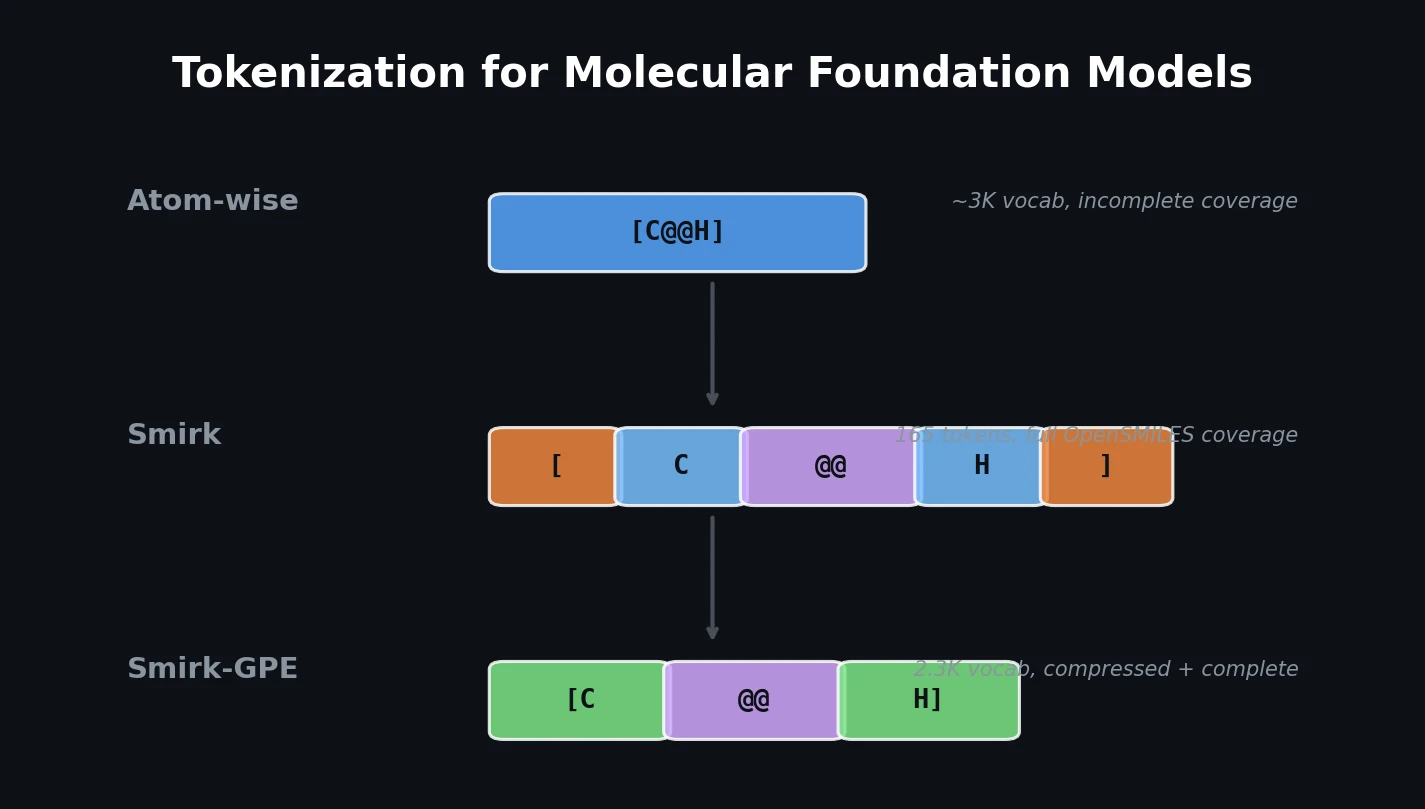
Visualization of tokenizer vocabulary coverage across chemical space

Smirk: Complete Tokenization for Molecular Models

Introduces Smirk and Smirk-GPE tokenizers that fully cover the OpenSMILES specification, proposes n-gram language models as low-cost proxies for evaluating tokenizer quality, and benchmarks 34 tokenizers across intrinsic and extrinsic metrics.
Molecular Representations
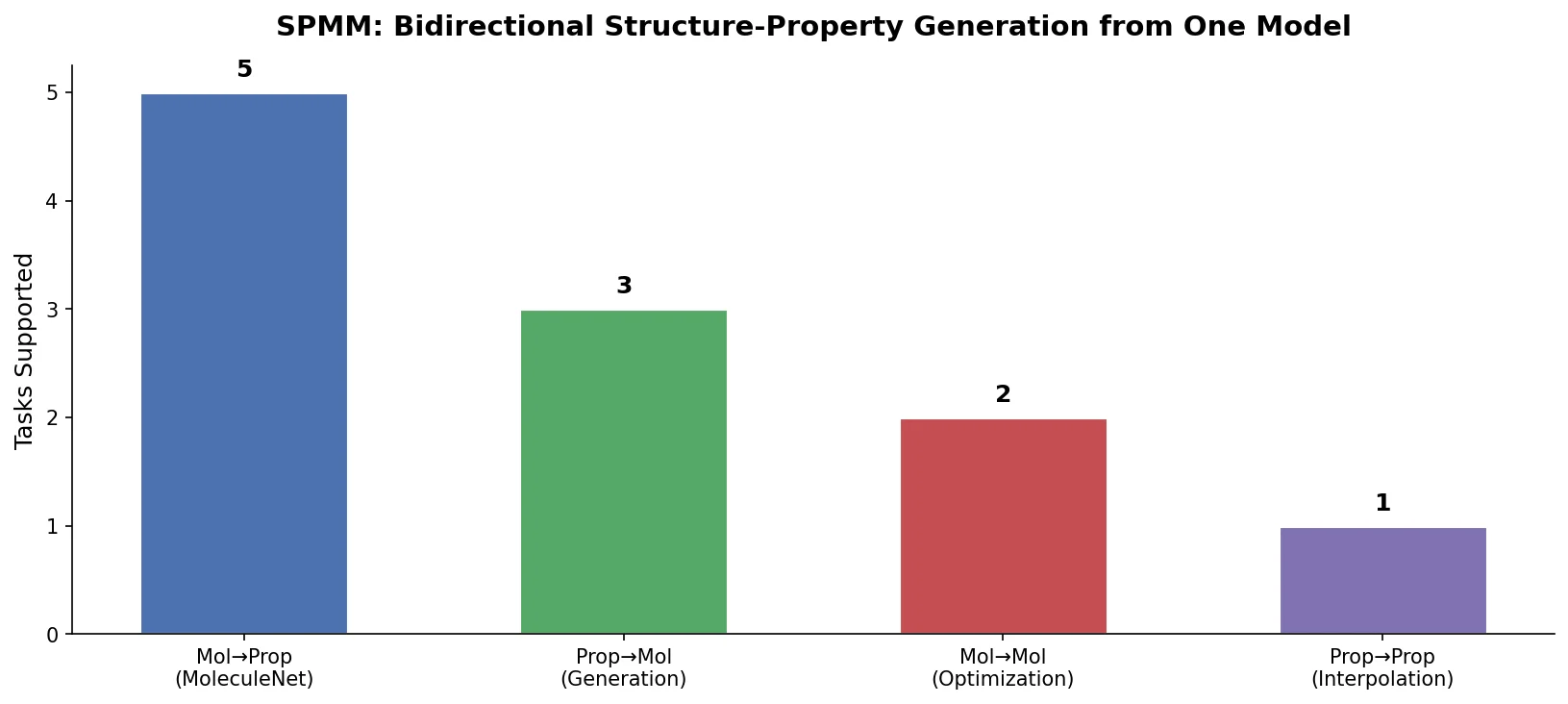
Bar chart showing SPMM supports bidirectional tasks: molecule to property, property to molecule, molecule optimization, and property interpolation

SPMM: A Bidirectional Molecular Foundation Model

SPMM pre-trains a dual-stream transformer on SMILES and 53 molecular property vectors using contrastive learning and cross-attention, enabling bidirectional structure-property generation, property prediction, and reaction prediction through a single model.

Computational Chemistry
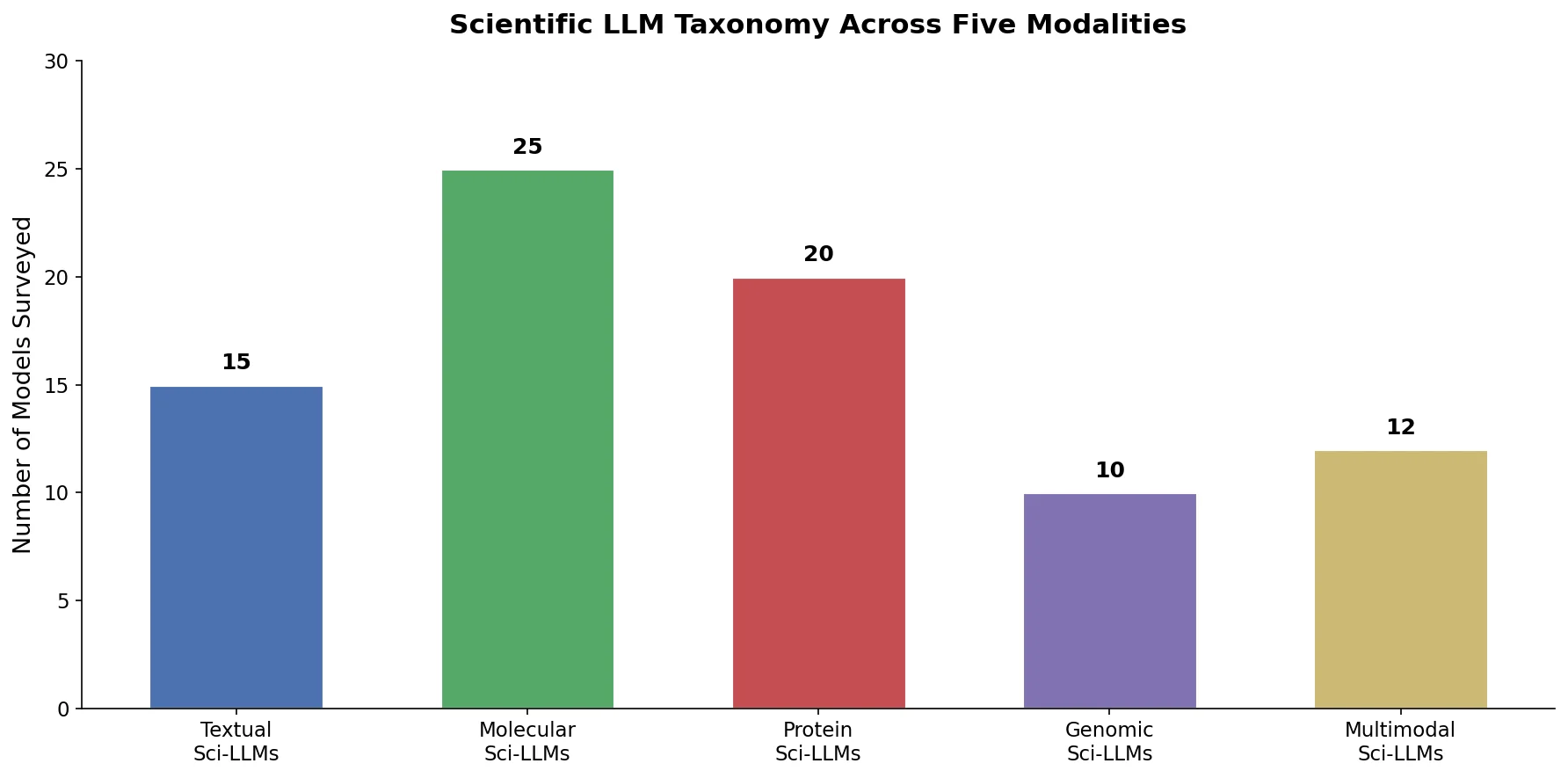
Bar chart showing scientific LLM taxonomy across five modalities: textual, molecular, protein, genomic, and multimodal

Survey of Scientific LLMs in Bio and Chem Domains

This survey systematically reviews scientific LLMs (Sci-LLMs) across five modalities: textual, molecular, protein, genomic, and multimodal, analyzing architectures, datasets, evaluation methods, and open challenges for AI-driven scientific discovery.

Molecular Representations
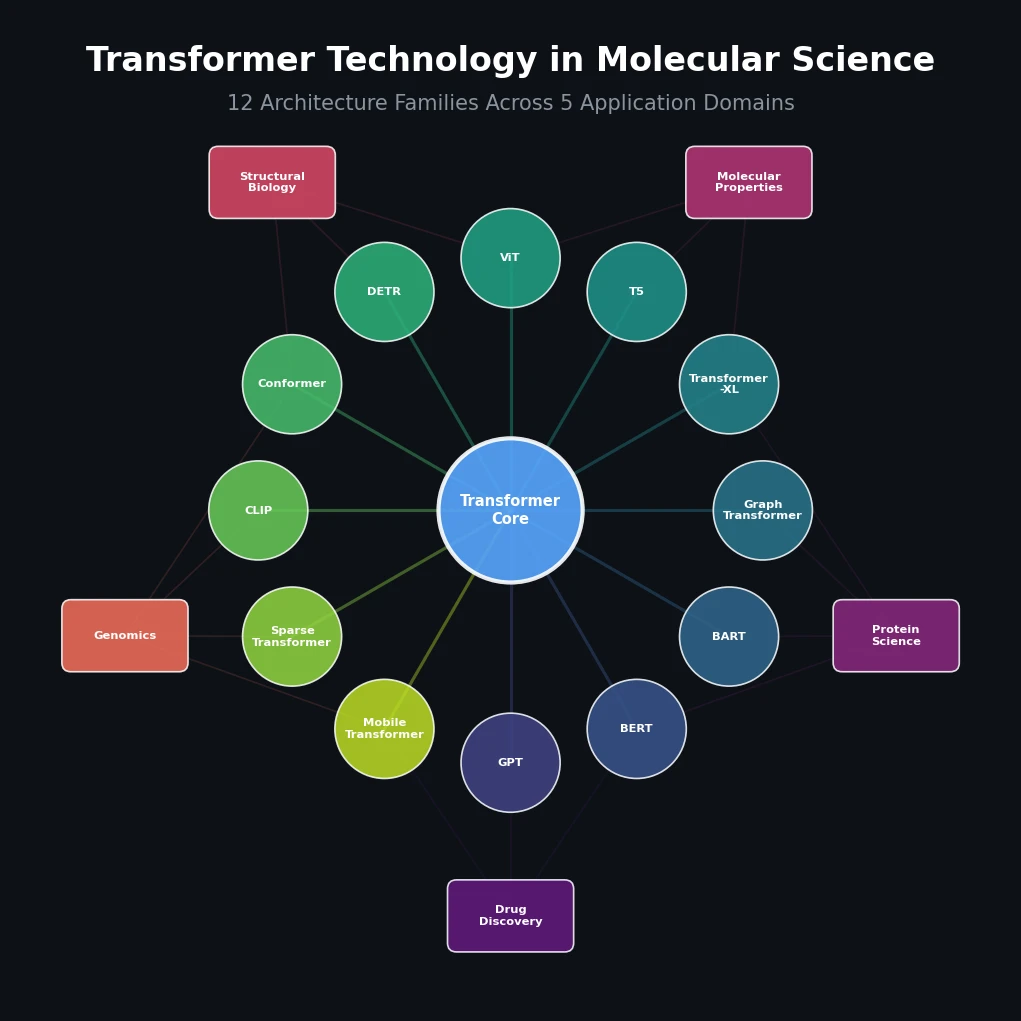
Radial diagram showing 12 transformer architecture families connected to 5 molecular science application domains

Survey of Transformer Architectures in Molecular Science

Jiang et al. survey 12 families of transformer architectures in molecular science, covering GPT, BERT, BART, graph transformers, Transformer-XL, T5, ViT, DETR, Conformer, CLIP, sparse transformers, and mobile/efficient variants, with detailed algorithmic descriptions and molecular applications.

Molecular Representations
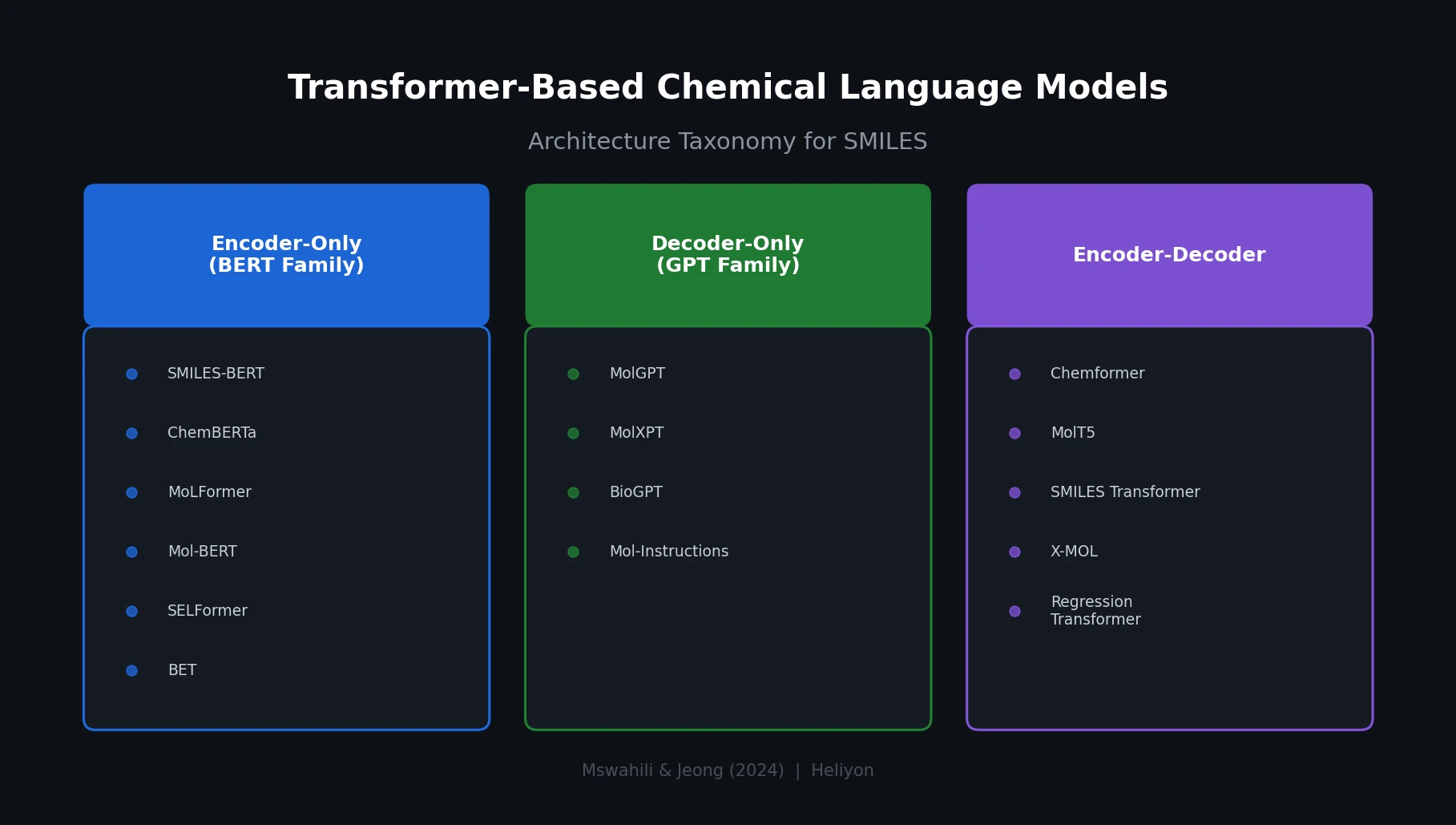
Taxonomy of transformer-based chemical language models organized by architecture type

Transformer CLMs for SMILES: Literature Review 2024

A comprehensive review of transformer-based chemical language models operating on SMILES, categorizing encoder-only (BERT variants), decoder-only (GPT variants), and encoder-decoder models with analysis of tokenization strategies, pre-training approaches, and future directions.

Molecular Representations
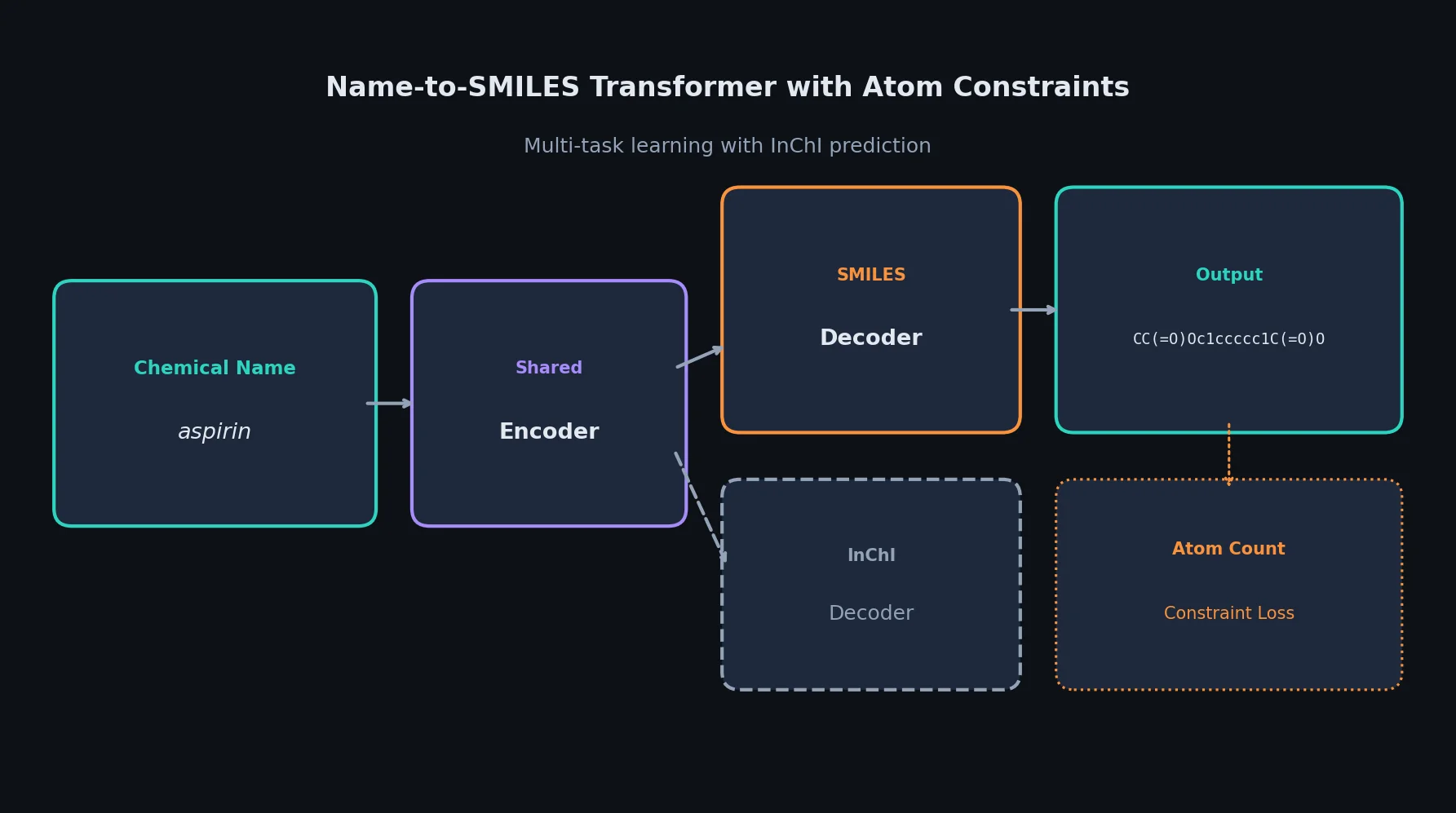
Diagram showing sequence-to-sequence translation from chemical names to SMILES with atom count constraints

Transformer Name-to-SMILES with Atom Count Losses

This paper applies a Transformer sequence-to-sequence model to predict SMILES strings from chemical compound names (Synonyms). Two enhancements, an atom-count constraint loss and SMILES/InChI multi-task learning, improve F-measure over rule-based and vanilla Transformer baselines.

Predictive Chemistry
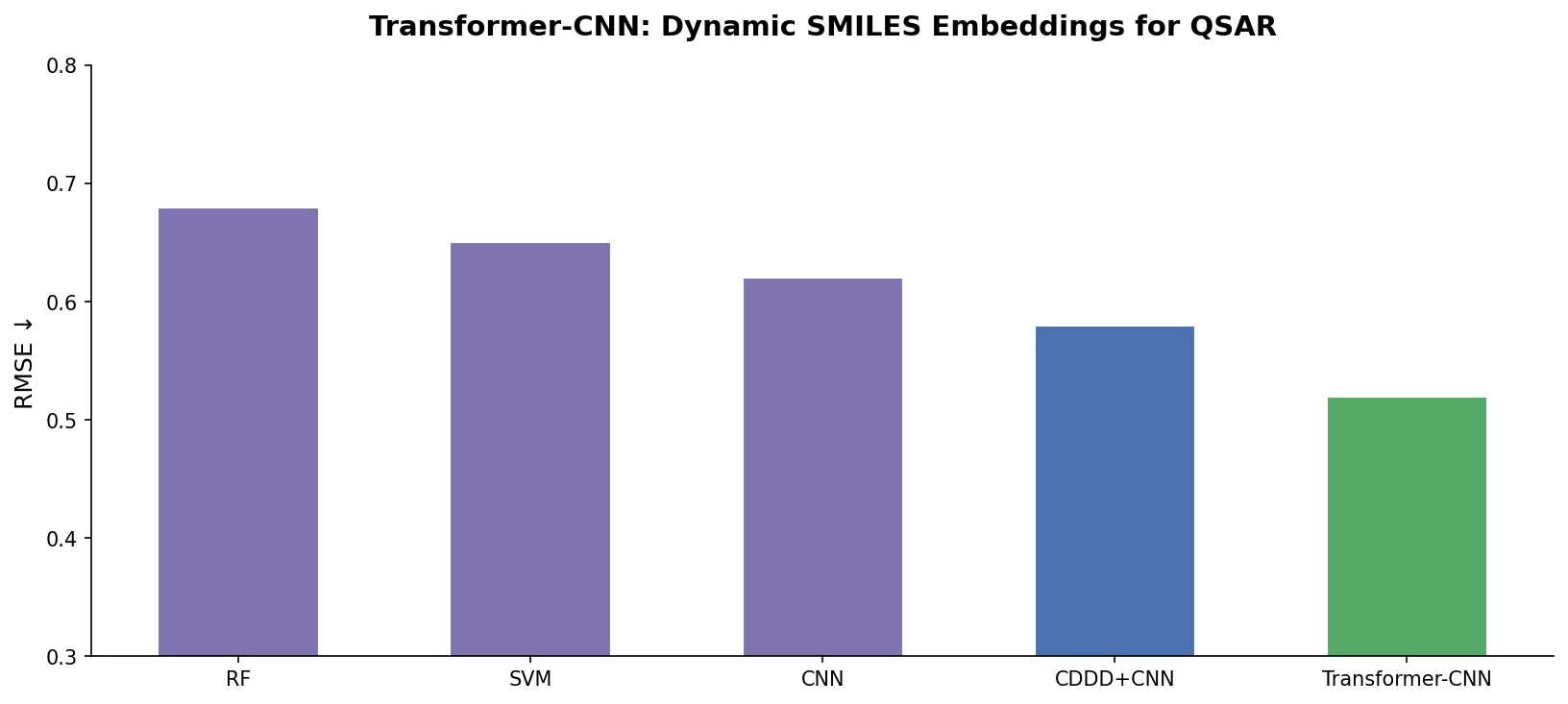
Bar chart comparing Transformer-CNN RMSE against RF, SVM, CNN, and CDDD baselines

Transformer-CNN: SMILES Embeddings for QSAR Modeling

Transformer-CNN extracts dynamic SMILES embeddings from a Transformer trained on SMILES canonicalization and feeds them to a TextCNN for QSAR modeling, achieving strong results across 18 benchmarks with built-in LRP interpretability.

Predictive Chemistry
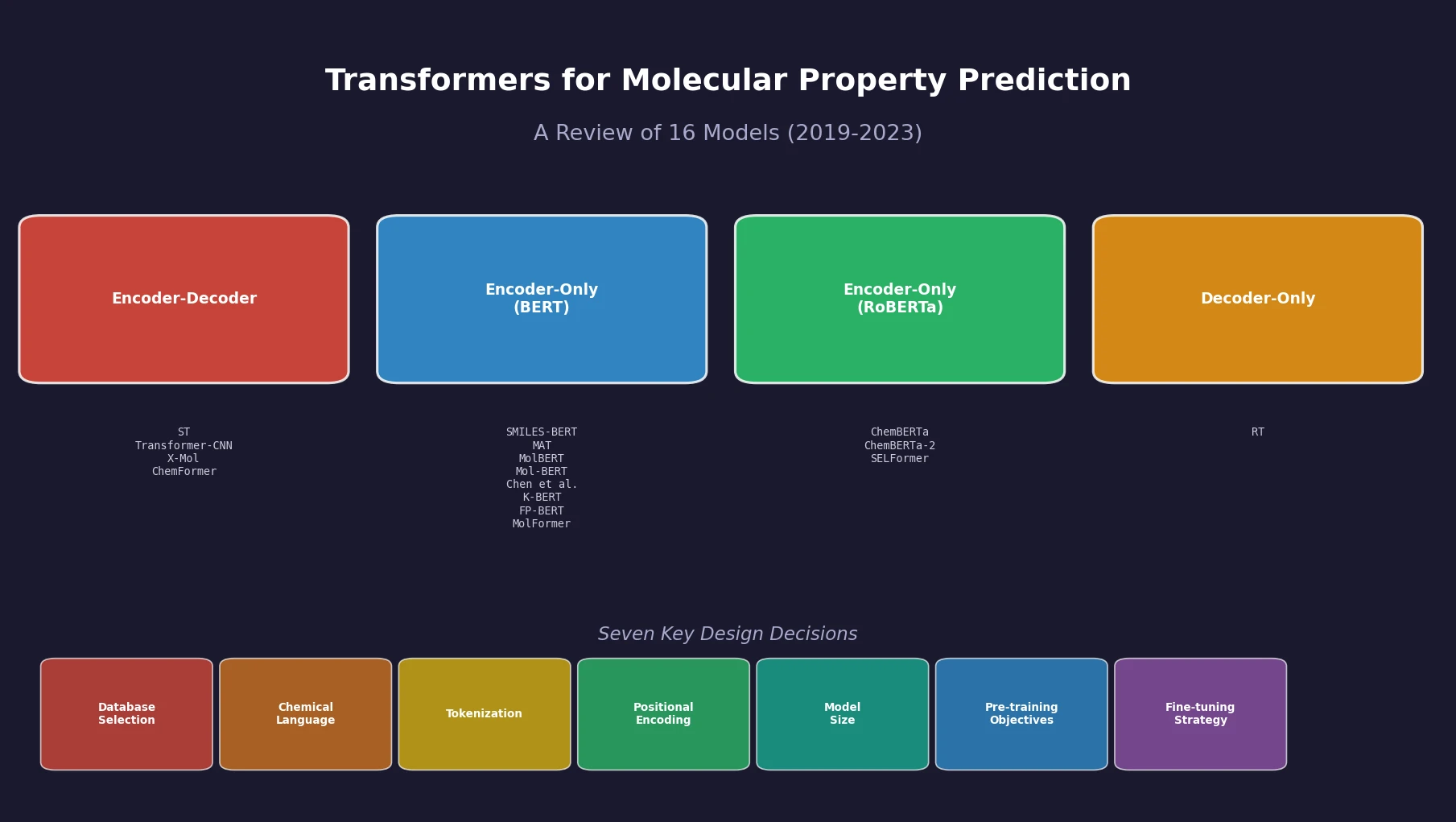
Overview of 16 transformer models for molecular property prediction organized by architecture type

Transformers for Molecular Property Prediction Review

Sultan et al. review 16 sequence-based transformer models for molecular property prediction, systematically analyzing seven design decisions (database selection, chemical language, tokenization, positional encoding, model size, pre-training objectives, and fine-tuning strategy) and identifying a critical need for standardized evaluation practices.

Molecular Representations
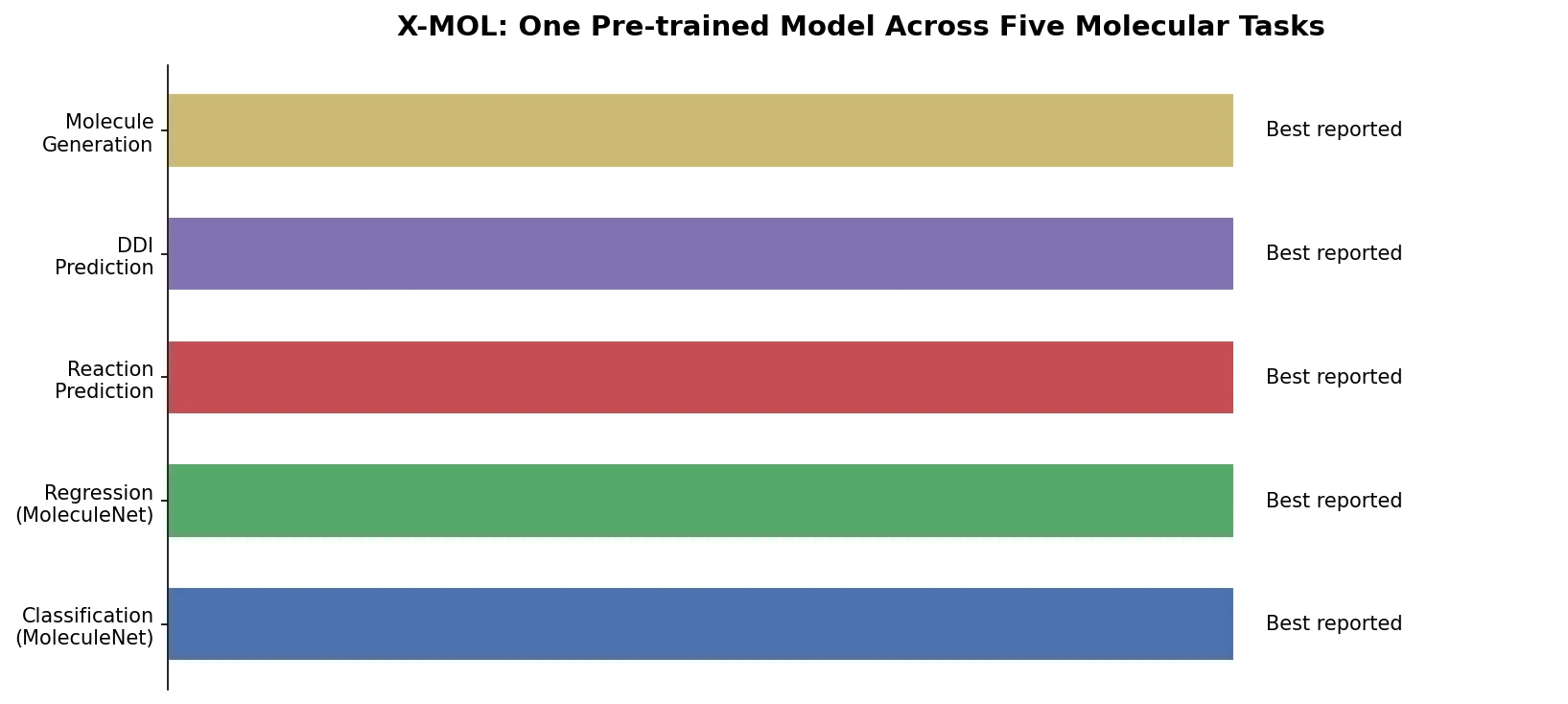
Horizontal bar chart showing X-MOL achieves best performance across five molecular tasks

X-MOL: Pre-training on 1.1B Molecules for SMILES

X-MOL applies large-scale Transformer pre-training on 1.1 billion molecules with a generative SMILES-to-SMILES strategy, then fine-tunes for five molecular analysis tasks including property prediction, reaction analysis, and de novo generation.

Molecular Representations
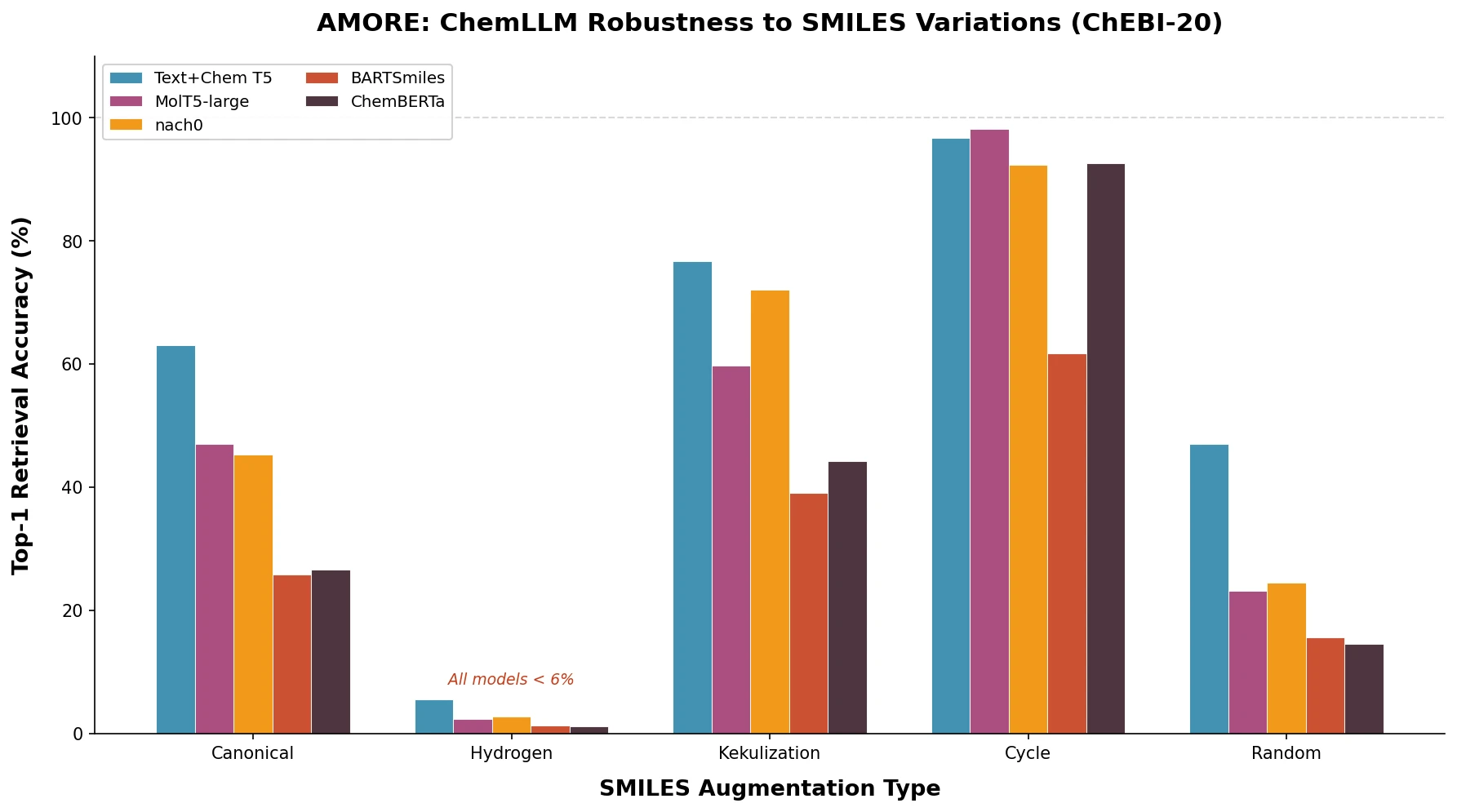
Bar chart showing retrieval accuracy of chemical language models across four SMILES augmentation types

AMORE: Testing ChemLLM Robustness to SMILES Variants

Introduces AMORE, an embedding-based retrieval framework that evaluates whether chemical language models can recognize the same molecule across different SMILES representations. Results show current models are not robust to identity-preserving augmentations.

Molecular Generation
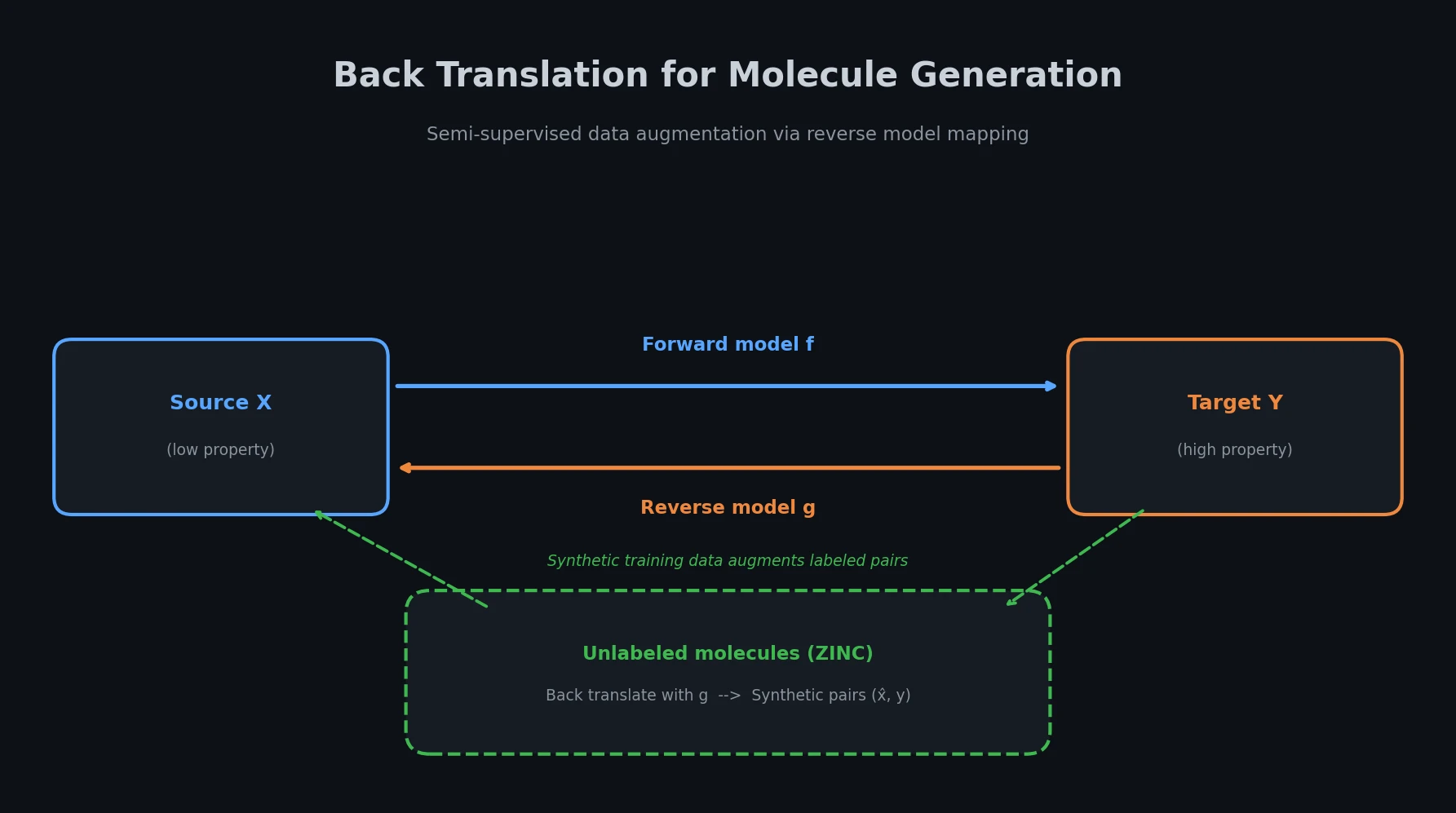
Diagram showing back translation workflow with forward and reverse models mapping between source and target molecular domains, augmented by unlabeled ZINC molecules

Back Translation for Semi-Supervised Molecule Generation

Adapts back translation from NLP to molecular generation, using unlabeled molecules from ZINC to create synthetic training pairs that improve property optimization and retrosynthesis prediction across Transformer and graph-based architectures.

Molecular Representations
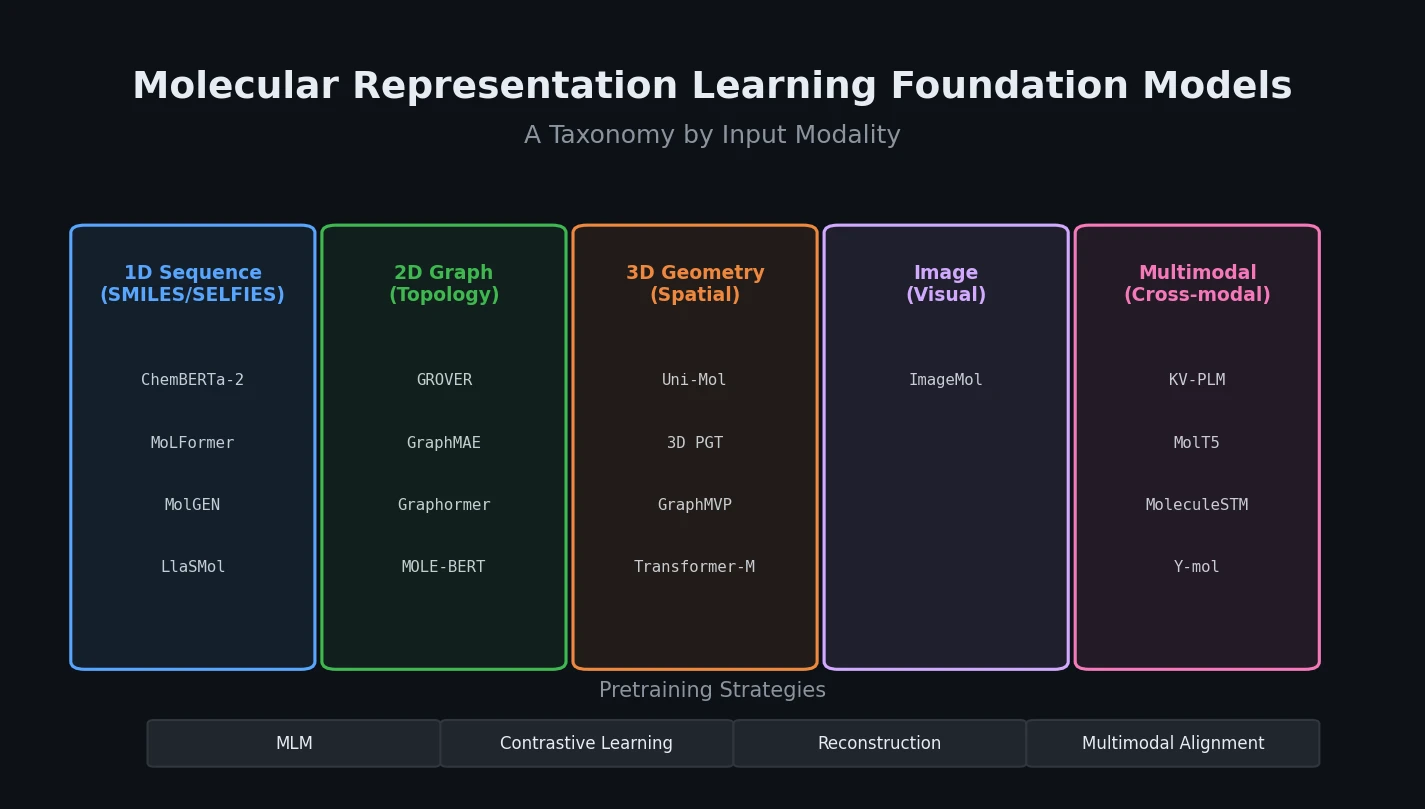
Taxonomy of molecular representation learning foundation models organized by input modality

Review of Molecular Representation Learning Models

A comprehensive survey classifying molecular representation learning foundation models by input modality (sequence, graph, 3D, image, multimodal) and analyzing four pretraining paradigms for drug discovery tasks.