Molecular Representations
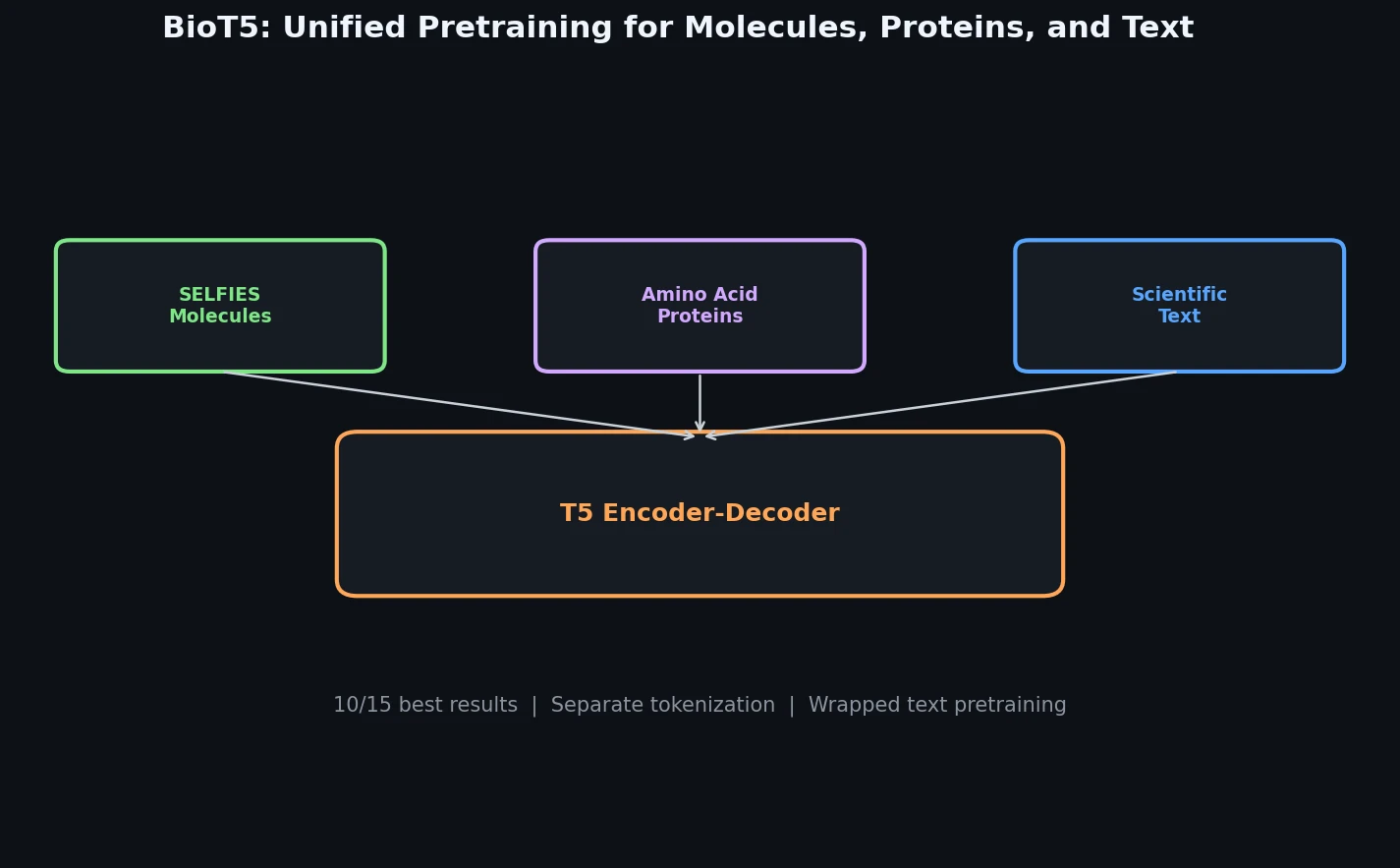
BioT5 architecture showing SELFIES molecules, amino acid proteins, and scientific text feeding into a T5 encoder-decoder

BioT5: Cross-Modal Integration of Biology and Chemistry

BioT5 uses SELFIES representations and separate tokenization to pre-train a unified T5 model across molecules, proteins, and text, achieving state-of-the-art results on 10 of 15 downstream tasks.
Computational Chemistry
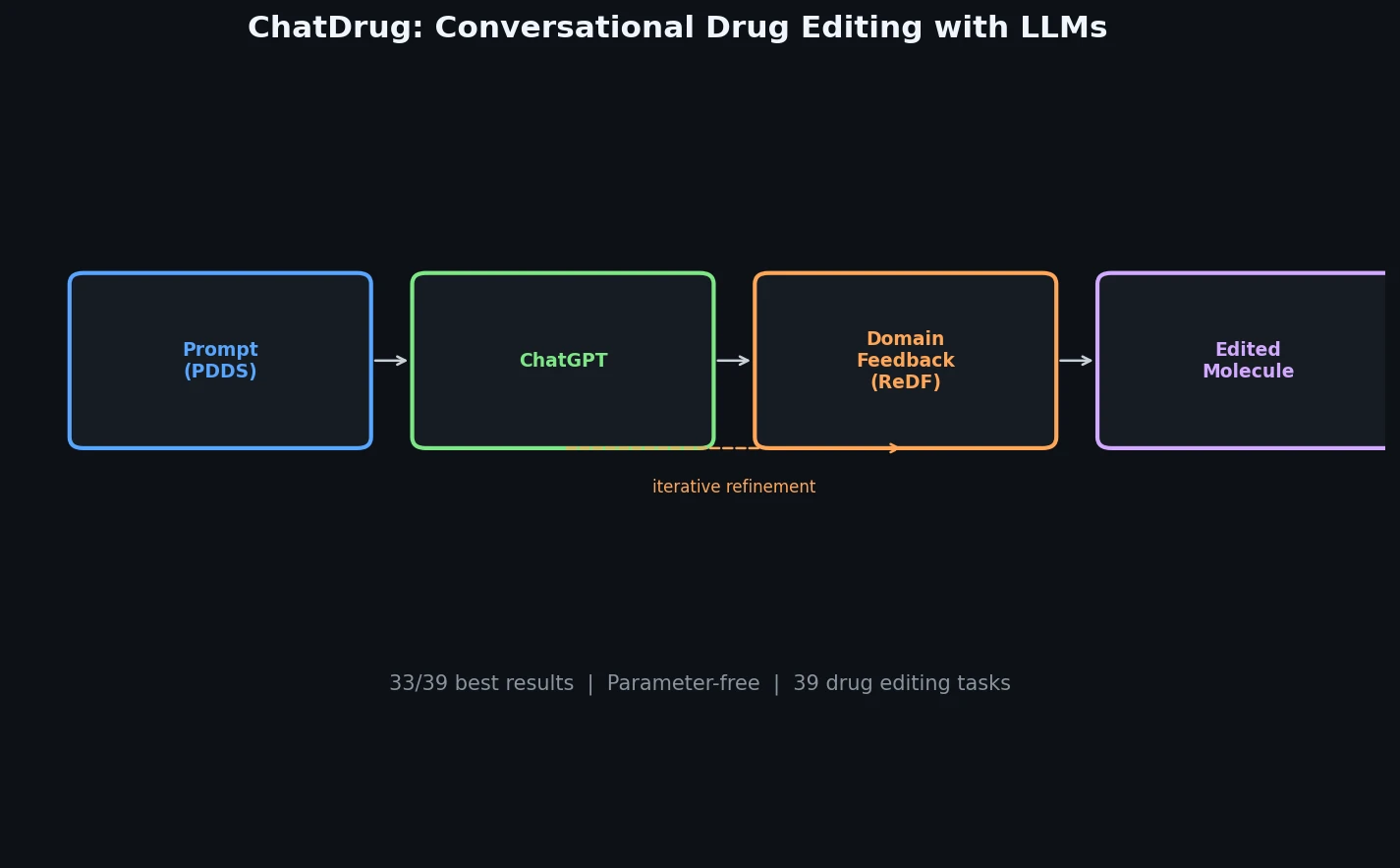
ChatDrug pipeline from prompt design through ChatGPT to domain feedback and edited molecule output

ChatDrug: Conversational Drug Editing with ChatGPT

ChatDrug is a parameter-free framework that combines ChatGPT with retrieval-augmented domain feedback and iterative conversation to edit drugs across small molecules, peptides, and proteins.

Computational Chemistry
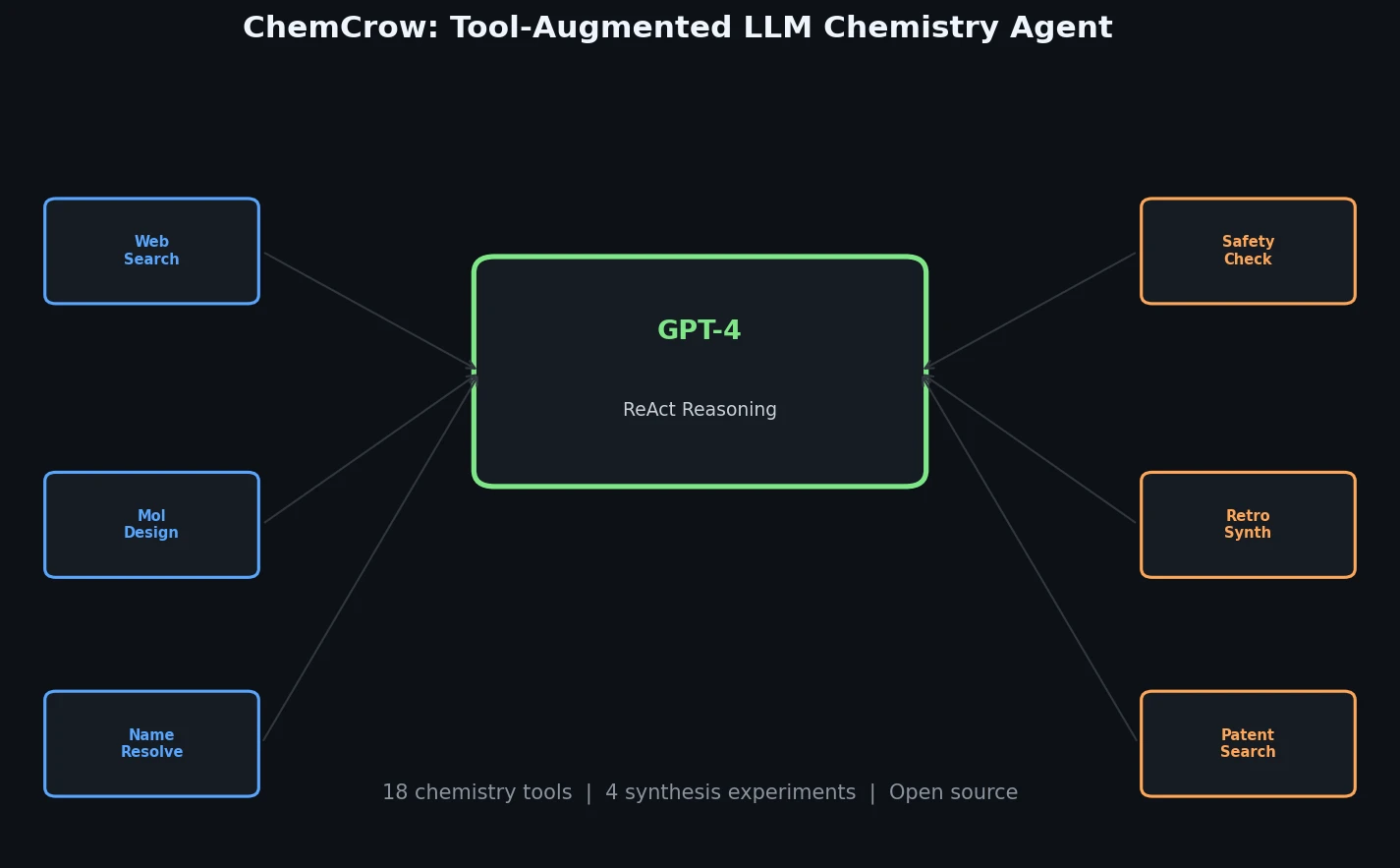
ChemCrow architecture with GPT-4 central planner connected to 18 chemistry tools via ReAct reasoning

ChemCrow: Augmenting LLMs with 18 Chemistry Tools

ChemCrow augments GPT-4 with 18 chemistry tools to autonomously plan and execute syntheses, discover novel chromophores, and solve diverse chemical reasoning tasks.

Computational Chemistry
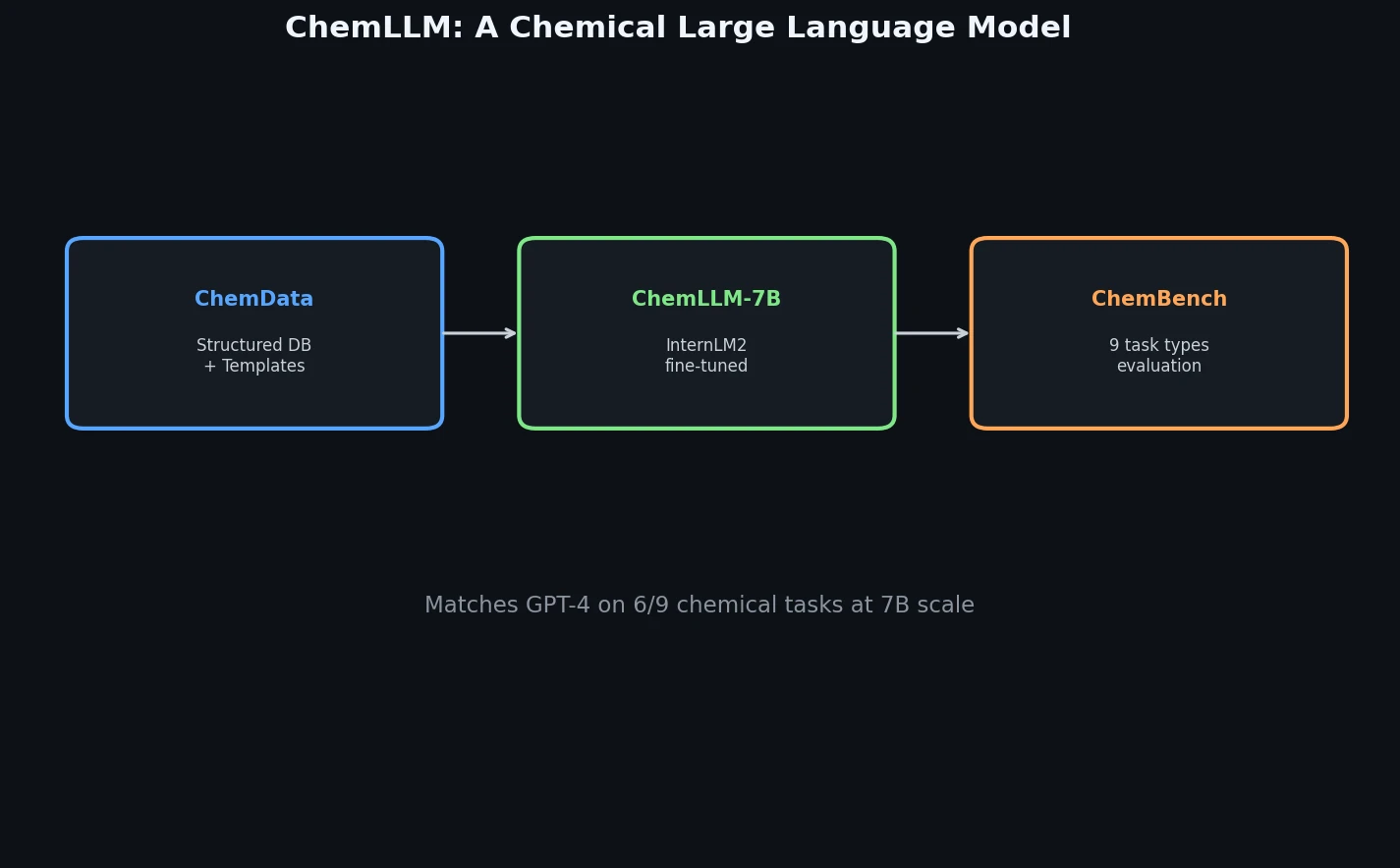
ChemLLM pipeline from ChemData structured templates through fine-tuned InternLM2 to ChemBench evaluation

ChemLLM: A Chemical Large Language Model Framework

ChemLLM presents a comprehensive framework for chemistry-specific language modeling, including a 7M-sample instruction tuning dataset (ChemData), a 4,100-question benchmark (ChemBench), and a two-stage fine-tuned model that matches GPT-4 on core chemical tasks.

Predictive Chemistry
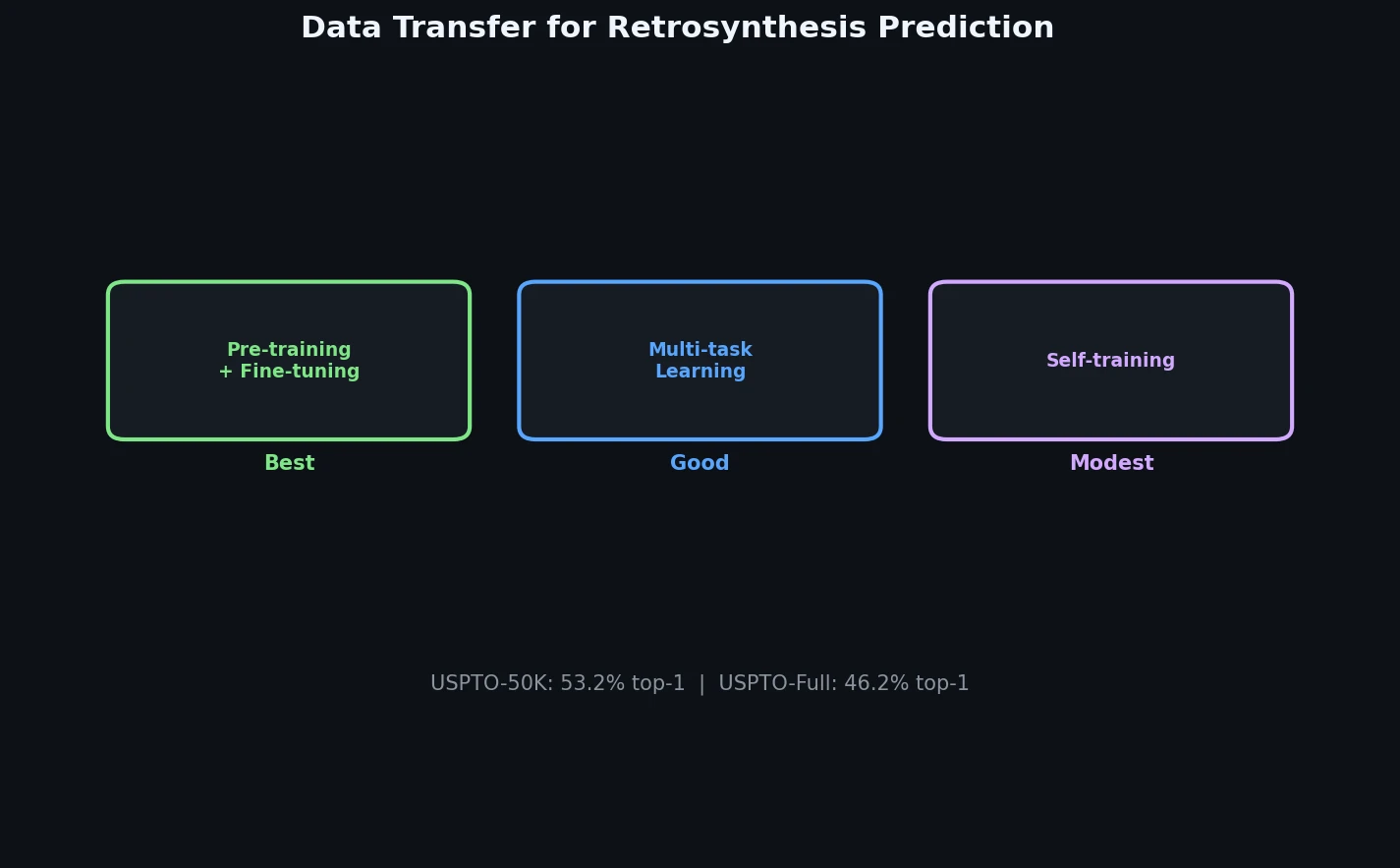
Three data transfer methods for retrosynthesis: pre-training plus fine-tuning, multi-task learning, and self-training

Data Transfer Approaches for Seq-to-Seq Retrosynthesis

A systematic study of data transfer techniques (joint training, self-training, pre-training plus fine-tuning) applied to Transformer-based retrosynthesis. Pre-training on USPTO-Full followed by fine-tuning on USPTO-50K achieves the best results, improving top-1 accuracy from 35.3% to 57.4%.

Computational Chemistry
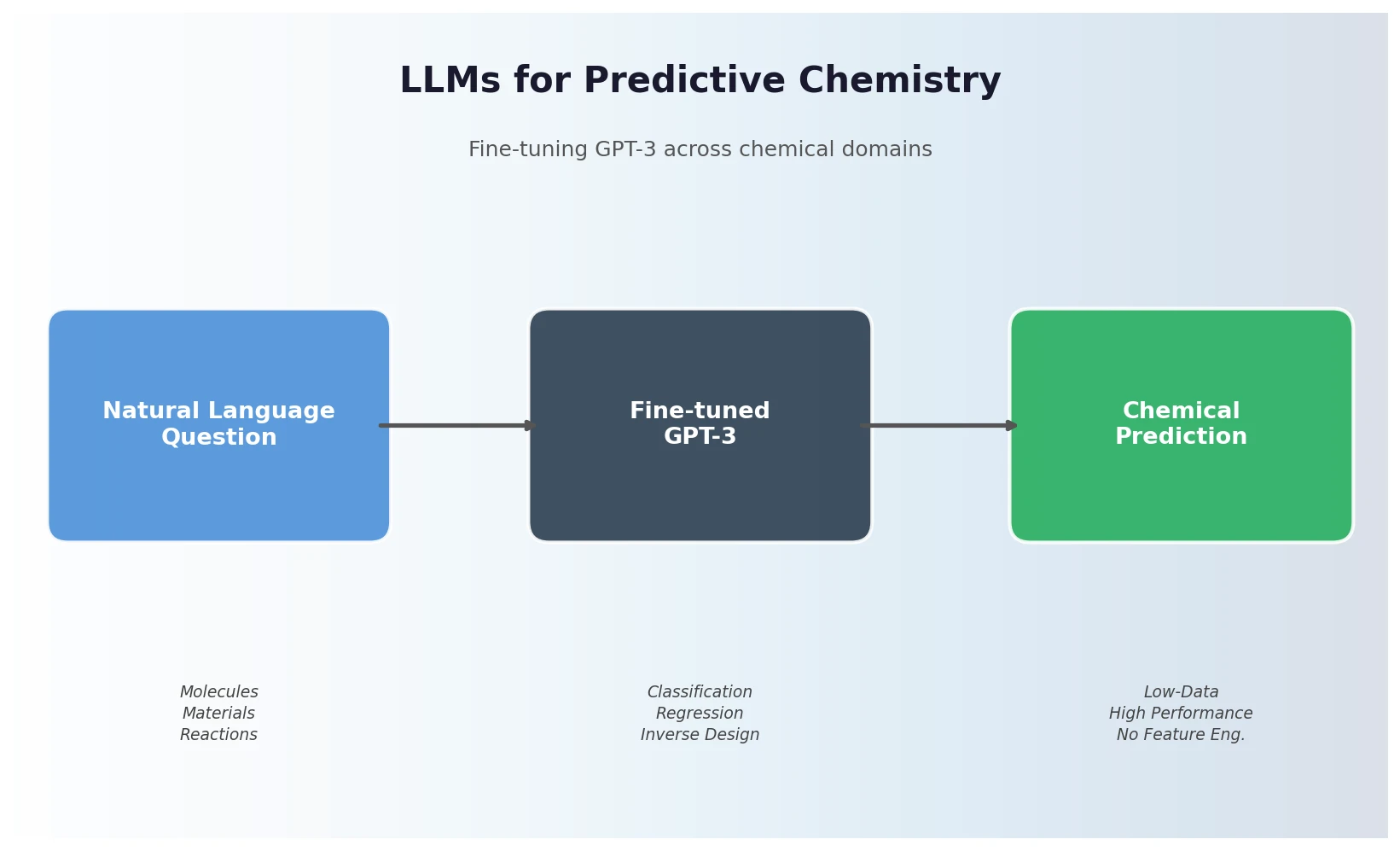
Pipeline diagram showing natural language chemistry questions flowing through fine-tuned GPT-3 to chemical predictions across molecules, materials, and reactions

Fine-Tuning GPT-3 for Predictive Chemistry Tasks

Jablonka et al. show that fine-tuning GPT-3 on natural language chemistry questions achieves competitive or superior performance to dedicated ML models across 15 benchmarks, with particular strength in low-data settings and inverse molecular design.

Computational Chemistry
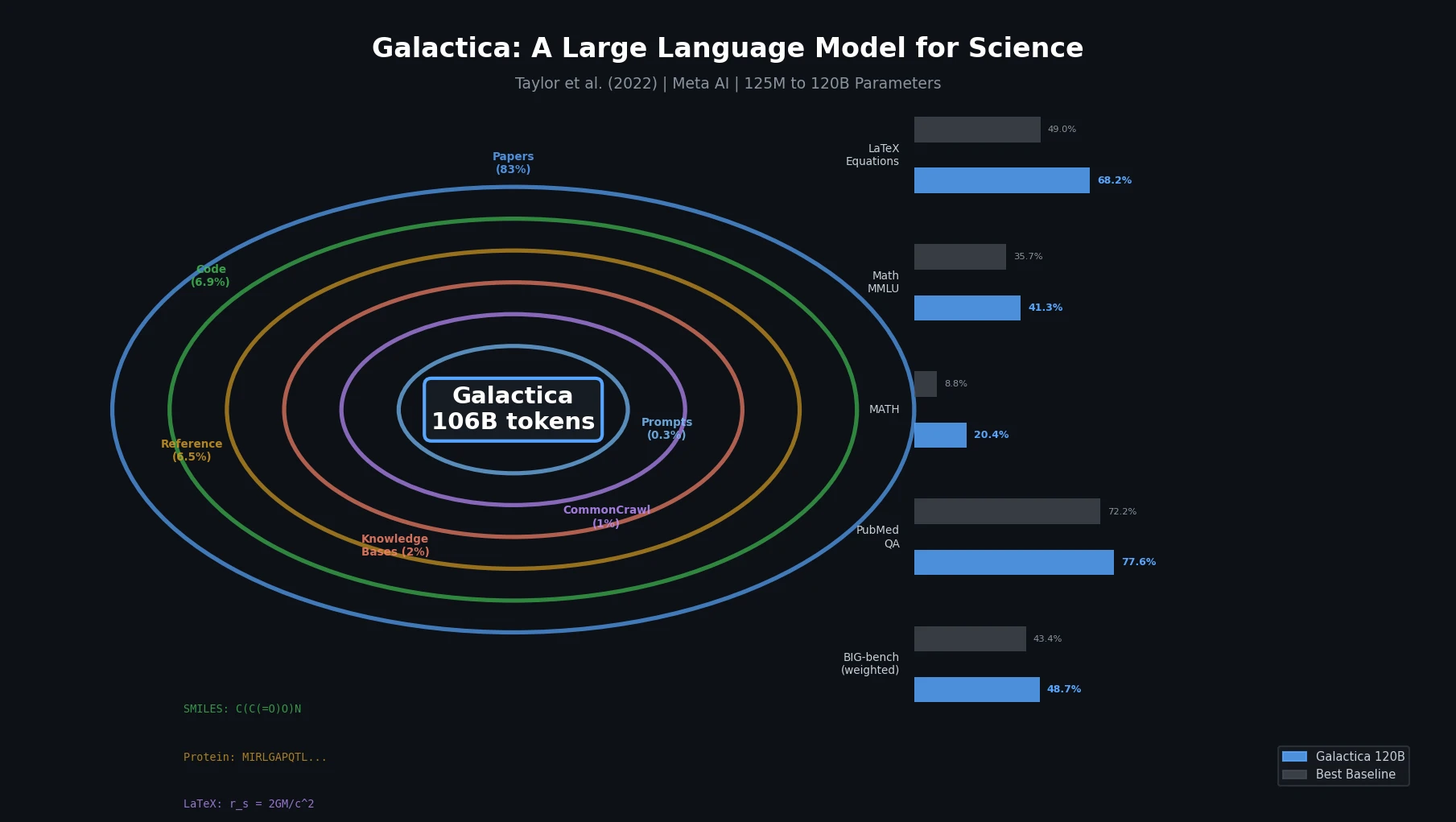
Visualization of Galactica corpus composition and benchmark performance comparing Galactica 120B against baselines

Galactica: A Curated Scientific LLM from Meta AI

Galactica trains a decoder-only Transformer on a curated 106B-token scientific corpus spanning papers, proteins, and molecules, achieving strong results on scientific QA, mathematical reasoning, and citation prediction.

Computational Chemistry
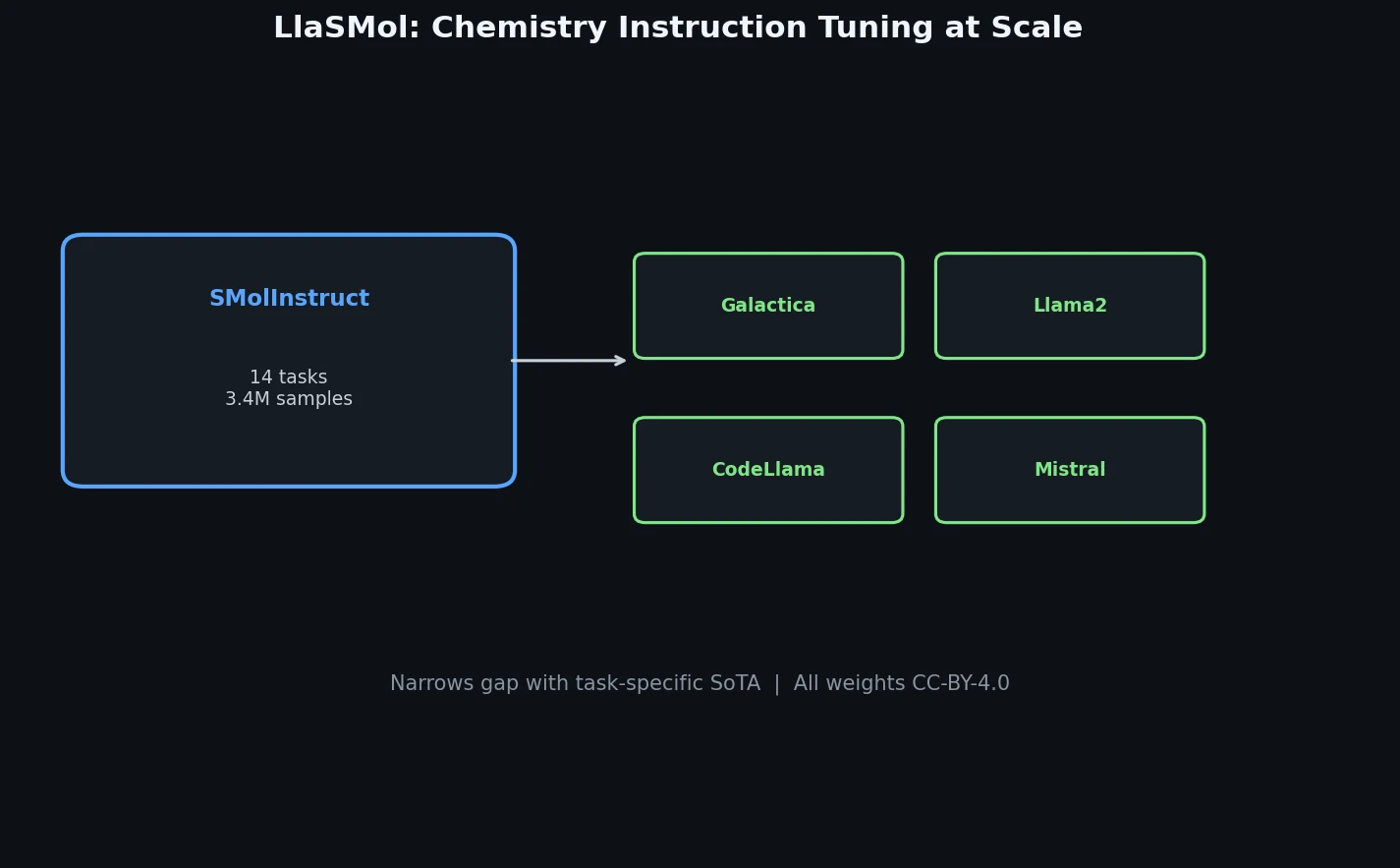
SMolInstruct dataset feeding into four base models for chemistry instruction tuning

LlaSMol: Instruction-Tuned LLMs for Chemistry Tasks

LlaSMol fine-tunes Mistral, Llama 2, and other open-source LLMs on SMolInstruct, a 3.3M-sample instruction tuning dataset covering 14 chemistry tasks. The Mistral-based model outperforms GPT-4 and Claude 3 Opus across all tasks.

Computational Chemistry
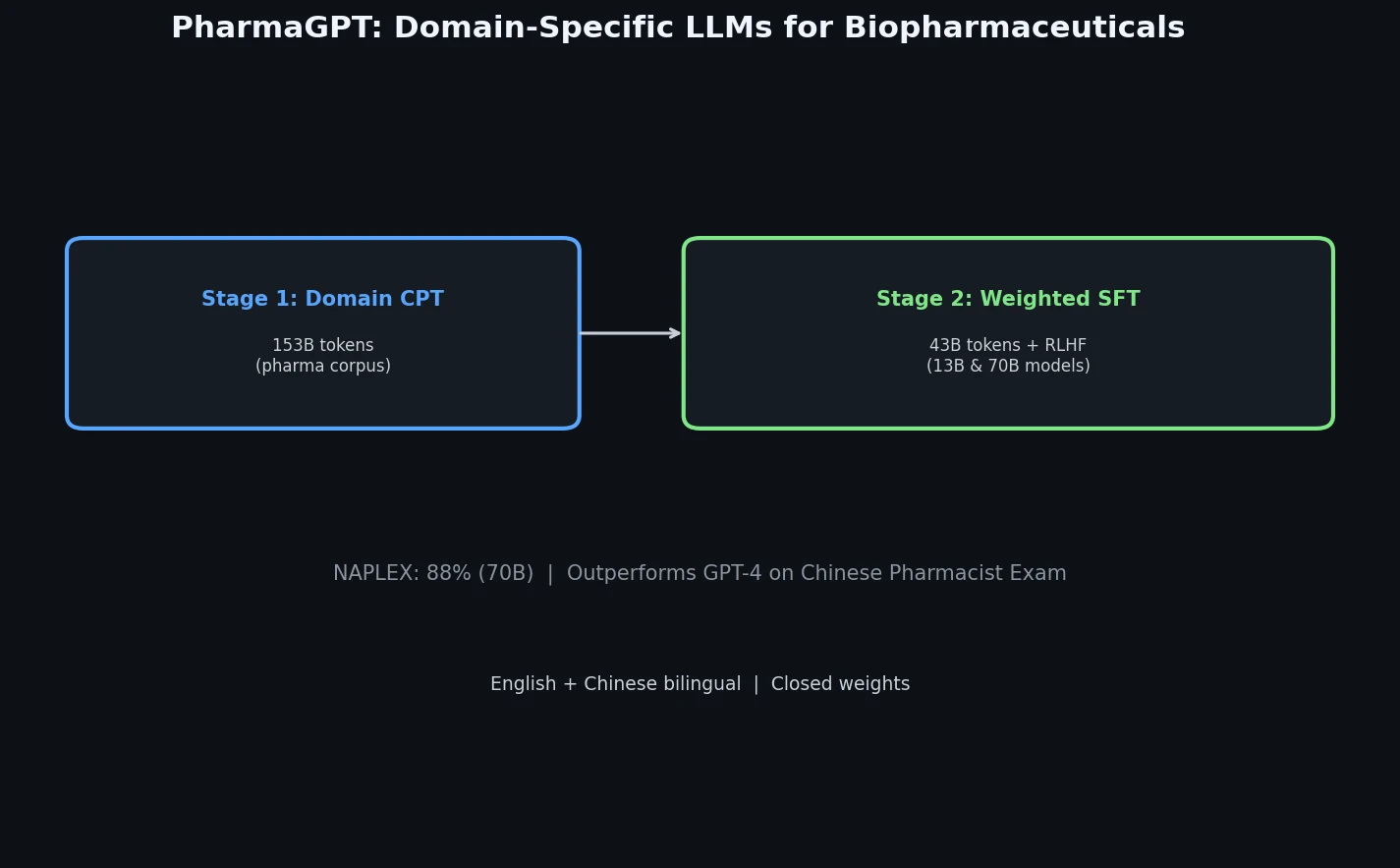
PharmaGPT two-stage training from domain continued pretraining to weighted supervised fine-tuning with RLHF

PharmaGPT: Domain-Specific LLMs for Pharma and Chem

PharmaGPT is a suite of domain-specific LLMs (13B and 70B parameters) built on LLaMA with continued pretraining on biopharmaceutical and chemical data, achieving strong results on NAPLEX and Chinese pharmacist exams.

Predictive Chemistry
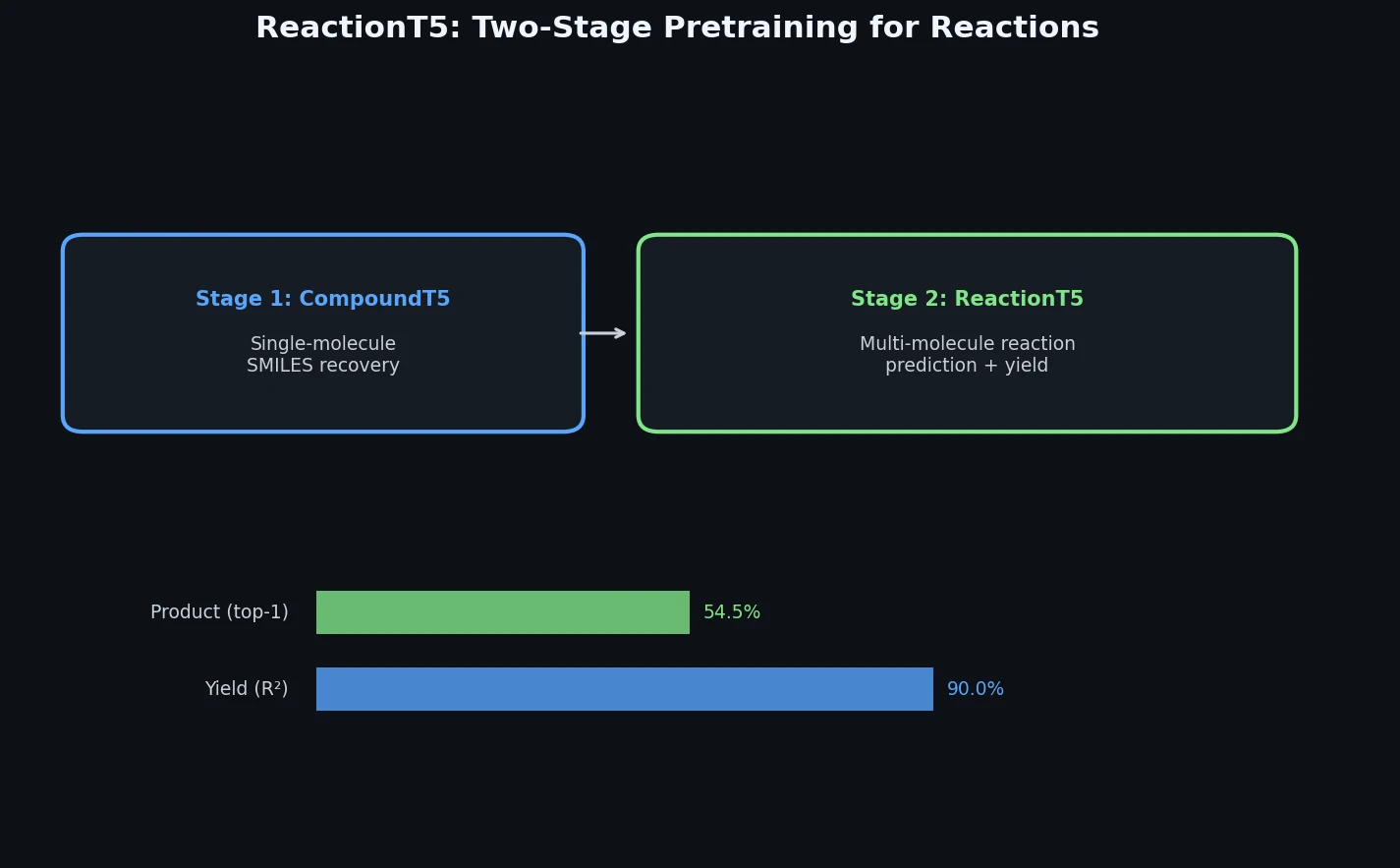
ReactionT5 two-stage pretraining from CompoundT5 to ReactionT5 with product prediction and yield results

ReactionT5: Pre-trained T5 for Reaction Prediction

ReactionT5 introduces a two-stage pretraining pipeline (compound then reaction) on the Open Reaction Database, enabling competitive product and yield prediction with as few as 30 fine-tuning reactions.

Computational Chemistry
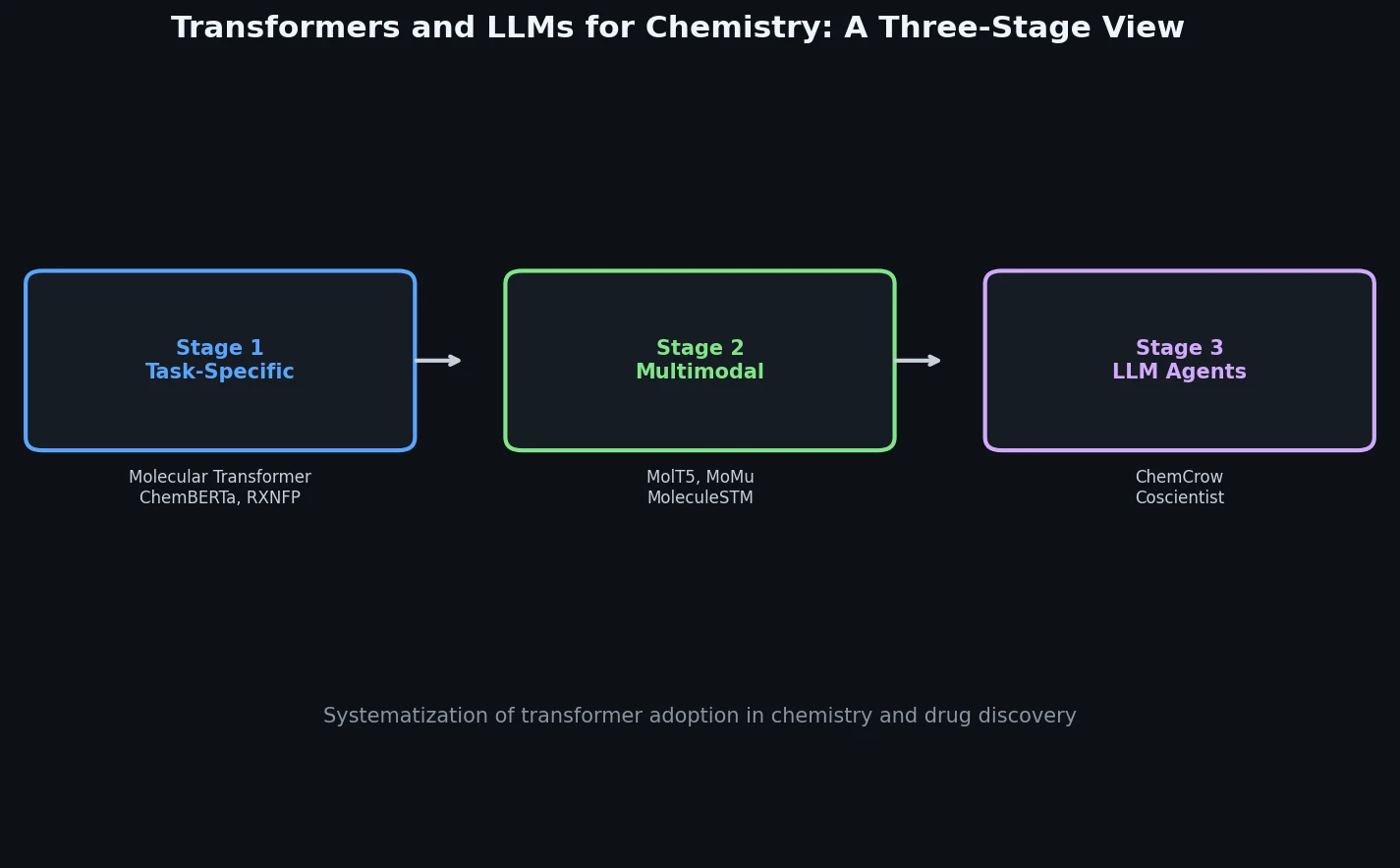
Three-stage progression from task-specific transformers through multimodal models to LLM chemistry agents

Transformers and LLMs for Chemistry Drug Discovery

A review chapter tracing three stages of transformer adoption in chemistry: task-specific single-modality models (reaction prediction, retrosynthesis), multimodal approaches bridging spectra and text, and LLM-powered agents like ChemCrow for general chemical reasoning.

Molecular Representations
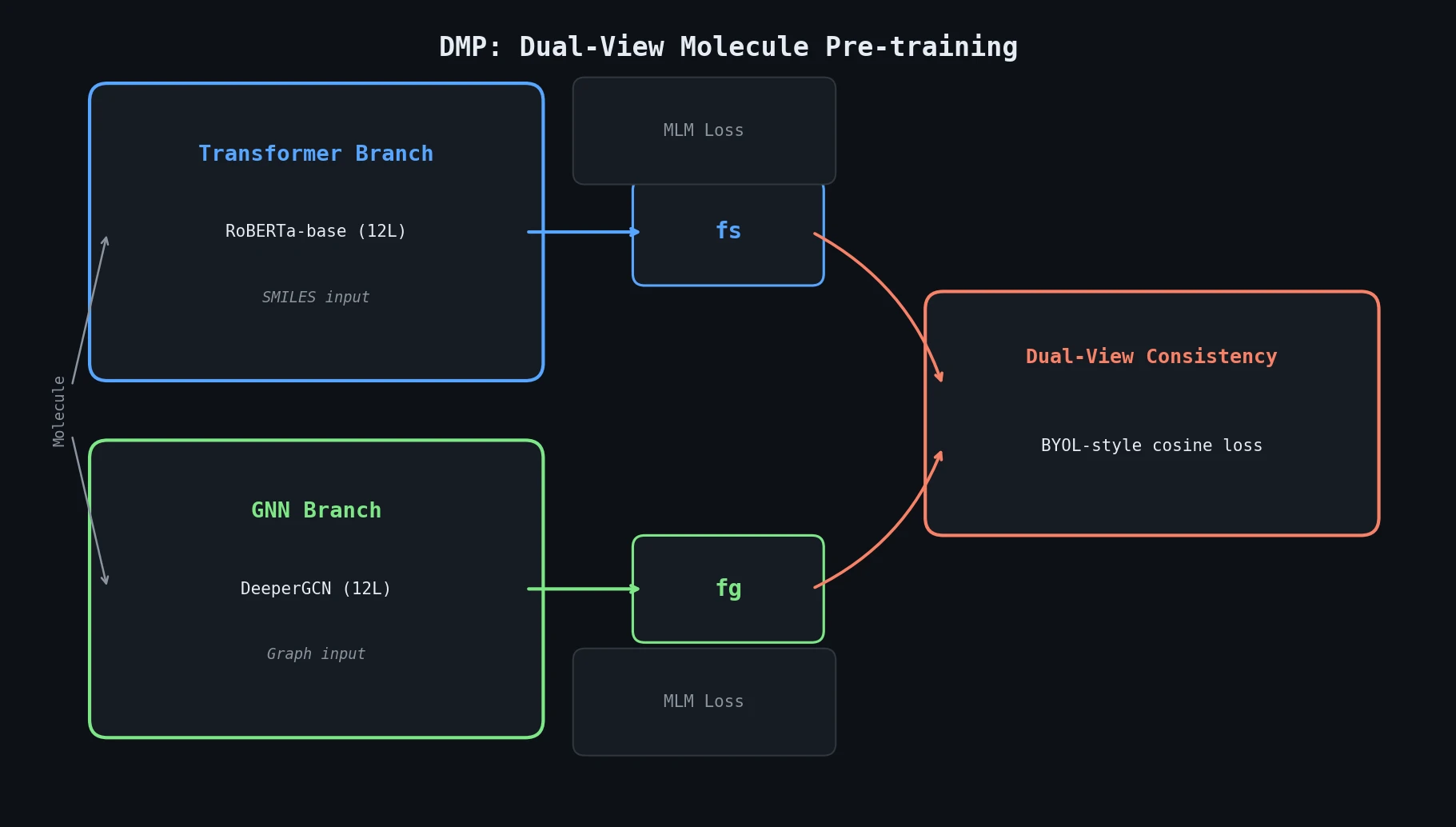
Diagram showing dual-view molecule pre-training with a SMILES Transformer branch and a GNN branch connected by a consistency loss

DMP: Dual-View Molecule Pre-training (SMILES+GNN)

DMP combines a SMILES Transformer and a GNN branch during pre-training, using masked language modeling plus a BYOL-inspired dual-view consistency loss to learn complementary molecular representations.