Computational Chemistry
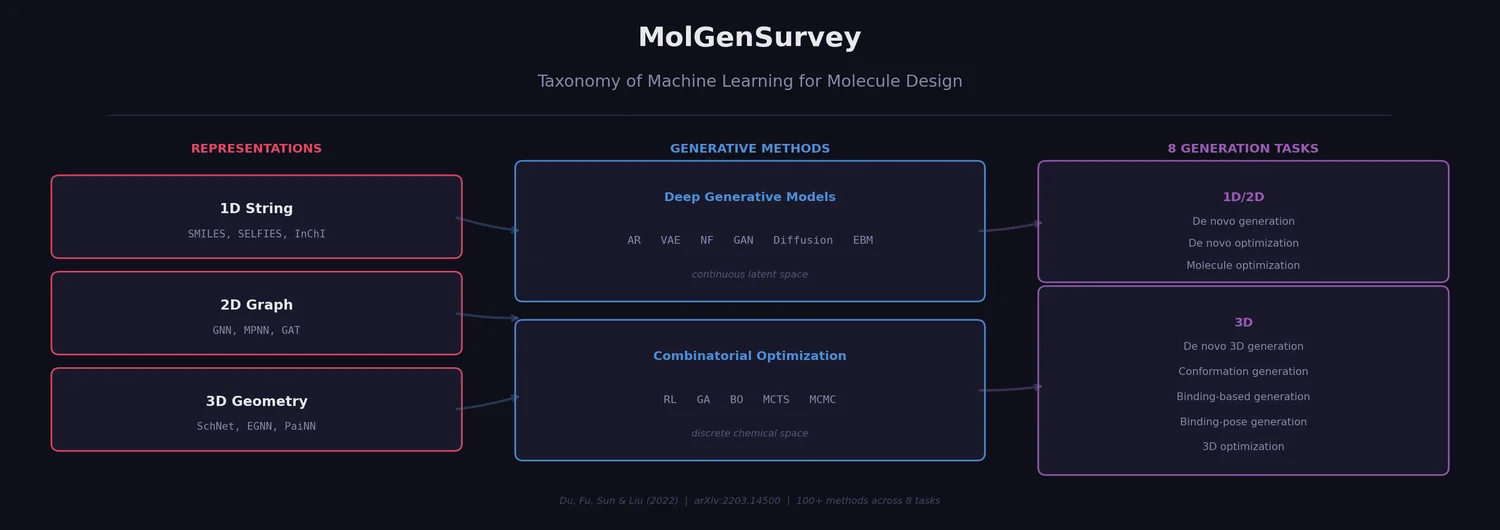
Taxonomy diagram showing the three axes of MolGenSurvey: molecular representations (1D string, 2D graph, 3D geometry), generative methods (deep generative models and combinatorial optimization), and eight generation tasks (1D/2D and 3D)

MolGenSurvey: Systematic Survey of ML for Molecule Design

MolGenSurvey systematically reviews ML models for molecule design, organizing the field by molecular representation (1D/2D/3D), generative method (deep generative models vs. combinatorial optimization), and task type (8 distinct generation/optimization tasks). It catalogs over 100 methods, unifies task definitions via input/output/goal taxonomy, and identifies key challenges including out-of-distribution generation, oracle costs, and lack of unified benchmarks.

Computational Chemistry

Review of OCSR Techniques and Models (Musazade 2022)

This systematization paper traces the history of OCSR, comparing early rule-based systems like OSRA with modern deep learning approaches like DECIMER. It highlights the shift from image classification to image captioning and identifies critical gaps in dataset standardization and evaluation metrics.

Computational Chemistry

A Review of Optical Chemical Structure Recognition Tools

This paper reviews three decades of OCSR development, transitioning from rule-based heuristics to early deep learning approaches. It includes a benchmark study comparing the performance of three open-source tools (OSRA, Imago, MolVec) on four diverse datasets.

Computational Chemistry
Embedding energy and effective charge functions for Ni and Pd from the original EAM paper

Embedded-Atom Method: Theory and Applications Review

This 1993 review systematizes the Embedded-Atom Method (EAM) as a practical semi-empirical approach for metallic systems. It synthesizes theory, applications, and connections to related methods while addressing the limitations of pair potentials.