Molecular Generation
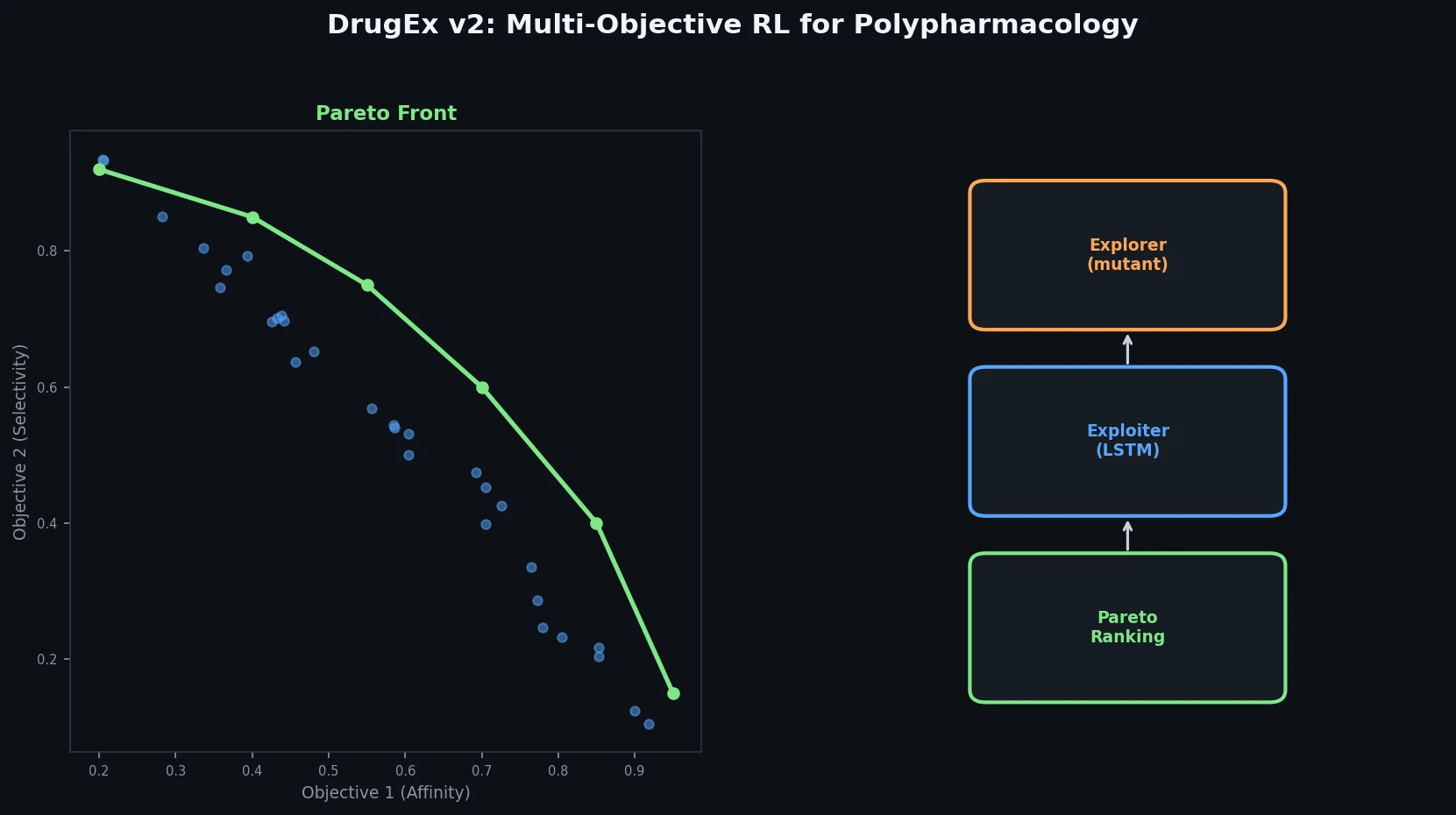
Pareto front plot for multi-objective optimization alongside DrugEx v2 explorer-exploiter architecture

DrugEx v2: Pareto Multi-Objective RL for Drug Design

DrugEx v2 introduces Pareto-based multi-objective optimization and evolutionary exploration strategies into an RNN reinforcement learning framework for de novo drug design toward multiple protein targets.
Molecular Generation
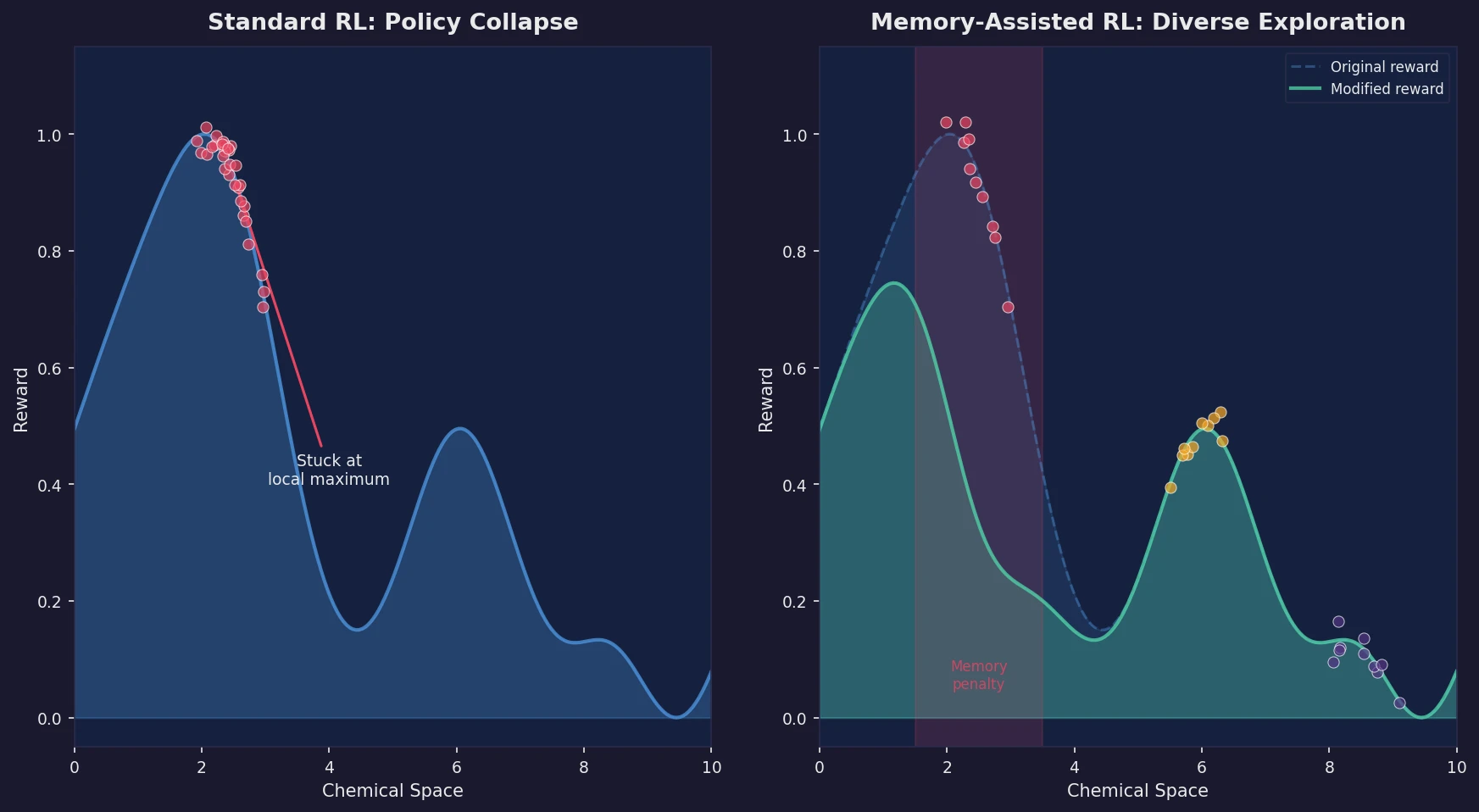
Diagram showing how memory-assisted reinforcement learning explores multiple local maxima in chemical space compared to standard RL

Memory-Assisted RL for Diverse De Novo Mol. Design

Introduces a memory unit that modifies the RL reward function to penalize previously explored chemical scaffolds, substantially increasing the diversity of generated molecules while maintaining relevance to known active ligands.

Molecular Generation
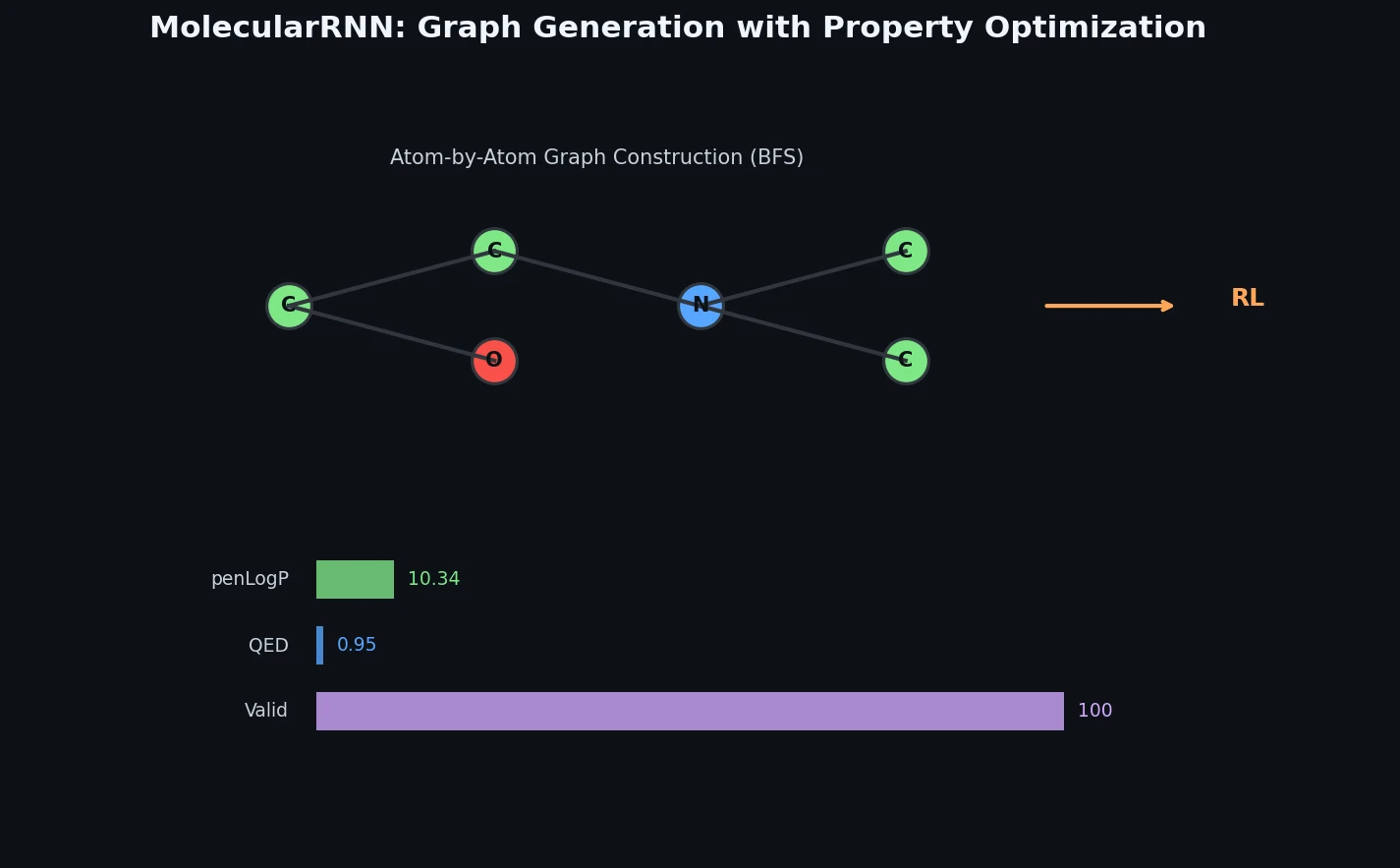
Molecular graph being built atom-by-atom with BFS ordering and property optimization bars

MolecularRNN: Graph-Based Molecular Generation and RL

Proposes MolecularRNN, a graph recurrent model that generates molecular graphs atom-by-atom with 100% validity via valency-based rejection sampling, then shifts property distributions using policy gradient reinforcement learning.

Molecular Generation
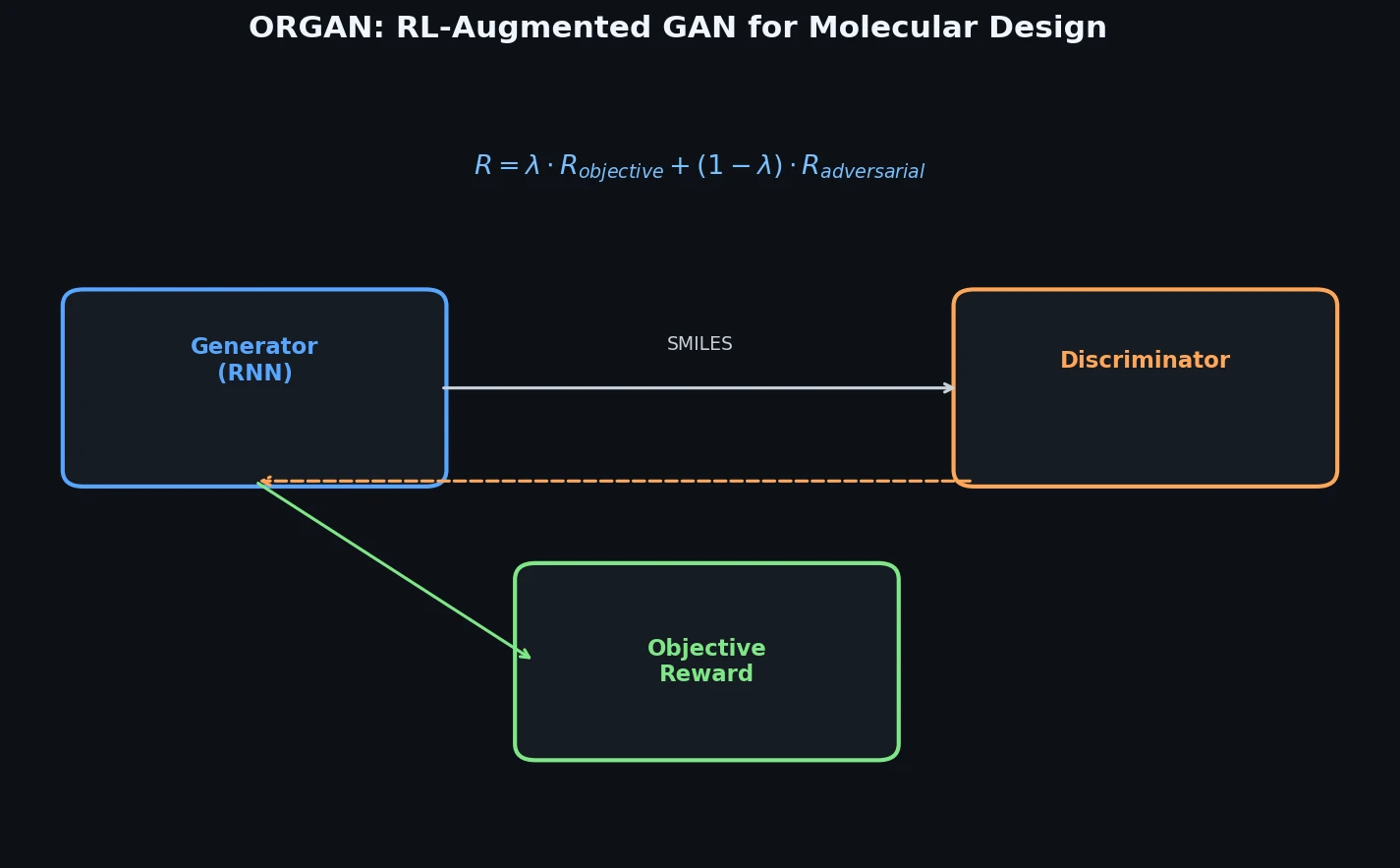
Architecture diagram showing ORGAN generator, discriminator, and objective reward with lambda interpolation formula

ORGAN: Objective-Reinforced GANs for Molecule Design

Proposes ORGAN, a framework that extends SeqGAN with domain-specific reward functions via reinforcement learning, enabling tunable generation of molecules optimized for druglikeness, solubility, and synthesizability while maintaining sample diversity.

Molecular Generation
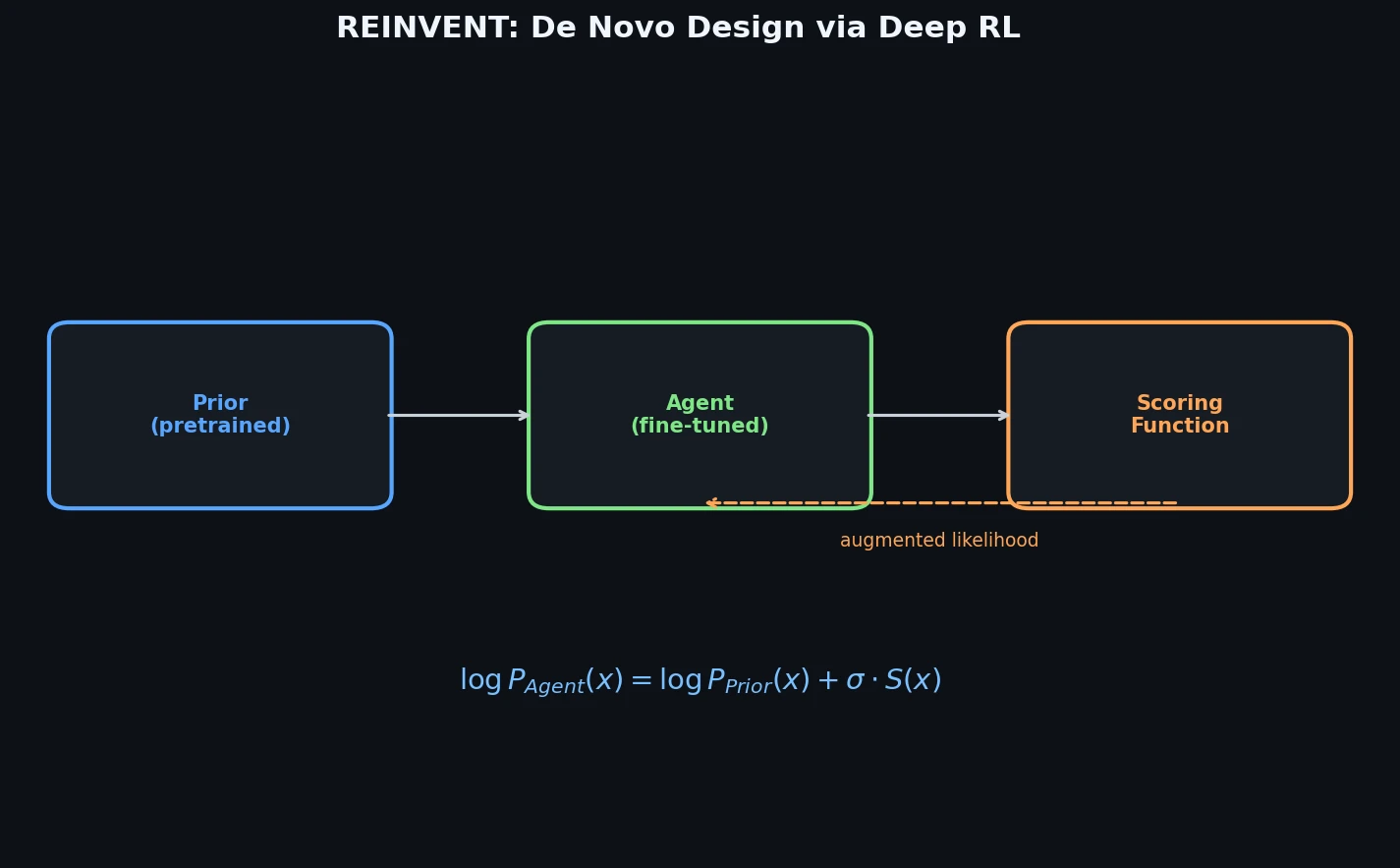
REINVENT pipeline showing Prior, Agent, and Scoring Function with augmented likelihood equation

REINVENT: Reinforcement Learning for Mol. Design

Introduces a policy-based reinforcement learning method that fine-tunes an RNN pre-trained on ChEMBL SMILES to generate molecules with specified desirable properties, using an augmented episodic likelihood that anchors the agent to its prior while optimizing a user-defined scoring function.

Molecular Generation
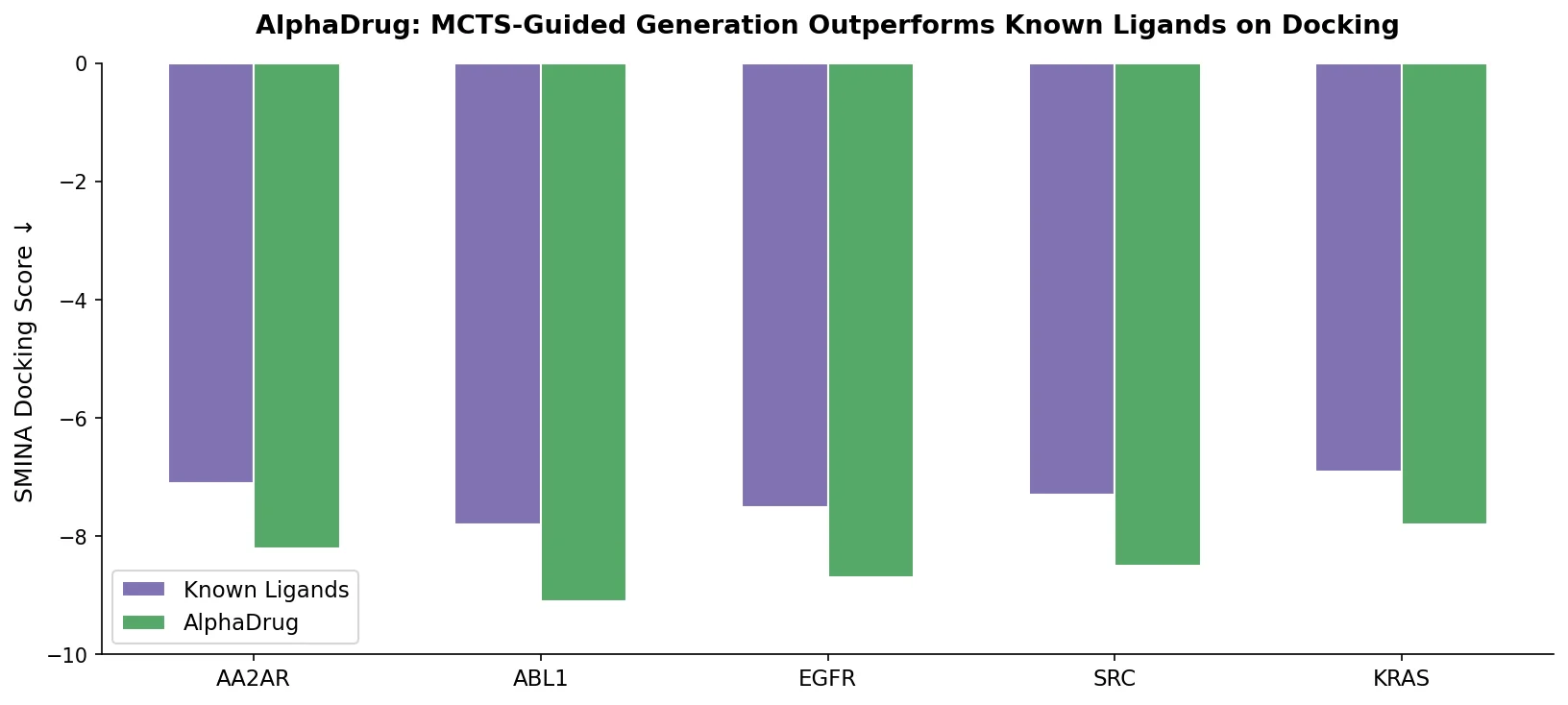
Bar chart comparing AlphaDrug docking scores against known ligands across five protein targets

AlphaDrug: MCTS-Guided Target-Specific Drug Design

AlphaDrug generates drug candidates for specific protein targets by combining an Lmser Transformer (with hierarchical encoder-decoder skip connections) and Monte Carlo tree search guided by docking scores, achieving higher binding affinities than known ligands on 86% of test proteins.

Molecular Generation
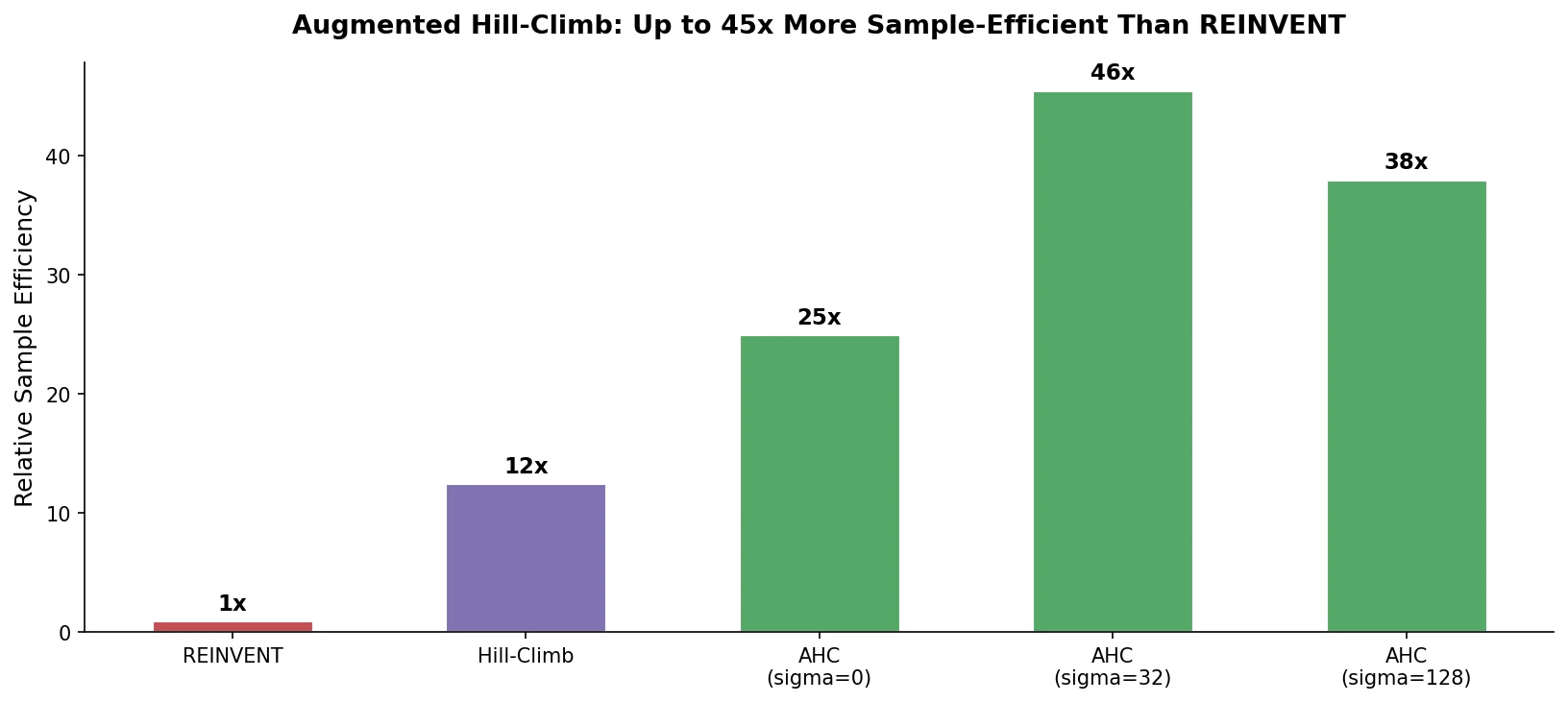
Bar chart showing Augmented Hill-Climb achieves up to 45x sample efficiency over REINVENT

Augmented Hill-Climb for RL-Based Molecule Design

Proposes Augmented Hill-Climb, a hybrid RL strategy for SMILES-based generative models that improves sample efficiency ~45-fold over REINVENT by filtering low-scoring molecules from the loss computation, with diversity filters to prevent mode collapse.

Molecular Generation
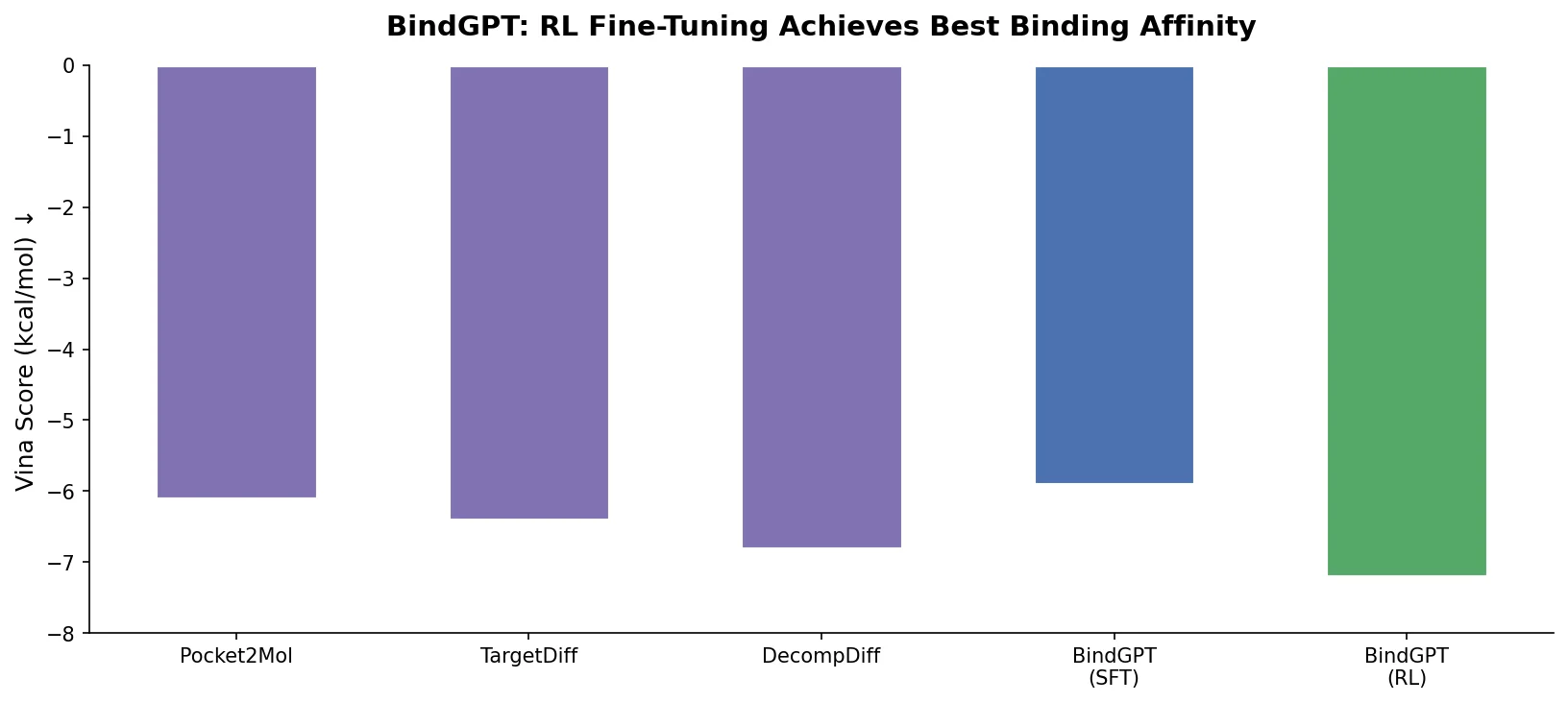
Bar chart showing BindGPT RL achieves best Vina binding scores compared to baselines

BindGPT: GPT for 3D Molecular Design and Docking

BindGPT formulates 3D molecular design as autoregressive text generation over combined SMILES and XYZ tokens, using large-scale pre-training and reinforcement learning to achieve competitive pocket-conditioned molecule generation.

Molecular Generation
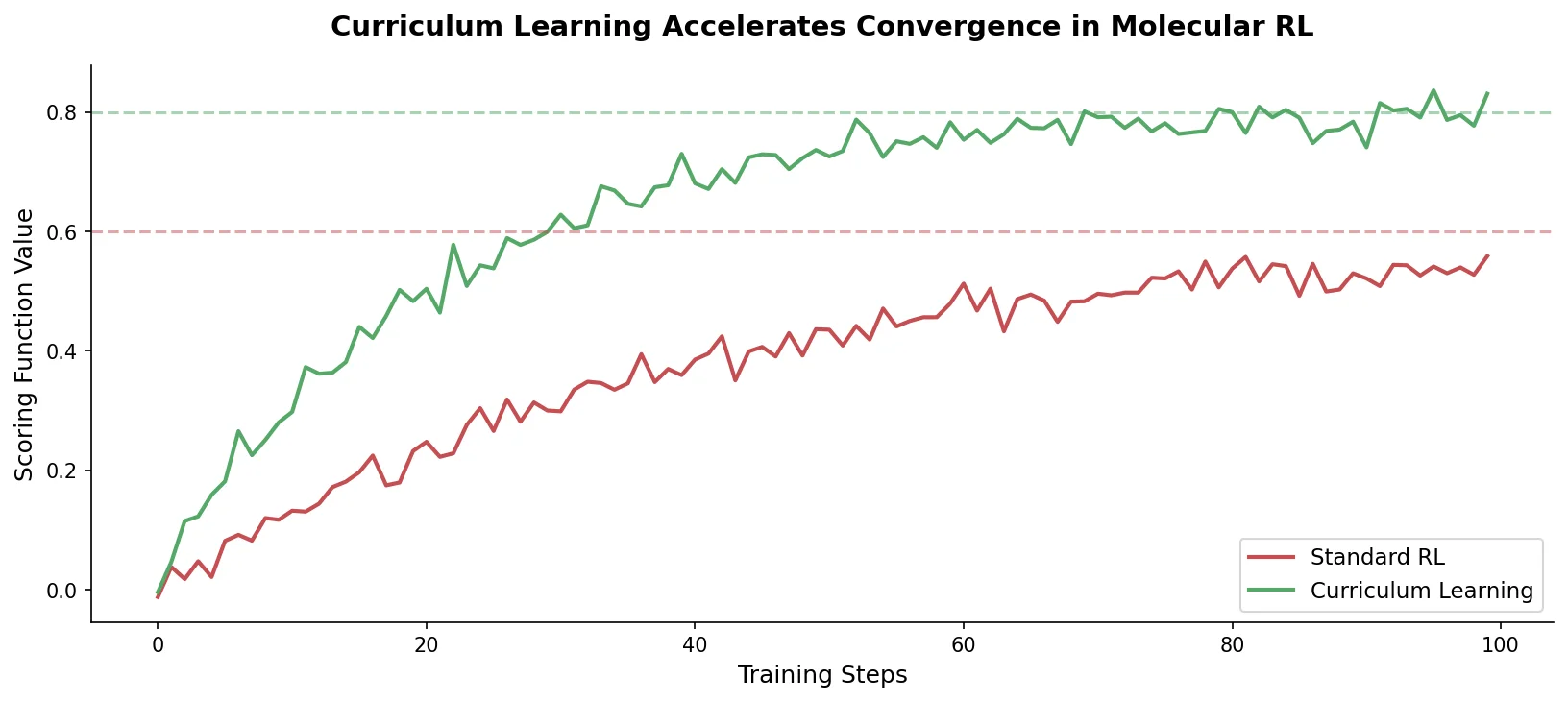
Line chart showing curriculum learning converges faster than standard RL for molecular generation

Curriculum Learning for De Novo Drug Design (REINVENT)

Introduces curriculum learning to the REINVENT de novo design platform, decomposing complex drug design objectives into simpler sequential tasks that accelerate agent convergence and improve output quality over standard reinforcement learning.

Molecular Generation
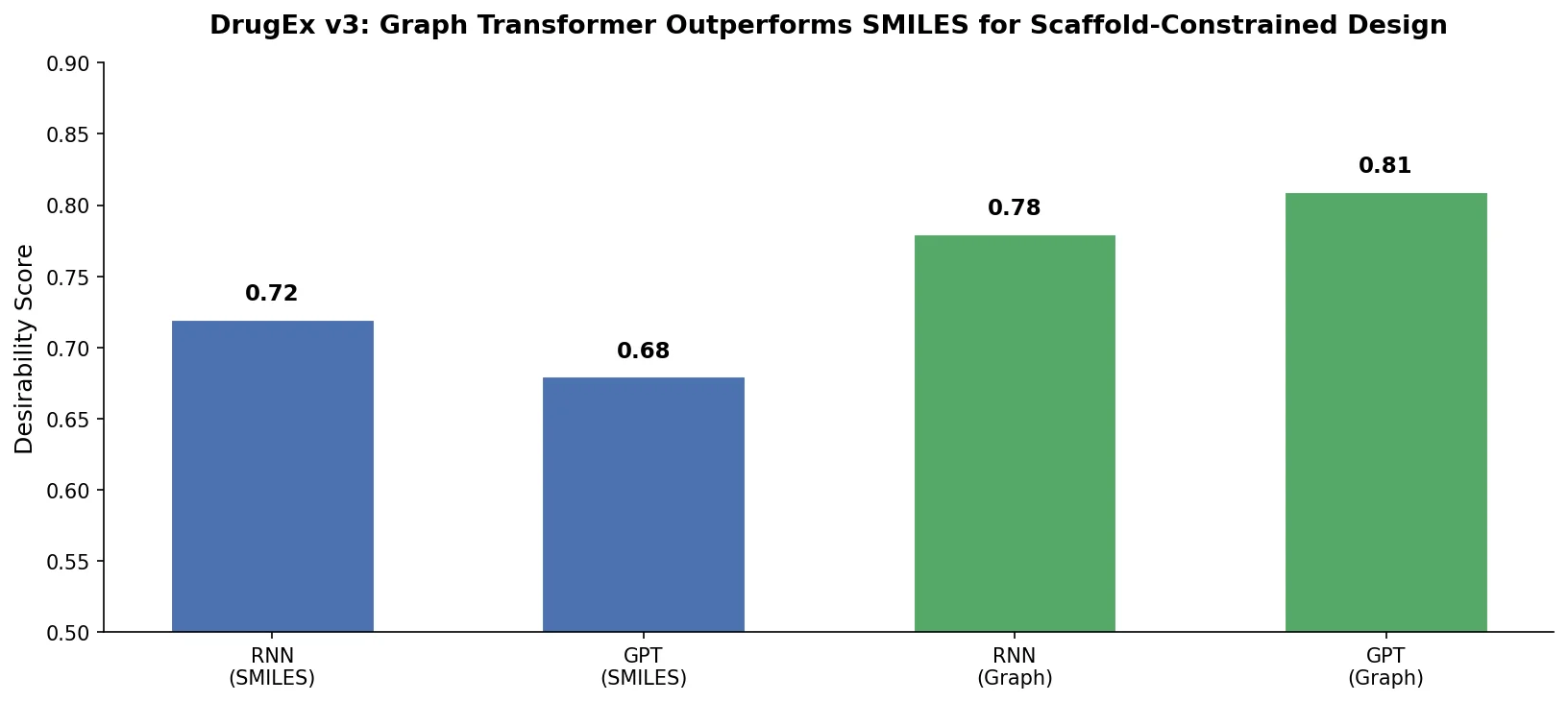
Bar chart comparing RNN and GPT architectures with SMILES and Graph representations on desirability scores

DrugEx v3: Scaffold-Constrained Graph Transformer

DrugEx v3 extends scaffold-constrained drug design by introducing a Graph Transformer with adjacency-matrix-based positional encoding, achieving 100% molecular validity and high predicted affinity for adenosine A2A receptor ligands.

Molecular Generation
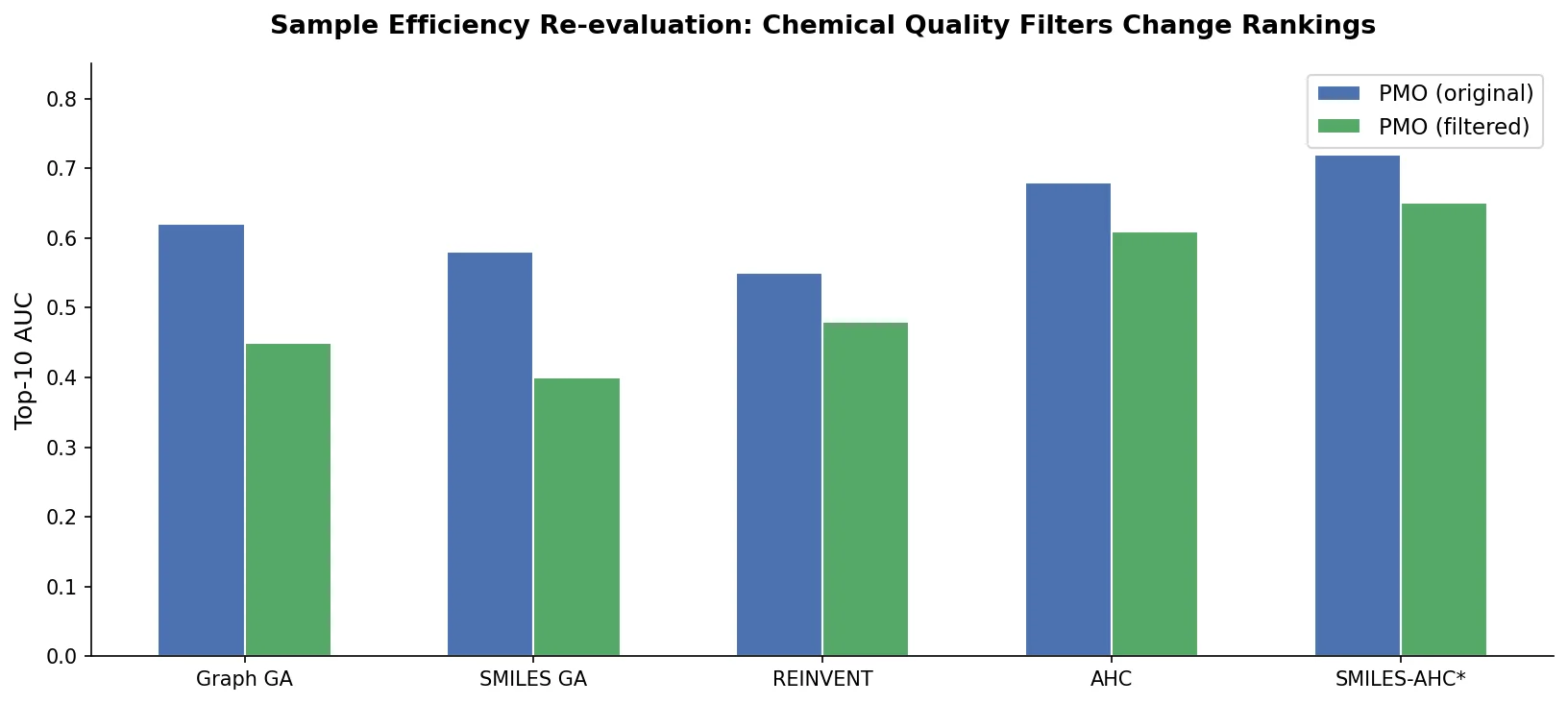
Bar chart comparing PMO benchmark scores with and without chemical quality filters across five generative methods

Re-evaluating Sample Efficiency in Molecule Generation

A critical reassessment of the PMO benchmark for de novo molecule generation, showing that adding molecular weight, LogP, and diversity filters substantially re-ranks generative models, with Augmented Hill-Climb emerging as the top method.

Computational Chemistry
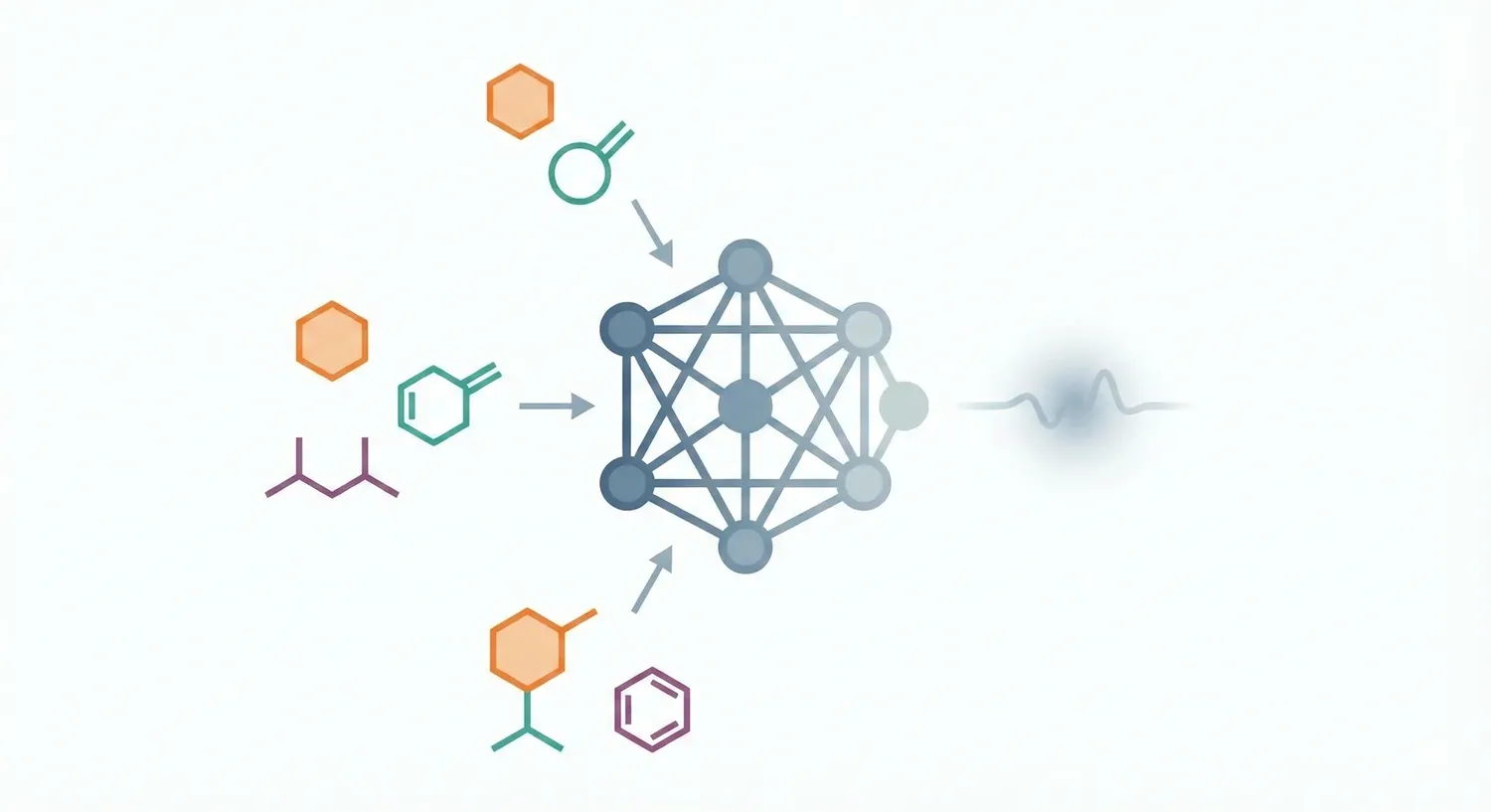
Chemical structures and molecular representations feeding into a neural network model that processes atomized chemical knowledge

ChemDFM-R: Chemical Reasoning LLM with Atomized Knowledge

ChemDFM-R is a 14B-parameter chemical reasoning model that integrates a 101B-token dataset of atomized chemical knowledge. Using a mix-sourced distillation strategy and domain-specific reinforcement learning, it outperforms similarly sized models and DeepSeek-R1 on ChemEval.