Machine Learning
Comparison of linear interpolation (teleportation) showing double peaks versus displacement interpolation (transportation) showing smooth single peak

A Convexity Principle for Interacting Gases (McCann 1997)

A theoretical paper that introduces displacement interpolation (optimal transport) to establish a new convexity principle for energy functionals. It proves the uniqueness of ground states for interacting gases and generalizes the Brunn-Minkowski inequality, providing mathematical tools later used in flow matching and optimal transport-based generative models.

Generative Modeling
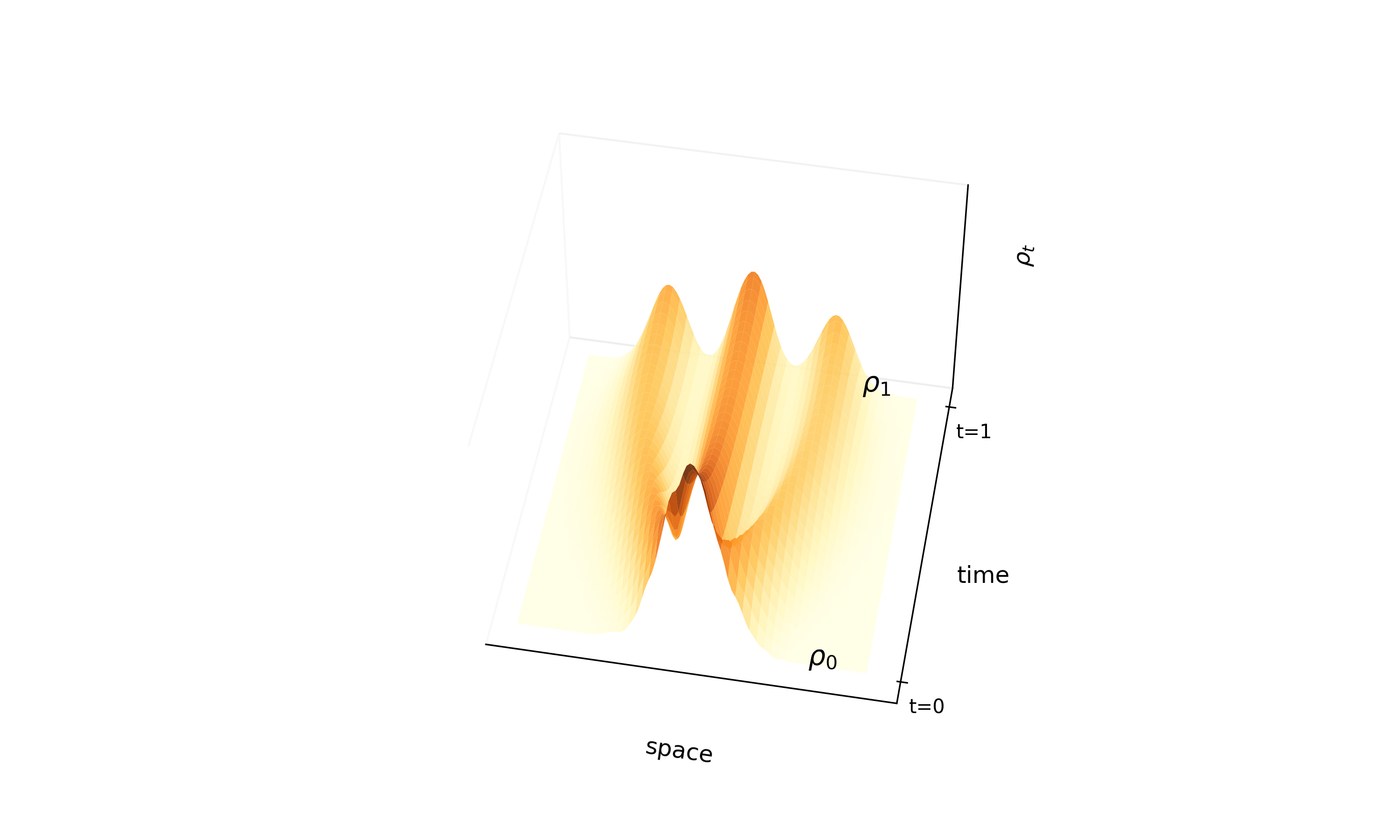
Visualization of probability density flow from initial distribution ρ₀ to target distribution ρ₁ over time through space

Building Normalizing Flows with Stochastic Interpolants

Proposes ‘InterFlow’, a method to learn continuous normalizing flows between arbitrary densities using stochastic interpolants. It avoids ODE backpropagation by minimizing a quadratic objective on the velocity field, enabling scalable ODE-based generation. On CIFAR-10, NLL matches ScoreSDE (2.99 bits per dim) with simulation-free training, though FID (10.27) trails dedicated image models (ScoreSDE: 2.92); the primary strength is tractable likelihood with efficient training cost.
Generative Modeling
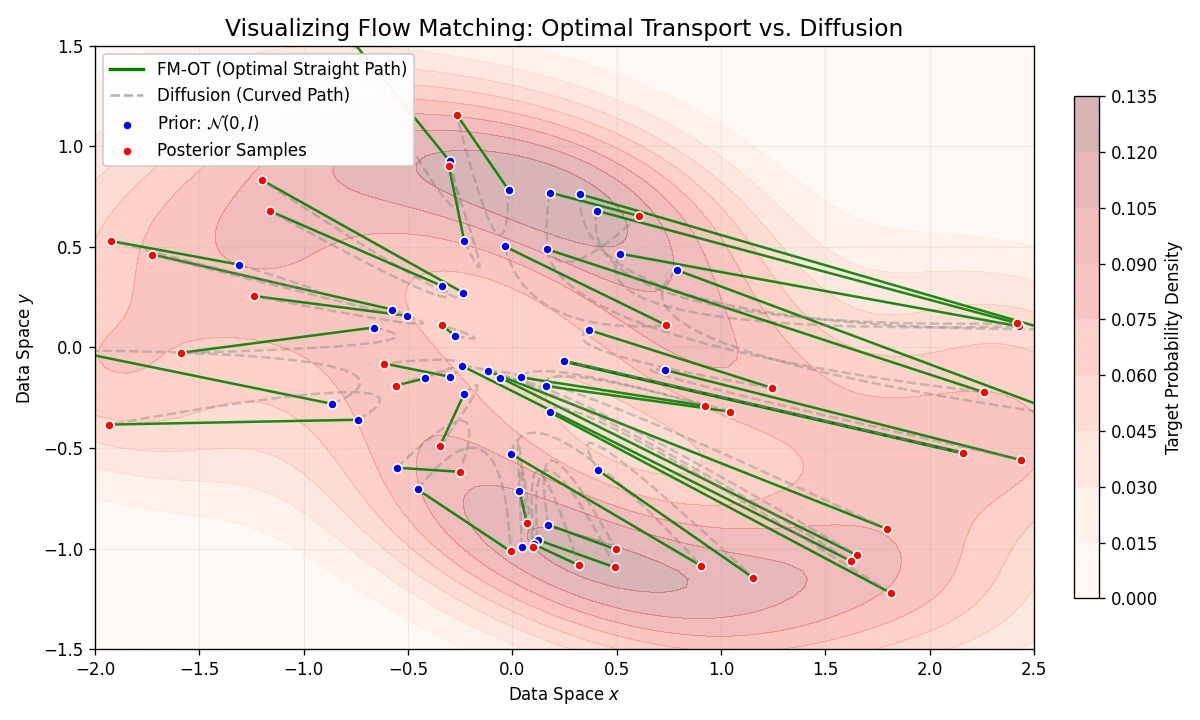
Visualization comparing Optimal Transport (straight paths) vs Diffusion (curved paths) for Flow Matching

Flow Matching for Generative Modeling: Scalable CNFs

Introduces Flow Matching, a scalable method for training CNFs by regressing vector fields of conditional probability paths. It generalizes diffusion and enables Optimal Transport paths for straighter, more efficient sampling.

Machine Learning
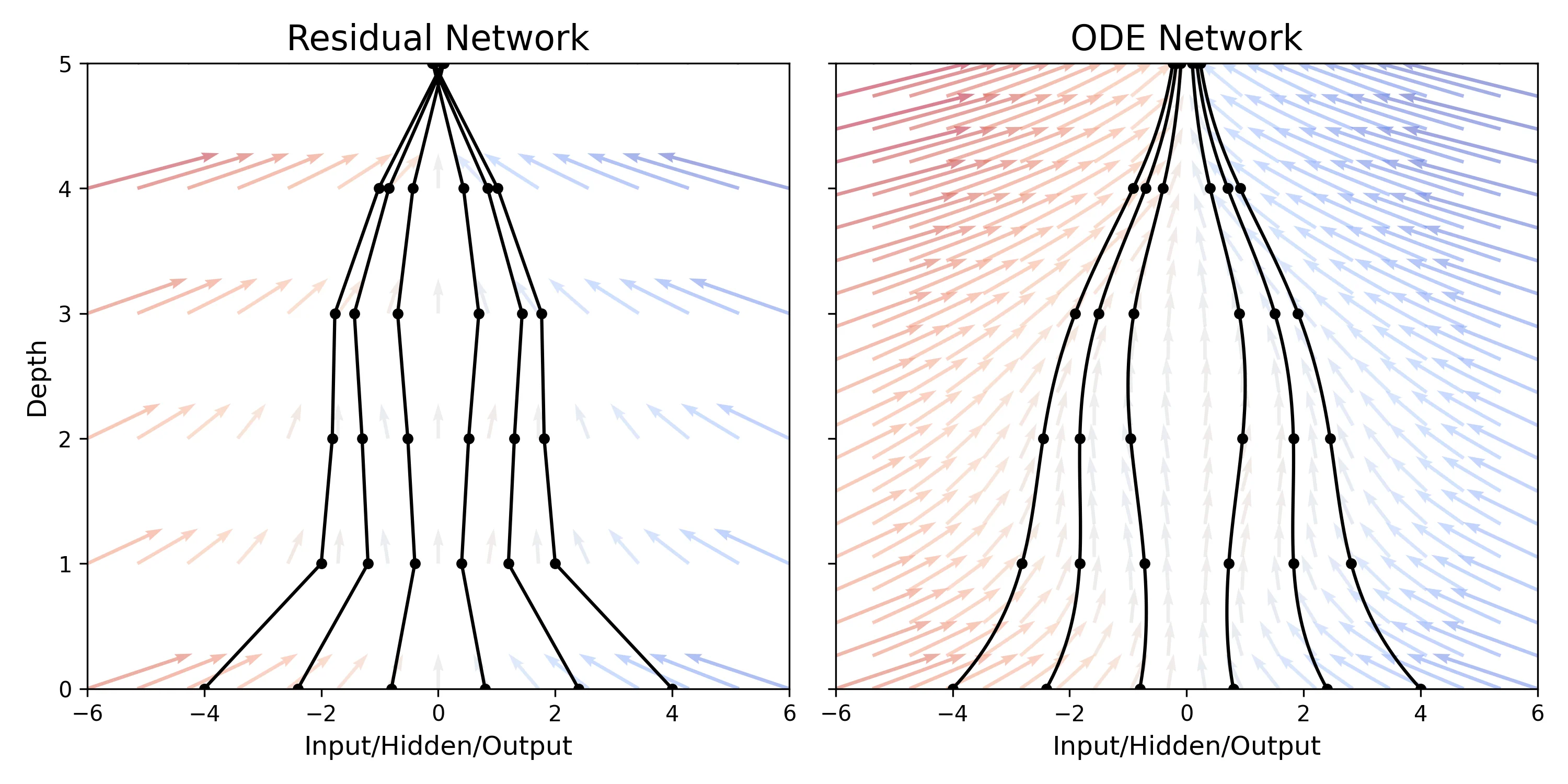
Comparison of Residual Network vs ODE Network architectures showing discrete layers versus continuous transformations

Neural ODEs: Continuous-Depth Deep Learning Models

This paper replaces discrete network layers with continuous ordinary differential equations (ODEs), allowing for adaptive computation depth and constant memory cost during training via the adjoint sensitivity method. It introduces Continuous Normalizing Flows and latent ODEs for time-series.

Generative Modeling
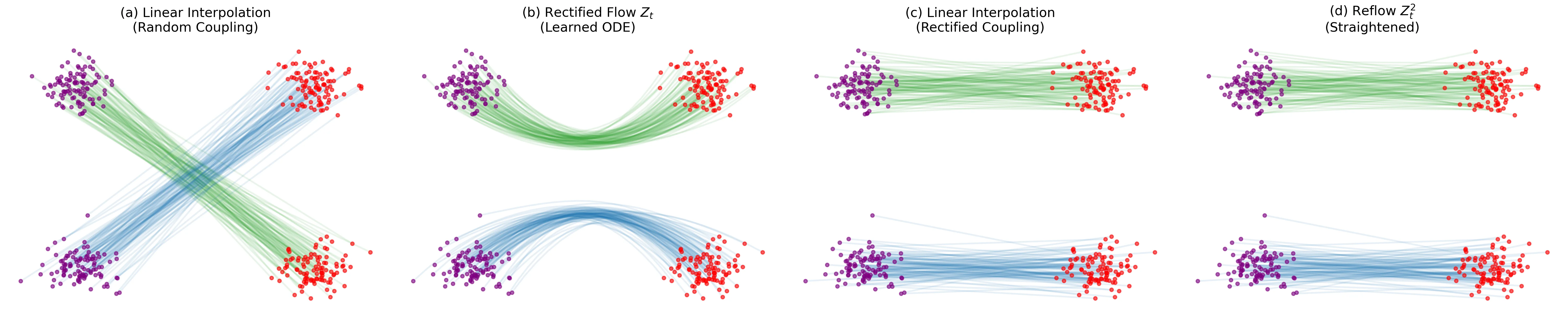
Visualization showing linear interpolation, learned ODE trajectories, and the reflow straightening process for rectified flow

Rectified Flow: Learning to Generate and Transfer Data

Introduces ‘Rectified Flow,’ a method to transport distributions via ODEs with straight paths. Uses a ‘reflow’ procedure to iteratively straighten trajectories, enabling high-quality 1-step generation with optional lightweight distillation.

Generative Modeling
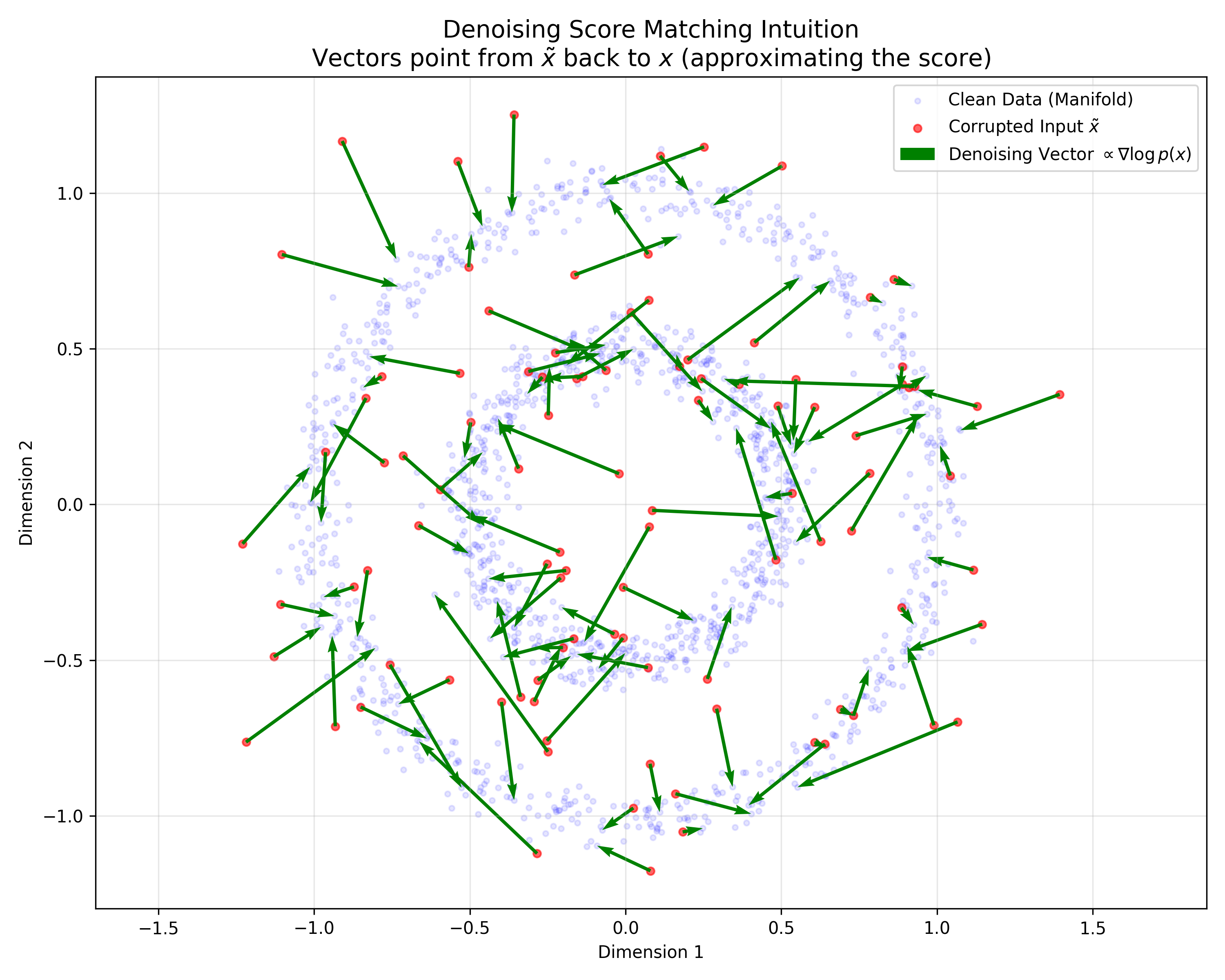
Denoising Score Matching Intuition - Vectors point from corrupted samples back to clean data, approximating the score

Score Matching and Denoising Autoencoders: A Connection

This paper provides a rigorous probabilistic foundation for Denoising Autoencoders by proving they are mathematically equivalent to Score Matching on a kernel-smoothed data distribution. It derives a specific energy function for DAEs and justifies the use of tied weights.

Molecular Simulation
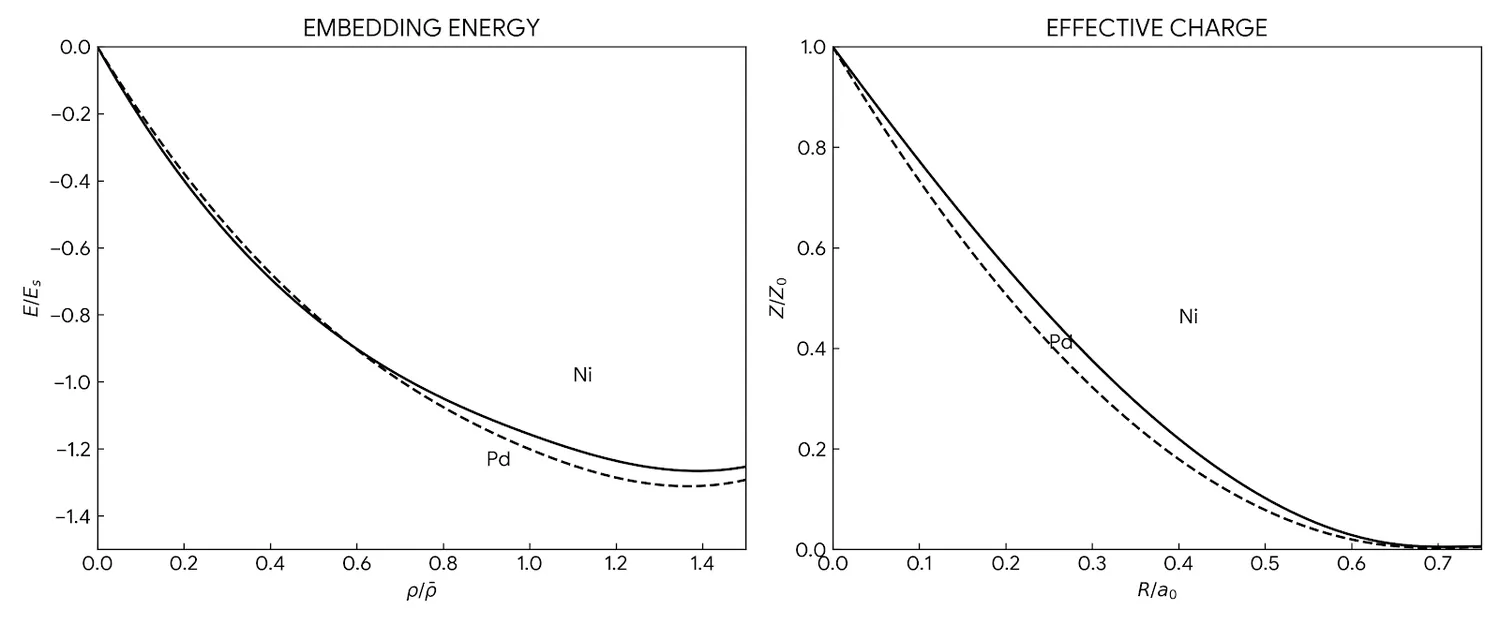
Embedding energy and effective charge functions for Ni and Pd from the original EAM paper

Embedded-Atom Method User Guide: Voter's 1994 Chapter

This 1994 handbook chapter serves as a practical user guide for the Embedded-Atom Method (EAM). It details the theoretical derivation from density-functional theory, synthesizes related methods like the Glue Model, and provides a complete tutorial on fitting potentials, illustrated with a specific implementation for the Ni-Al-B system.

Machine Learning
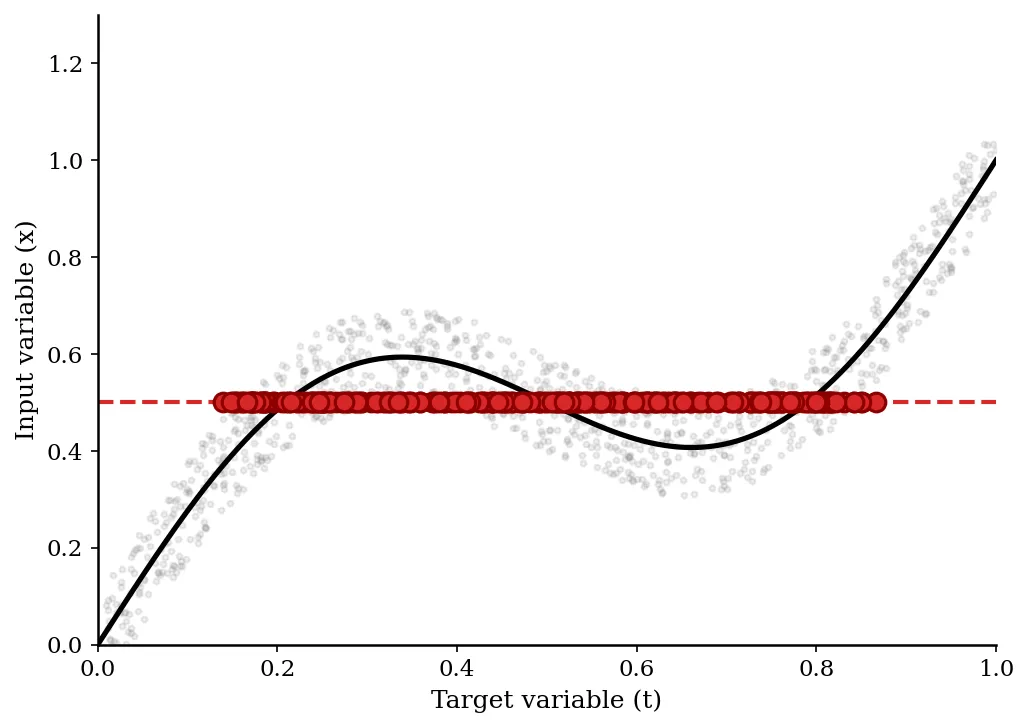
Visualization of inverse problem showing one input mapping to multiple valid outputs

Mixture Density Networks: Modeling Multimodal Distributions

A 1994 paper identifying why standard least-squares networks fail at inverse problems (multi-valued mappings). It introduces the Mixture Density Network (MDN), which predicts the parameters of a Gaussian Mixture Model to capture the full conditional probability density.

Scientific Computing
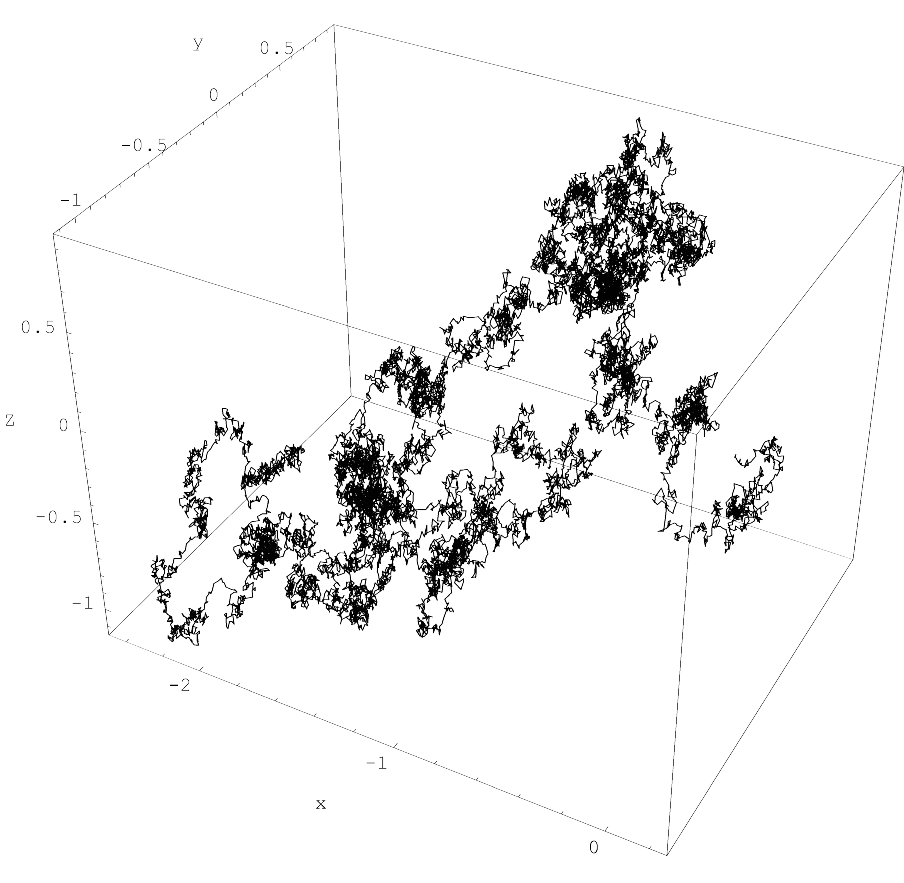
Three-dimensional Brownian motion trajectory showing random walk behavior

Second-Order Langevin Equation for Field Simulations

Proposes the Hyperbolic Algorithm for Euclidean field theory simulations. By adding a second-order fictitious time derivative to the Langevin equation, the method reduces systematic errors from O(ε) down to O(ε²).

Generative Modeling
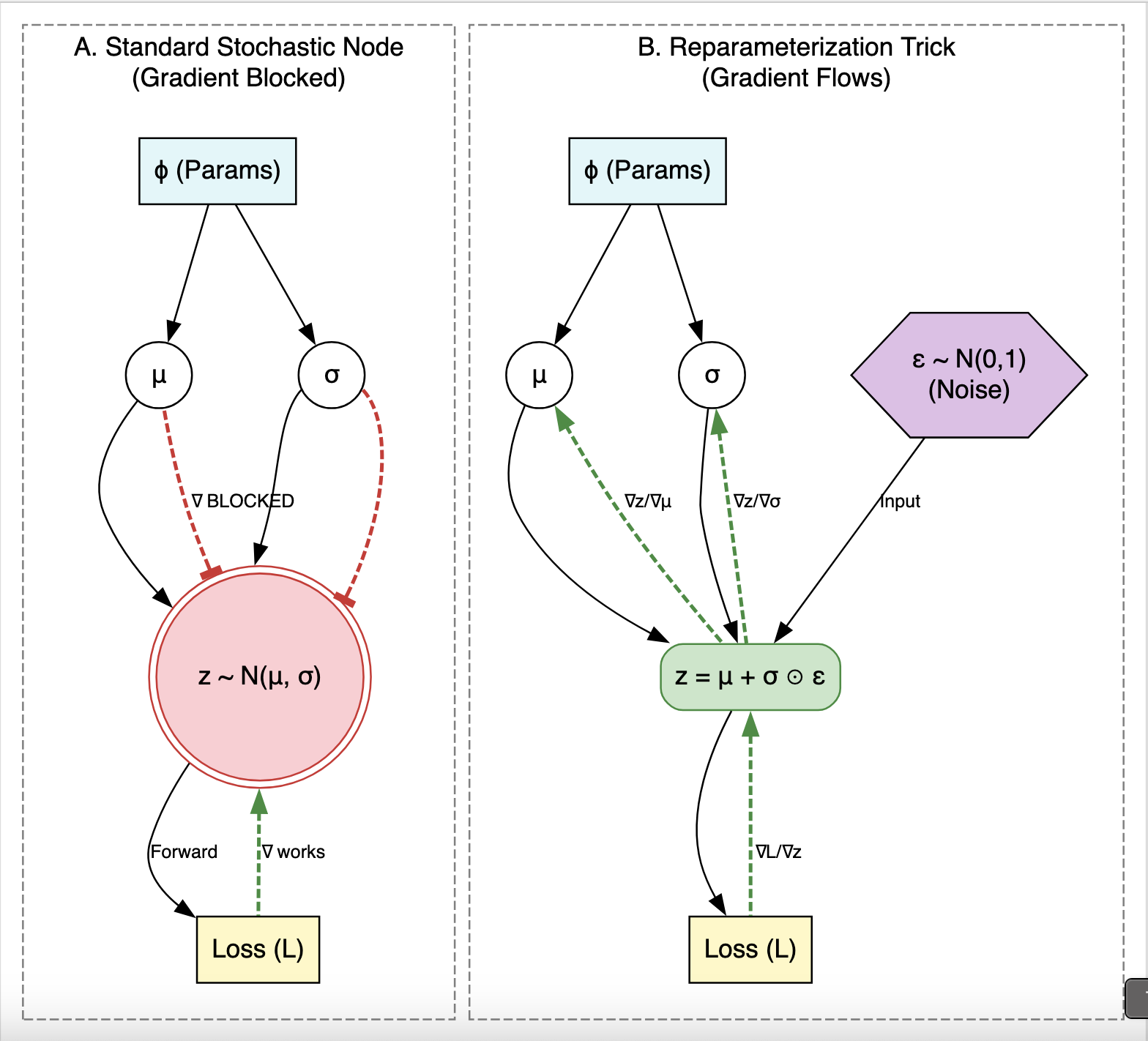
Diagram comparing standard stochastic sampling (gradient blocked) vs the reparameterization trick (gradient flows)

Auto-Encoding Variational Bayes: VAE Paper Summary

Kingma and Welling’s 2013 paper introducing Variational Autoencoders and the reparameterization trick, enabling end-to-end gradient-based training of generative models with continuous latent variables by moving the stochasticity outside the computational graph so that gradients can flow through a deterministic path.

Generative Modeling
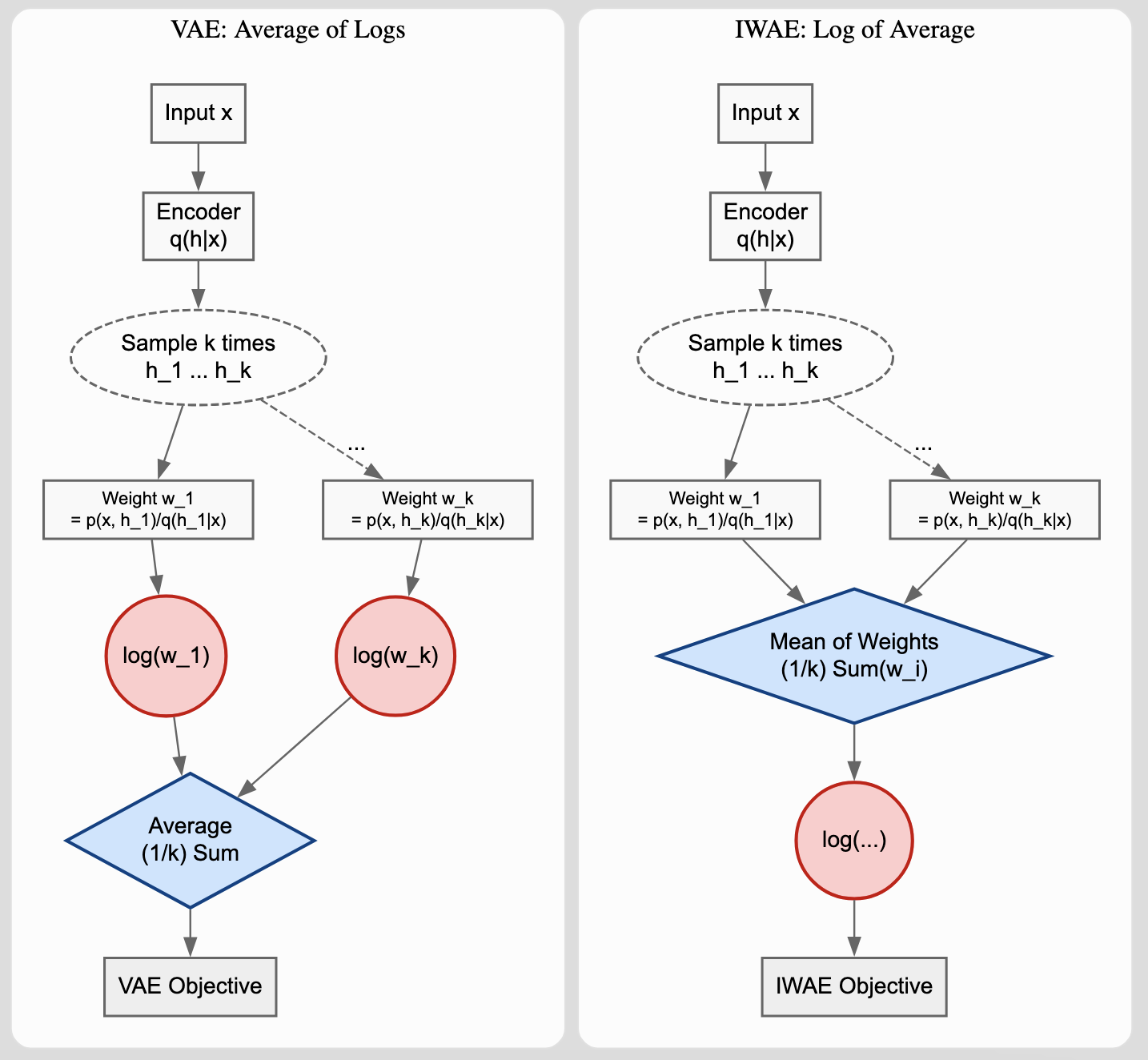
Flowchart comparing VAE and IWAE computation showing the key difference in where averaging occurs relative to the log operation

Importance Weighted Autoencoders (IWAE) for Tighter Bounds

Burda et al.’s ICLR 2016 paper introducing Importance Weighted Autoencoders, which use importance sampling to derive a strictly tighter log-likelihood lower bound than standard VAEs, addressing posterior collapse and improving generative quality. The model architecture remains the same.

Generative Modeling
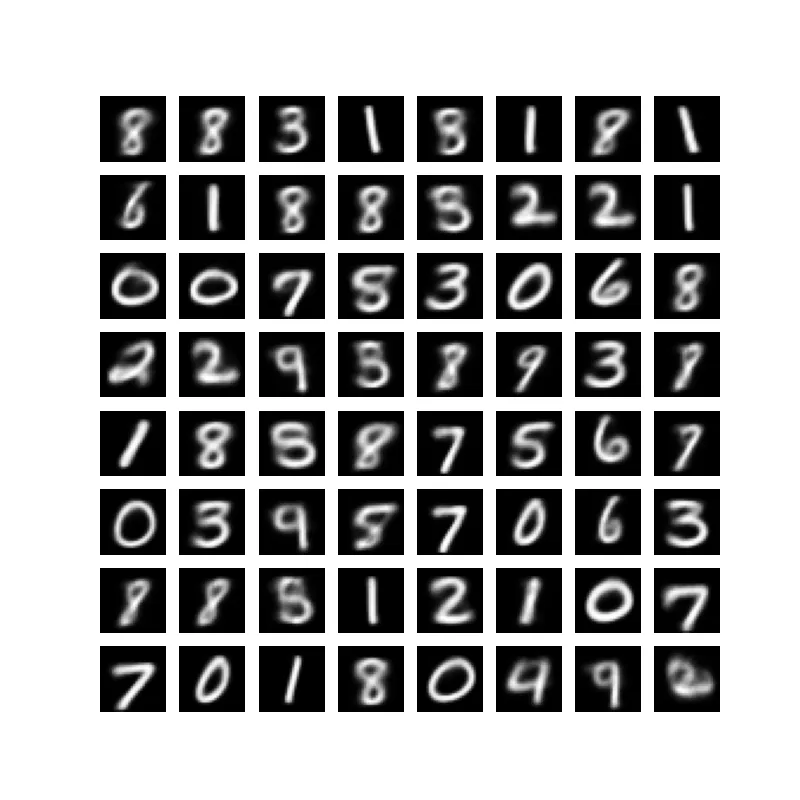
MNIST digit samples generated from a Variational Autoencoder latent space

Importance Weighted Autoencoders: Beyond the Standard VAE

Discover how Importance Weighted Autoencoders (IWAEs) use the same architecture as VAEs with a fundamentally more powerful objective to leverage multiple samples effectively.