Molecular Generation
Schematic of Link-INVENT architecture showing encoder-decoder RNN with reinforcement learning scoring loop

Link-INVENT: RL-Driven Molecular Linker Generation

Link-INVENT is an RNN-based generative model for molecular linker design that uses reinforcement learning with a flexible scoring function, demonstrated on fragment linking, scaffold hopping, and PROTAC design.

Molecular Generation
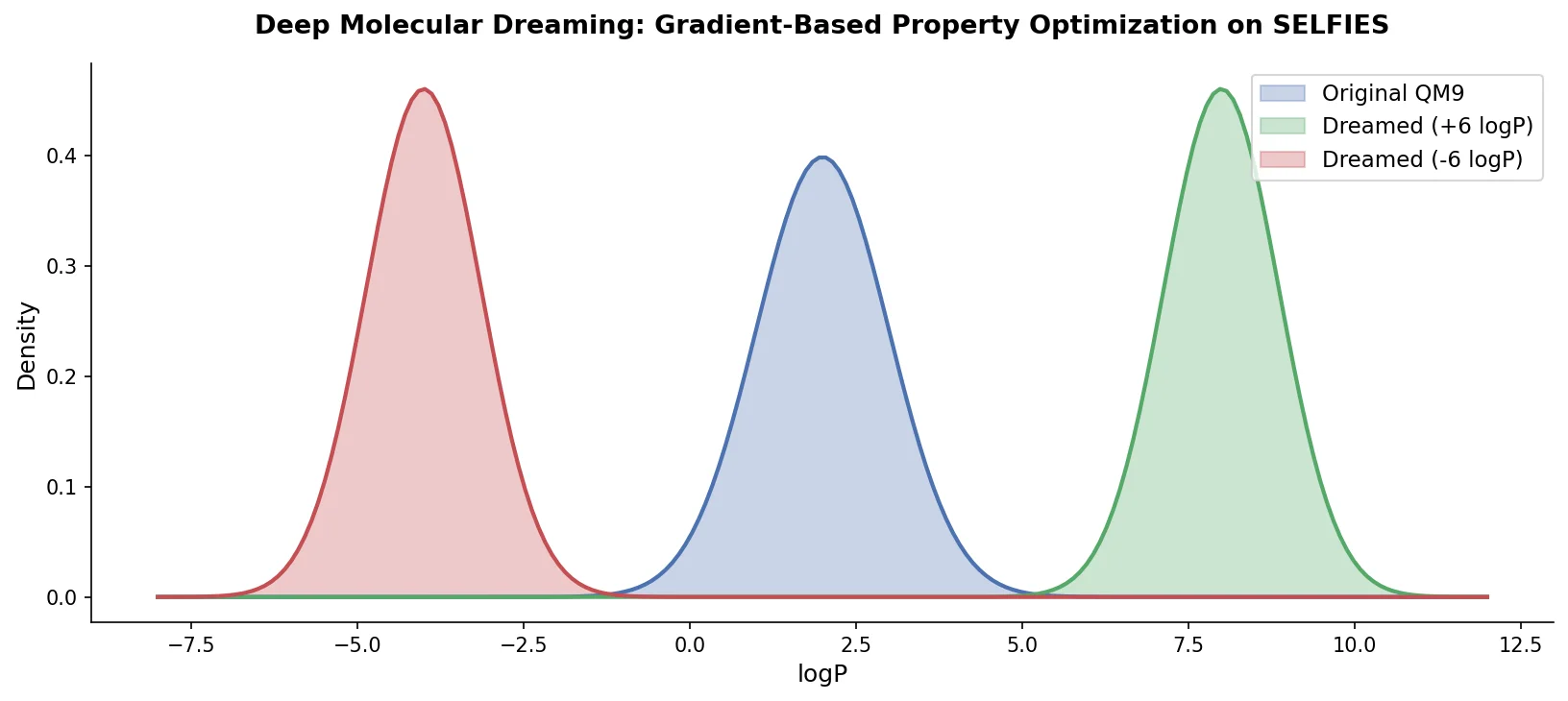
Distribution plot showing original QM9 logP shifted toward +6 and -6 targets via gradient-based dreaming

PASITHEA: Gradient-Based Molecular Design via Dreaming

PASITHEA adapts deep dreaming from computer vision to molecular design, directly optimizing SELFIES-encoded molecules for target chemical properties via gradient-based inversion of a trained regression network.
Molecular Representations
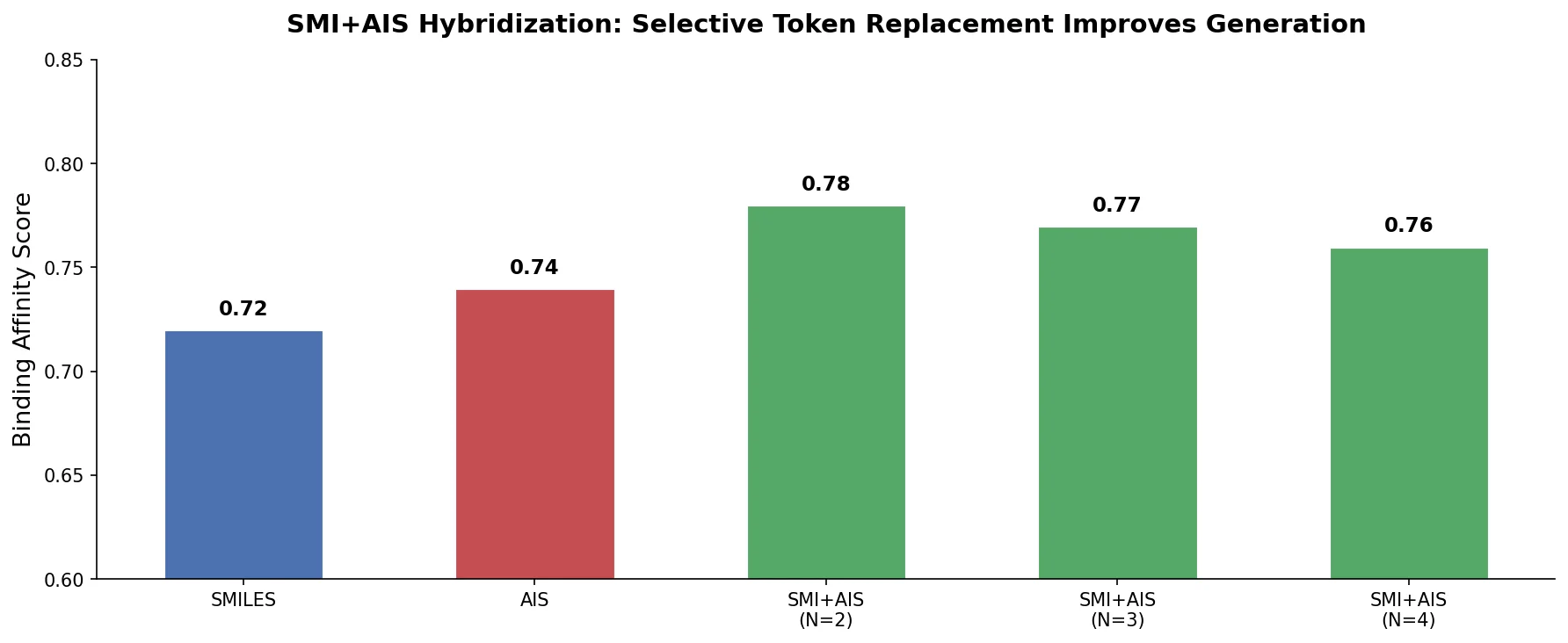
Bar chart comparing binding affinity scores across SMILES, AIS, and SMI+AIS hybrid tokenization strategies

SMI+AIS: Hybridizing SMILES with Environment Tokens

Proposes SMI+AIS, a hybrid molecular representation combining standard SMILES tokens with chemical-environment-aware Atom-In-SMILES tokens, demonstrating improved molecular generation for drug design targets.

Molecular Generation
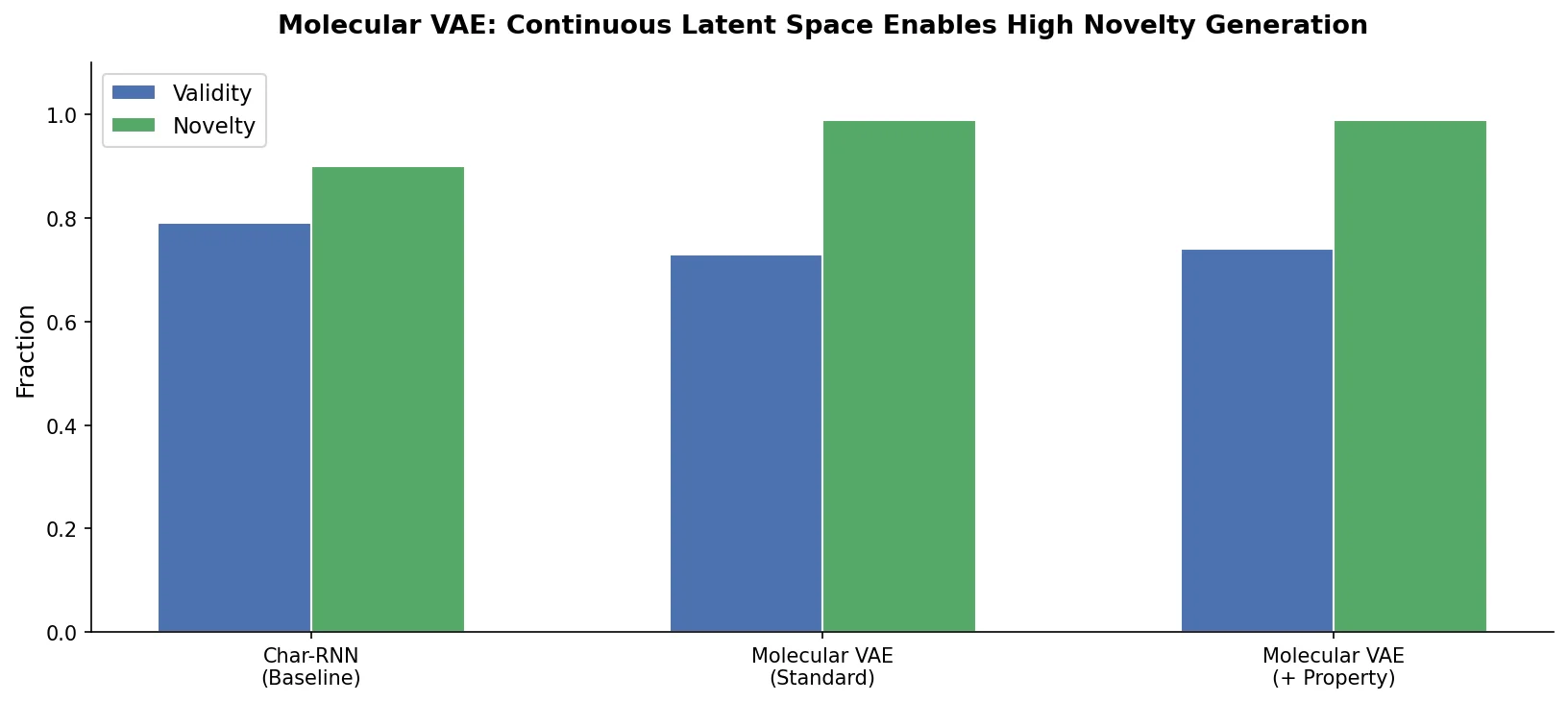
Bar chart comparing Char-RNN and Molecular VAE on validity and novelty metrics

VAE for Automatic Chemical Design (2018 Seminal)

This foundational paper introduces a variational autoencoder (VAE) that encodes SMILES strings into a continuous latent space, allowing gradient-based optimization of molecular properties. Joint training with a property predictor organizes the latent space by chemical properties, and Bayesian optimization over the latent surface discovers drug-like molecules with improved QED and synthetic accessibility.

Molecular Generation
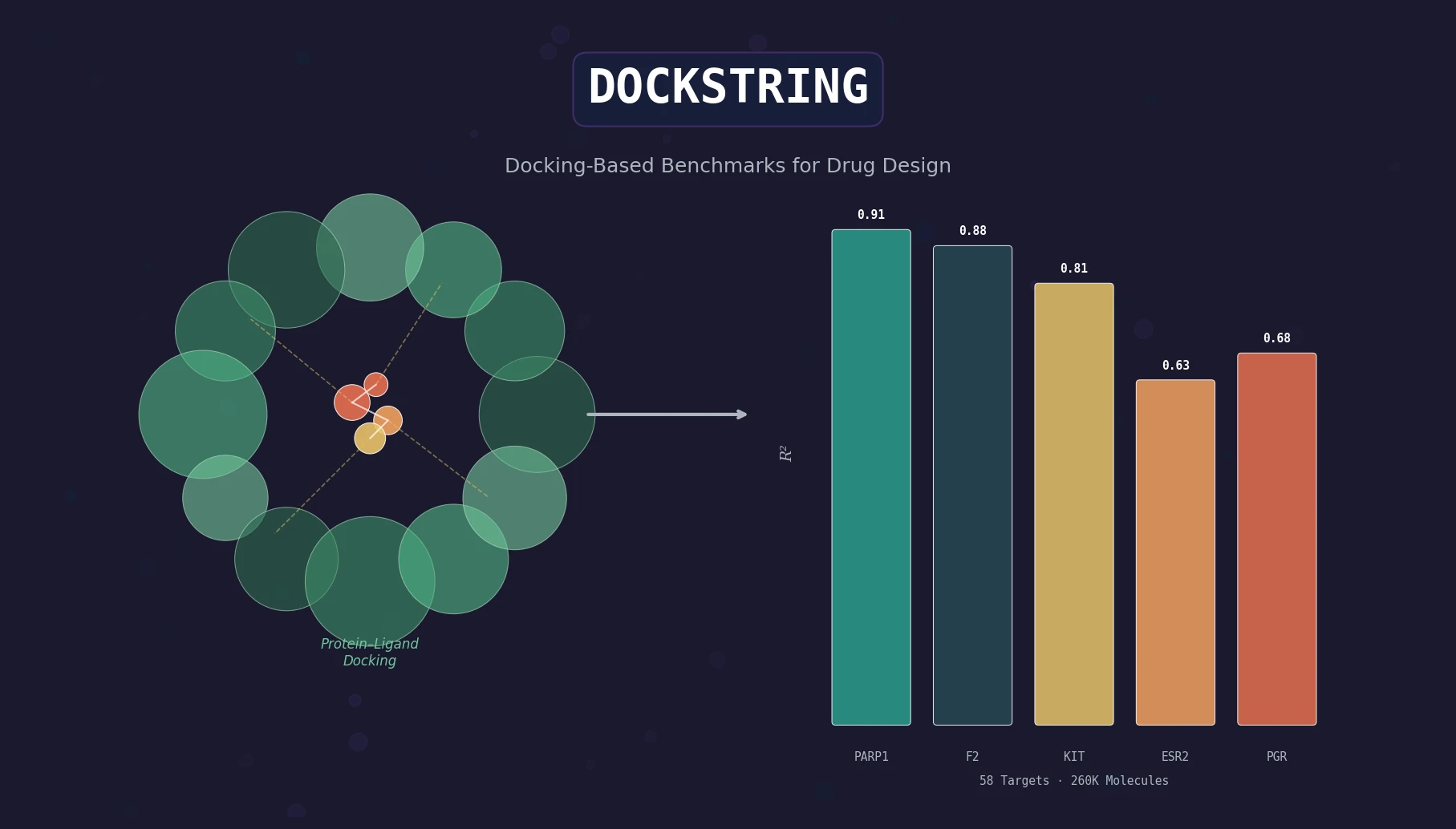
Stylized visualization of protein-ligand docking and benchmark performance bars across five drug targets

DOCKSTRING: Docking-Based Benchmarks for Drug Design

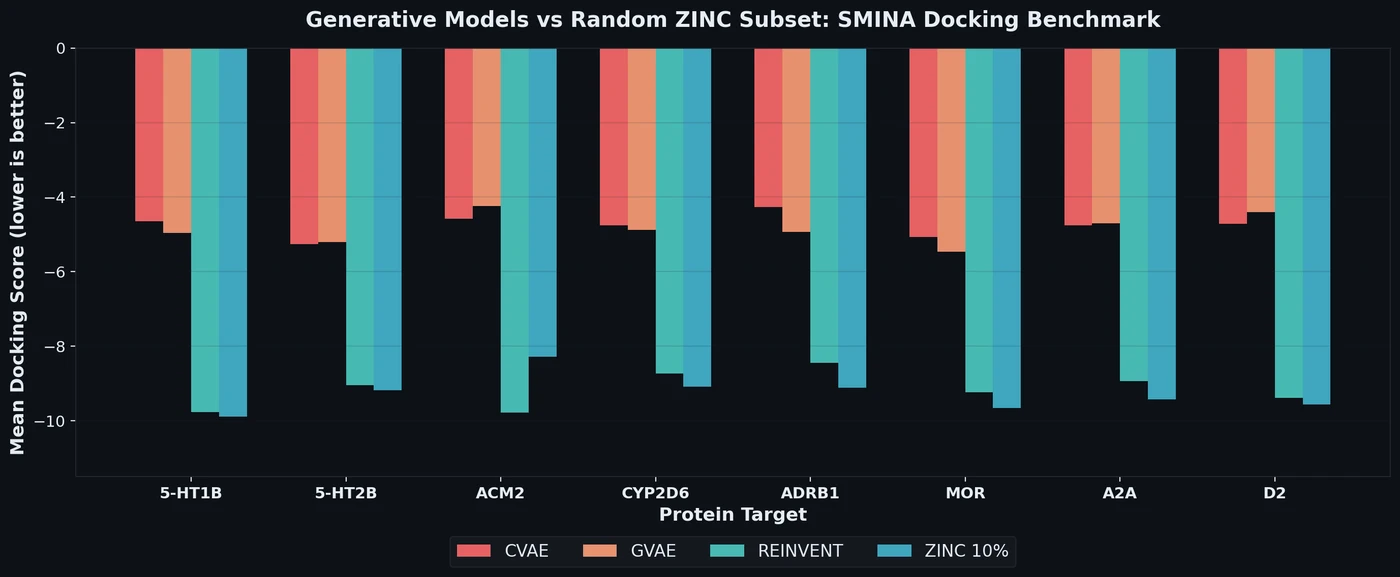
DOCKSTRING bundles an AutoDock Vina wrapper, a 260K-molecule docking dataset across 58 protein targets, and pharmaceutically relevant benchmarks for regression, virtual screening, and de novo design.

Molecular Generation
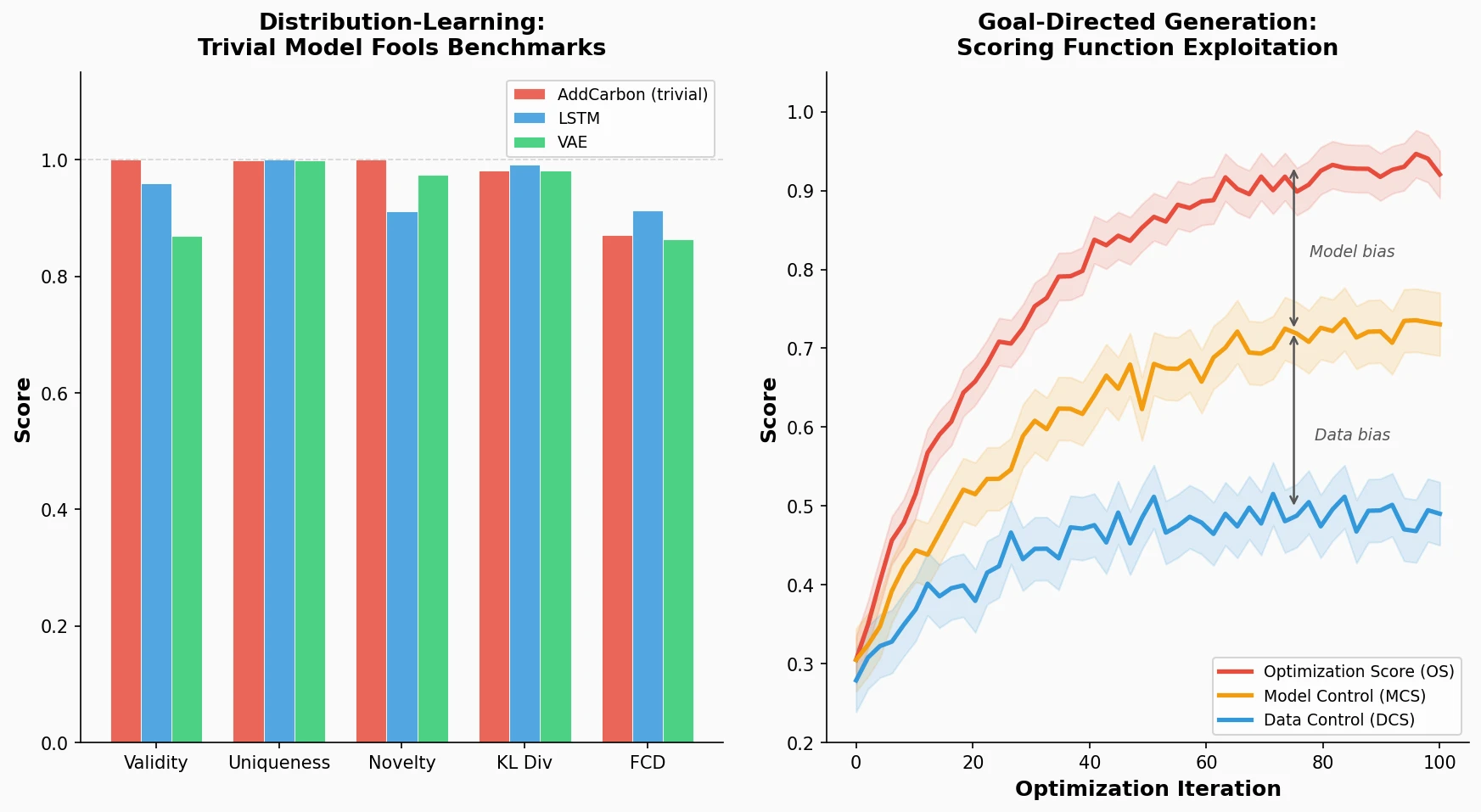
Diagram showing divergence between optimization score and control scores during molecular optimization

Failure Modes in Molecule Generation & Optimization

Identifies failure modes in molecular generative models, showing that trivial edits fool distribution-learning benchmarks and that ML-based scoring functions introduce exploitable model-specific and data-specific biases during goal-directed optimization.

Molecular Generation
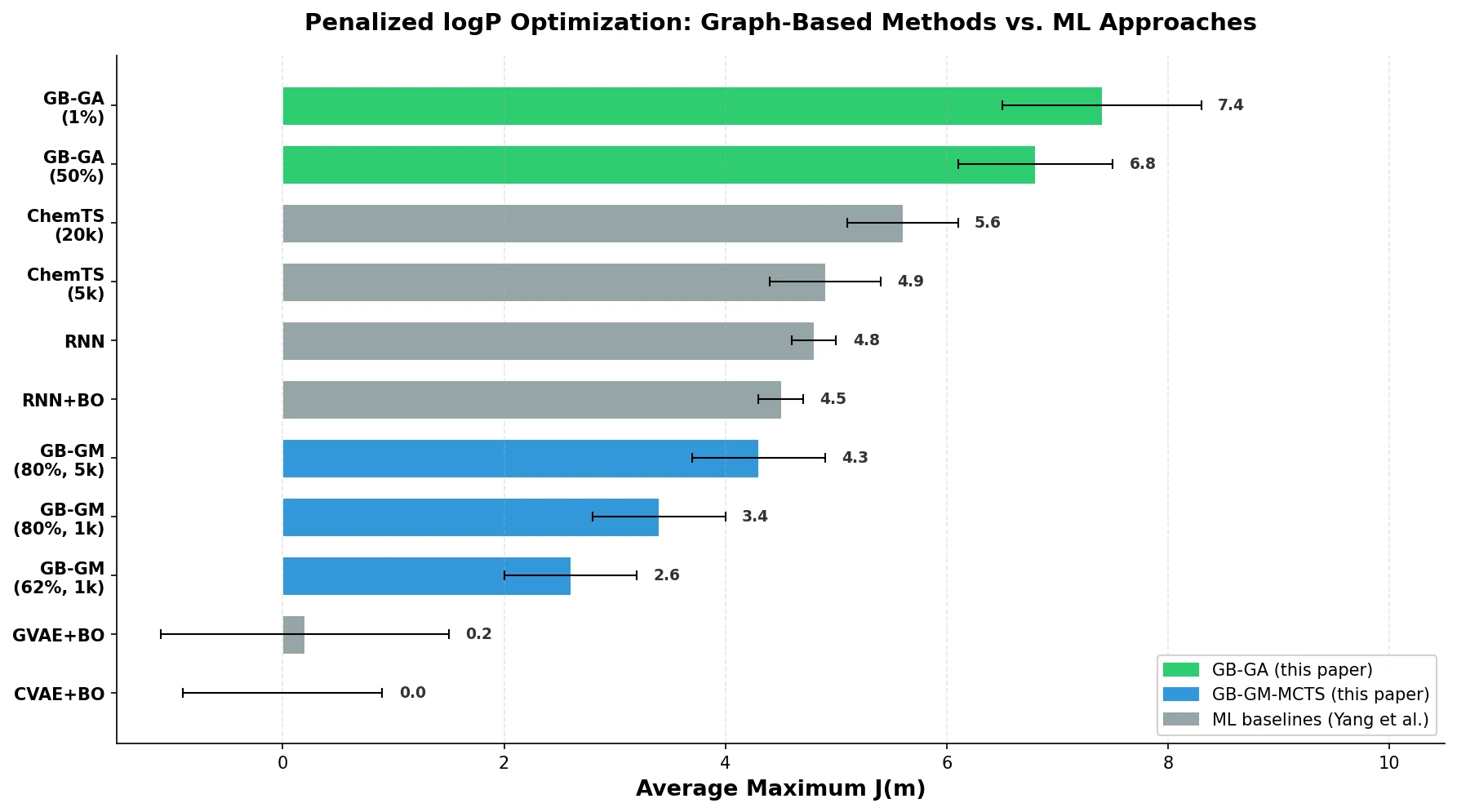
Comparison bar chart showing penalized logP scores for GB-GA, GB-GM-MCTS, and ML-based molecular optimization methods

Graph-Based GA and MCTS Generative Model for Molecules

A graph-based genetic algorithm (GB-GA) and a graph-based generative model with Monte Carlo tree search (GB-GM-MCTS) for molecular optimization that match or outperform ML-based generative approaches while being orders of magnitude faster.

Molecular Generation
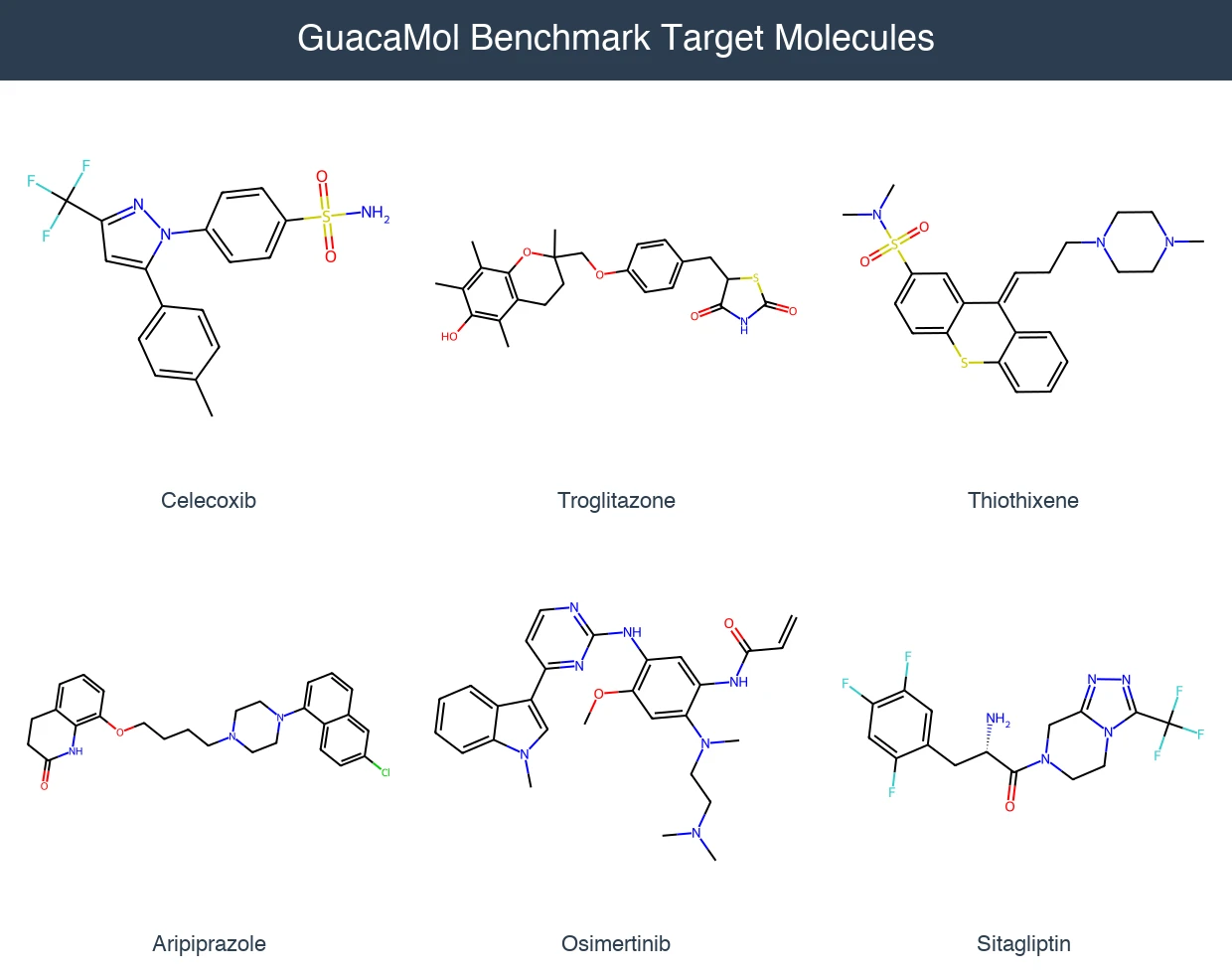
Grid of six GuacaMol benchmark target molecules: Celecoxib, Troglitazone, Thiothixene, Aripiprazole, Osimertinib, and Sitagliptin

GuacaMol: Benchmarking Models for De Novo Molecular Design

GuacaMol provides an open-source benchmarking framework with 5 distribution-learning and 20 goal-directed tasks to standardize evaluation of de novo molecular design models.

Molecular Generation
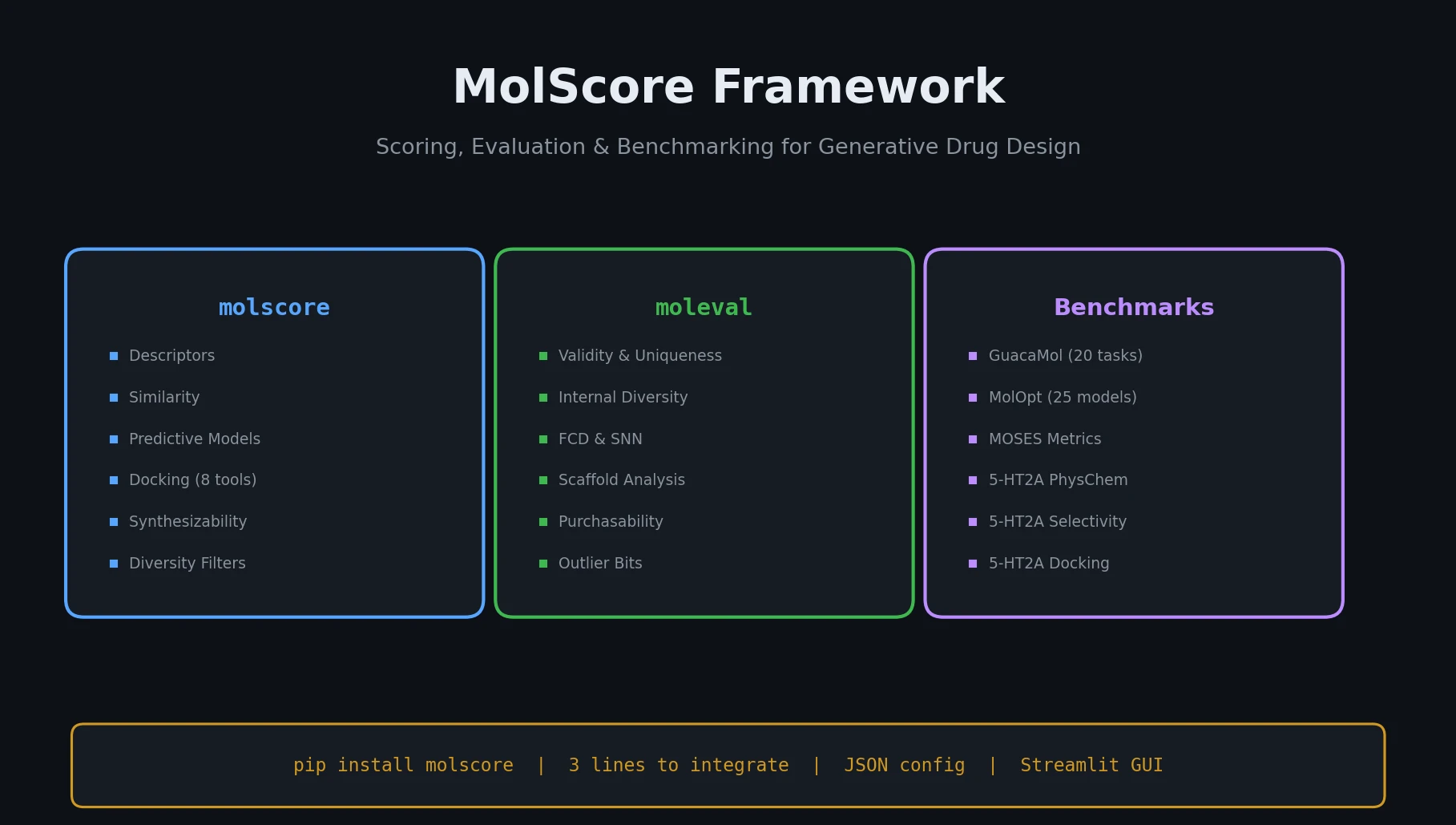
Diagram showing MolScore framework components: scoring functions, evaluation metrics, and benchmark modes

MolScore: Scoring and Benchmarking for Drug Design

MolScore is an open-source framework that unifies scoring functions, evaluation metrics, and benchmarks for generative molecular design, with configurable objectives and GUI support.

Molecular Generation
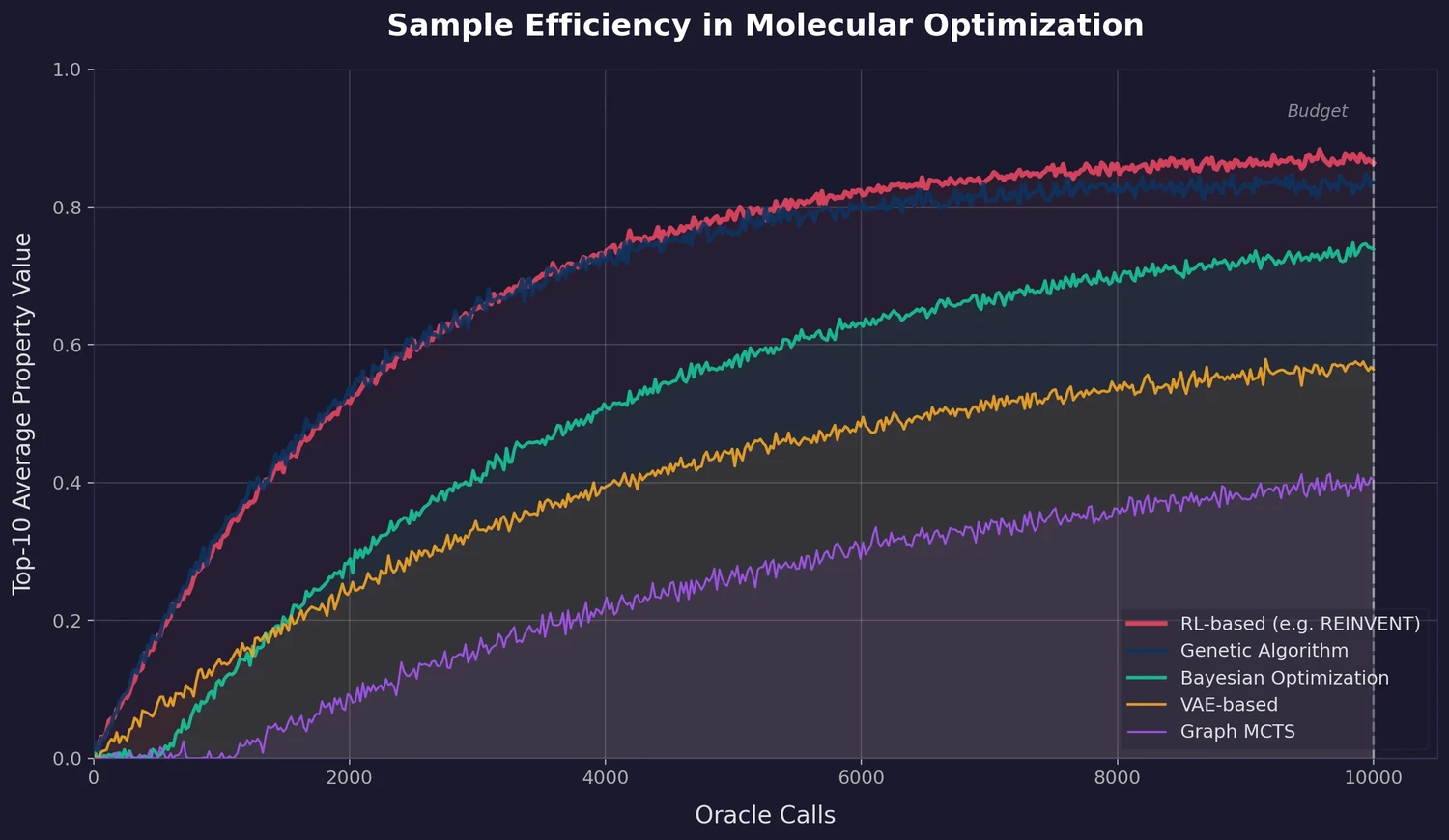
Sample efficiency curves showing different molecular optimization algorithm families converging at different rates under a fixed oracle budget

PMO: Benchmarking Sample-Efficient Molecular Design

A large-scale benchmark of 25 molecular optimization methods on 23 oracles under constrained oracle budgets, showing that sample efficiency is a critical and often neglected dimension of evaluation.

Molecular Representations
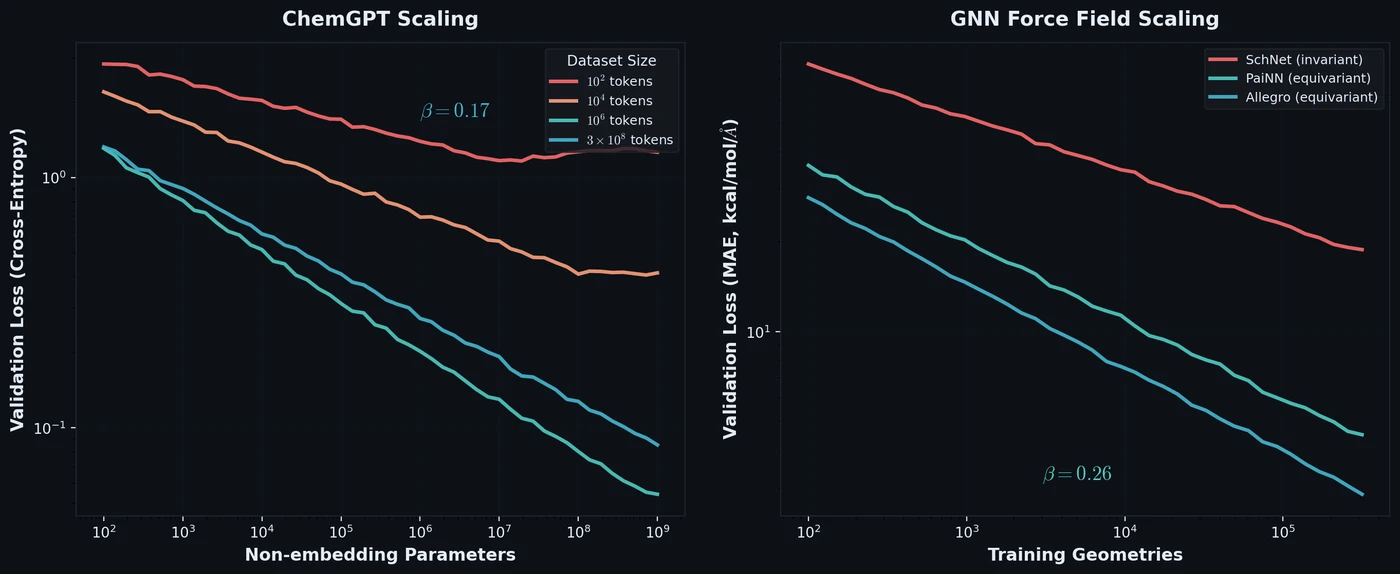
Log-log plots showing power-law scaling of ChemGPT validation loss versus model size and GNN force field loss versus dataset size

Neural Scaling of Deep Chemical Models

Frey et al. discover empirical power-law scaling relations for both chemical language models (ChemGPT, up to 1B parameters) and equivariant GNN interatomic potentials, finding that neither domain has saturated with respect to model size, data, or compute.

Molecular Generation
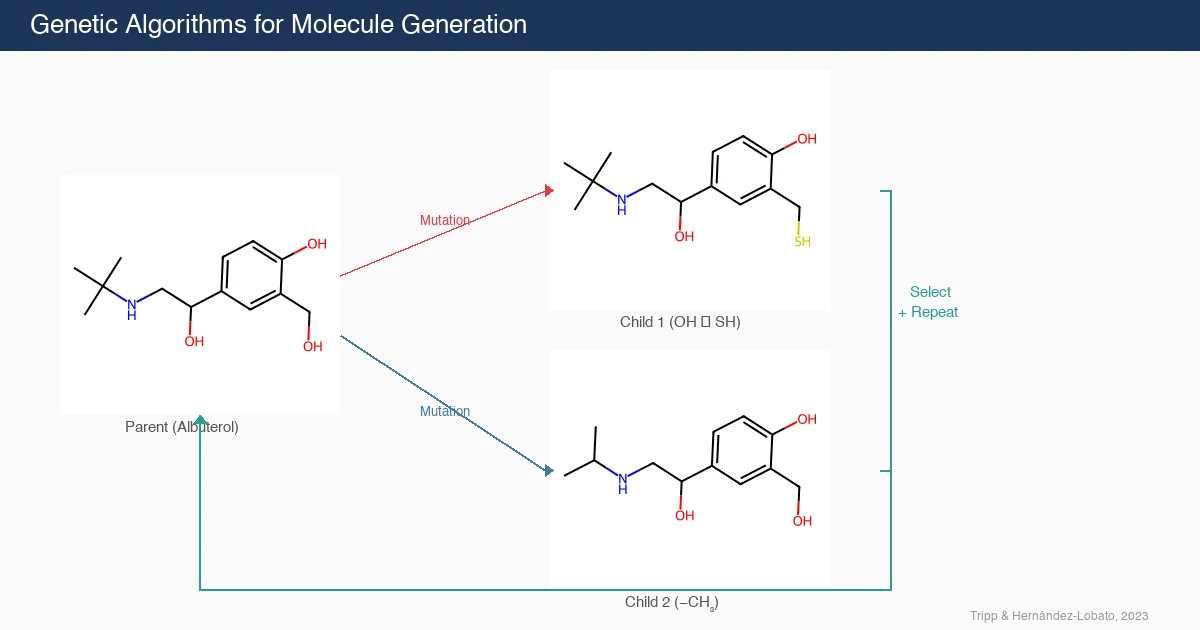
Diagram showing a genetic algorithm for molecules where a parent albuterol molecule undergoes mutation to produce two child molecules, with a selection and repeat loop

Genetic Algorithms as Baselines for Molecule Generation

This position paper demonstrates that genetic algorithms (GAs) perform surprisingly well on molecular generation benchmarks, often outperforming complex deep learning methods. The authors propose the GA criterion: new molecule generation algorithms should demonstrate a clear advantage over GAs.