Computational Biology
Graph-grammar expansion of a carbon fixation reaction network with ILP flow queries selecting short autocatalytic cycles

Graph Grammar and ILP for Carbon Fixation Pathways

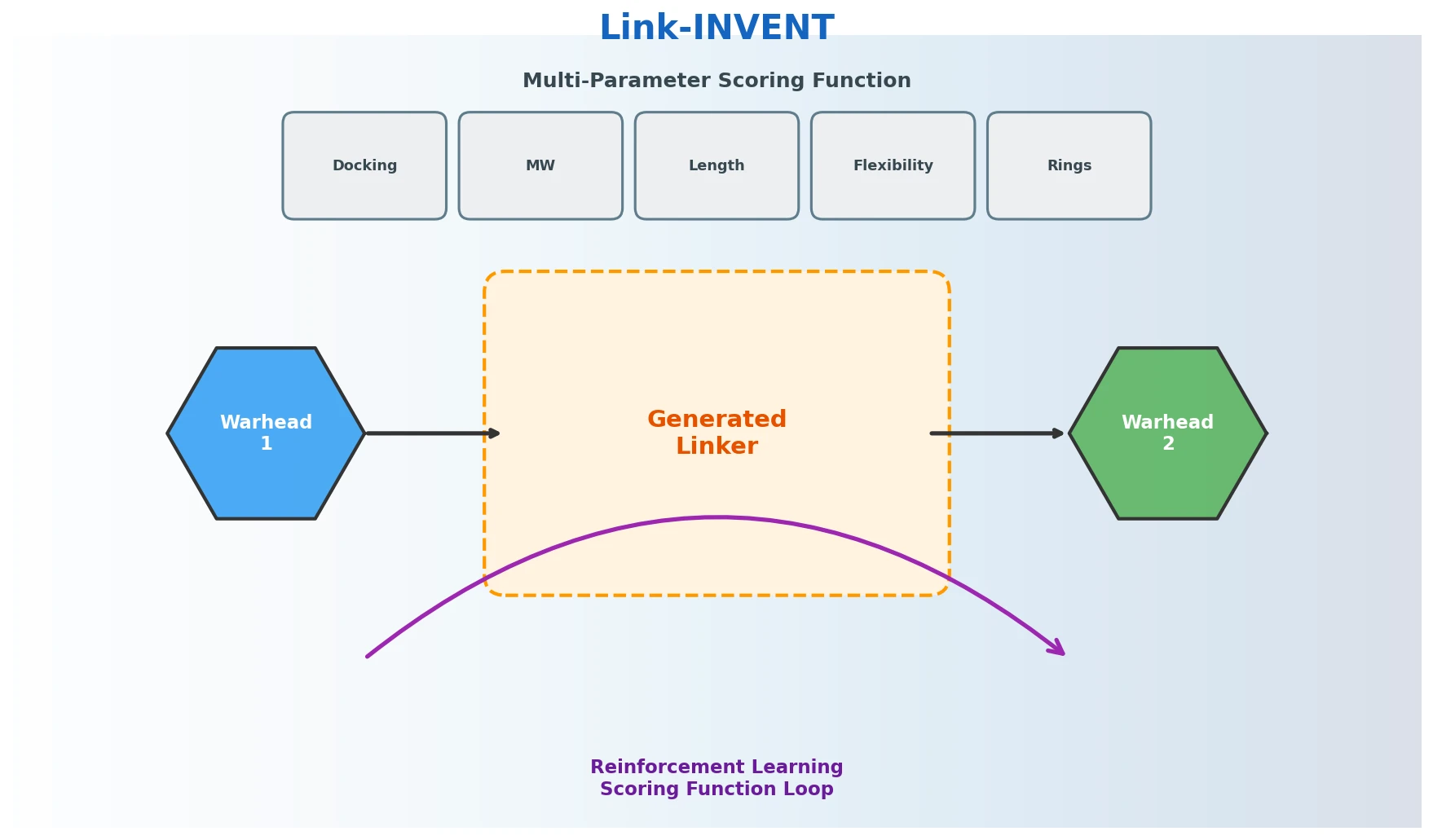
A graph-grammar cheminformatics workflow expands the carbon fixation reaction network, then uses integer linear programming flow queries to surface short autocatalytic pathways producing Acetyl-CoA and Malate with efficiencies approaching the CETCH cycle.

Predictive Chemistry
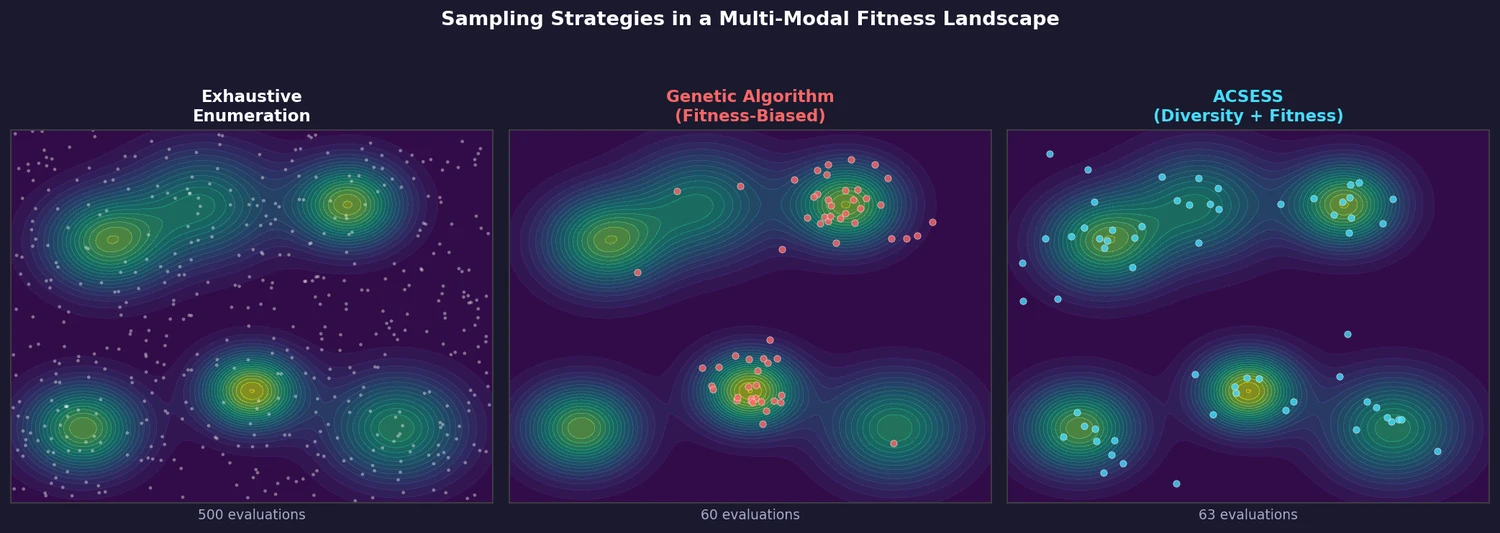
Three panels comparing sampling strategies in a multi-modal fitness landscape: exhaustive enumeration, genetic algorithm clustering around few peaks, and ACSESS covering all peaks with fewer evaluations

ACSESS: Diverse Optimal Molecules in the SMU

Property-optimizing ACSESS combines diversity-biased sampling with iterative fitness thresholding to discover diverse sets of molecules with favorable properties. Tested on GDB-9 (dipole moment optimization) and NKp fitness landscapes, it outperforms standard genetic algorithms in diversity while matching or exceeding their fitness, using only ~30,000 evaluations to navigate a 300,000-molecule space.
Natural Language Processing
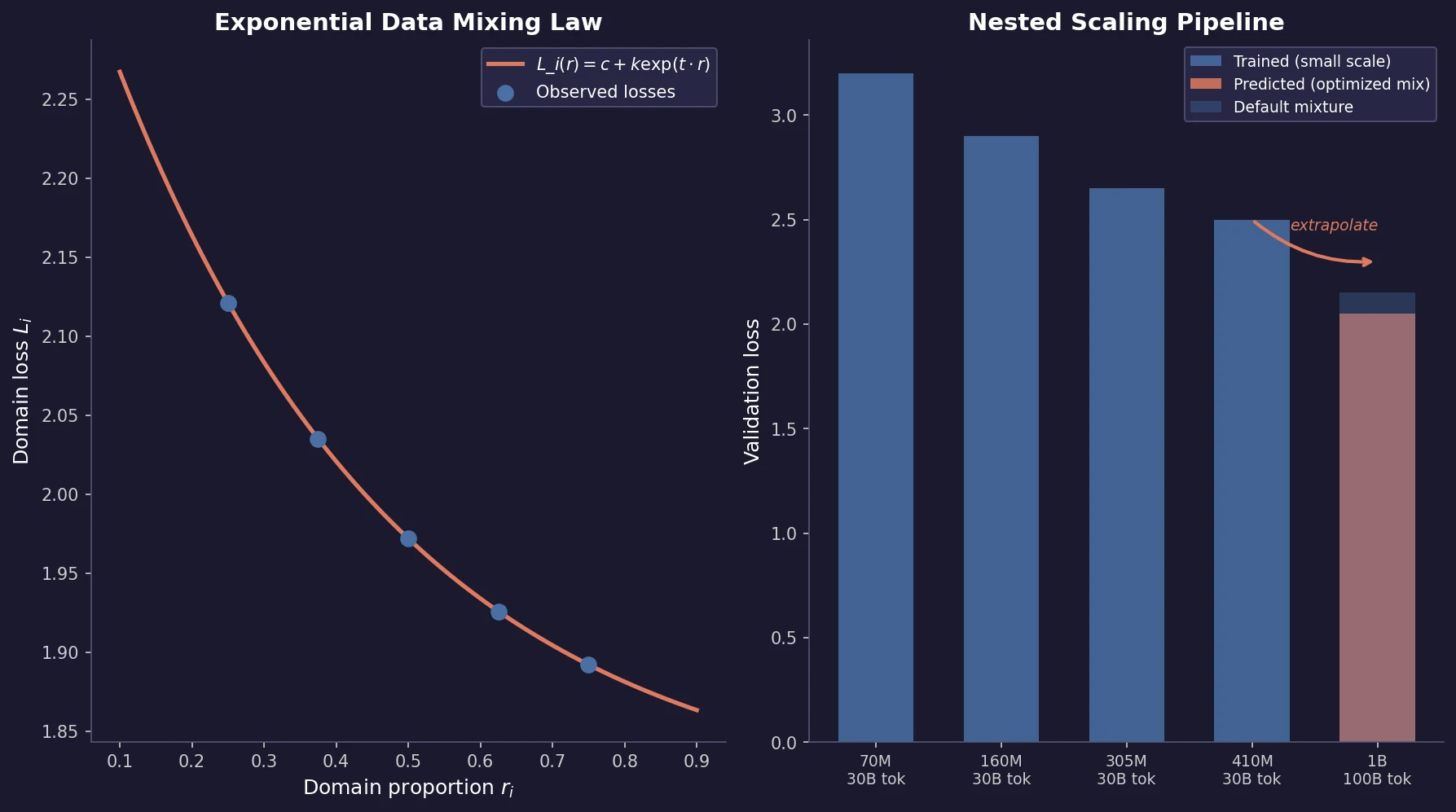
Diagram showing the three-step nested pipeline from small-scale training to large-model loss prediction across data mixtures

Data Mixing Laws for LM Pretraining Optimization

Ye et al. find that language model loss on each domain follows an exponential function of training mixture proportions. By nesting data mixing laws with scaling laws for steps and model size, small-scale experiments can predict and optimize mixtures for large models, achieving 48% training efficiency gains.

Natural Language Processing
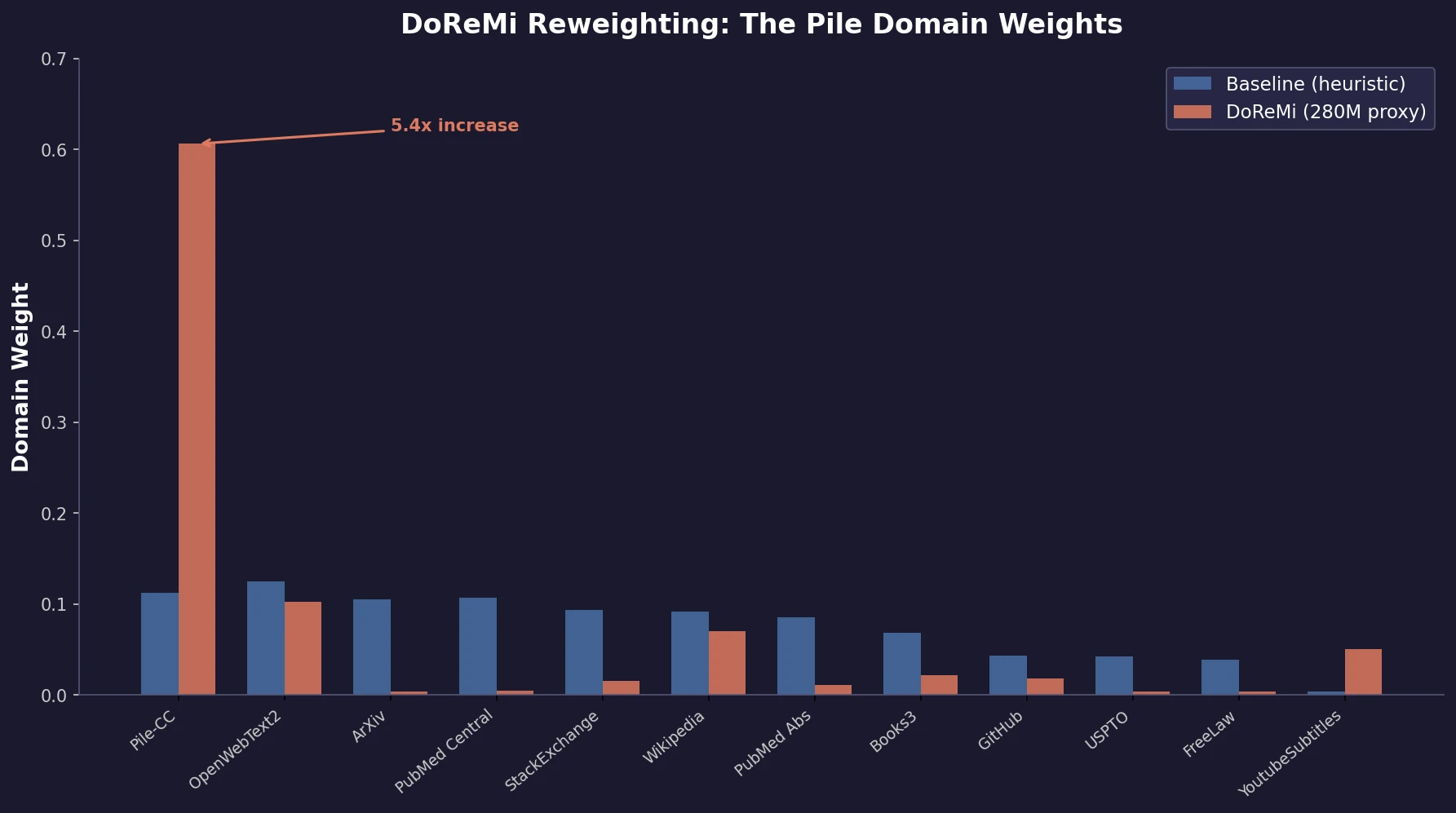
Bar chart comparing baseline and DoReMi domain weights across 12 Pile domains, showing Pile-CC upweighted 5.4x

DoReMi: Optimizing Data Mixtures for LM Pretraining

Xie et al. propose DoReMi, which trains a 280M proxy model using Group DRO to find optimal domain mixture weights, then uses those weights to train an 8B model 2.6x faster with 6.5% better downstream accuracy.

Natural Language Processing
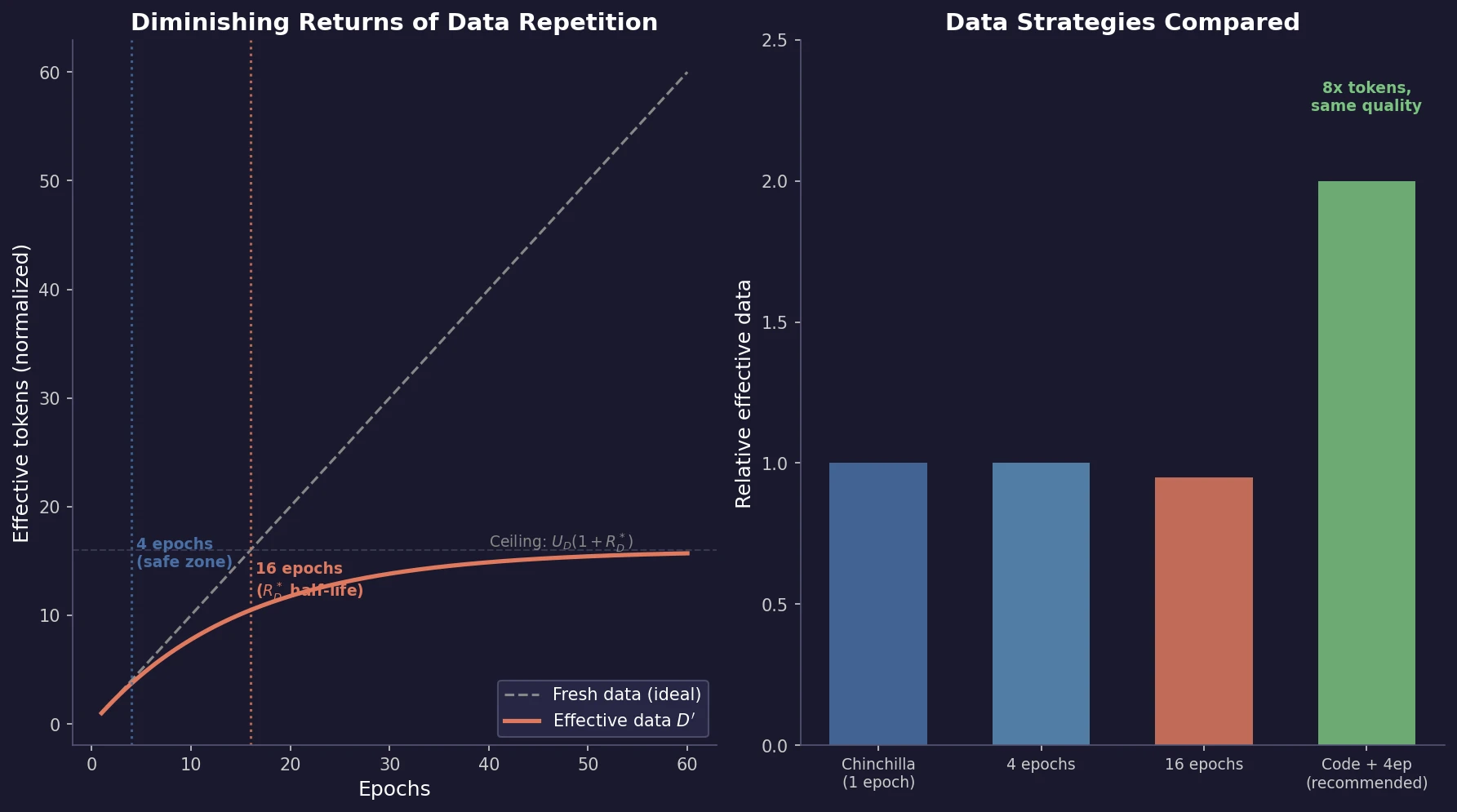
Chart showing effective data as a function of epochs with exponential decay, with the 4-epoch safe zone and 16-epoch half-life marked

Scaling Data-Constrained Language Models

Muennighoff et al. train 400+ models to study how data repetition affects scaling. They propose a data-constrained scaling law with exponential decay for repeated tokens, finding that up to 4 epochs have negligible impact on loss, returns diminish around 16 epochs, and code augmentation provides a 2x effective data boost.

Natural Language Processing
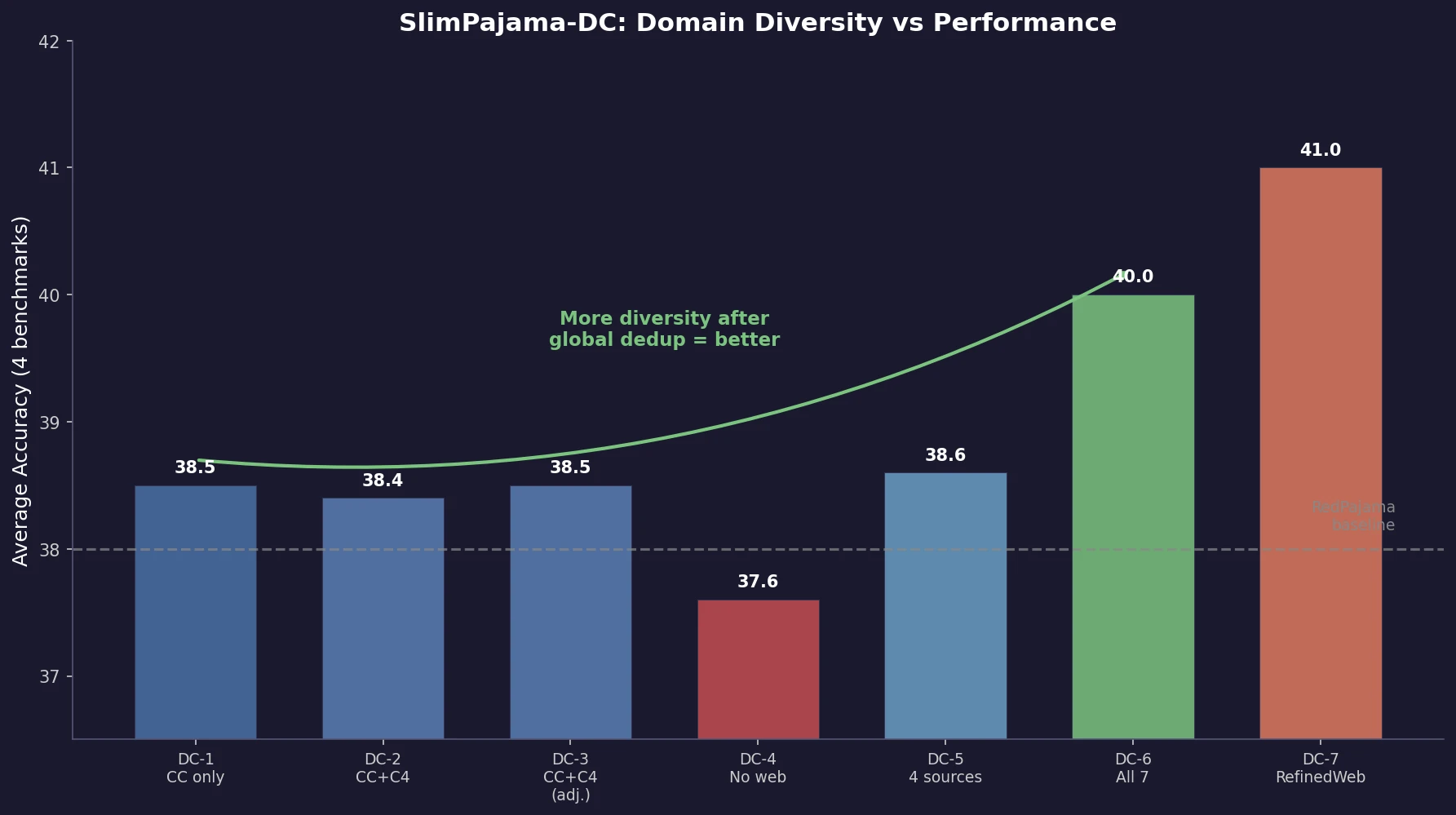
Bar chart comparing average benchmark accuracy across seven domain combination configurations showing diversity improves performance

SlimPajama-DC: Data Combinations for LLM Training

Shen et al. empirically analyze how different domain combinations and deduplication strategies in the SlimPajama dataset affect 1.3B model performance. Global deduplication across sources outperforms local deduplication, and increasing domain diversity consistently improves average accuracy, with findings transferring to 7B scale.

Natural Language Processing
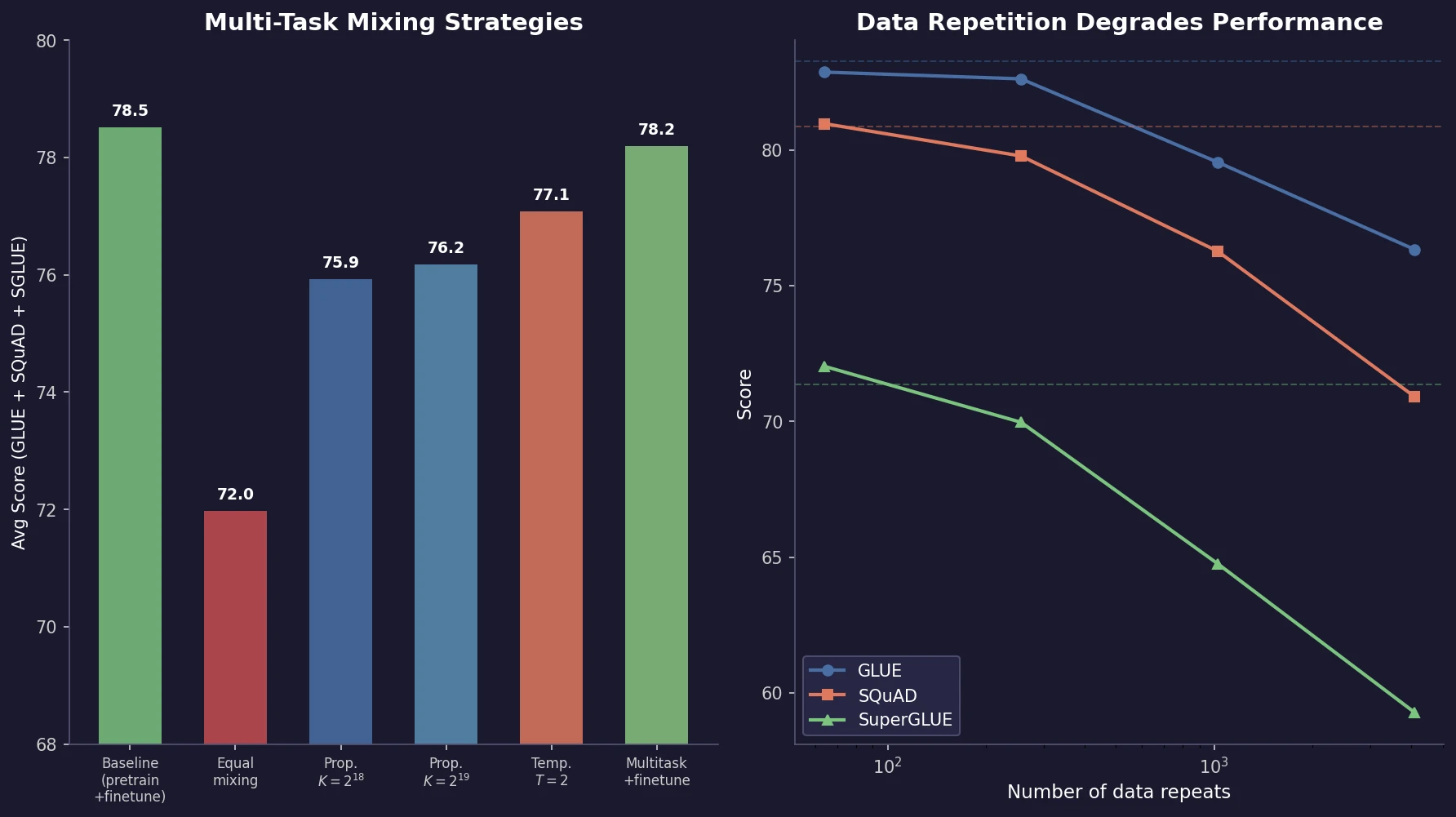
Table comparing multi-task mixing strategies showing examples-proportional and temperature-scaled mixing results

T5: Exploring Transfer Learning Limits

Raffel et al. introduce T5, a unified text-to-text framework for NLP transfer learning. Through systematic ablation of architectures, pre-training objectives, datasets, and multi-task mixing strategies, they identify best practices and scale to 11B parameters, achieving state-of-the-art results across multiple benchmarks.

Computational Chemistry
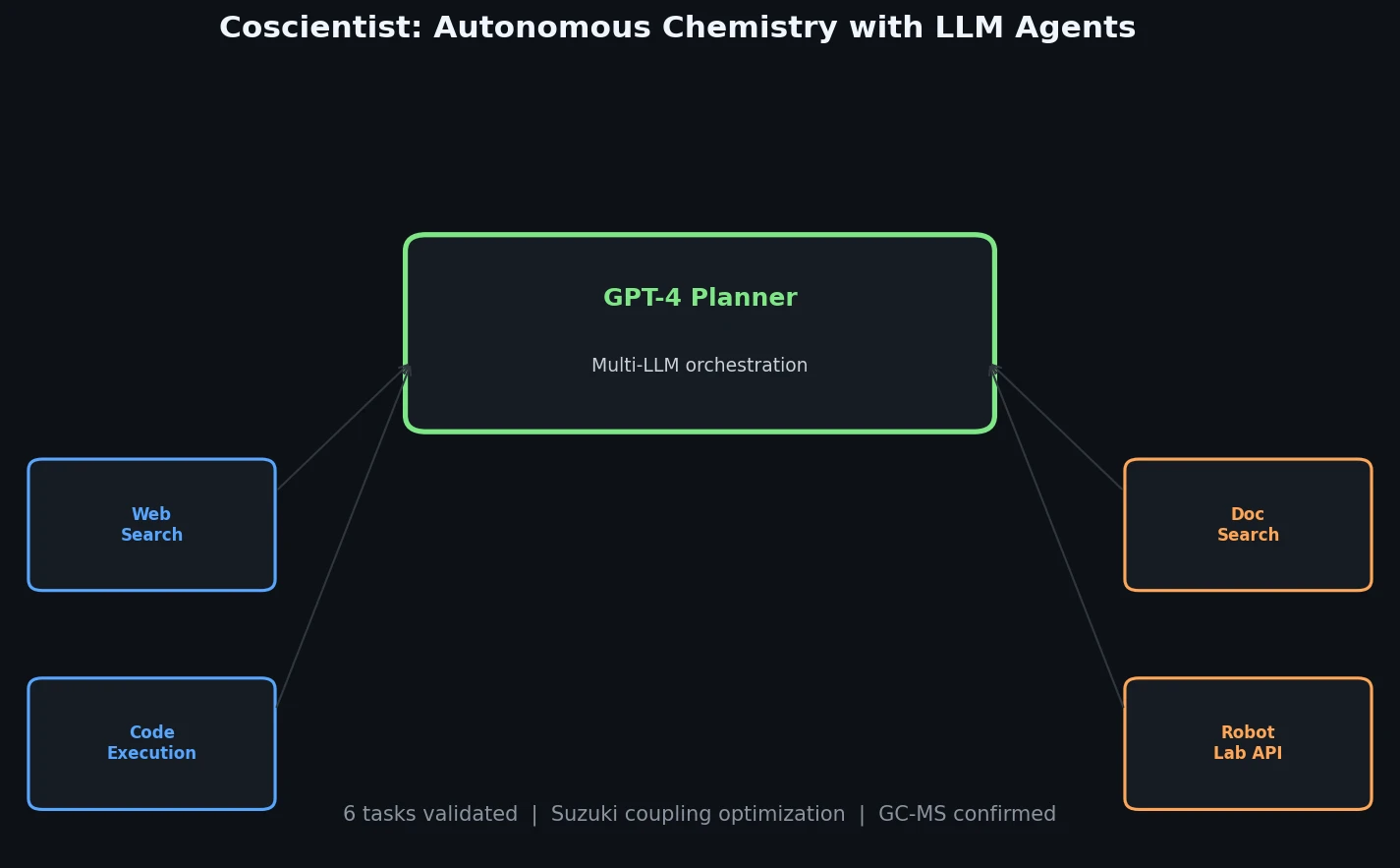
Coscientist architecture with GPT-4 planner orchestrating web search, code execution, document search, and robot lab API modules

Coscientist: Autonomous Chemistry with LLM Agents

Introduces Coscientist, a GPT-4-driven AI system that autonomously designs and executes chemical experiments using web search, code execution, and robotic lab automation.

Molecular Generation
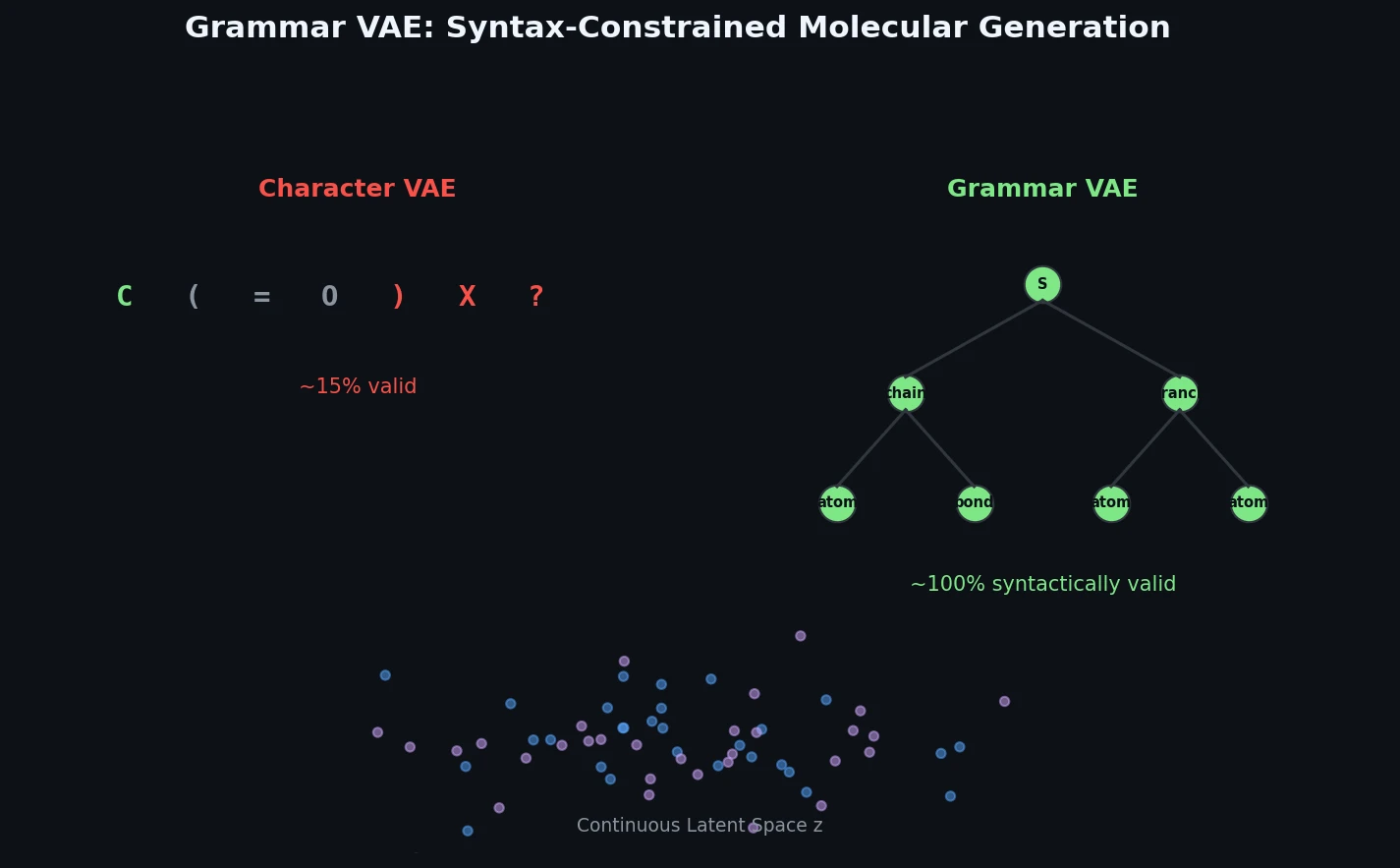
Diagram comparing character-level VAE with low validity to Grammar VAE using parse tree constraints for molecular generation

Grammar VAE: Generating Valid Molecules via CFGs

The Grammar VAE replaces character-level decoding with context-free grammar production rules, using a stack-based masking mechanism to guarantee that all generated SMILES strings are syntactically valid. Applied to molecular optimization and symbolic regression, it learns smoother latent spaces and finds better molecules than character-level baselines.

Molecular Generation
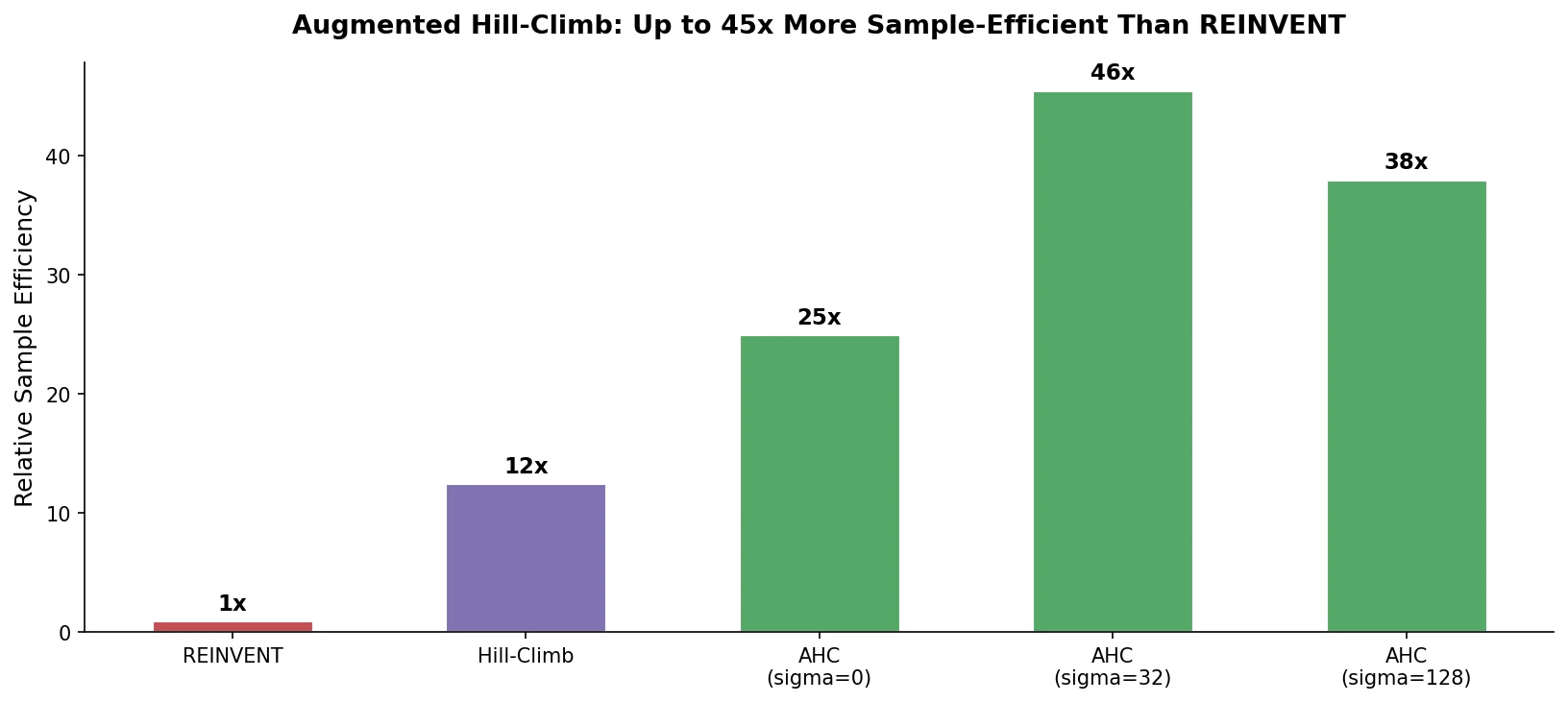
Bar chart showing Augmented Hill-Climb achieves up to 45x sample efficiency over REINVENT

Augmented Hill-Climb for RL-Based Molecule Design

Proposes Augmented Hill-Climb, a hybrid RL strategy for SMILES-based generative models that improves sample efficiency ~45-fold over REINVENT by filtering low-scoring molecules from the loss computation, with diversity filters to prevent mode collapse.

Molecular Generation
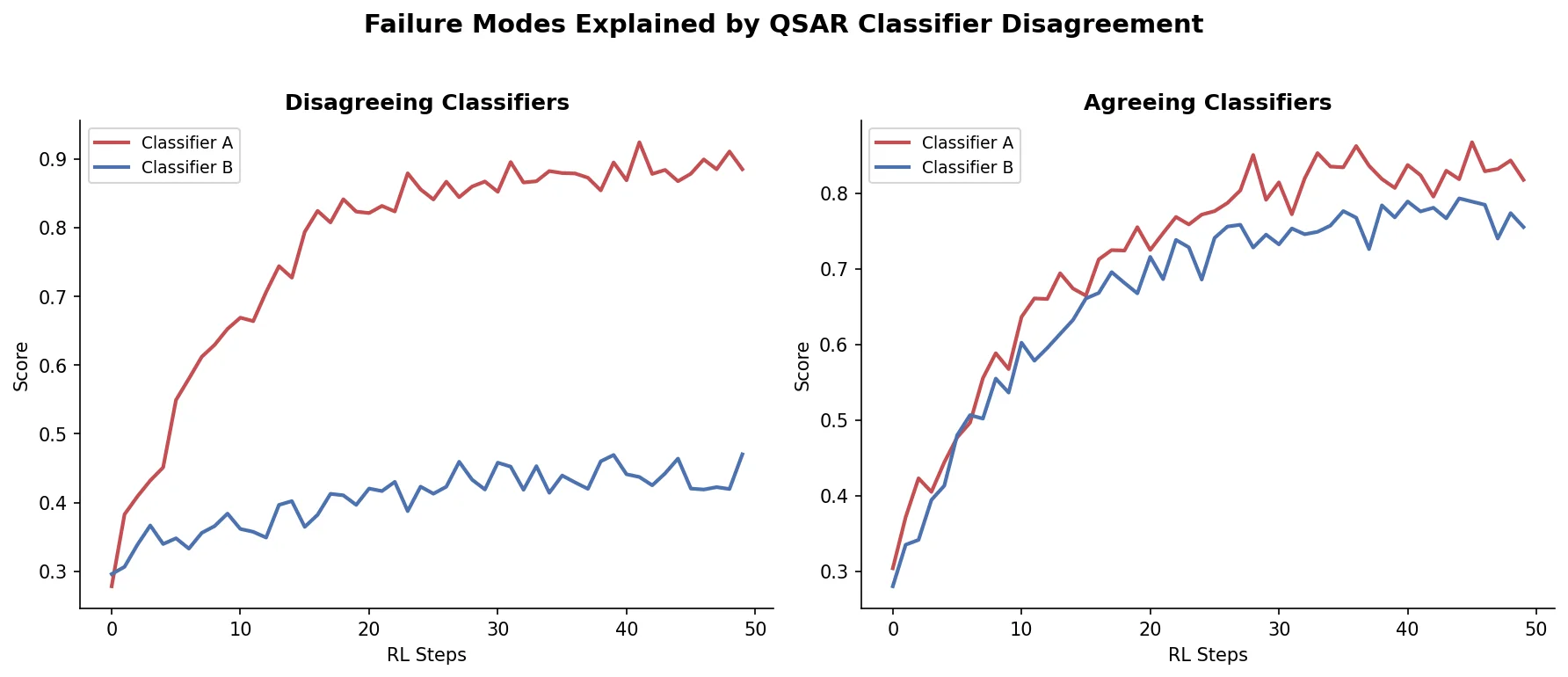
Two-panel plot showing score divergence with disagreeing classifiers vs convergence with agreeing classifiers

Avoiding Failure Modes in Goal-Directed Generation

Shows that divergence between optimization and control scores during goal-directed molecular generation is explained by pre-existing disagreement among QSAR models on the training distribution, not by algorithmic exploitation of model-specific biases.

Molecular Generation
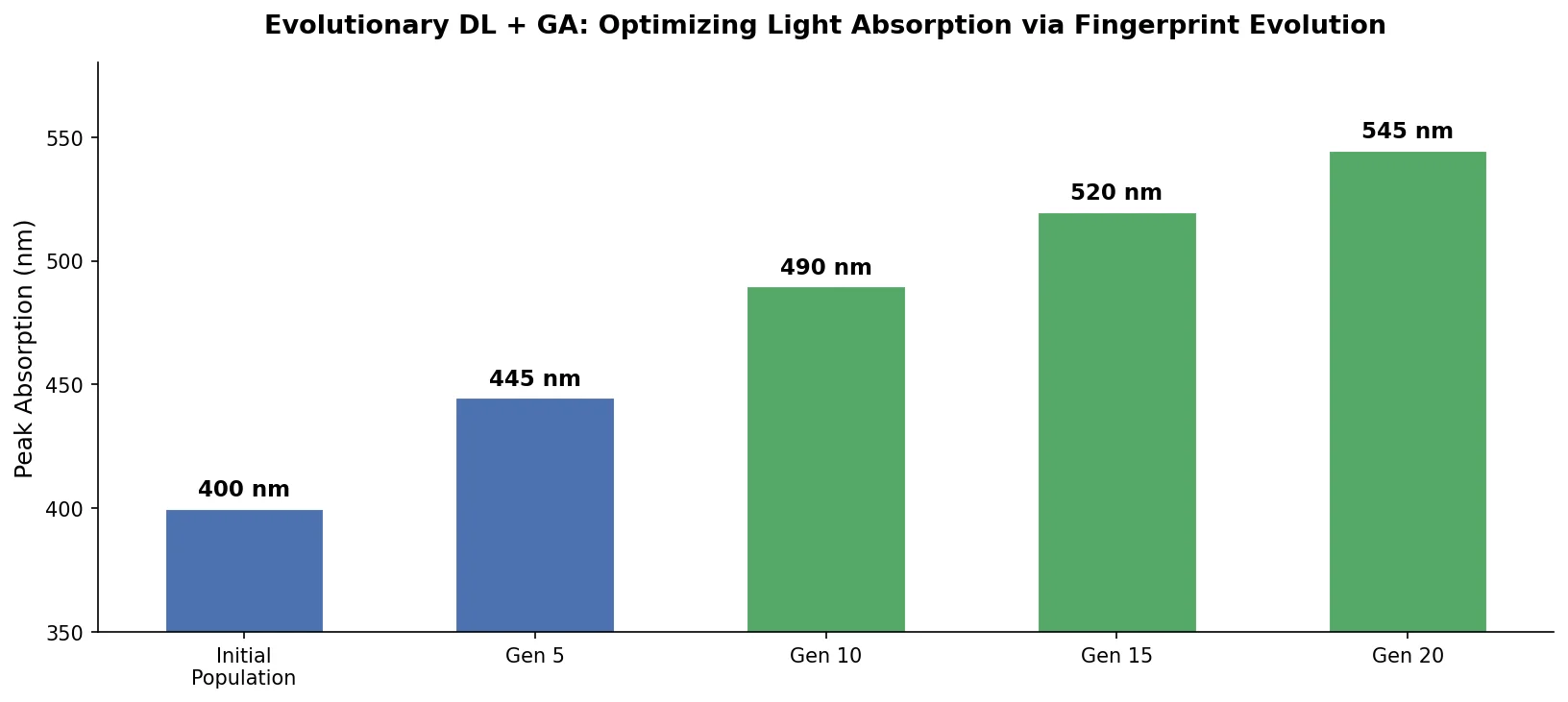
Bar chart showing peak absorption wavelength increasing across evolutionary generations

Evolutionary Molecular Design via Deep Learning + GA

An evolutionary molecular design framework that evolves ECFP fingerprint vectors using a genetic algorithm, reconstructs valid SMILES via an RNN decoder, and evaluates fitness with a DNN property predictor.