Molecular Generation
Distribution plot showing original QM9 logP shifted toward +6 and -6 targets via gradient-based dreaming

PASITHEA: Gradient-Based Molecular Design via Dreaming

PASITHEA adapts deep dreaming from computer vision to molecular design, directly optimizing SELFIES-encoded molecules for target chemical properties via gradient-based inversion of a trained regression network.

Molecular Generation
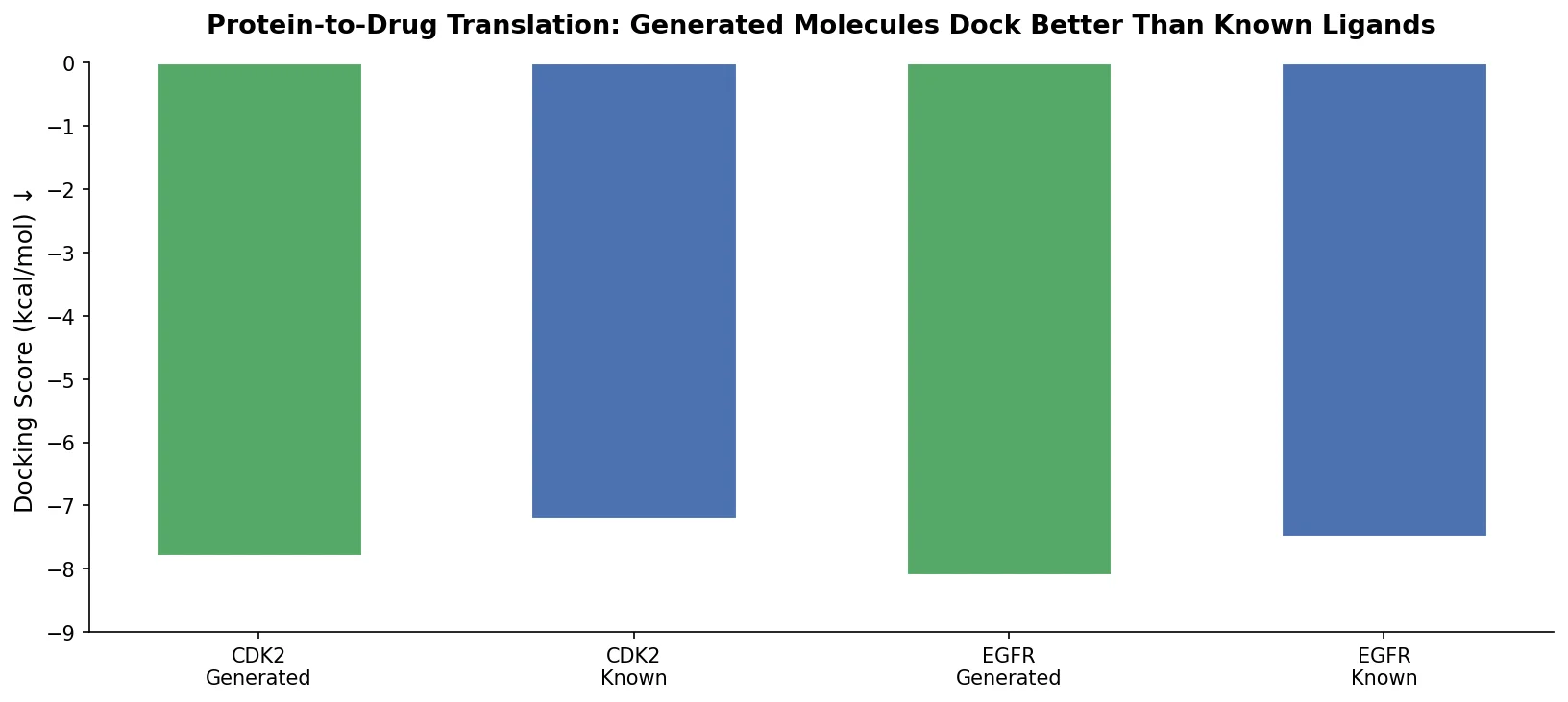
Bar chart comparing docking scores of generated vs known ligands for CDK2 and EGFR targets

Protein-to-Drug Molecule Translation via Transformer

Applies the Transformer architecture to generate drug-like molecules conditioned on protein amino acid sequences, treating target-specific de novo drug design as a sequence-to-sequence translation problem.
Molecular Representations
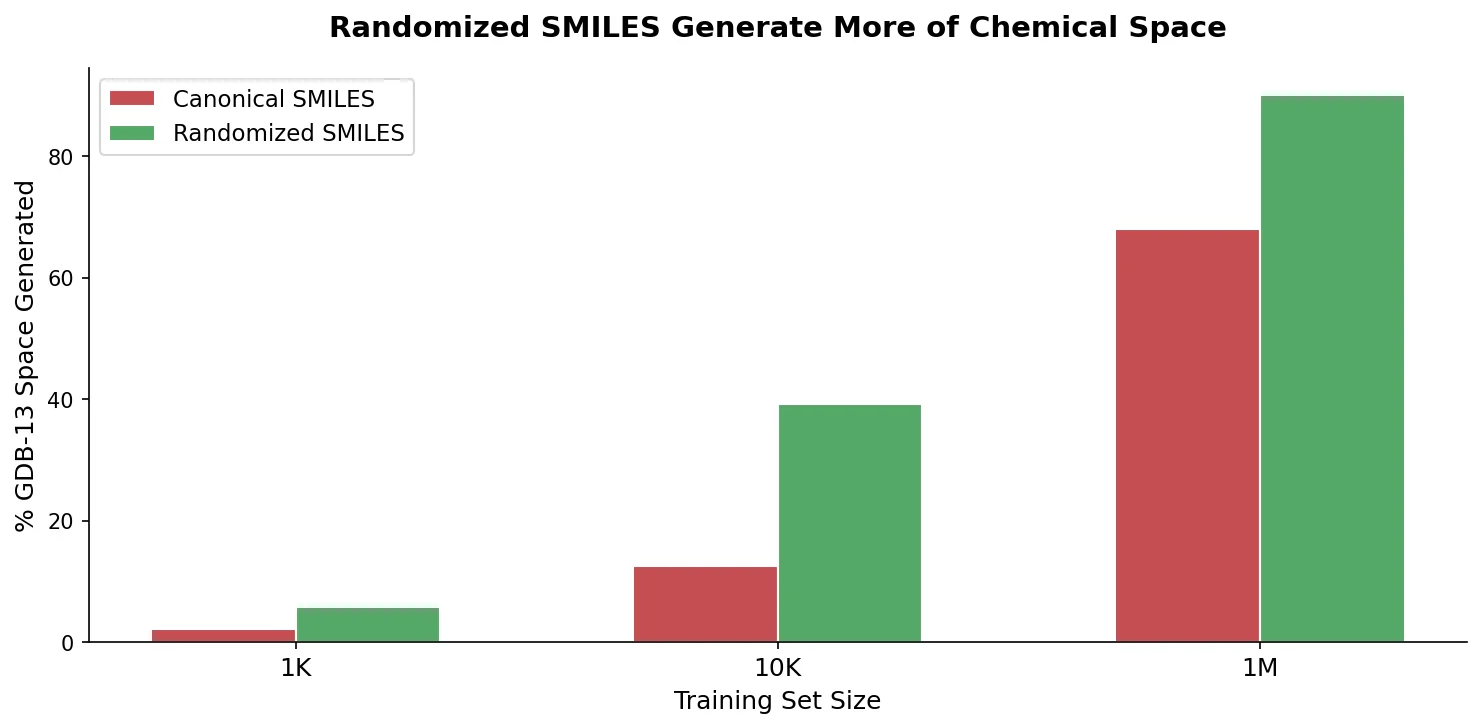
Bar chart showing randomized SMILES generate more of GDB-13 chemical space than canonical SMILES across training set sizes

Randomized SMILES Improve Molecular Generative Models

An extensive benchmark showing that training RNN generative models with randomized (non-canonical) SMILES strings yields more uniform, complete, and closed molecular output domains than canonical SMILES.

Molecular Generation
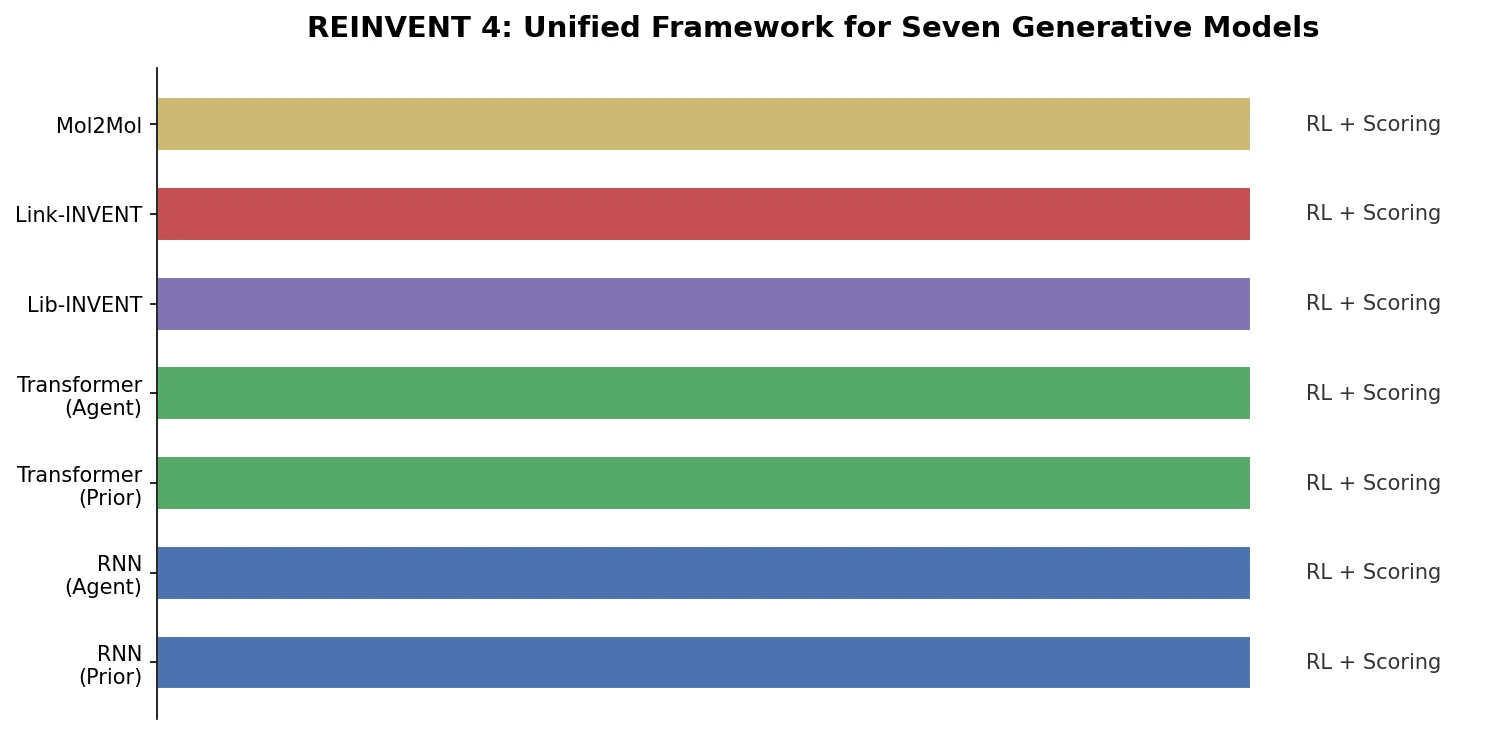
Horizontal bar chart showing REINVENT 4 unified framework supporting seven generative model types

REINVENT 4: Open-Source Generative Molecule Design

Overview of REINVENT 4, an open-source generative molecular design framework from AstraZeneca that unifies RNN and transformer generators within reinforcement learning, transfer learning, and curriculum learning optimization algorithms.

Molecular Generation
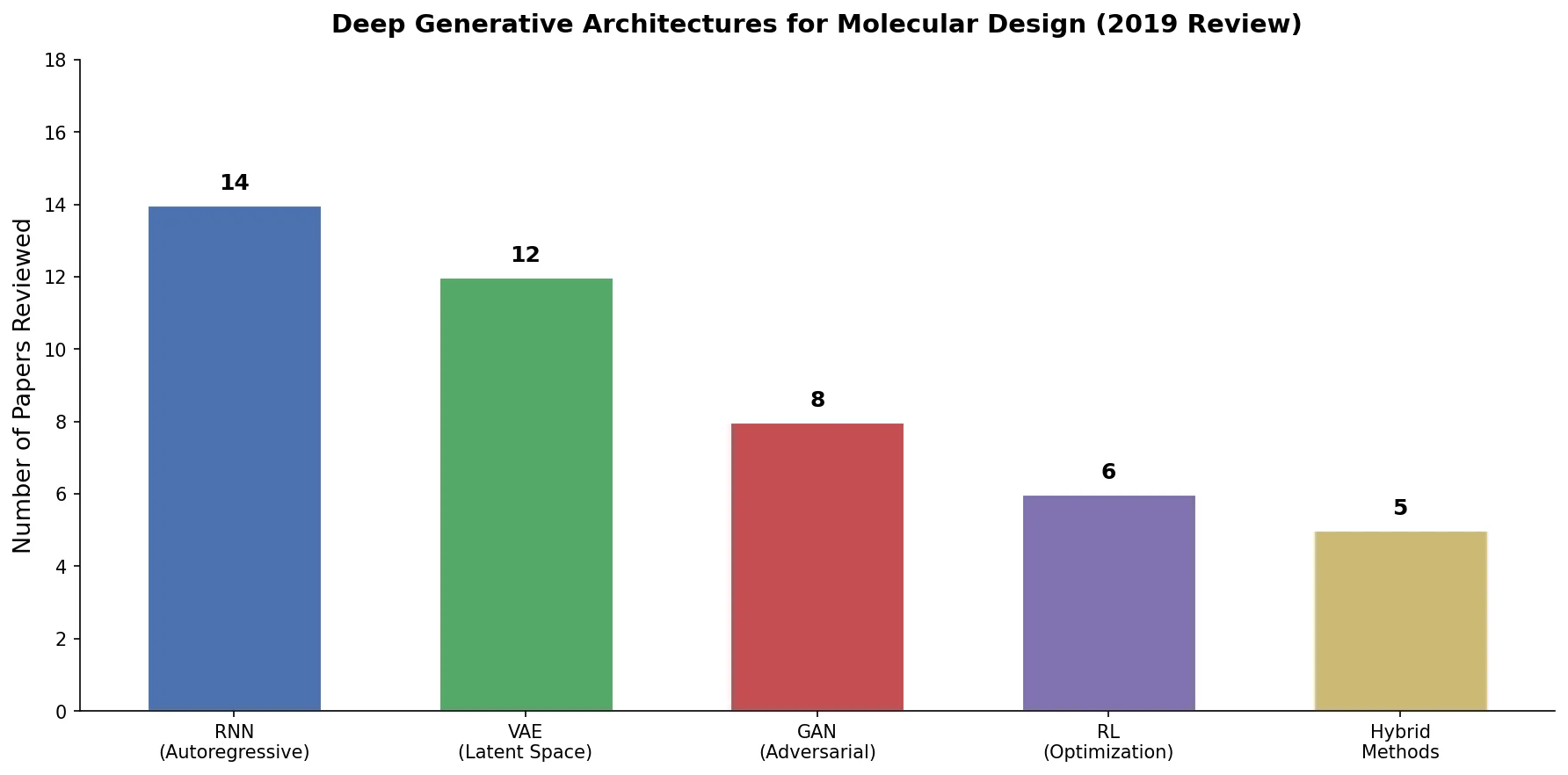
Bar chart showing deep generative architecture types for molecular design: RNN, VAE, GAN, RL, and hybrid methods

Review: Deep Learning for Molecular Design (2019)

An early and influential review cataloging 45 papers on deep generative modeling for molecules, comparing RNN, VAE, GAN, and reinforcement learning architectures across SMILES and graph-based representations.

Molecular Generation
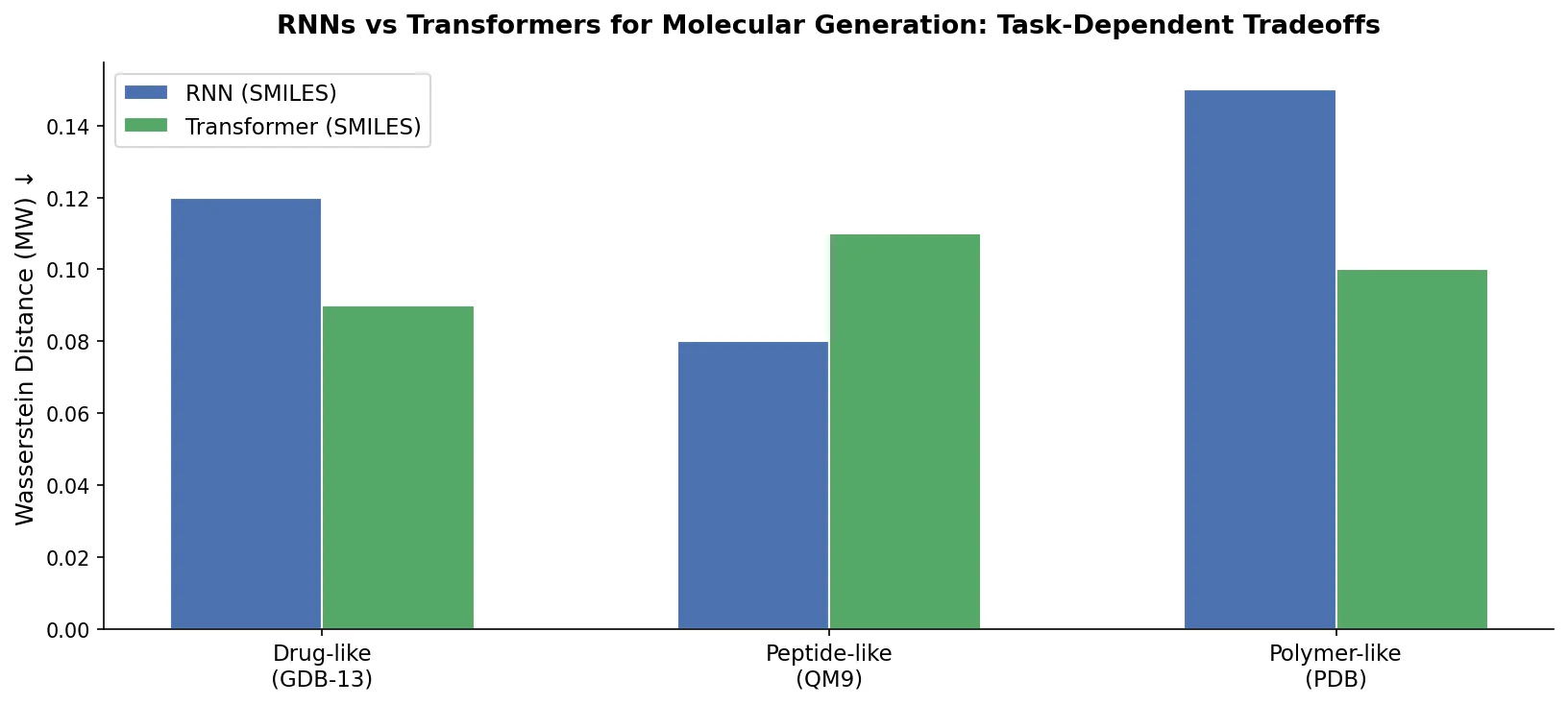
Bar chart comparing RNN and Transformer Wasserstein distances across drug-like, peptide-like, and polymer-like generation tasks

RNNs vs Transformers for Molecular Generation Tasks

Compares RNN-based and Transformer-based chemical language models across three molecular generation tasks of increasing complexity, finding that RNNs excel at local features while Transformers handle large molecules better.

Molecular Generation
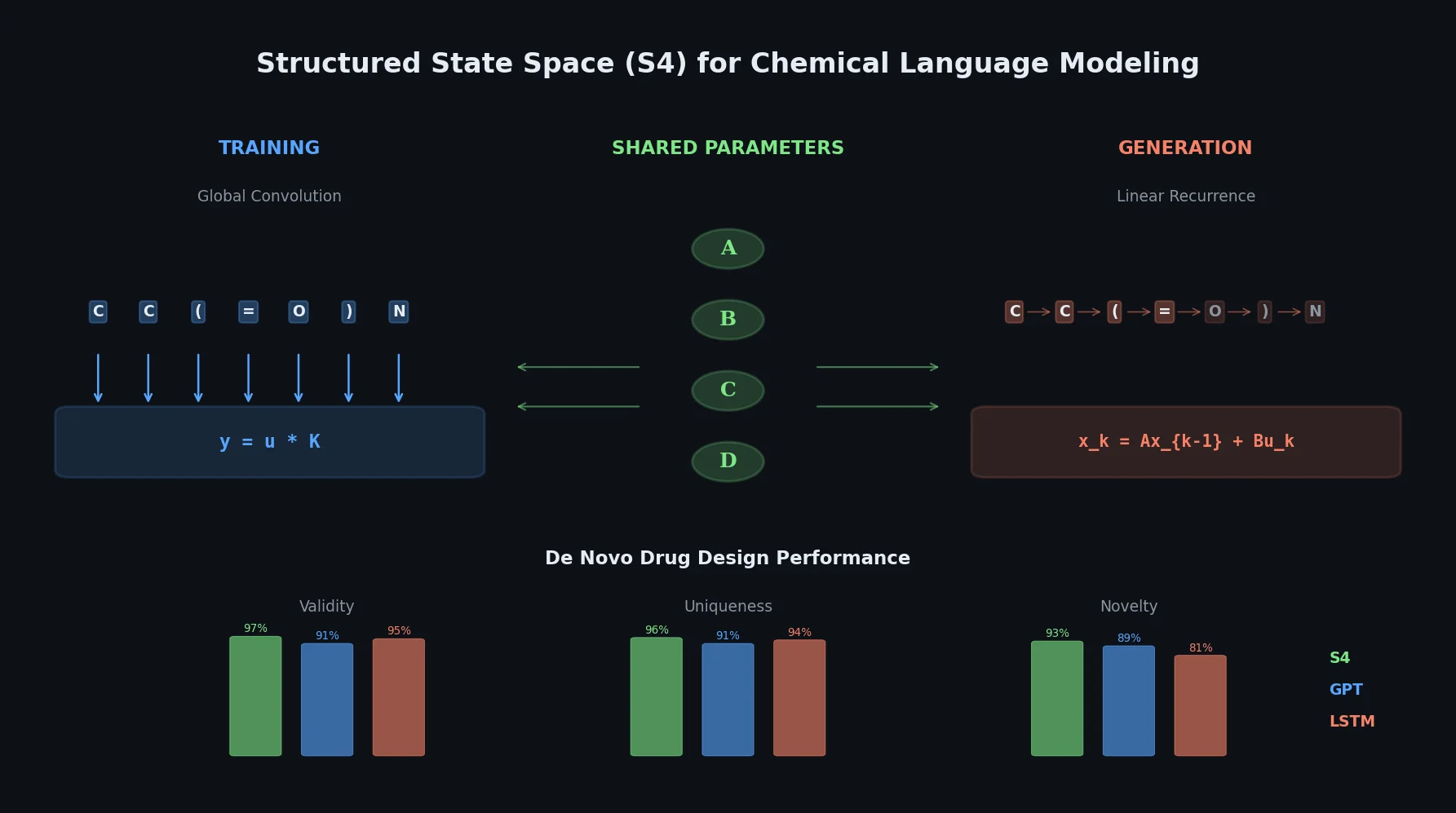
Diagram showing the dual formulation of S4 models with convolution during training and recurrence during generation for SMILES-based molecular design

S4 Structured State Space Models for De Novo Drug Design

This paper introduces structured state space sequence (S4) models to chemical language modeling, showing they combine the strengths of LSTMs (efficient recurrent generation) and GPTs (holistic sequence learning) for de novo molecular design.

Molecular Representations
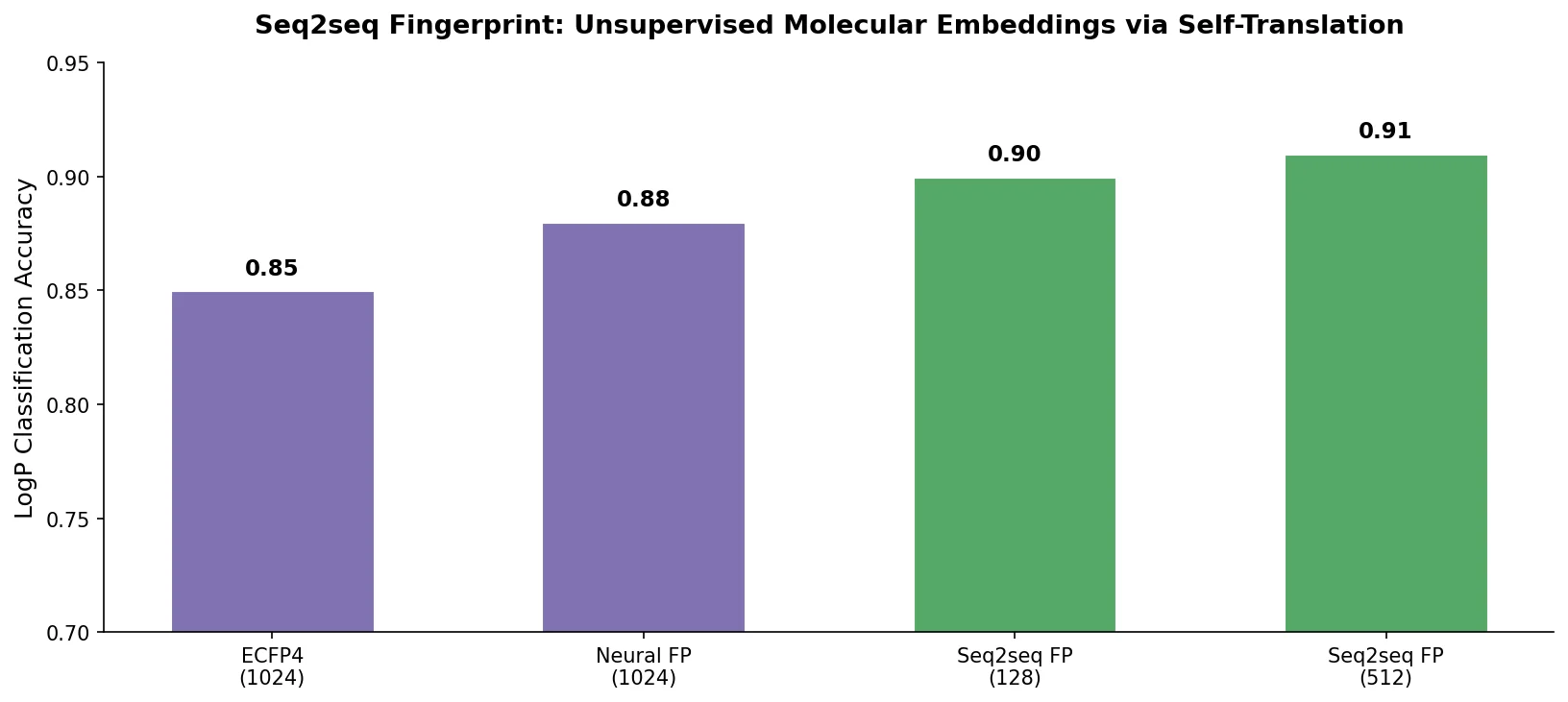
Diagram showing SMILES string flowing through encoder to fixed-length fingerprint vector and back through decoder

Seq2seq Fingerprint: Unsupervised Molecular Embedding

A GRU-based sequence-to-sequence model that learns fixed-length molecular fingerprints by translating SMILES strings to themselves, enabling unsupervised representation learning for drug discovery tasks.

Molecular Representations
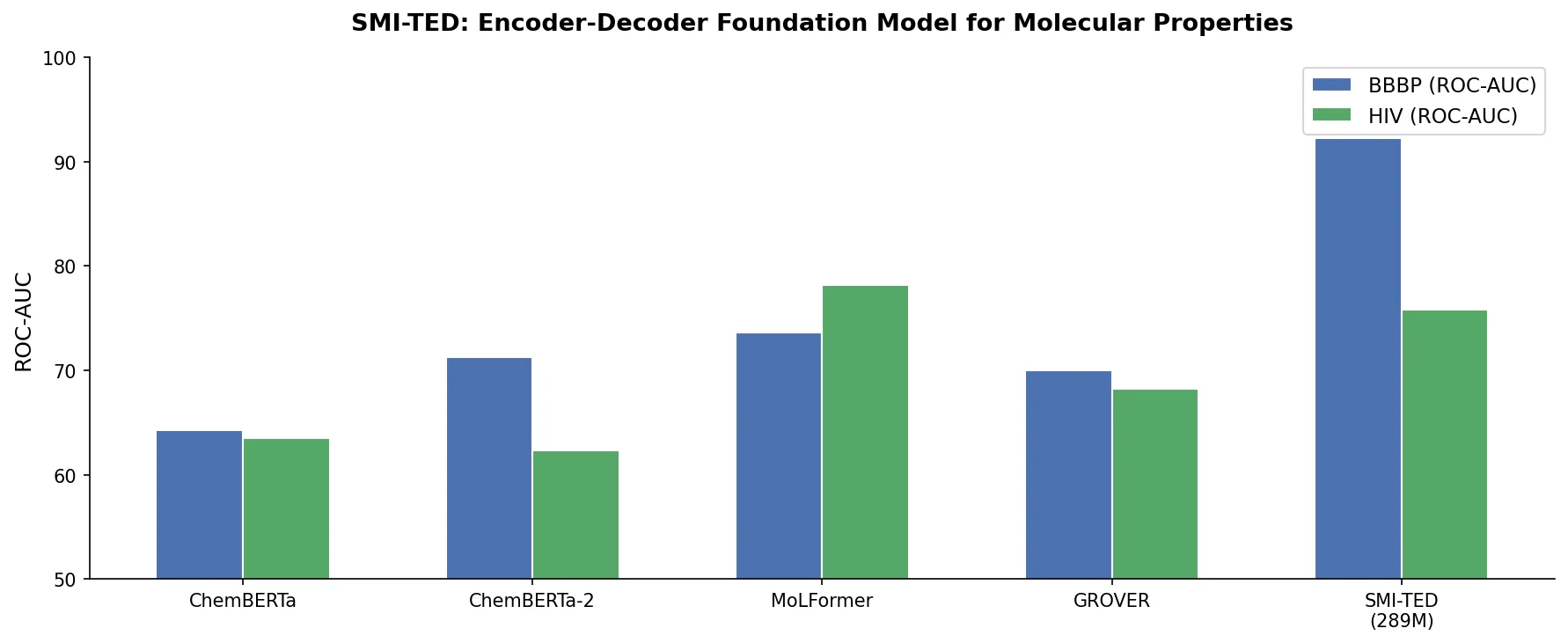
Bar chart comparing SMI-TED ROC-AUC scores against ChemBERTa, ChemBERTa-2, MoLFormer, and GROVER on BBBP and HIV

SMI-TED: Encoder-Decoder Foundation Models for Chemistry

SMI-TED introduces encoder-decoder chemical foundation models (289M parameters) pre-trained on 91 million PubChem molecules, achieving strong results across property prediction, reaction yield, and molecule generation benchmarks.

Molecular Representations
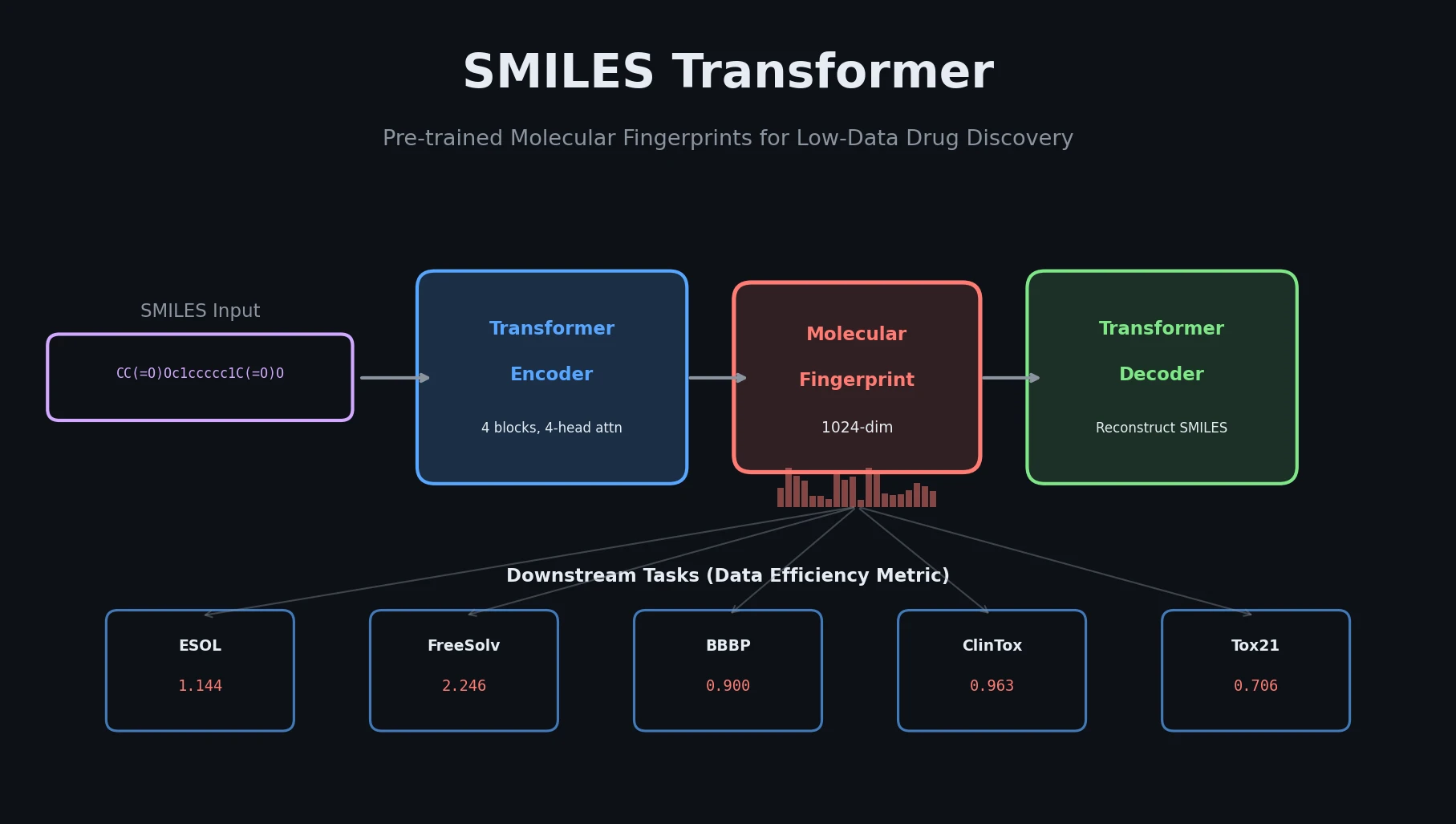
Diagram showing Transformer encoder-decoder architecture converting SMILES strings into molecular fingerprints

SMILES Transformer: Low-Data Molecular Fingerprints

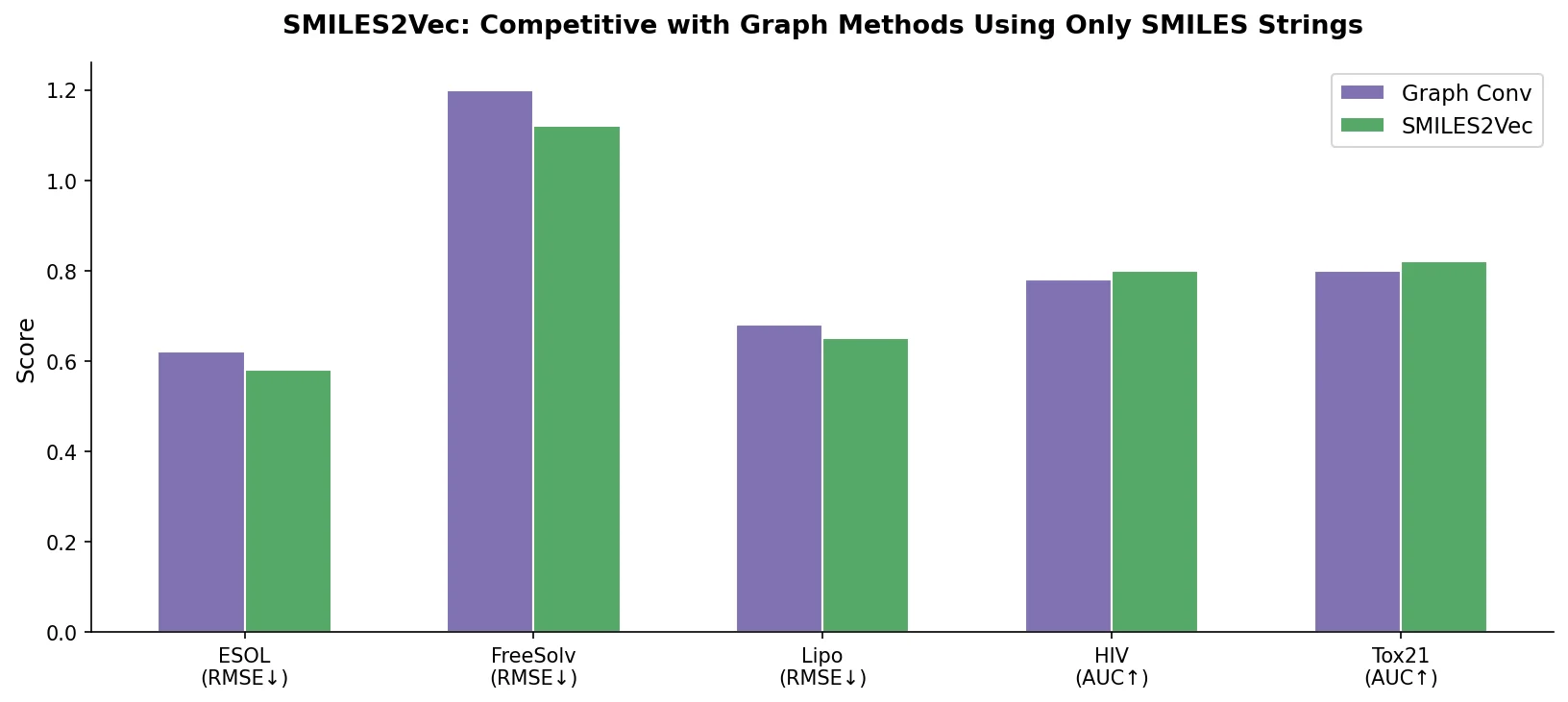
A Transformer-based encoder-decoder pre-trained on 861K SMILES from ChEMBL24 produces 1024-dimensional molecular fingerprints that outperform ECFP and graph convolutions on 5 of 10 MoleculeNet tasks in low-data settings.

Molecular Representations
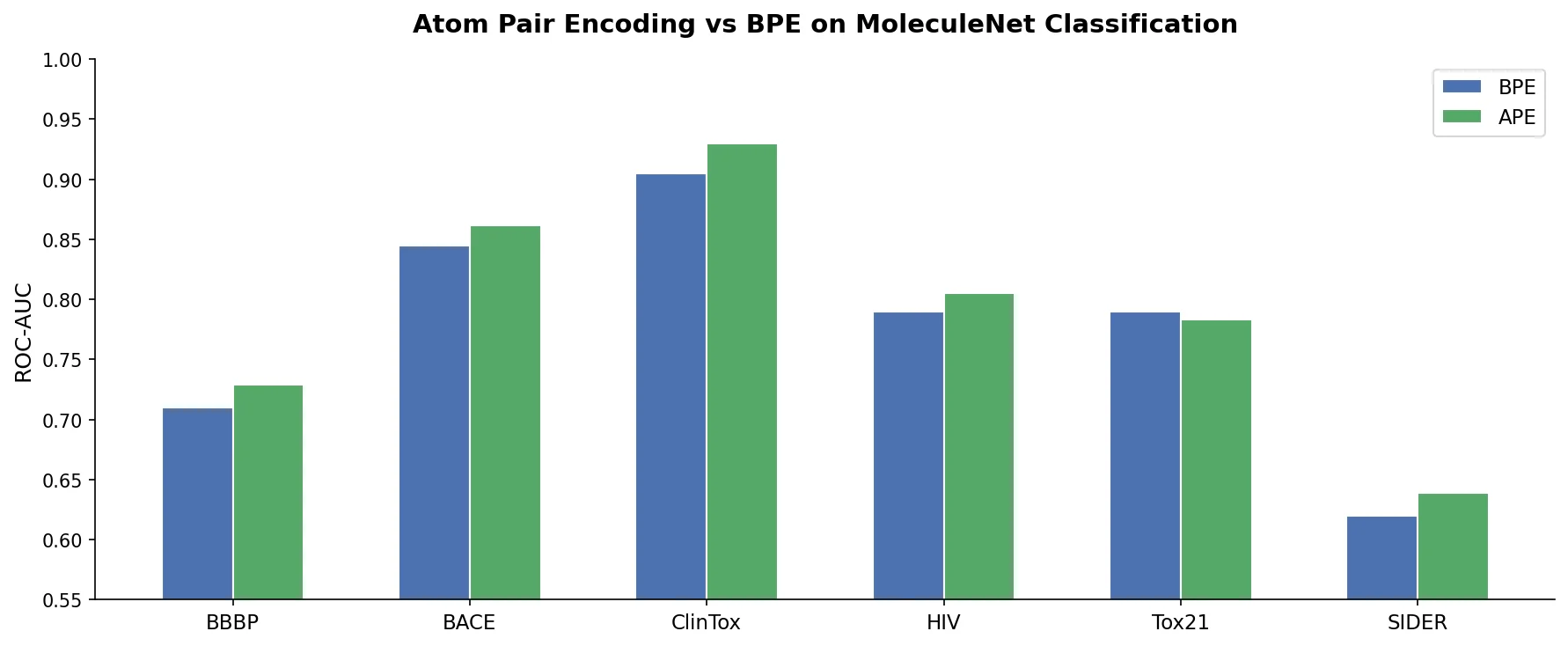
Bar chart comparing Atom Pair Encoding vs BPE tokenization on MoleculeNet classification tasks

SMILES vs SELFIES Tokenization for Chemical LMs

Introduces Atom Pair Encoding (APE), a chemistry-aware tokenizer for SMILES and SELFIES, and shows it consistently outperforms Byte Pair Encoding in RoBERTa-based molecular property classification on BBBP, HIV, and Tox21 benchmarks.

Molecular Representations
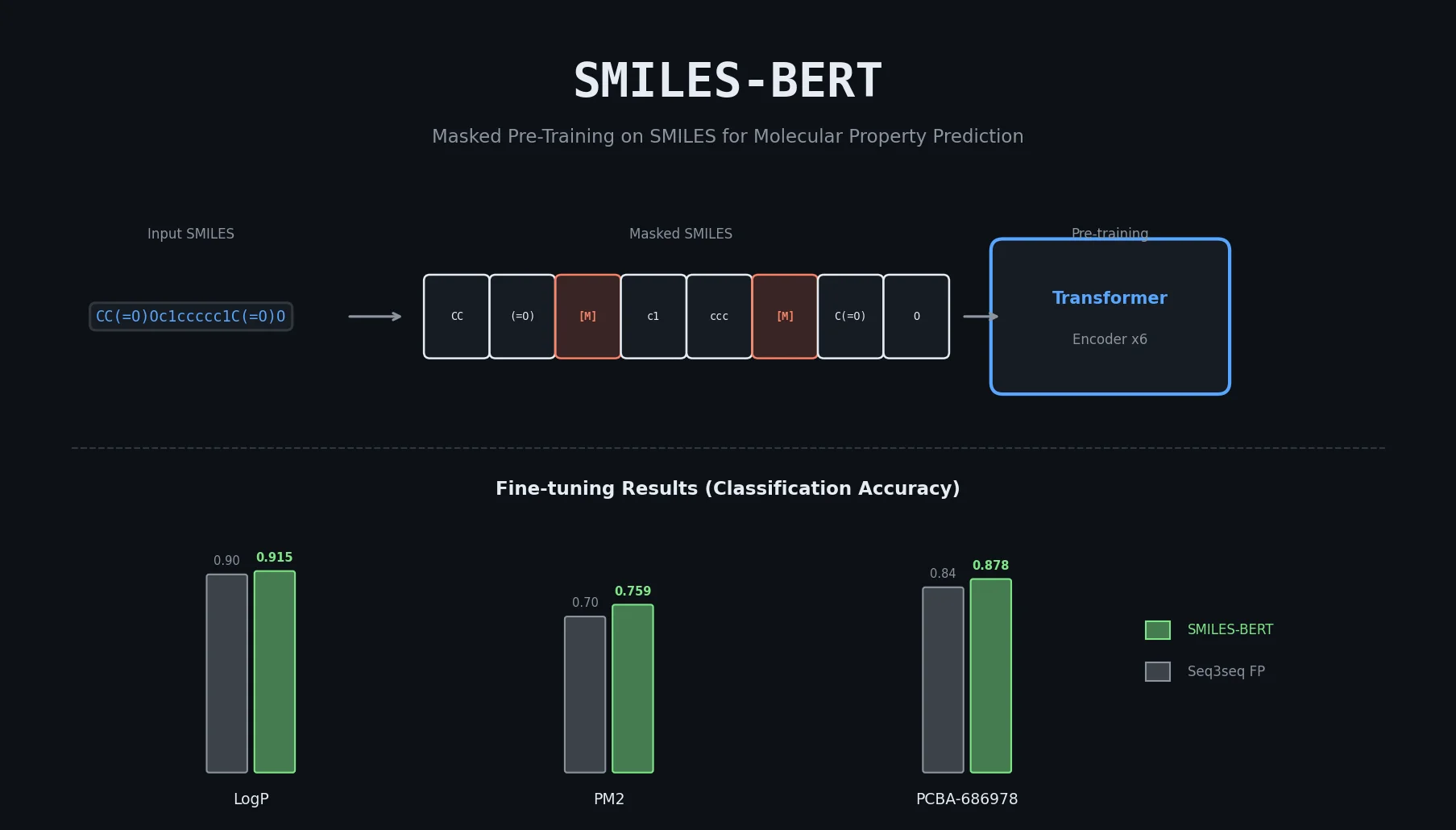
Bar chart comparing SMILES-BERT accuracy against baselines on HIV, LogP, and PCBA tasks

SMILES-BERT: BERT-Style Pre-Training for Molecules

SMILES-BERT pre-trains a Transformer encoder on 18M+ SMILES from ZINC using a masked recovery task, then fine-tunes for molecular property prediction, outperforming prior methods on three datasets.