Molecular Generation
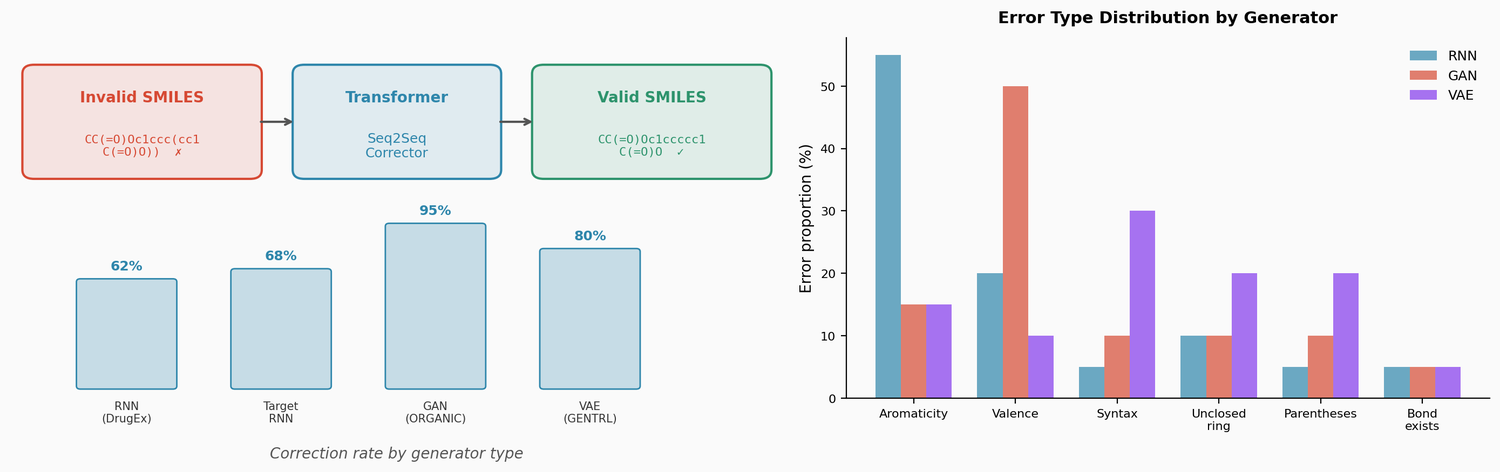
Diagram showing the UnCorrupt SMILES pipeline: invalid SMILES are corrected by a transformer seq2seq model into valid SMILES, with correction rates of 62-95% across generator types

UnCorrupt SMILES: Post Hoc Correction for De Novo Design

This paper trains a transformer model to correct invalid SMILES produced by de novo molecular generators (RNN, VAE, GAN). The corrector fixes 60-95% of invalid outputs, and the fixed molecules are comparable in novelty and similarity to valid generator outputs. The approach also enables local chemical space exploration by introducing and correcting errors in existing molecules.

Molecular Generation
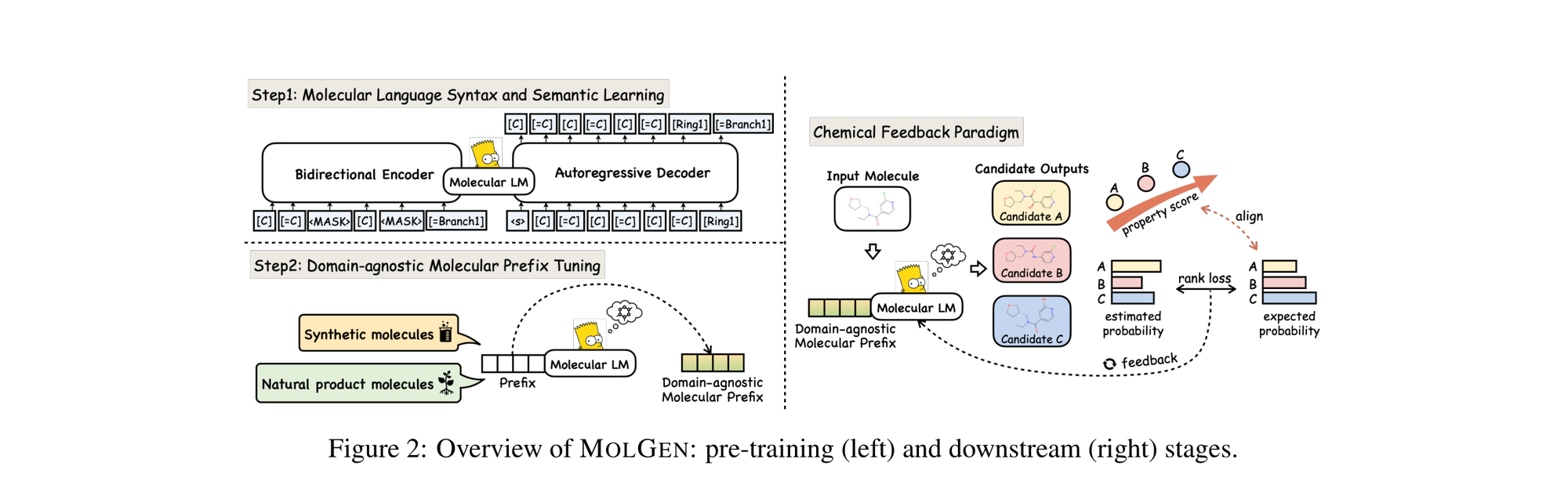
MolGen overview showing two-stage pre-training (molecular language syntax learning and domain-agnostic prefix tuning) and chemical feedback paradigm

MolGen: Molecular Generation with Chemical Feedback

MolGen pre-trains on 100M+ SELFIES molecules, introduces domain-agnostic prefix tuning for cross-domain transfer, and applies a chemical feedback paradigm to reduce molecular hallucinations.

Molecular Representations
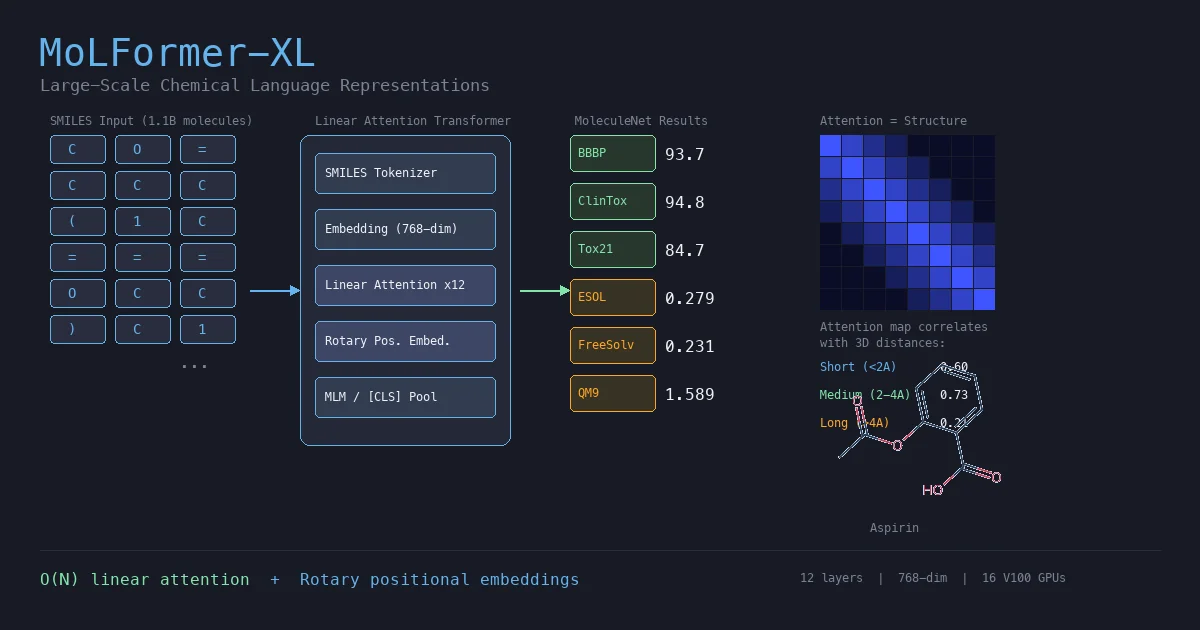
MoLFormer-XL architecture diagram showing SMILES tokens flowing through a linear attention transformer to MoleculeNet benchmark results and attention-structure correlation

MoLFormer: Large-Scale Chemical Language Representations

MoLFormer is a transformer encoder with linear attention and rotary positional embeddings, pretrained via masked language modeling on 1.1 billion molecules from PubChem and ZINC. MoLFormer-XL outperforms GNN baselines on most MoleculeNet classification and regression tasks, and attention analysis reveals that the model learns interatomic spatial relationships directly from SMILES strings.

Molecular Representations
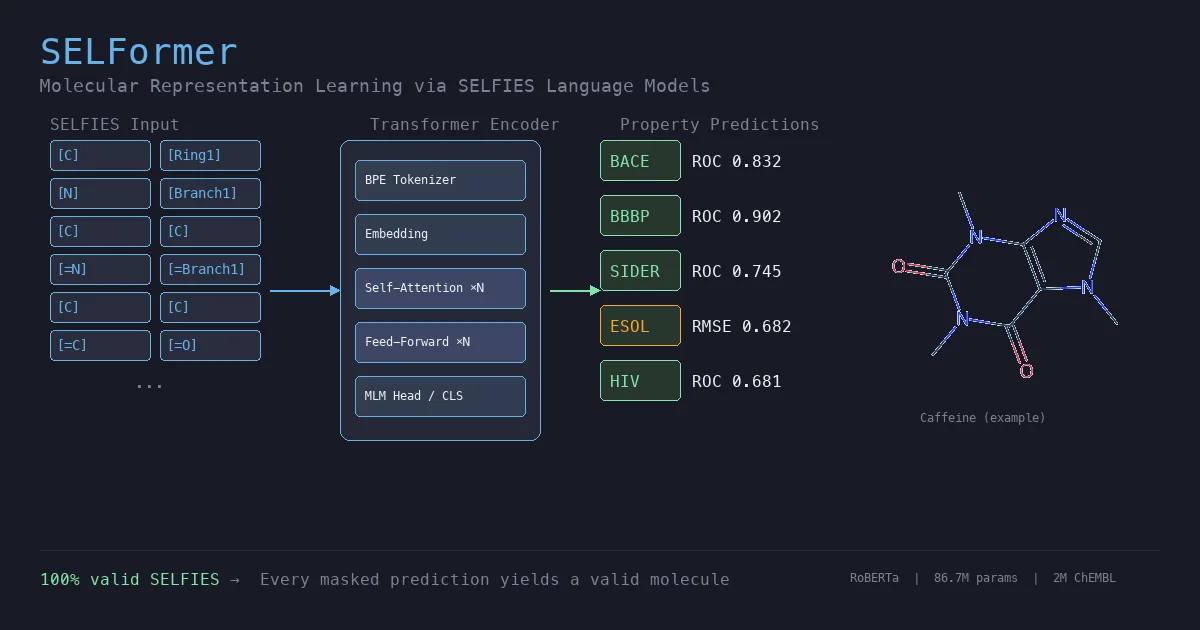
SELFormer architecture diagram showing SELFIES token input flowing through a RoBERTa transformer encoder to molecular property predictions

SELFormer: A SELFIES-Based Molecular Language Model

SELFormer is a transformer-based chemical language model that uses SELFIES instead of SMILES as input. Pretrained on 2M ChEMBL compounds via masked language modeling, it achieves strong classification performance on MoleculeNet tasks, outperforming ChemBERTa-2 by ~12% on average across BACE, BBBP, and HIV.

Optical Chemical Structure Recognition
Diagram showing graph traversal chain-of-thought parsing of a molecular structure image into atom and bond predictions

GTR-CoT: Graph Traversal Chain-of-Thought for Molecules

A 2025 Vision-Language Model for OCSR that uses graph traversal chain-of-thought reasoning and a two-stage SFT plus GRPO training scheme to handle both printed molecules (including chemical abbreviations like Ph and Et) and hand-drawn structures, achieving strong performance on the new MolRec-Bench benchmark.

Molecular Representations
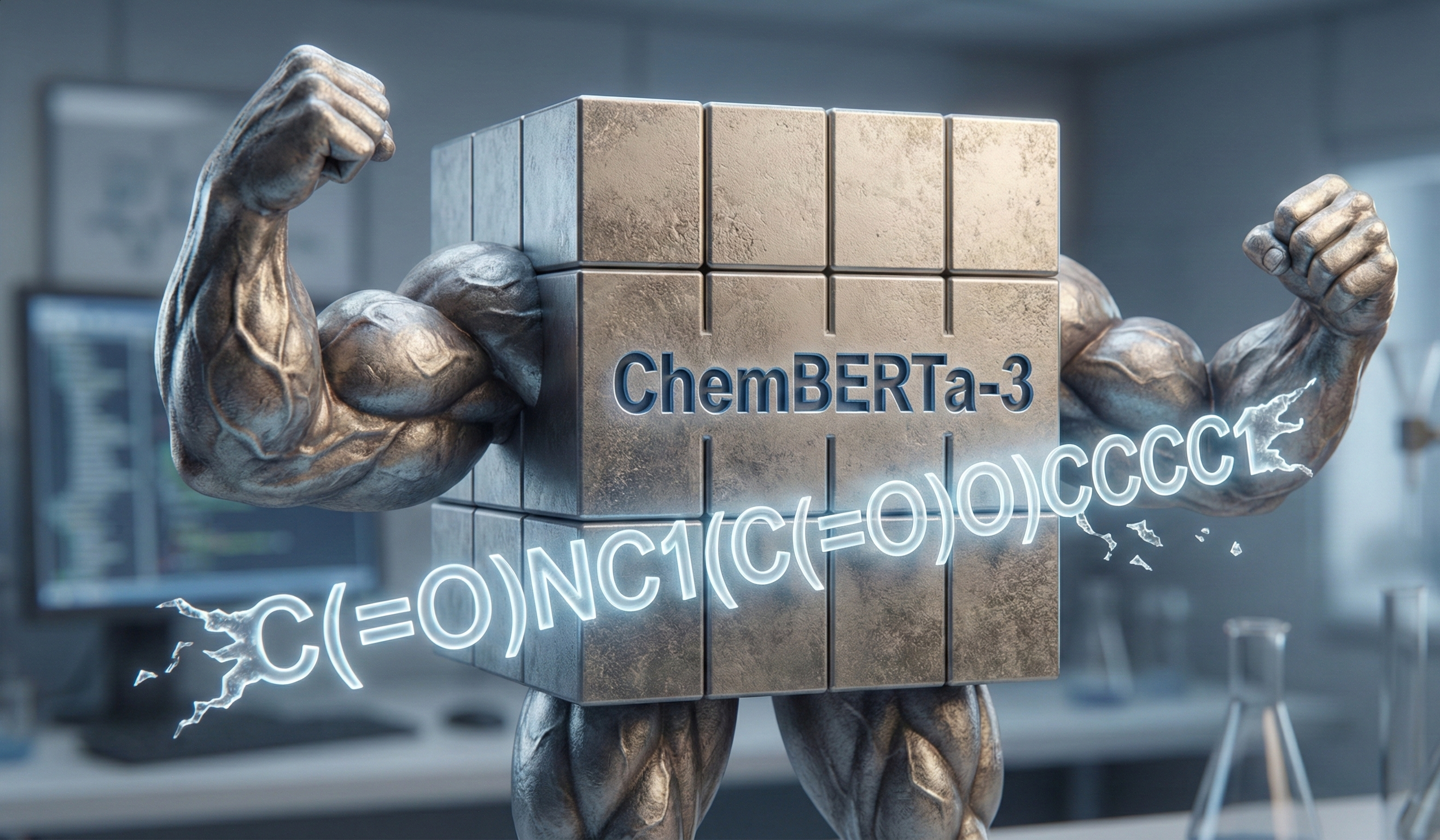
ChemBERTa-3 visualization showing muscular arms lifting a stack of building blocks representing molecular data with SMILES notation, symbolizing the power and scalability of the open-source training framework

ChemBERTa-3: Open Source Chemical Foundation Models

ChemBERTa-3 provides a unified, scalable infrastructure for pretraining and benchmarking chemical foundation models. It addresses reproducibility gaps in previous studies like MoLFormer through standardized scaffold splitting and open-source tooling.

Molecular Representations
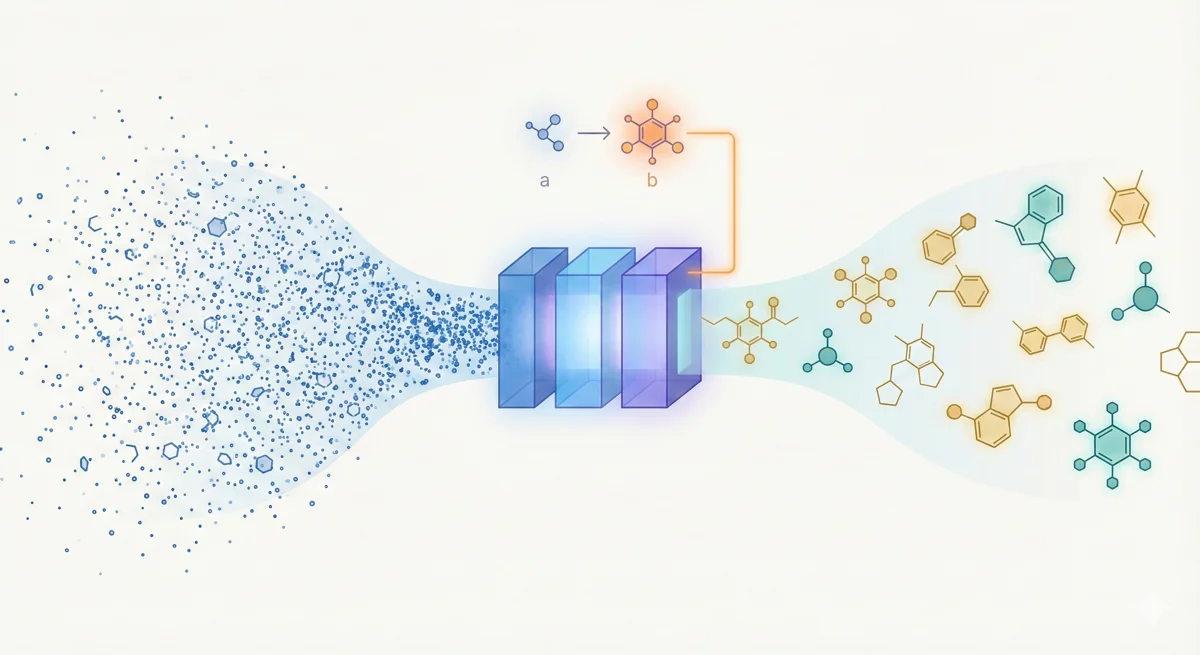
ChemBERTa-2 visualization showing flowing SMILES strings in blue tones representing molecular data streams

ChemBERTa-2: Scaling Molecular Transformers to 77M

This work investigates the scaling hypothesis for molecular transformers, training RoBERTa models on 77M SMILES from PubChem. It compares Masked Language Modeling (MLM) against Multi-Task Regression (MTR) pretraining, finding that MTR yields better downstream performance but is computationally heavier.

Molecular Generation
GP-MoLFormer architecture showing large-scale SMILES input, linear-attention transformer decoder, and property optimization via pair-tuning soft prompts

GP-MoLFormer: Molecular Generation via Transformers

This methodological paper proposes a linear-attention transformer decoder trained on 1.1 billion molecules. It introduces pair-tuning for efficient property optimization and establishes empirical scaling laws relating inference compute to generation novelty.

Molecular Generation
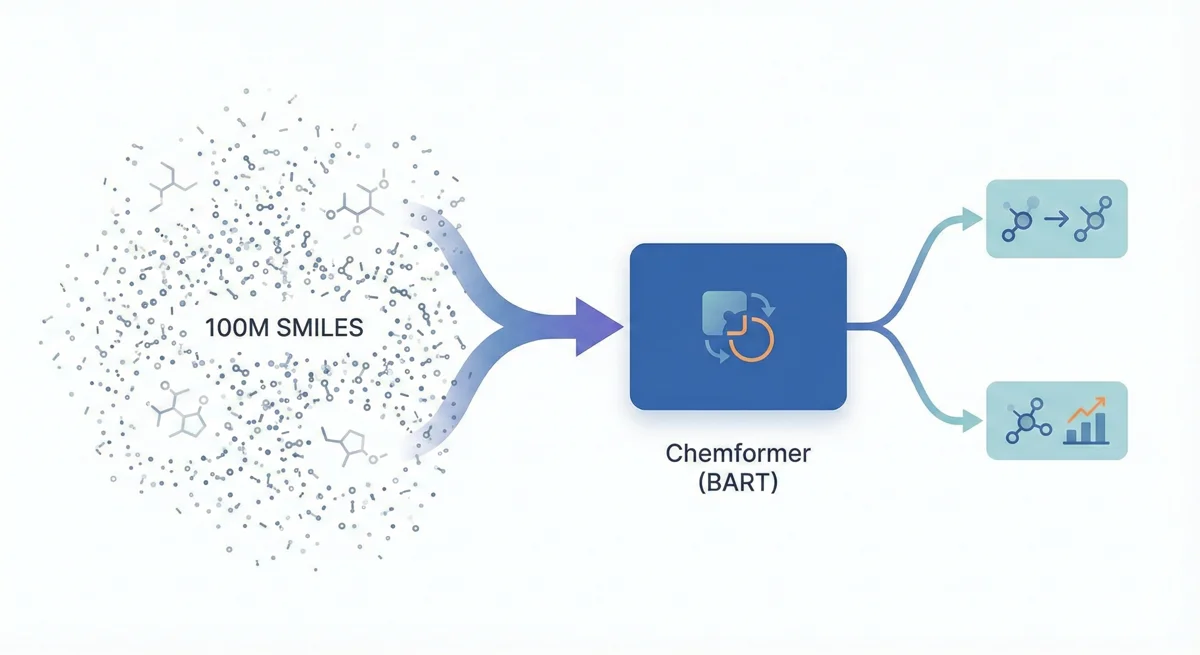
Chemformer pre-training on 100M SMILES strings flowing into BART model, which then enables reaction prediction and property prediction tasks

Chemformer: A Pre-trained Transformer for Comp Chem

This paper introduces Chemformer, a BART-based sequence-to-sequence model pre-trained on 100M molecules using a ‘combined’ masking and augmentation task. It achieves top-1 accuracy on reaction prediction benchmarks while significantly reducing training time through transfer learning.

Computational Chemistry
ChemDFM-X architecture showing five modalities (2D graphs, 3D conformations, images, MS2 spectra, IR spectra) feeding through separate encoders into unified LLM decoder

ChemDFM-X: Multimodal Foundation Model for Chemistry

ChemDFM-X is a multimodal chemical foundation model that integrates five non-text modalities (2D graphs, 3D conformations, images, MS2 spectra, IR spectra) into a single LLM decoder. It overcomes data scarcity by generating a 7.6M instruction-tuning dataset through approximate calculations and model predictions, establishing strong baseline performance across multiple modalities.

Computational Chemistry
Diagram showing text, molecular structures, and reactions feeding into a multimodal index and search system that outputs passages with context

Multimodal Search in Chemical Documents and Reactions

This paper presents a multimodal search system that facilitates passage-level retrieval of chemical reactions and molecular structures by linking diagrams, text, and reaction records extracted from scientific PDFs.

Molecular Representations
Diagram showing molecular structure passing through a neural network to produce IUPAC chemical nomenclature document

STOUT V2.0: Transformer-Based SMILES to IUPAC Translation

STOUT V2.0 uses Transformers trained on ~1 billion SMILES-IUPAC pairs to accurately translate chemical structures into systematic names (and vice-versa), outperforming its RNN predecessor.