Systematic Review of Deep Learning CLMs (2020-2024)
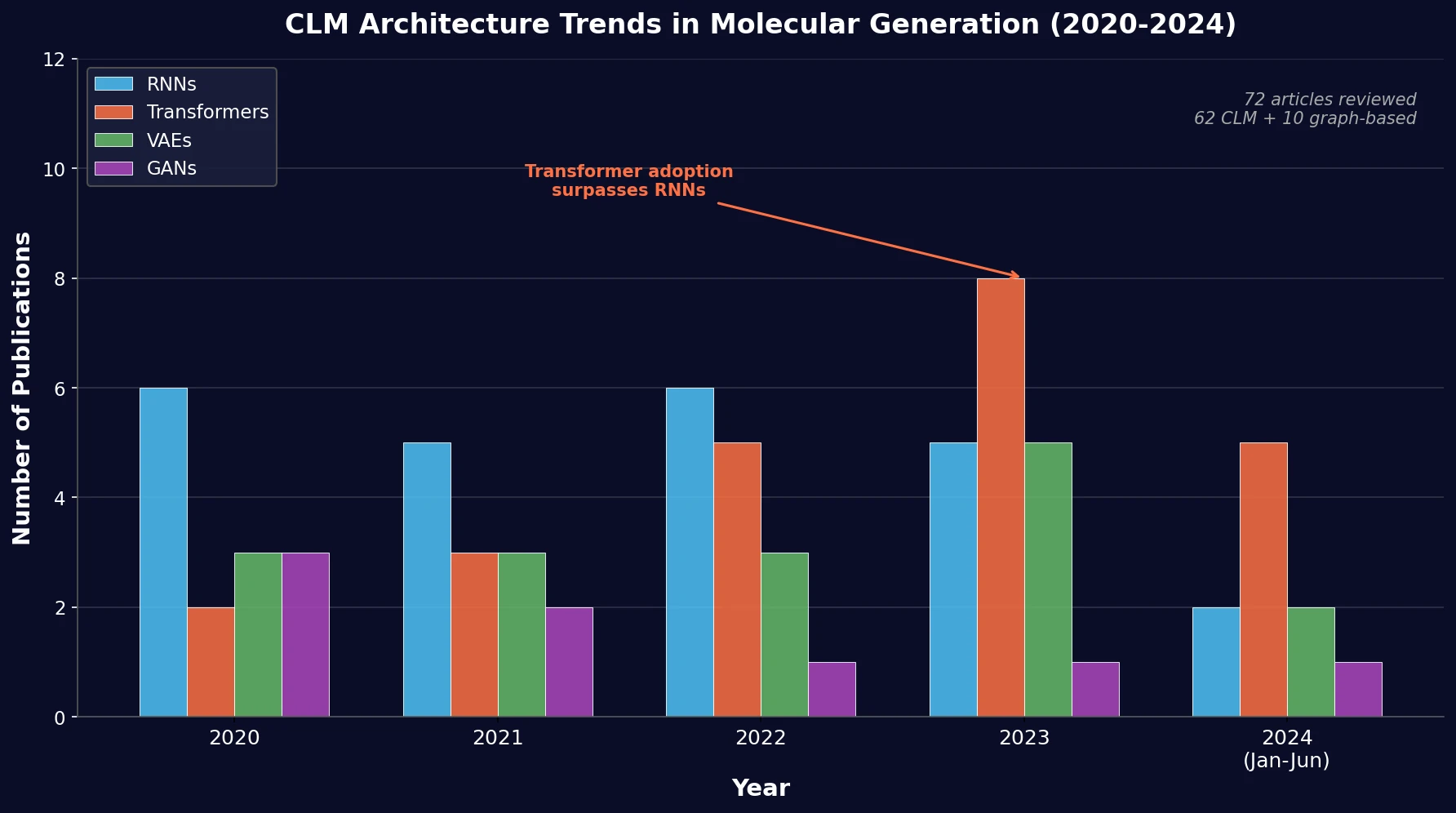
PRISMA-based systematic review of 72 papers on chemical language models for molecular generation, comparing architectures and biased methods using MOSES metrics.

PRISMA-based systematic review of 72 papers on chemical language models for molecular generation, comparing architectures and biased methods using MOSES metrics.

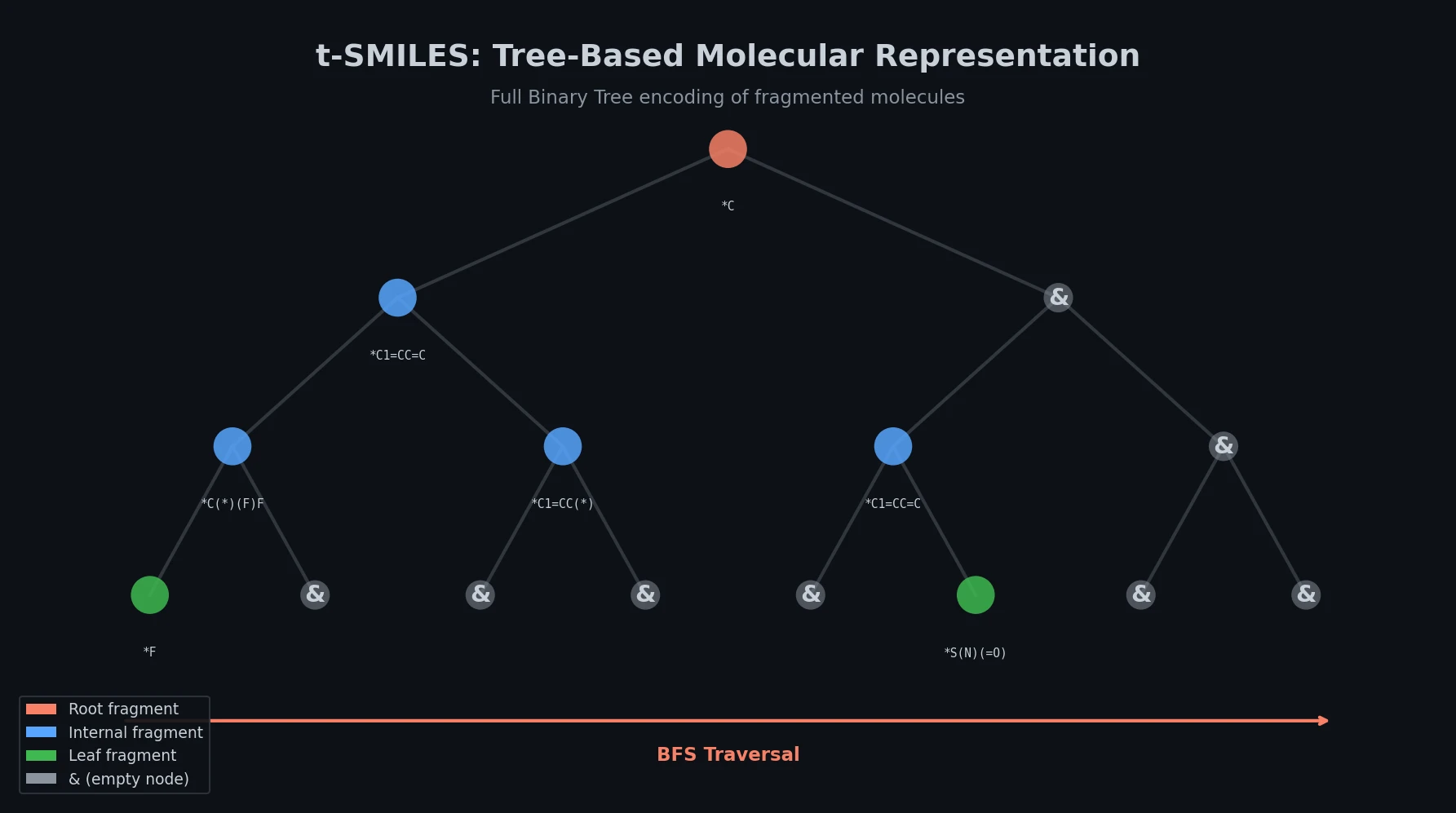
t-SMILES represents molecules by fragmenting them into substructures, building full binary trees, and traversing them breadth-first to produce SMILES-type strings that reduce nesting depth and outperform SMILES, DeepSMILES, and SELFIES on generation benchmarks.

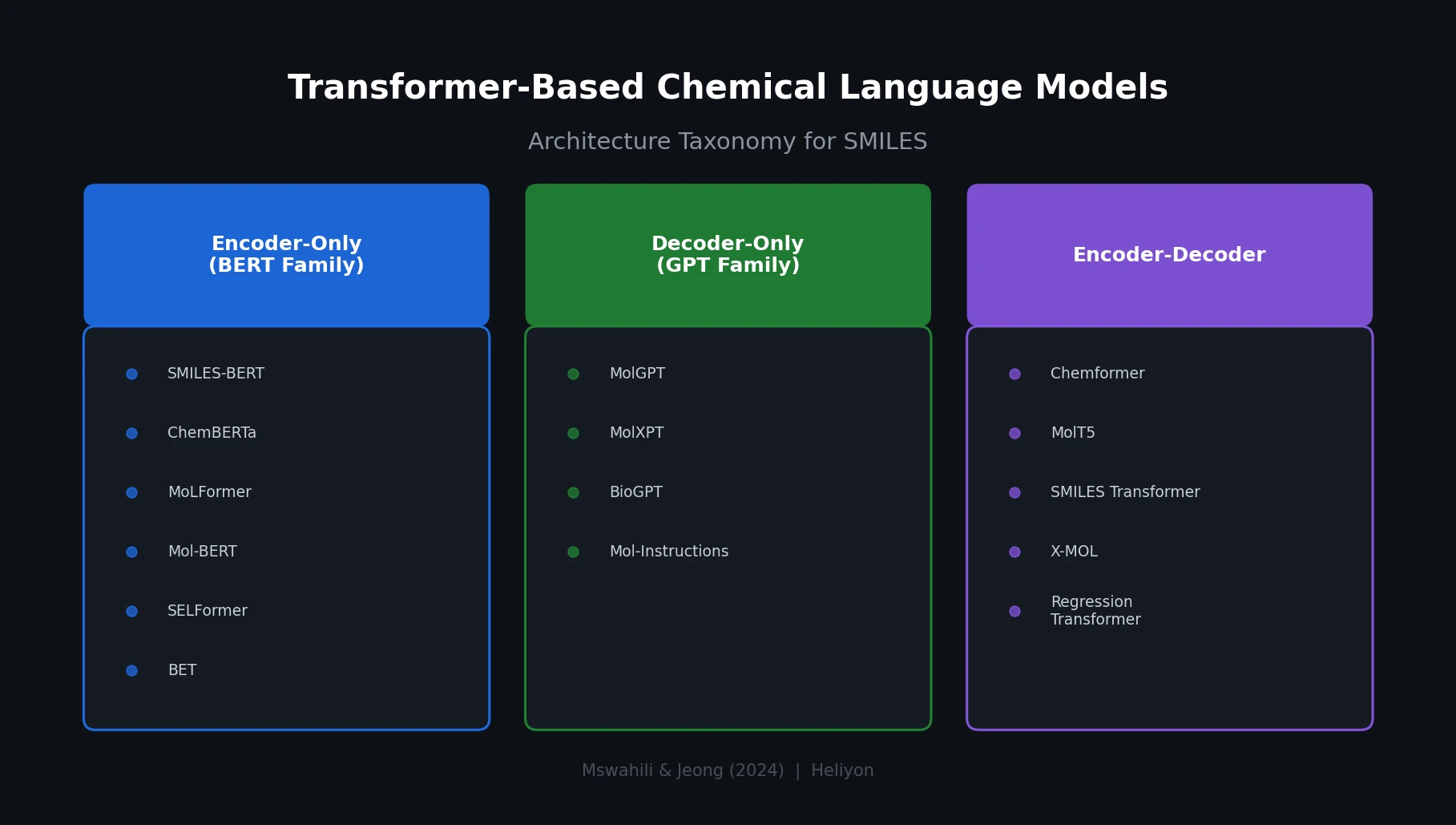
A comprehensive review of transformer-based chemical language models operating on SMILES, categorizing encoder-only (BERT variants), decoder-only (GPT variants), and encoder-decoder models with analysis of tokenization strategies, pre-training approaches, and future directions.

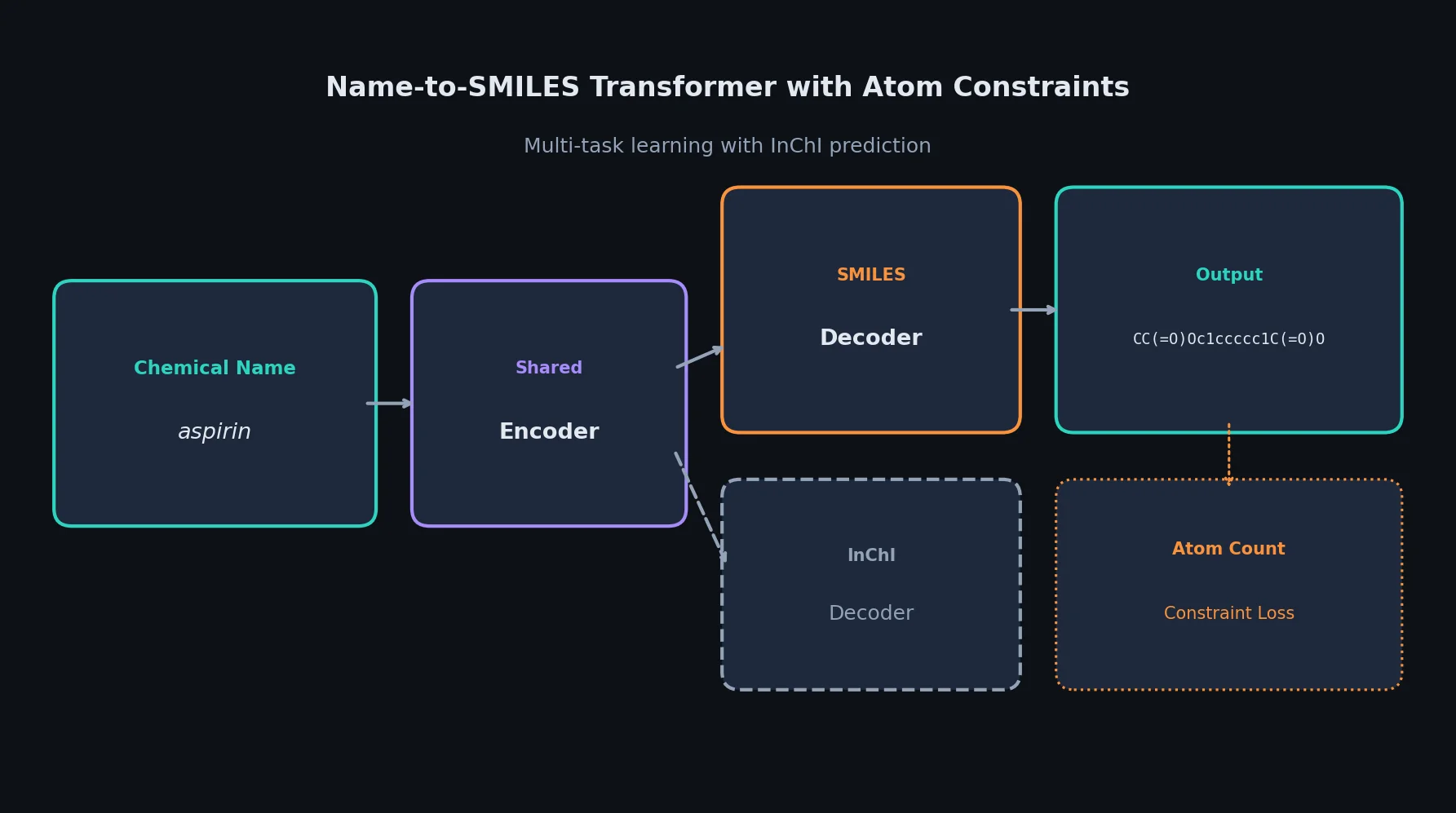
This paper applies a Transformer sequence-to-sequence model to predict SMILES strings from chemical compound names (Synonyms). Two enhancements, an atom-count constraint loss and SMILES/InChI multi-task learning, improve F-measure over rule-based and vanilla Transformer baselines.

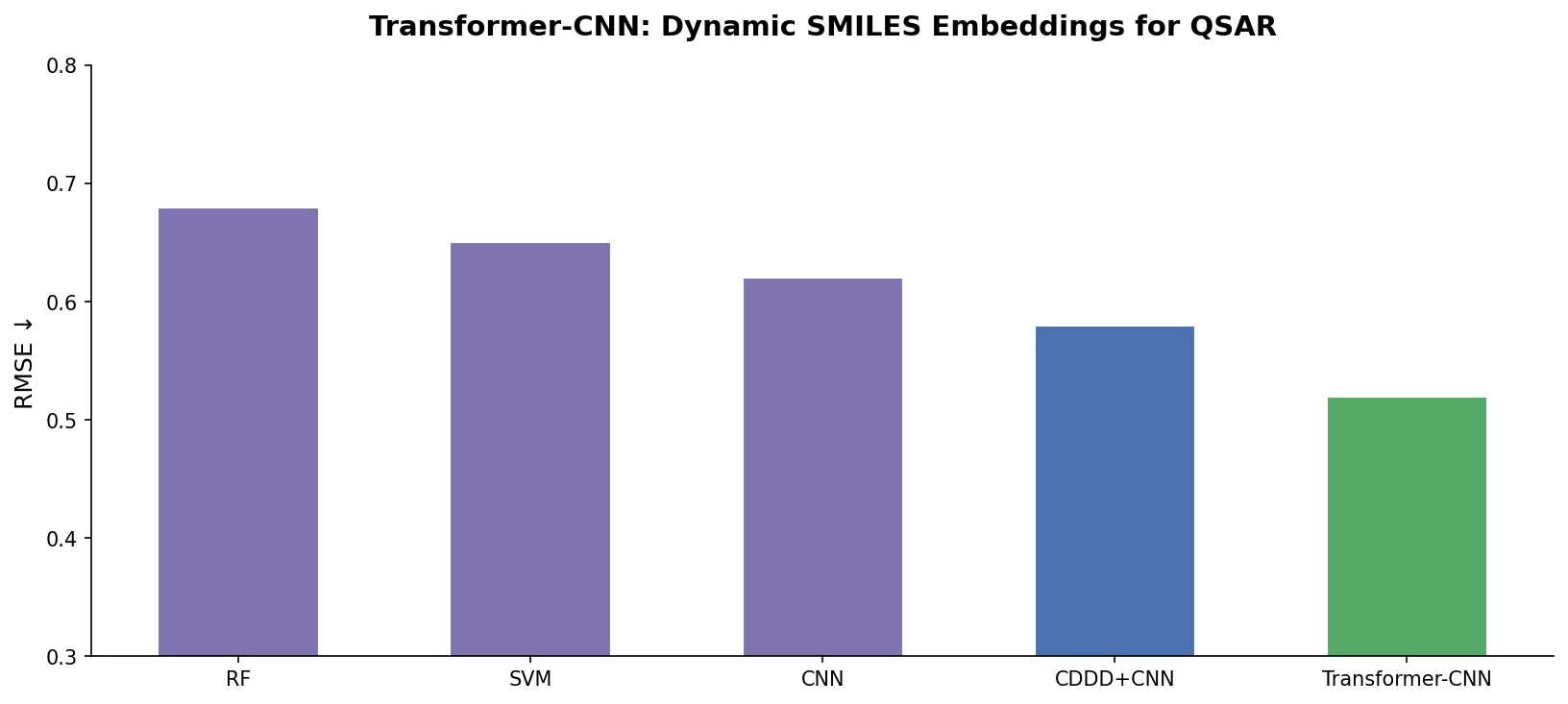
Transformer-CNN extracts dynamic SMILES embeddings from a Transformer trained on SMILES canonicalization and feeds them to a TextCNN for QSAR modeling, achieving strong results across 18 benchmarks with built-in LRP interpretability.

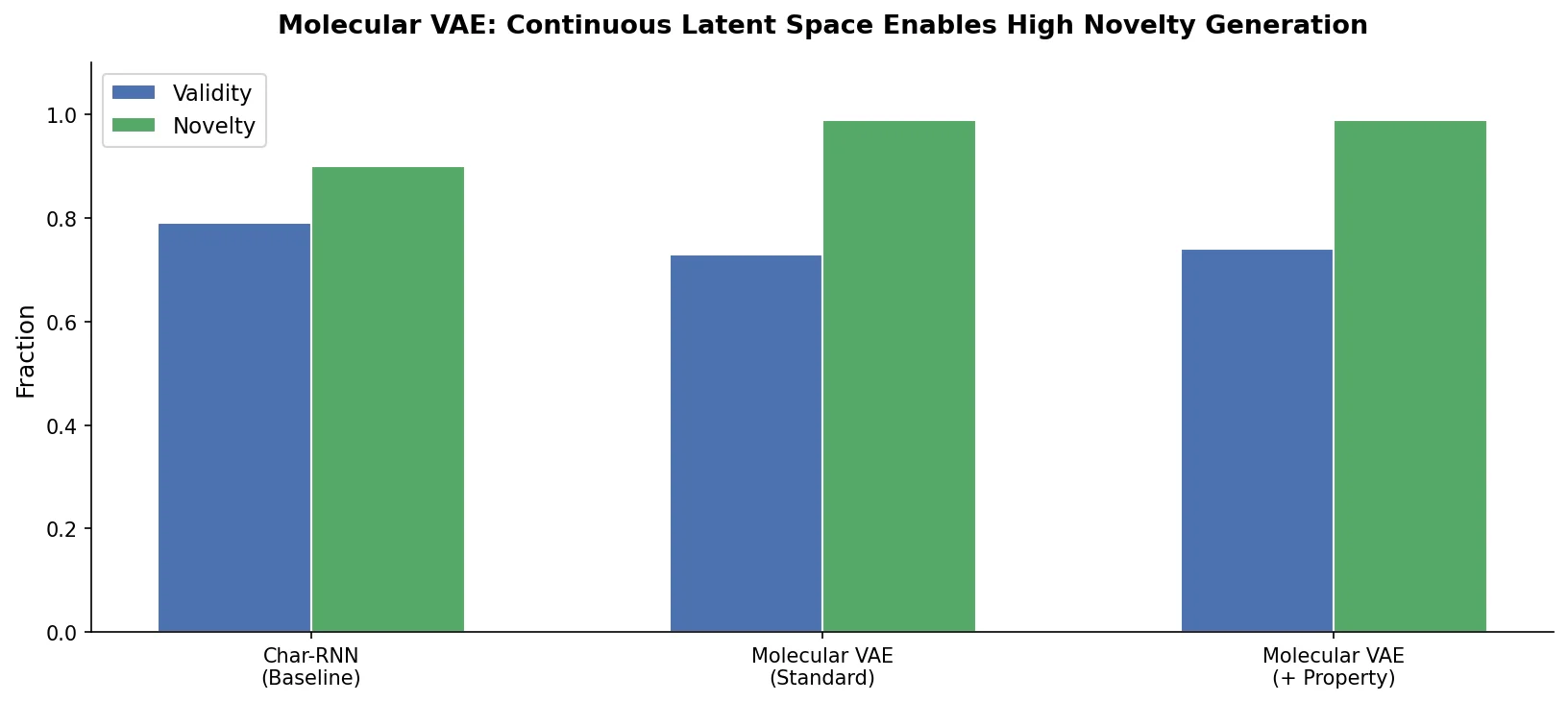
This foundational paper introduces a variational autoencoder (VAE) that encodes SMILES strings into a continuous latent space, allowing gradient-based optimization of molecular properties. Joint training with a property predictor organizes the latent space by chemical properties, and Bayesian optimization over the latent surface discovers drug-like molecules with improved QED and synthetic accessibility.

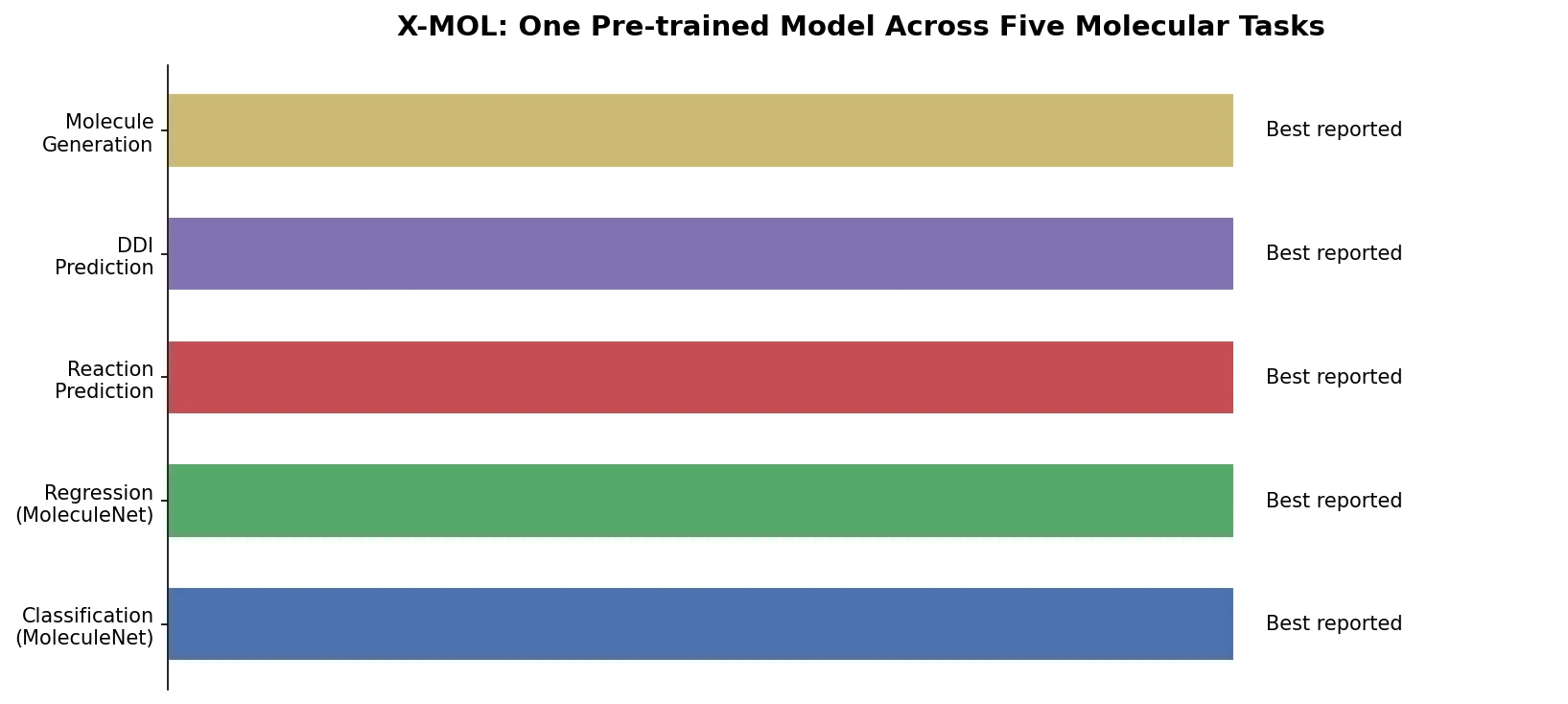
X-MOL applies large-scale Transformer pre-training on 1.1 billion molecules with a generative SMILES-to-SMILES strategy, then fine-tunes for five molecular analysis tasks including property prediction, reaction analysis, and de novo generation.

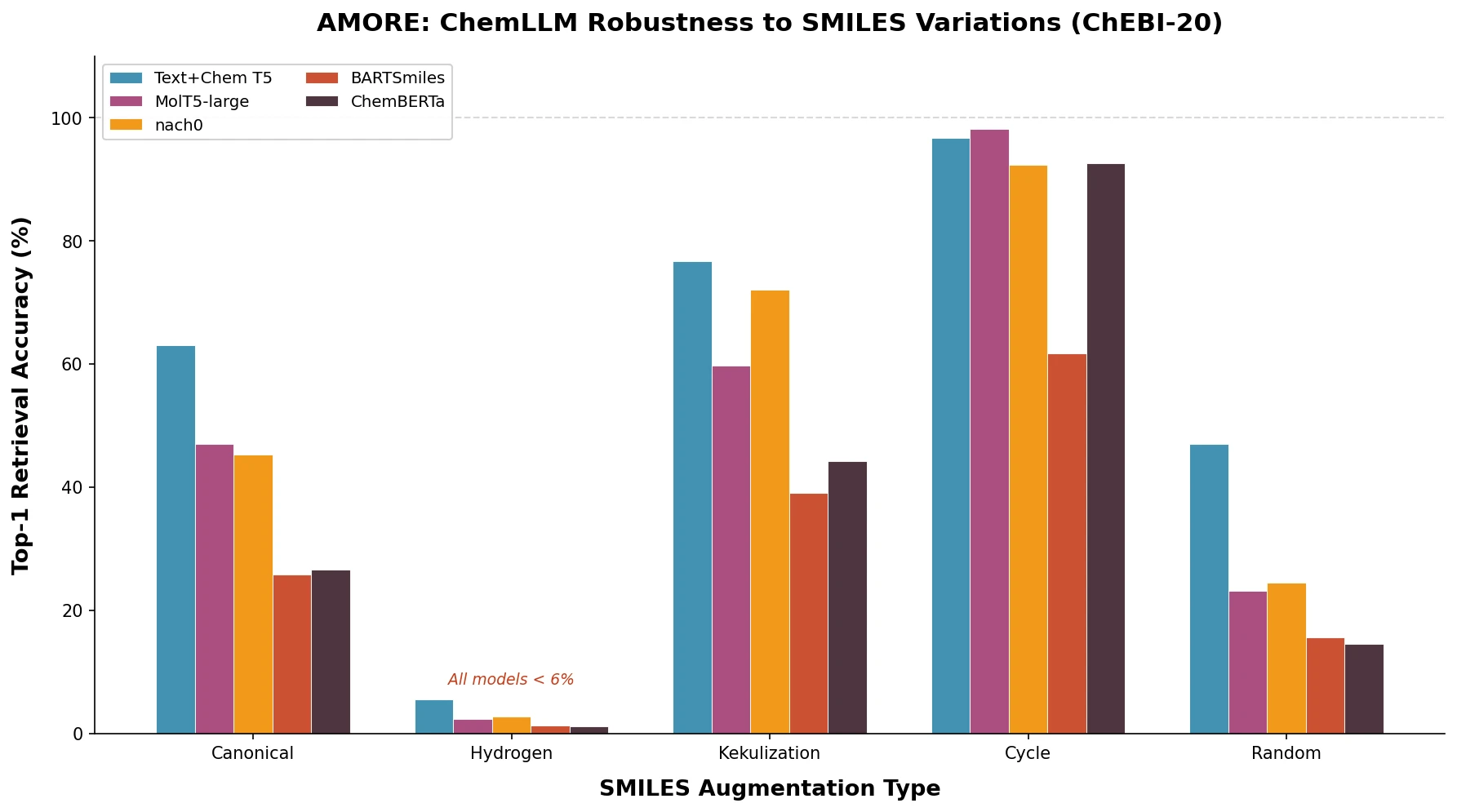
Introduces AMORE, an embedding-based retrieval framework that evaluates whether chemical language models can recognize the same molecule across different SMILES representations. Results show current models are not robust to identity-preserving augmentations.

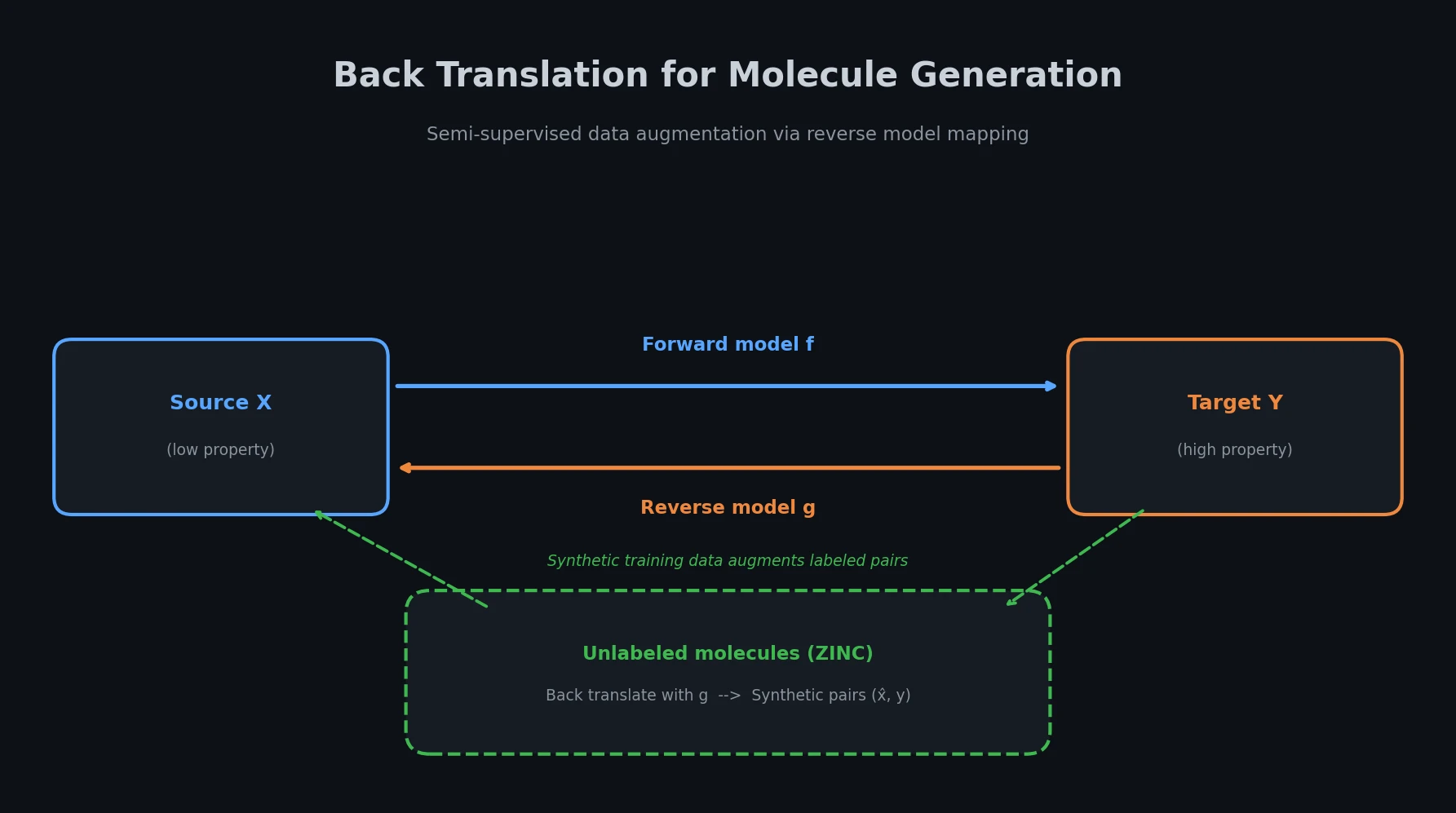
Adapts back translation from NLP to molecular generation, using unlabeled molecules from ZINC to create synthetic training pairs that improve property optimization and retrosynthesis prediction across Transformer and graph-based architectures.

Benchmarks large language models on six molecular property prediction datasets, finding that LLMs lag behind GNNs but can augment ML models when used collaboratively.

This study trains over 62,000 models to systematically evaluate molecular representations and models for property prediction, finding that traditional ML on fixed descriptors often outperforms deep learning approaches.

ChemEval is a four-level, 62-task benchmark for evaluating LLMs across chemical knowledge, literature understanding, molecular reasoning, and scientific deduction, revealing that general LLMs excel at comprehension while chemistry-specific models perform better on domain tasks.