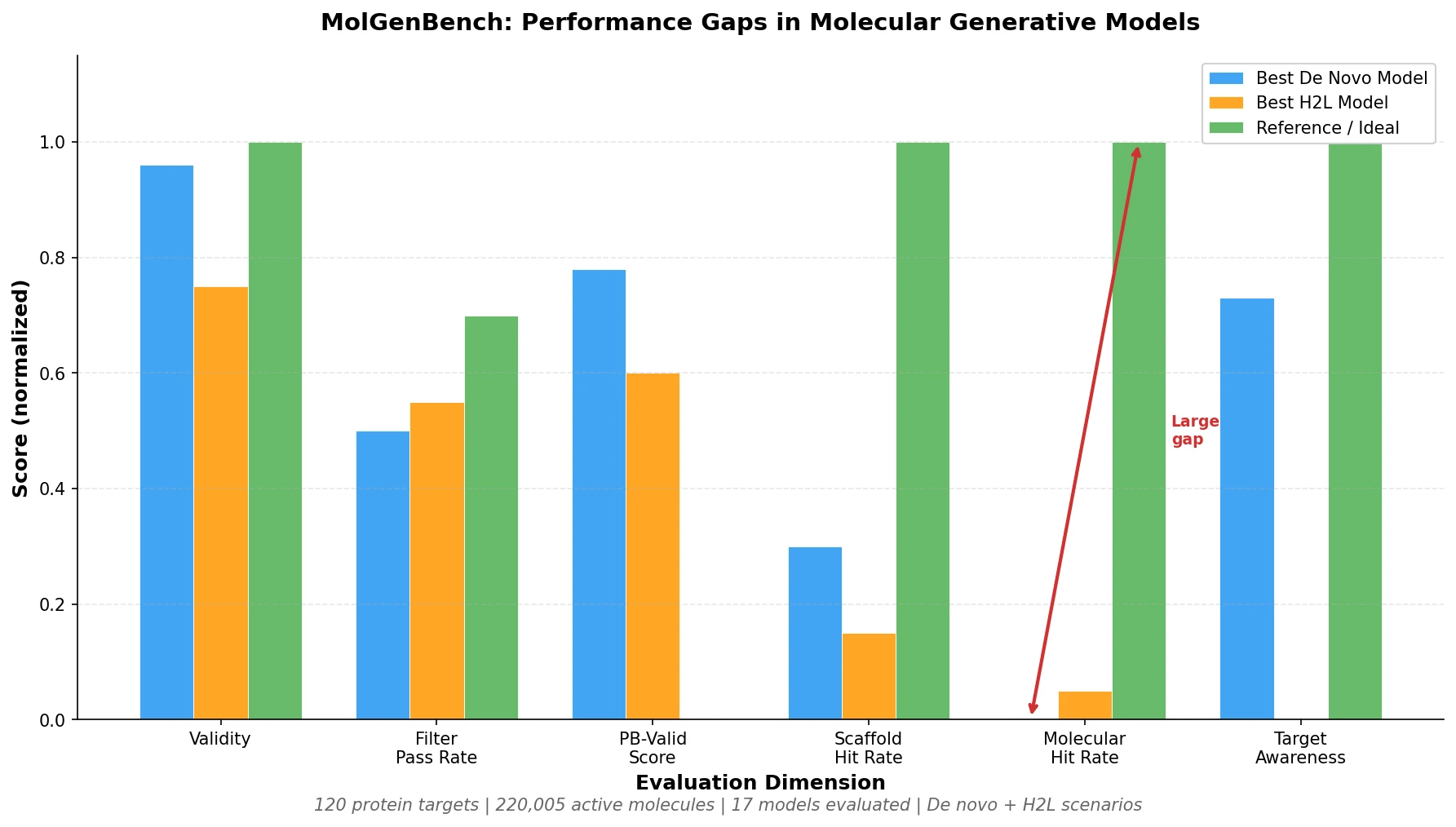
Molecular Representations
Radial diagram showing 12 transformer architecture families connected to 5 molecular science application domains

Survey of Transformer Architectures in Molecular Science

Jiang et al. survey 12 families of transformer architectures in molecular science, covering GPT, BERT, BART, graph transformers, Transformer-XL, T5, ViT, DETR, Conformer, CLIP, sparse transformers, and mobile/efficient variants, with detailed algorithmic descriptions and molecular applications.

Molecular Representations
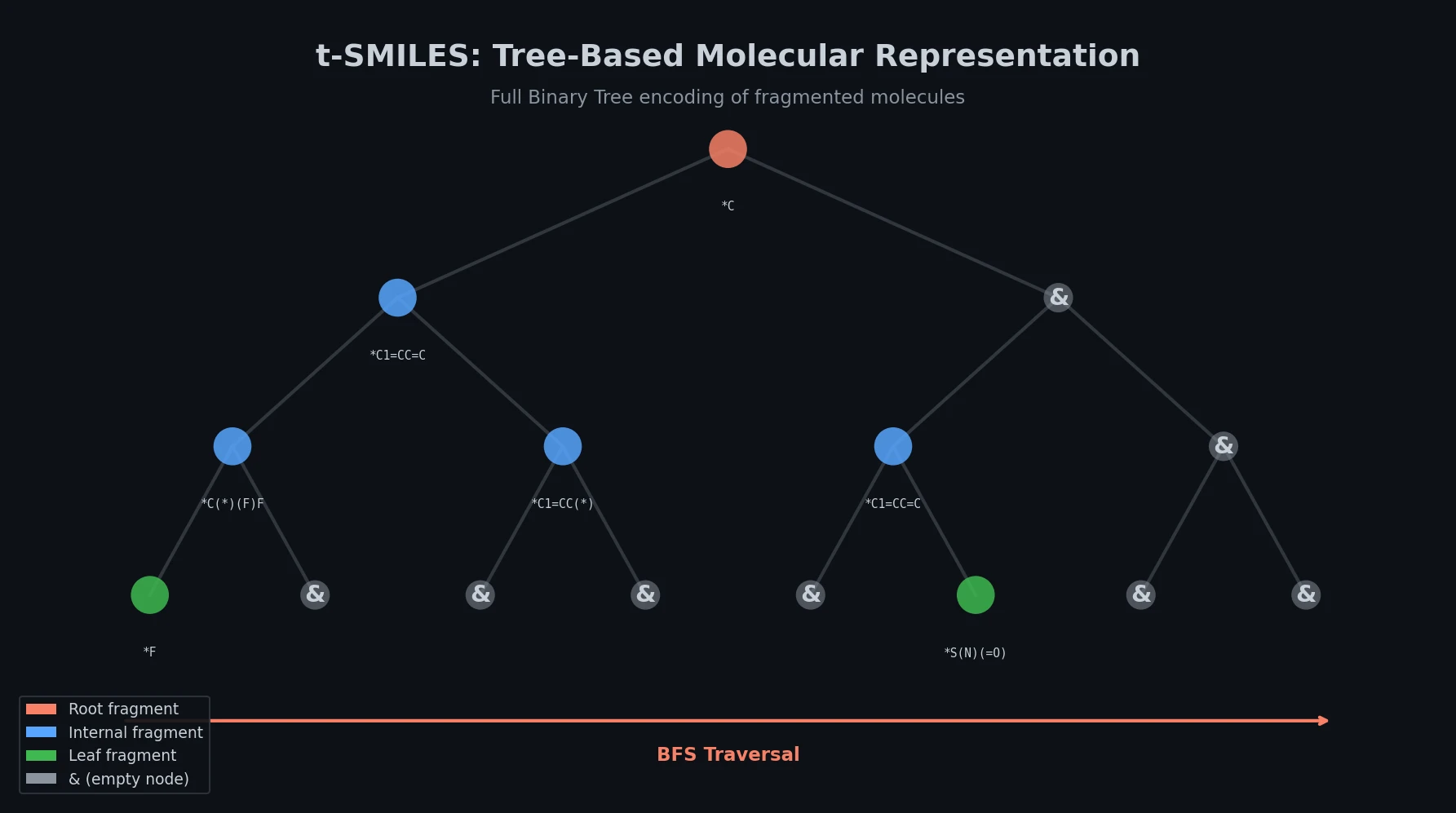
Diagram showing the t-SMILES pipeline from molecular graph fragmentation to binary tree traversal producing a string representation

t-SMILES: Tree-Based Fragment Molecular Encoding

t-SMILES represents molecules by fragmenting them into substructures, building full binary trees, and traversing them breadth-first to produce SMILES-type strings that reduce nesting depth and outperform SMILES, DeepSMILES, and SELFIES on generation benchmarks.
Predictive Chemistry
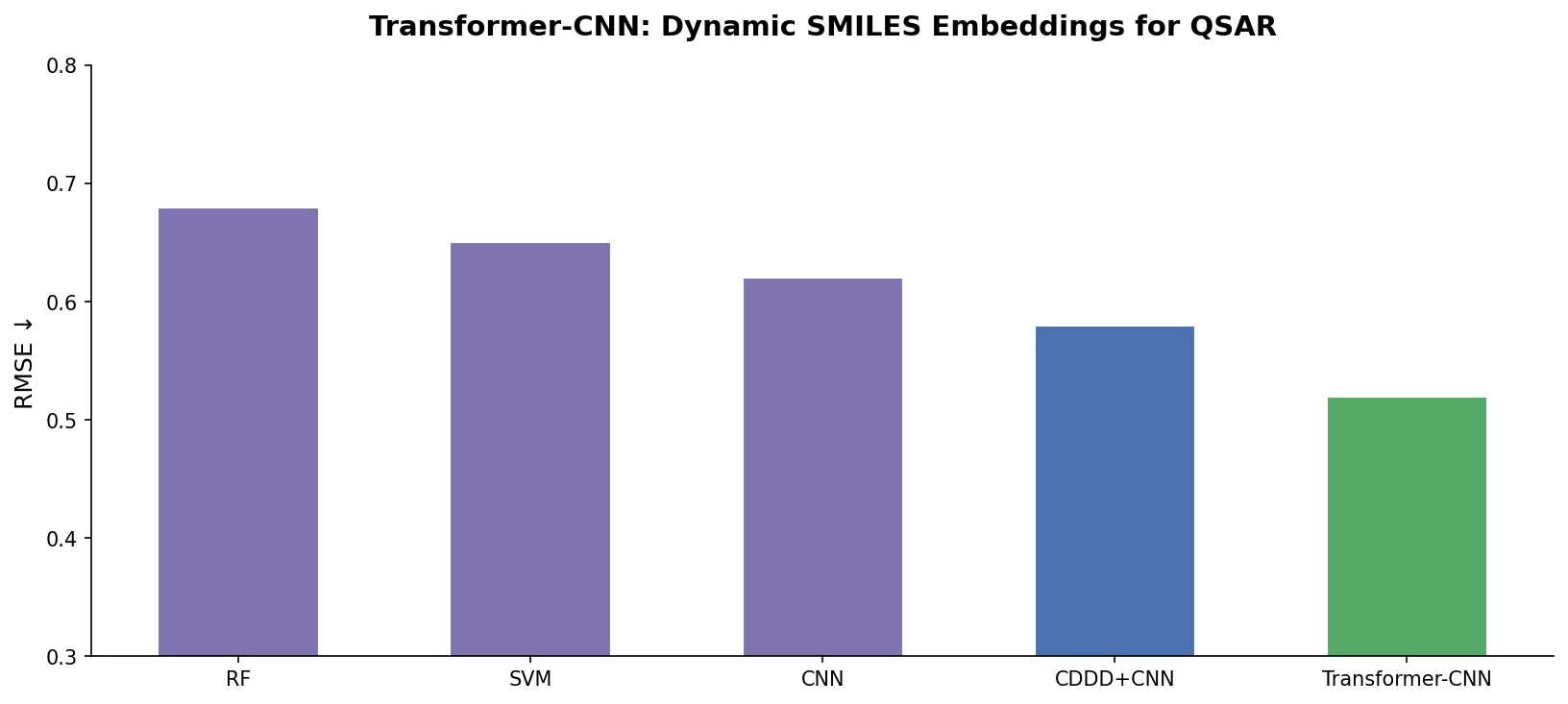
Bar chart comparing Transformer-CNN RMSE against RF, SVM, CNN, and CDDD baselines

Transformer-CNN: SMILES Embeddings for QSAR Modeling

Transformer-CNN extracts dynamic SMILES embeddings from a Transformer trained on SMILES canonicalization and feeds them to a TextCNN for QSAR modeling, achieving strong results across 18 benchmarks with built-in LRP interpretability.

Predictive Chemistry
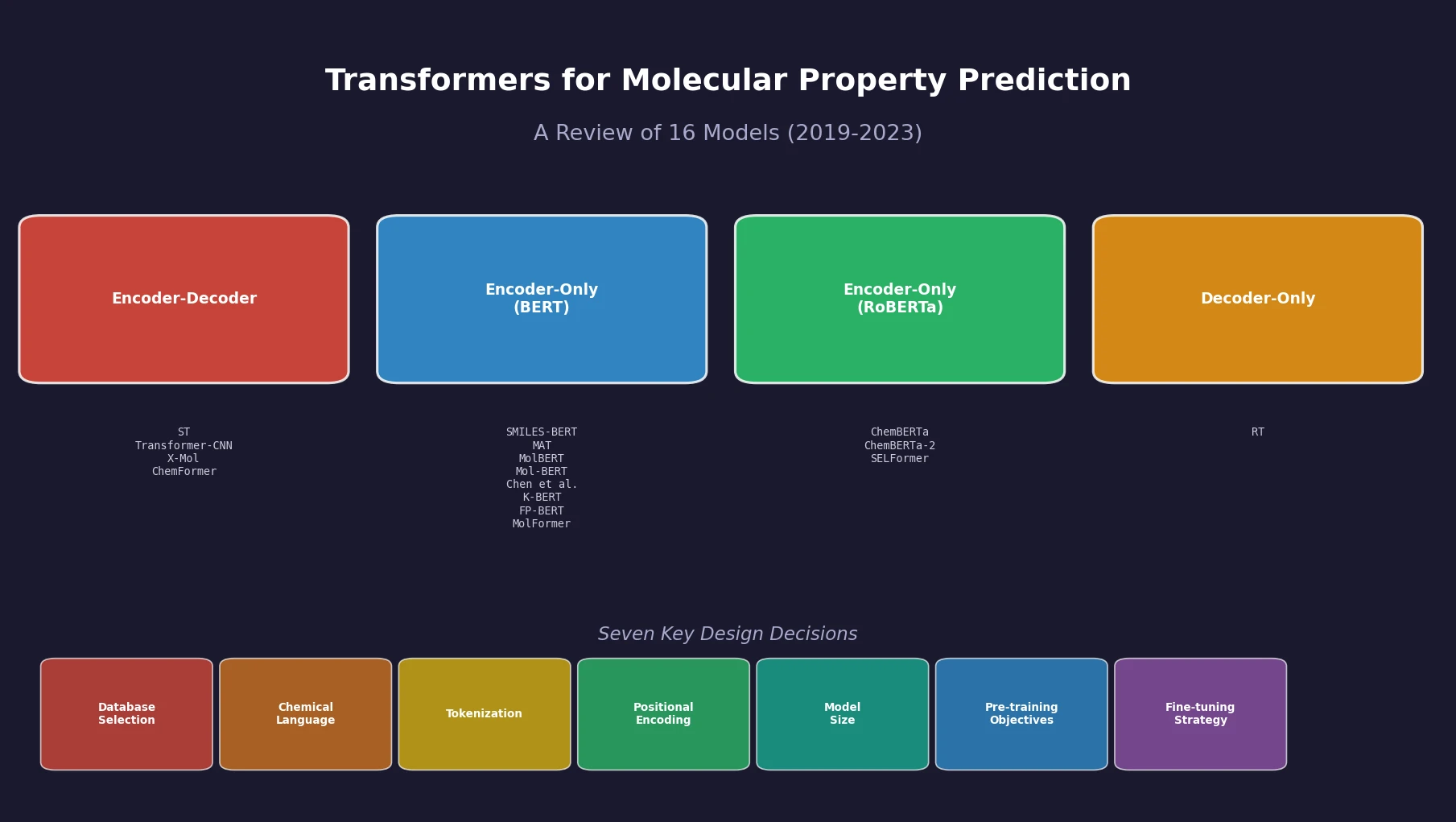
Overview of 16 transformer models for molecular property prediction organized by architecture type

Transformers for Molecular Property Prediction Review

Sultan et al. review 16 sequence-based transformer models for molecular property prediction, systematically analyzing seven design decisions (database selection, chemical language, tokenization, positional encoding, model size, pre-training objectives, and fine-tuning strategy) and identifying a critical need for standardized evaluation practices.

Molecular Representations
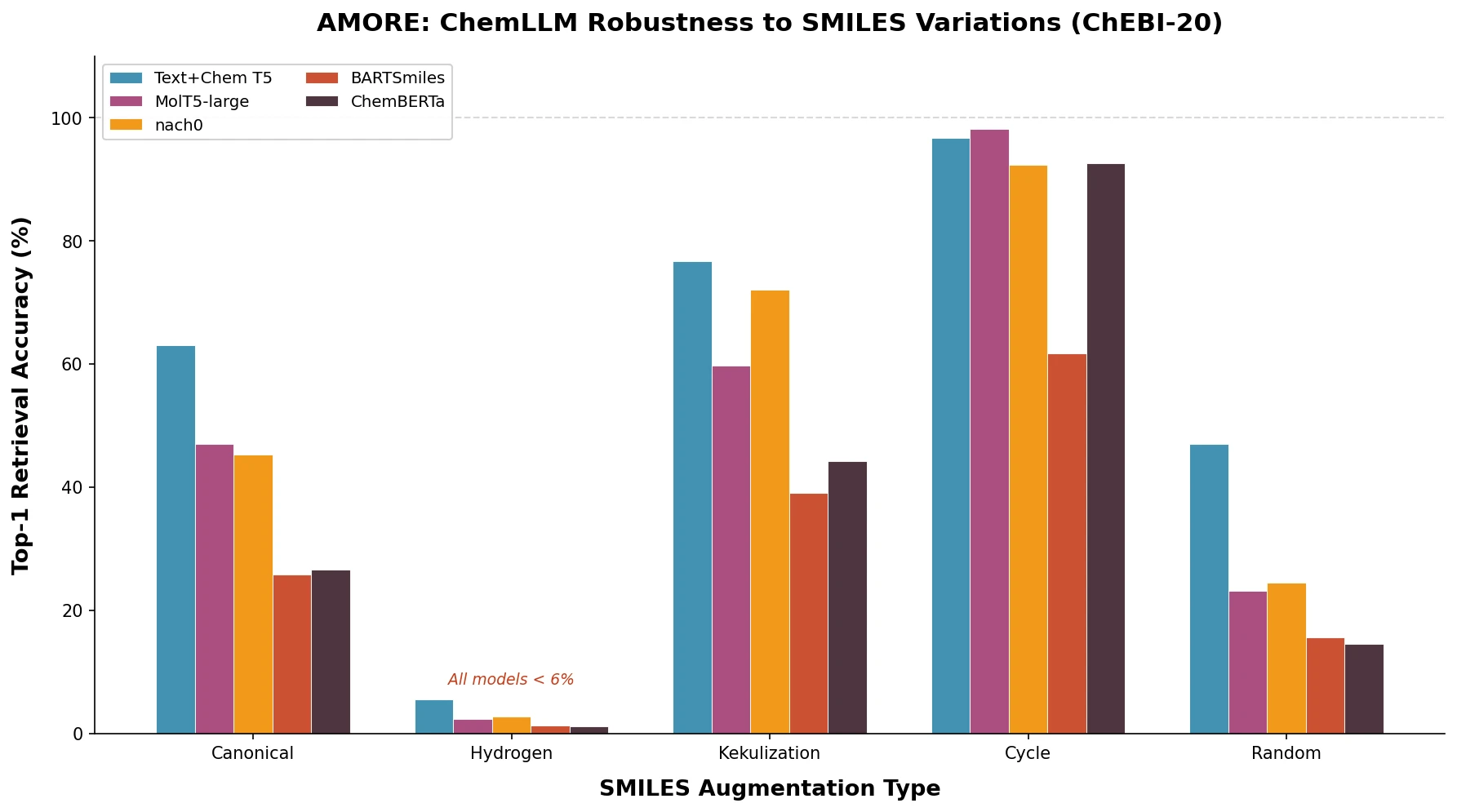
Bar chart showing retrieval accuracy of chemical language models across four SMILES augmentation types

AMORE: Testing ChemLLM Robustness to SMILES Variants

Introduces AMORE, an embedding-based retrieval framework that evaluates whether chemical language models can recognize the same molecule across different SMILES representations. Results show current models are not robust to identity-preserving augmentations.

Molecular Generation
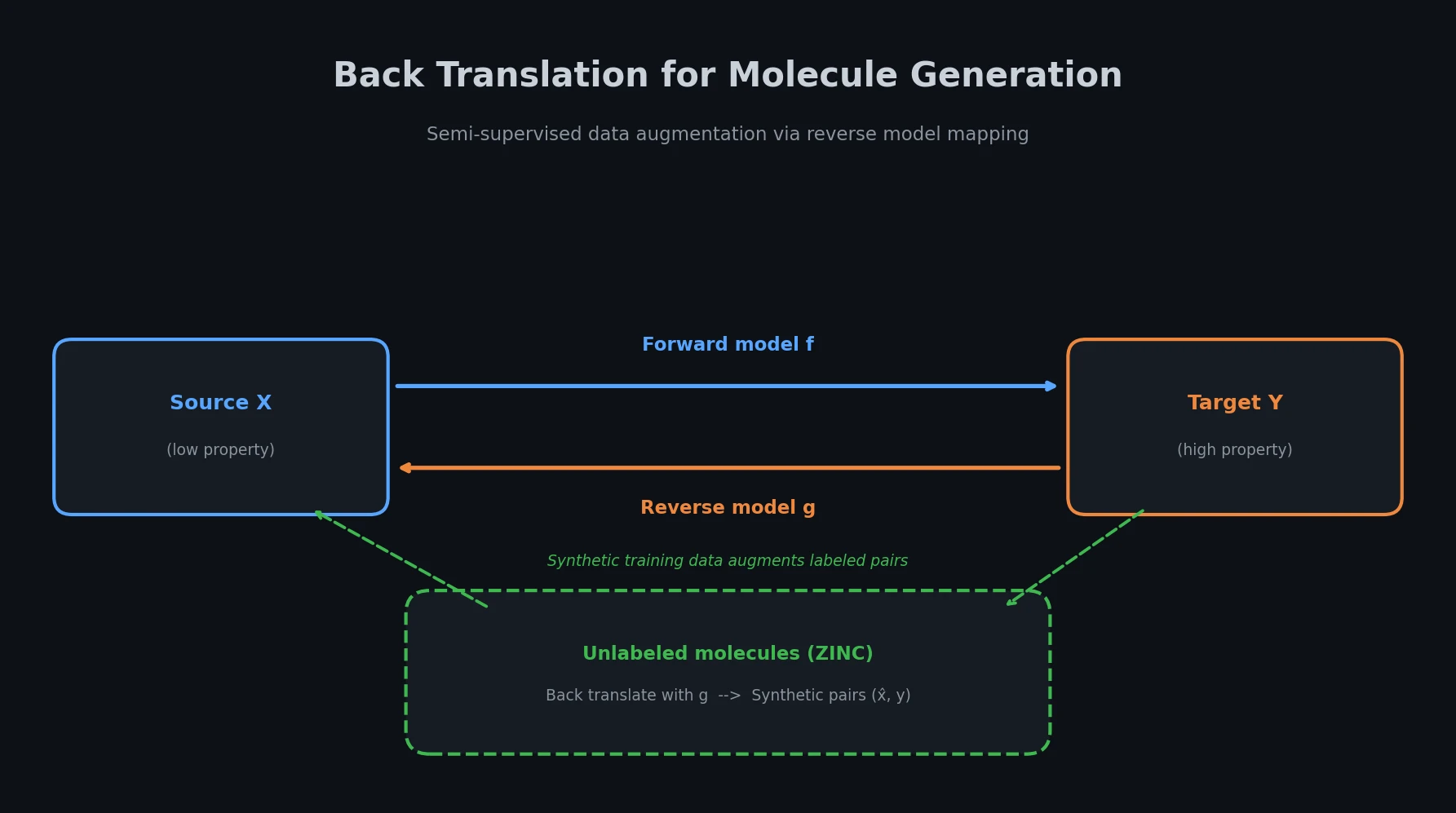
Diagram showing back translation workflow with forward and reverse models mapping between source and target molecular domains, augmented by unlabeled ZINC molecules

Back Translation for Semi-Supervised Molecule Generation

Adapts back translation from NLP to molecular generation, using unlabeled molecules from ZINC to create synthetic training pairs that improve property optimization and retrosynthesis prediction across Transformer and graph-based architectures.

Computational Chemistry
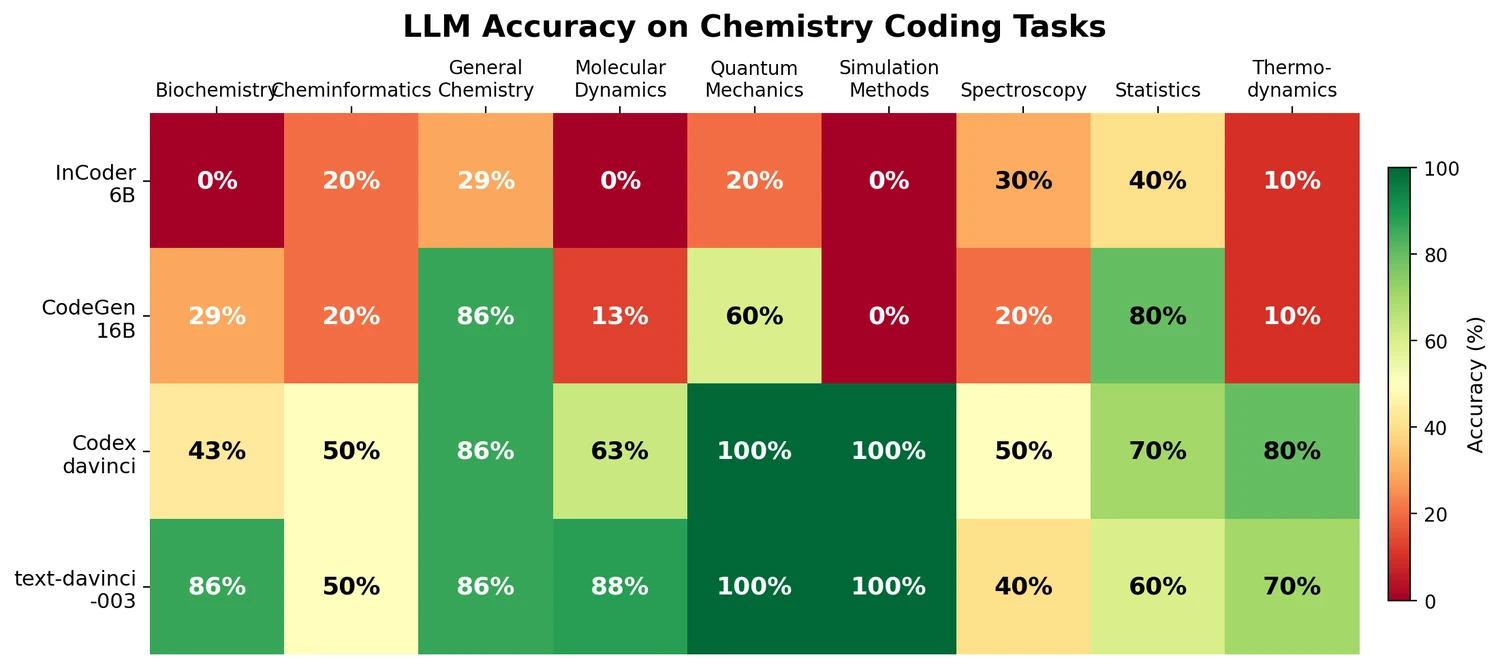
Heatmap showing LLM accuracy across nine chemistry coding task categories for four models, with green indicating high accuracy and red indicating low accuracy

Benchmarking Chemistry Knowledge in Code-Gen LLMs

A benchmark of 84 chemistry coding tasks evaluating code-generating LLMs like Codex, showing 72% accuracy with prompt engineering strategies that improve performance by 30 percentage points.

Predictive Chemistry
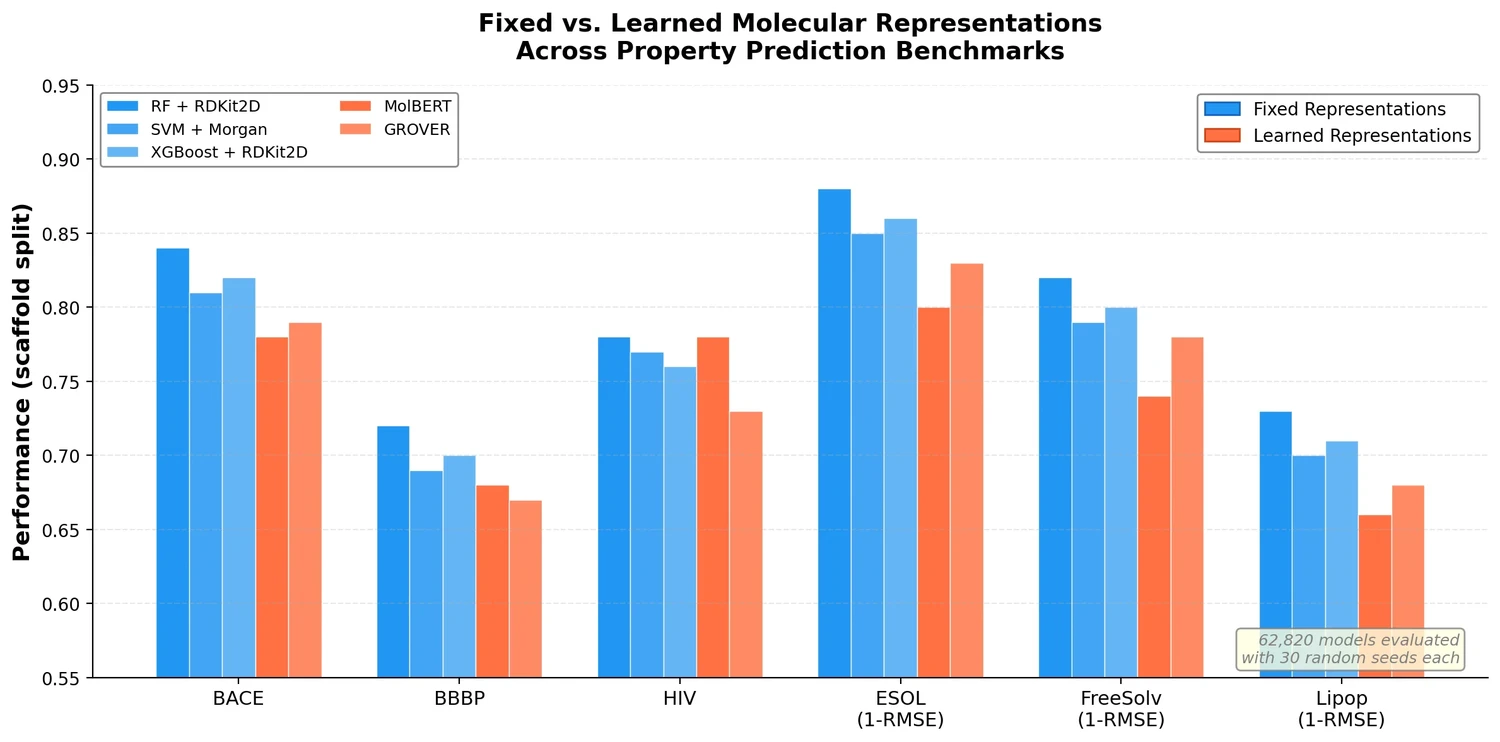
Bar chart comparing fixed molecular representations (RF, SVM, XGBoost) against learned representations (MolBERT, GROVER) across six property prediction benchmarks under scaffold split

Benchmarking Molecular Property Prediction at Scale

This study trains over 62,000 models to systematically evaluate molecular representations and models for property prediction, finding that traditional ML on fixed descriptors often outperforms deep learning approaches.

Computational Chemistry
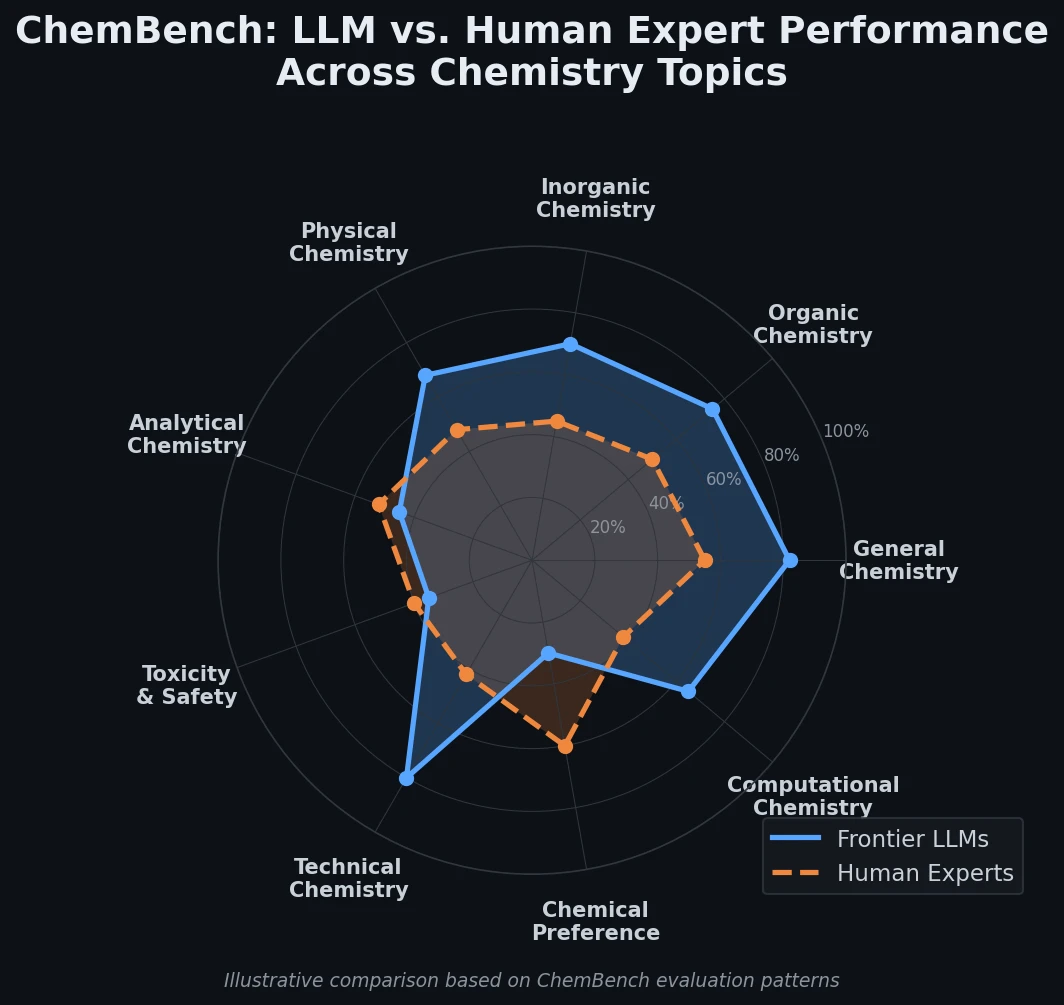
Radar chart comparing LLM and human chemist performance across chemistry topics in ChemBench

ChemBench: Evaluating LLM Chemistry Against Experts

ChemBench introduces an automated benchmark of 2,700+ chemistry questions to evaluate LLMs against human expert chemists, revealing that frontier models outperform domain experts on average while struggling with basic tasks and confidence calibration.

Computational Chemistry
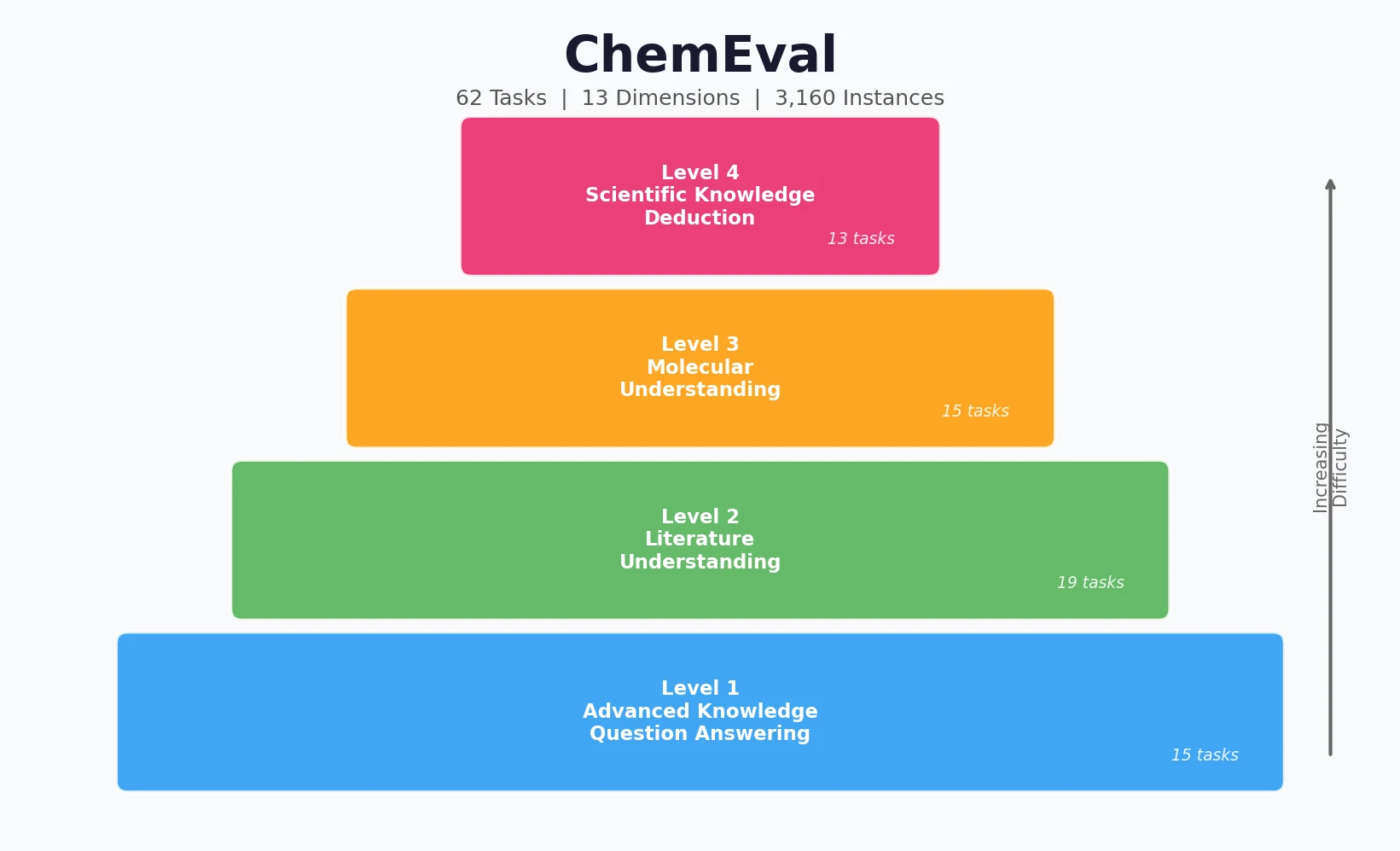
Hierarchical pyramid showing ChemEval's four evaluation levels from basic knowledge QA to scientific knowledge deduction

ChemEval: Fine-Grained LLM Evaluation for Chemistry

ChemEval is a four-level, 62-task benchmark for evaluating LLMs across chemical knowledge, literature understanding, molecular reasoning, and scientific deduction, revealing that general LLMs excel at comprehension while chemistry-specific models perform better on domain tasks.

Molecular Generation
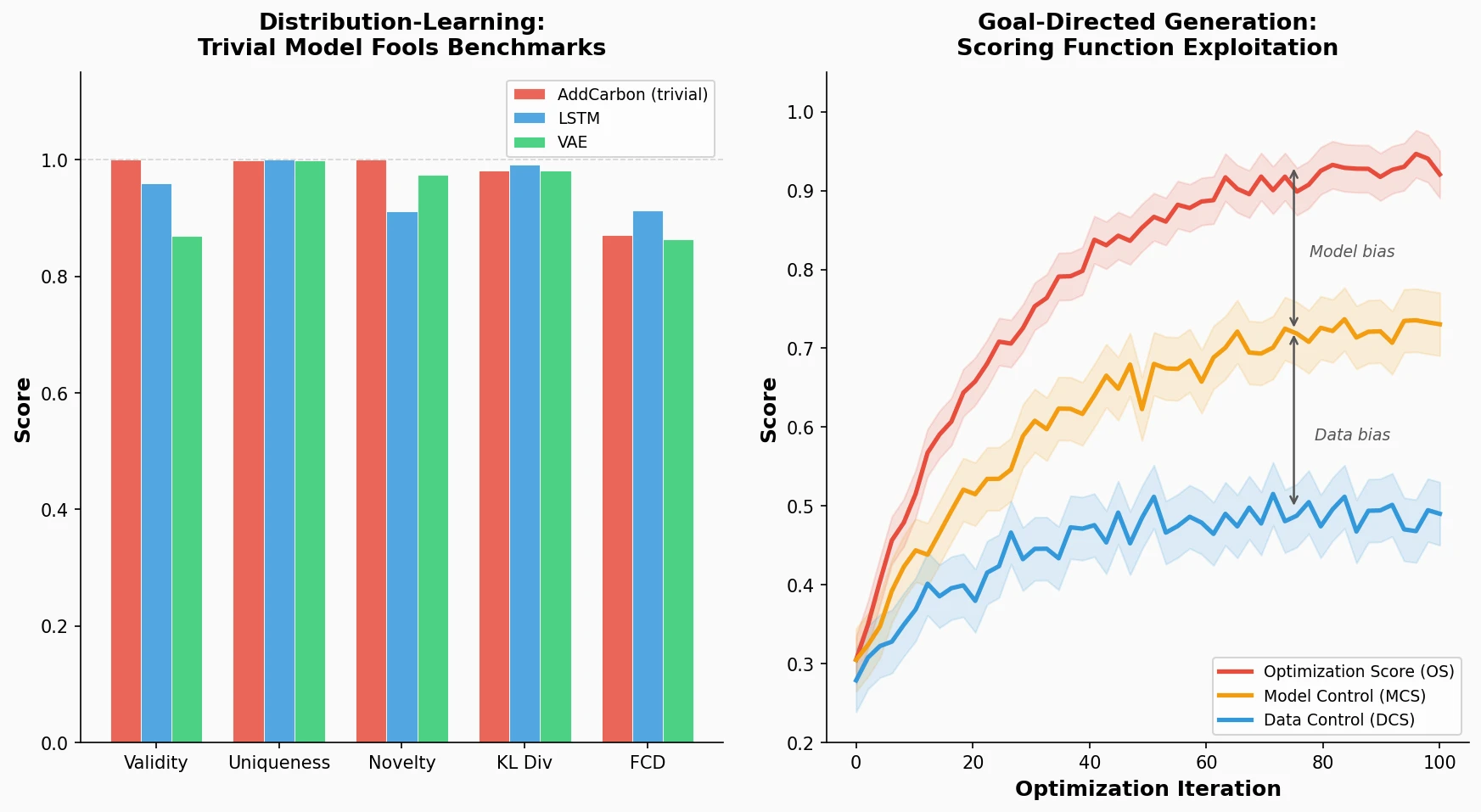
Diagram showing divergence between optimization score and control scores during molecular optimization

Failure Modes in Molecule Generation & Optimization

Identifies failure modes in molecular generative models, showing that trivial edits fool distribution-learning benchmarks and that ML-based scoring functions introduce exploitable model-specific and data-specific biases during goal-directed optimization.

Predictive Chemistry
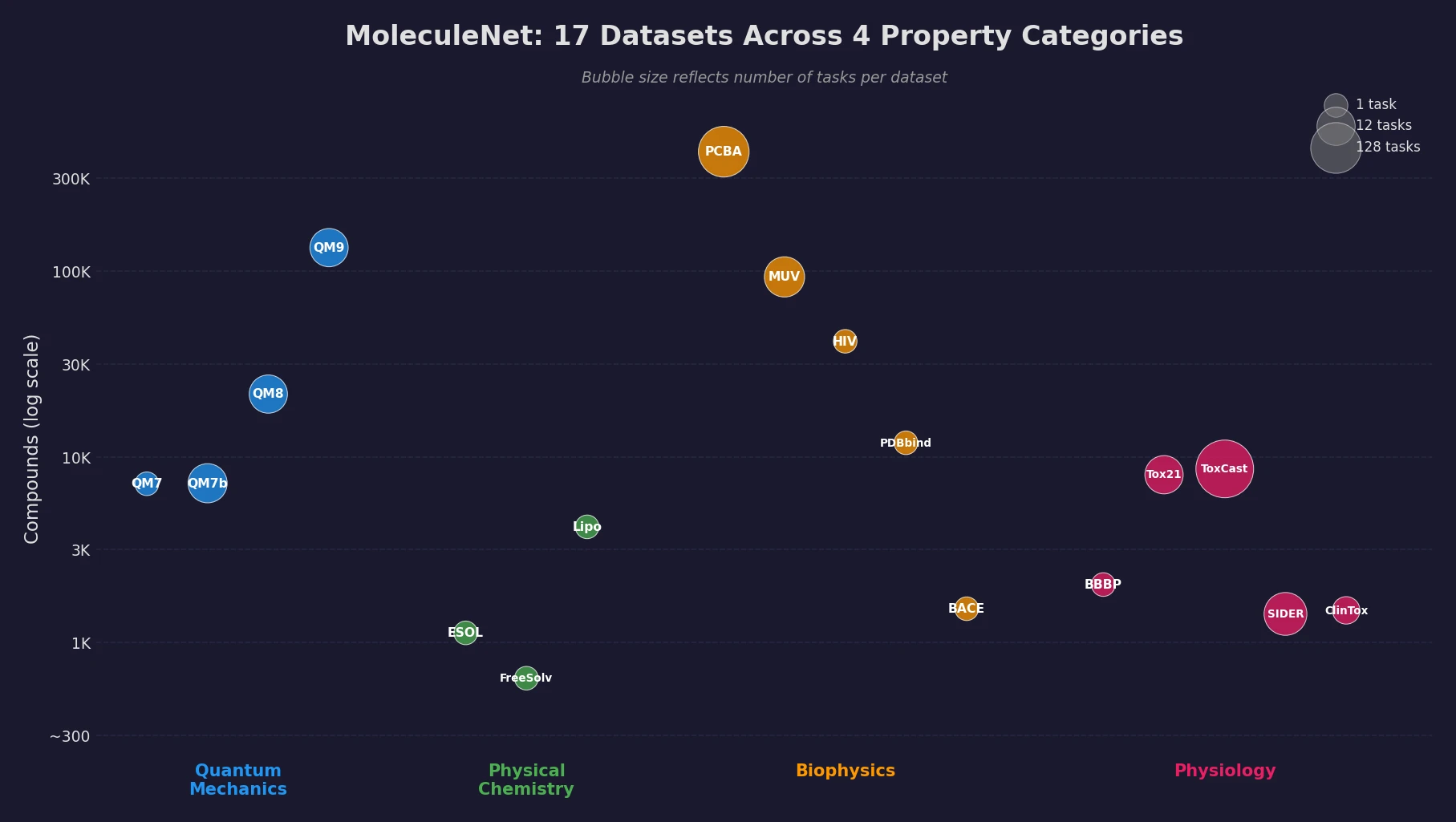
Overview of MoleculeNet dataset categories and task counts across quantum mechanics, physical chemistry, biophysics, and physiology

MoleculeNet: Benchmarking Molecular Machine Learning

MoleculeNet introduces a large-scale benchmark suite for molecular machine learning, curating over 700,000 compounds across 17 datasets with standardized metrics, data splits, and featurization methods integrated into the DeepChem open-source library.