Molecular Generation
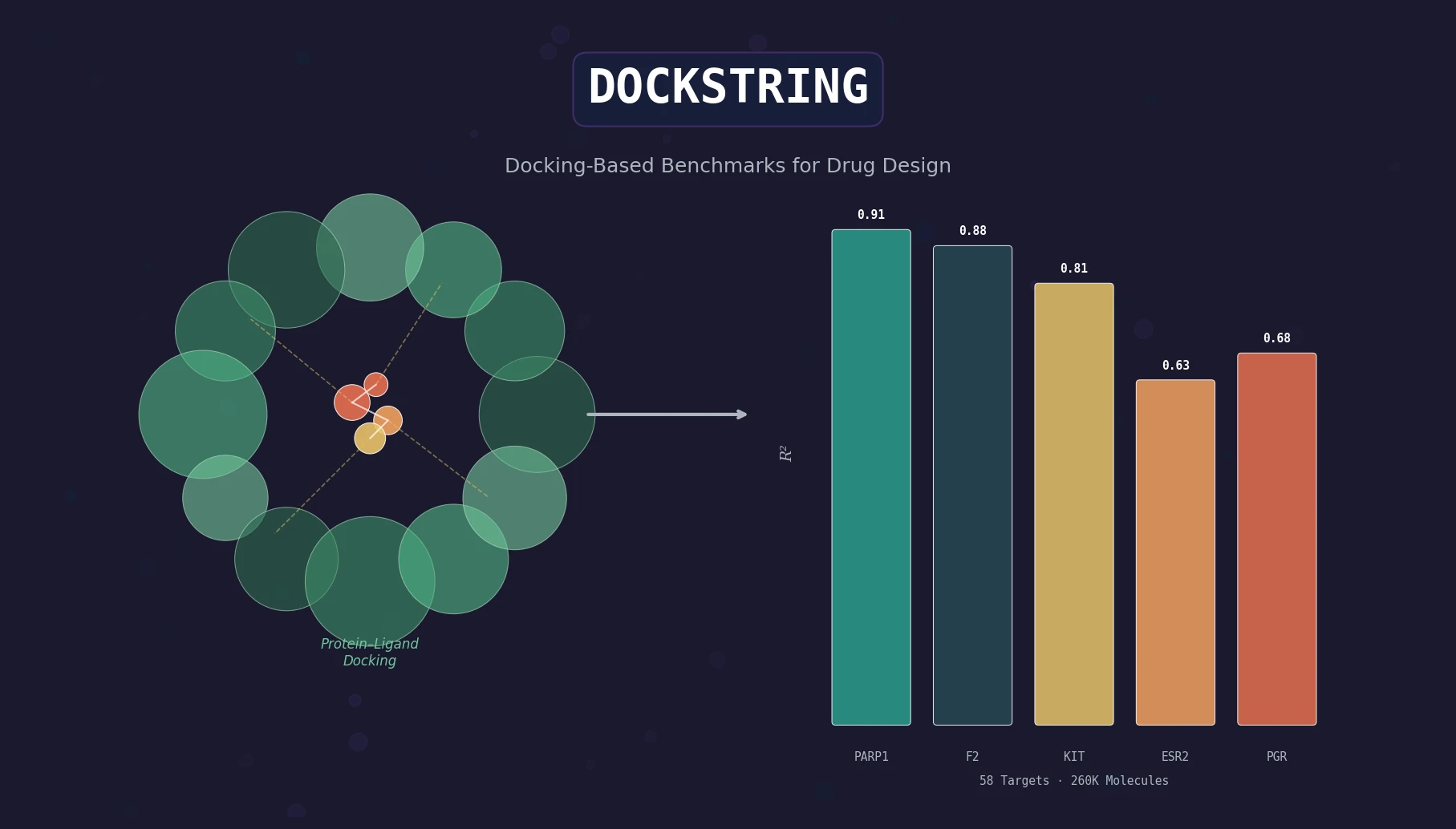
Stylized visualization of protein-ligand docking and benchmark performance bars across five drug targets

DOCKSTRING: Docking-Based Benchmarks for Drug Design

DOCKSTRING bundles an AutoDock Vina wrapper, a 260K-molecule docking dataset across 58 protein targets, and pharmaceutically relevant benchmarks for regression, virtual screening, and de novo design.
Molecular Generation
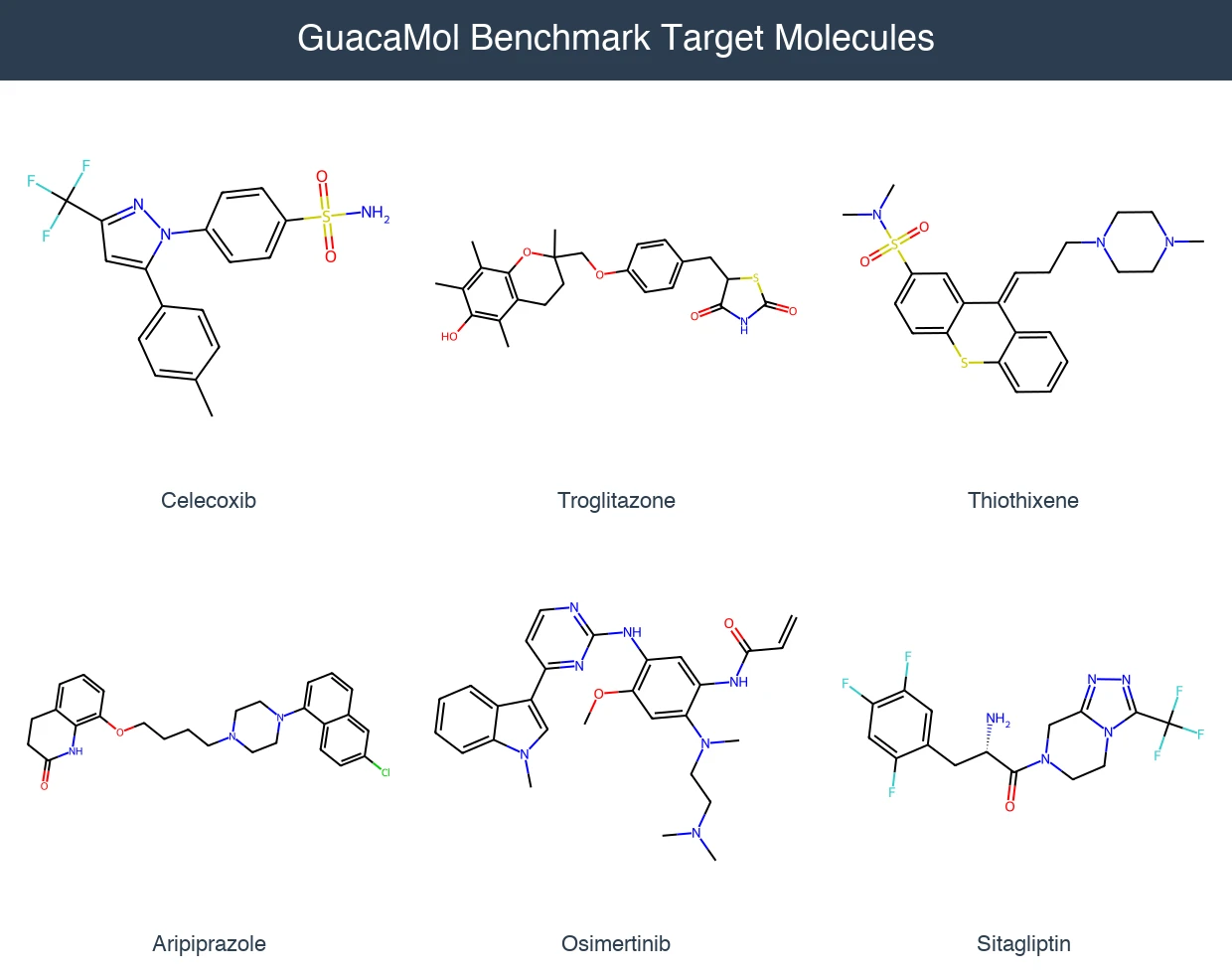
Grid of six GuacaMol benchmark target molecules: Celecoxib, Troglitazone, Thiothixene, Aripiprazole, Osimertinib, and Sitagliptin

GuacaMol: Benchmarking Models for De Novo Molecular Design

GuacaMol provides an open-source benchmarking framework with 5 distribution-learning and 20 goal-directed tasks to standardize evaluation of de novo molecular design models.

Predictive Chemistry
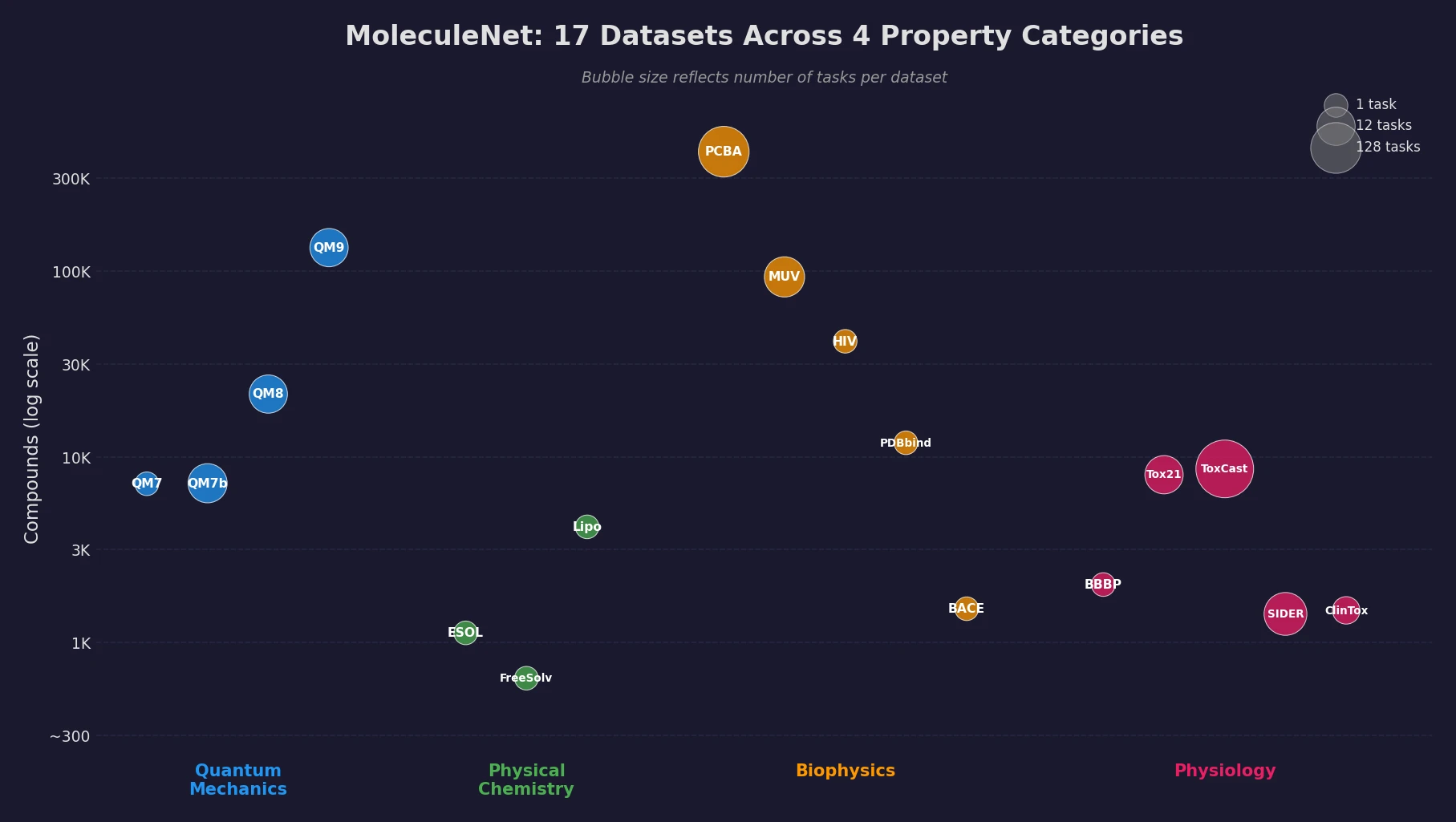
Overview of MoleculeNet dataset categories and task counts across quantum mechanics, physical chemistry, biophysics, and physiology

MoleculeNet: Benchmarking Molecular Machine Learning

MoleculeNet introduces a large-scale benchmark suite for molecular machine learning, curating over 700,000 compounds across 17 datasets with standardized metrics, data splits, and featurization methods integrated into the DeepChem open-source library.

Molecular Generation
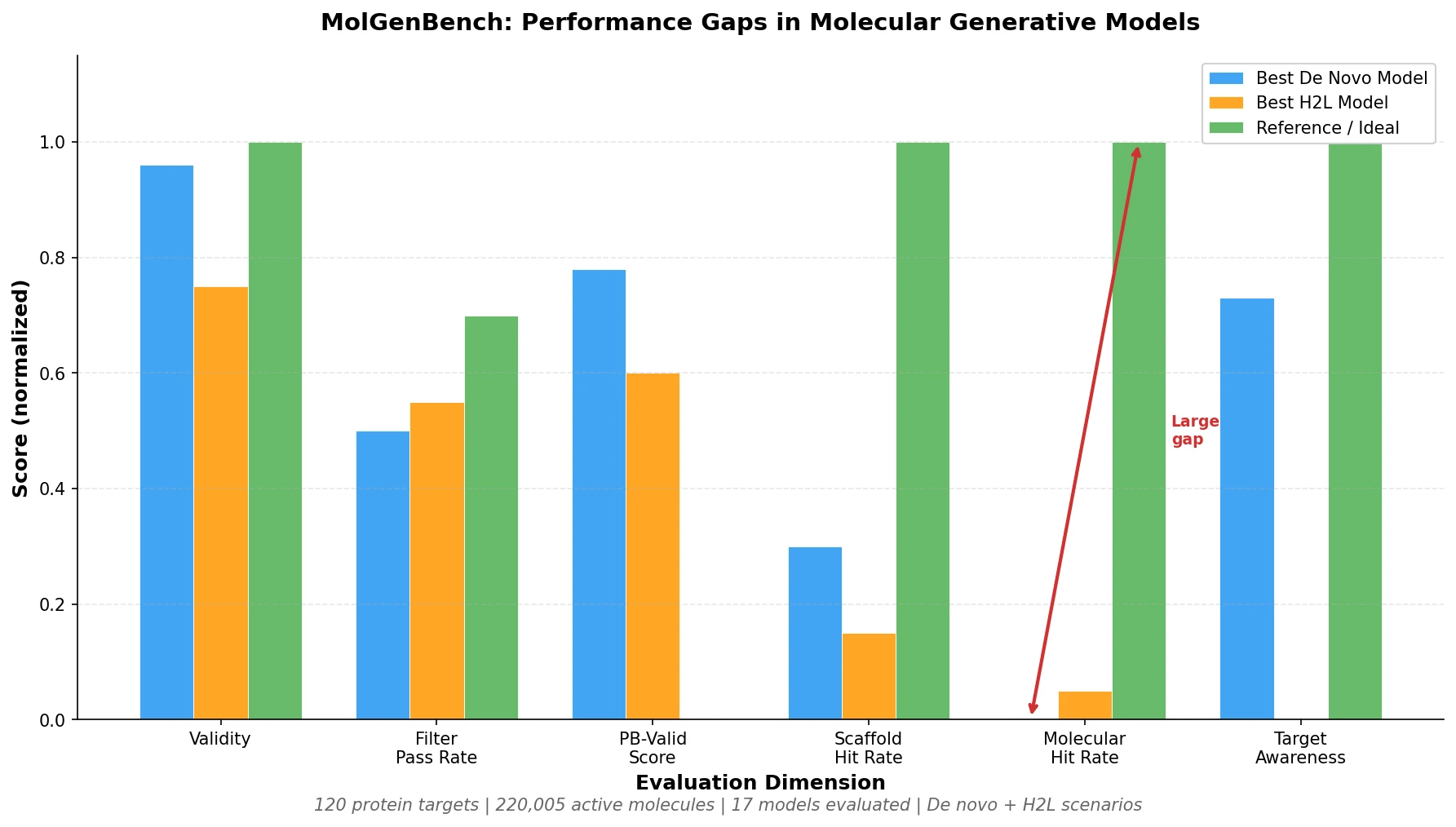
Bar chart comparing molecular generative model performance across six evaluation dimensions including validity, safety, and hit rates

MolGenBench: Benchmarking Molecular Generative Models

MolGenBench introduces a comprehensive benchmark for evaluating molecular generative models in realistic drug discovery settings, spanning de novo design and hit-to-lead optimization across 120 protein targets with 220,005 experimentally validated actives.

Molecular Generation
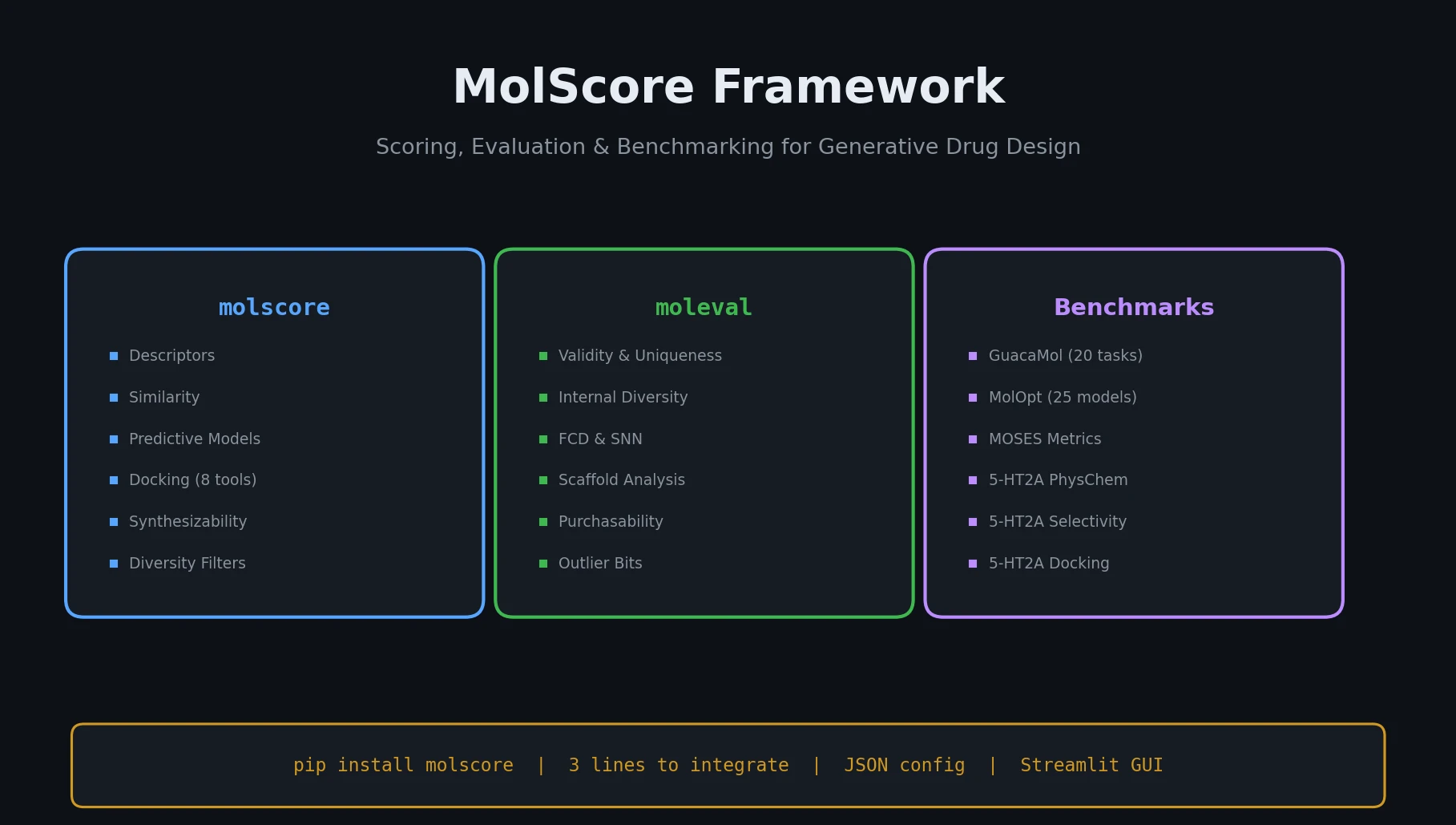
Diagram showing MolScore framework components: scoring functions, evaluation metrics, and benchmark modes

MolScore: Scoring and Benchmarking for Drug Design

MolScore is an open-source framework that unifies scoring functions, evaluation metrics, and benchmarks for generative molecular design, with configurable objectives and GUI support.

Molecular Generation
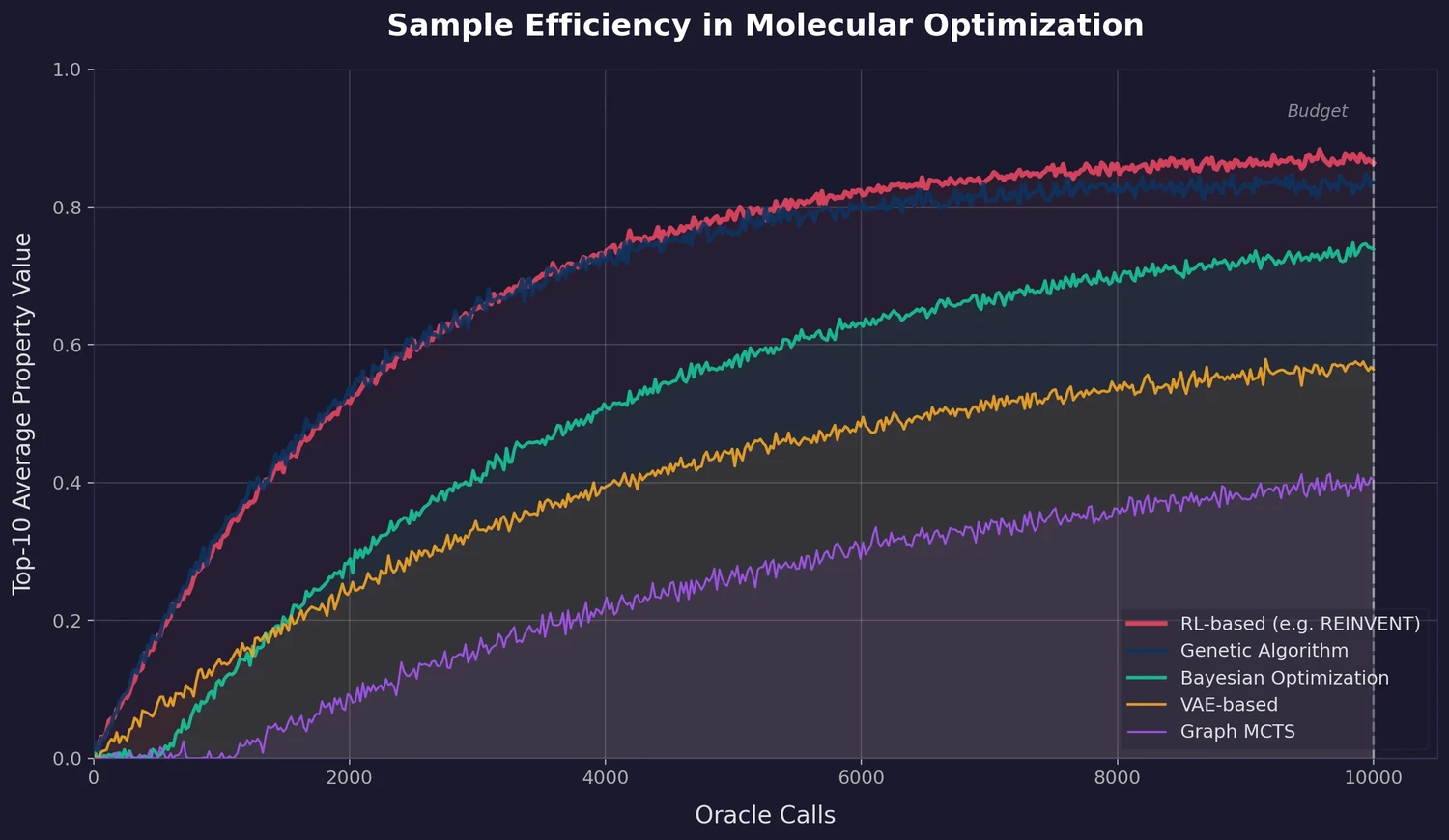
Sample efficiency curves showing different molecular optimization algorithm families converging at different rates under a fixed oracle budget

PMO: Benchmarking Sample-Efficient Molecular Design

A large-scale benchmark of 25 molecular optimization methods on 23 oracles under constrained oracle budgets, showing that sample efficiency is a critical and often neglected dimension of evaluation.

Molecular Representations
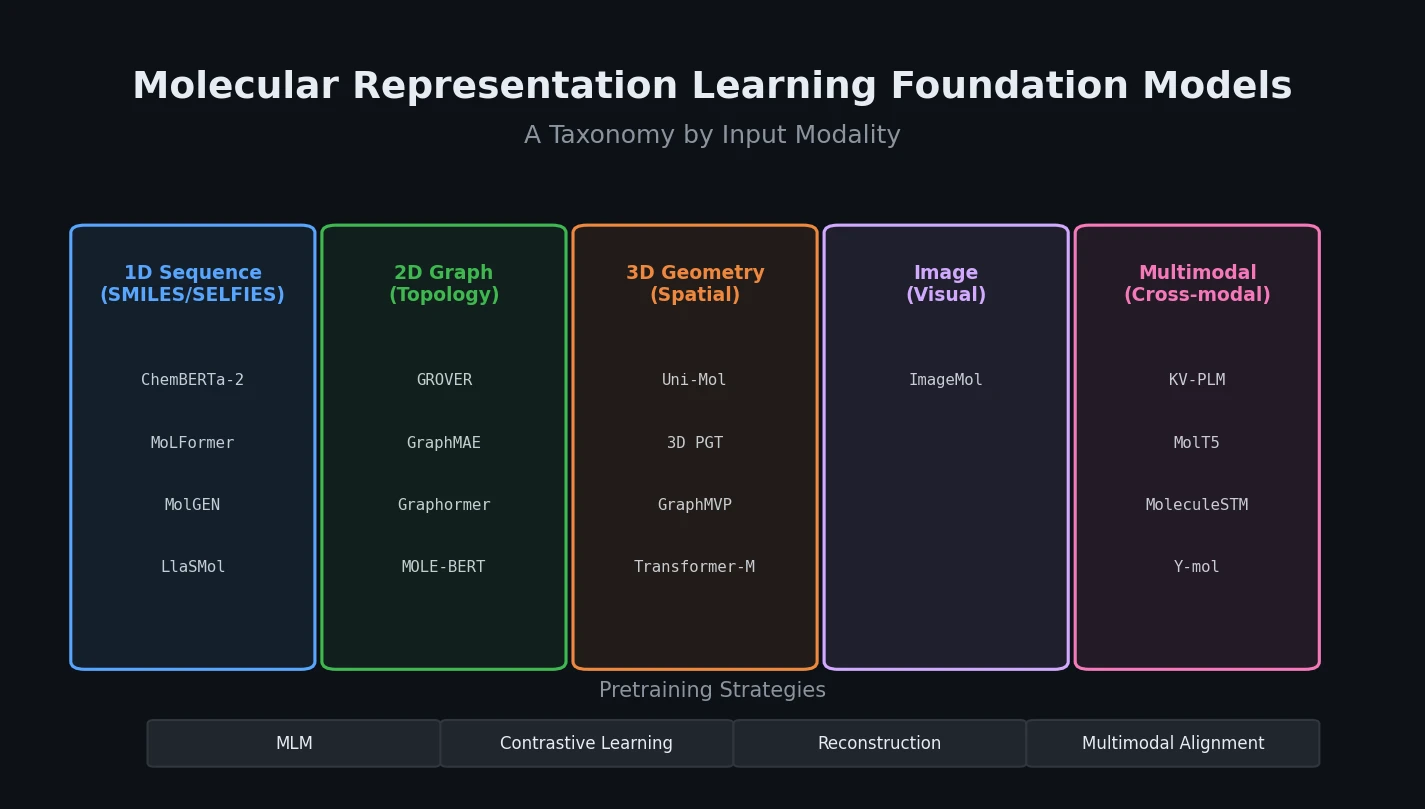
Taxonomy of molecular representation learning foundation models organized by input modality

Review of Molecular Representation Learning Models

A comprehensive survey classifying molecular representation learning foundation models by input modality (sequence, graph, 3D, image, multimodal) and analyzing four pretraining paradigms for drug discovery tasks.

Molecular Generation
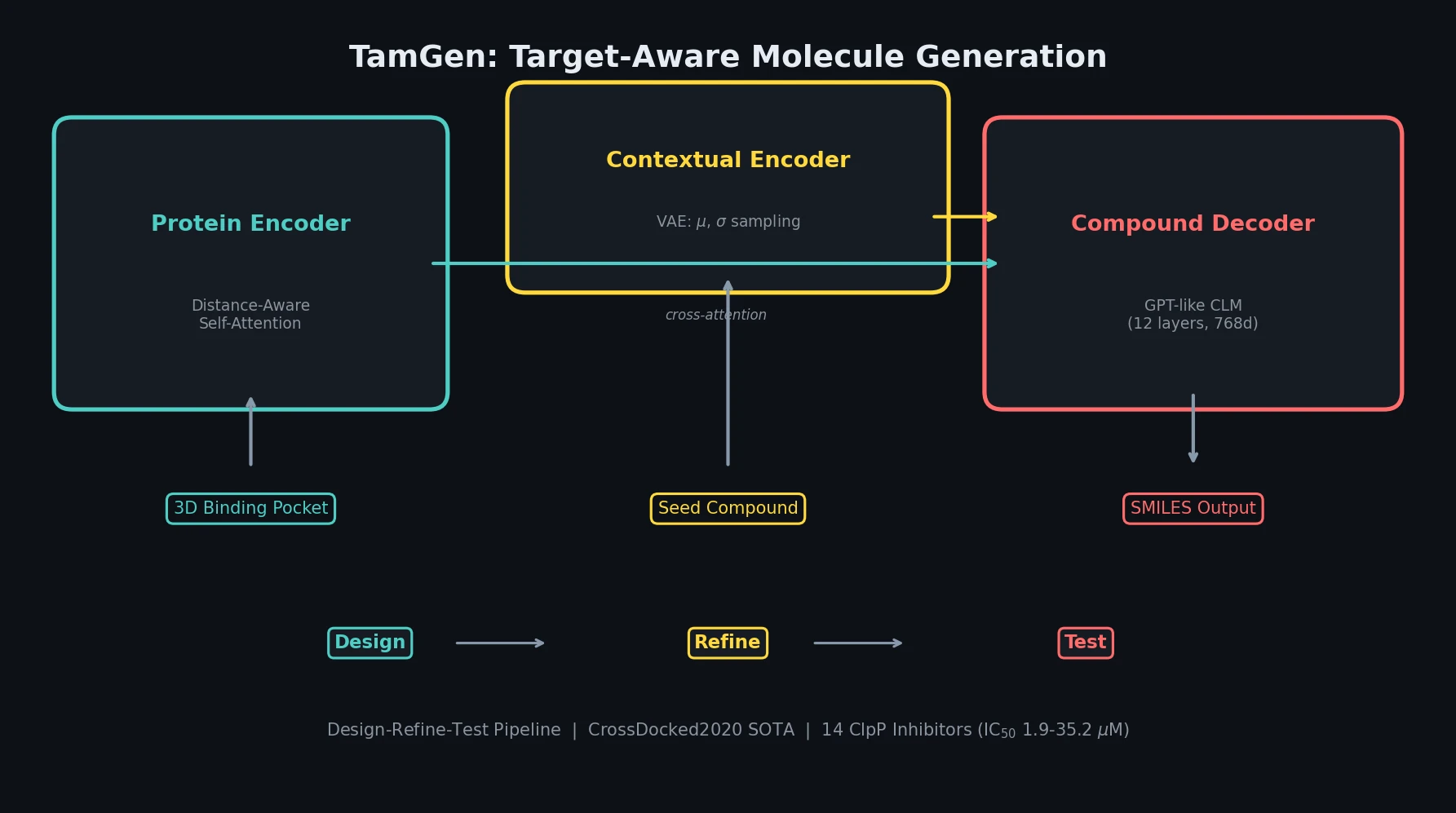
Diagram showing the TamGen three-stage pipeline from protein pocket encoding through compound generation to experimental testing

TamGen: GPT-Based Target-Aware Drug Design and Generation

Introduces TamGen, a target-aware molecular generation method using a pre-trained GPT-like chemical language model with protein structure conditioning. A Design-Refine-Test pipeline discovers 14 inhibitors against tuberculosis ClpP protease, with IC50 values as low as 1.9 uM.

Molecular Generation
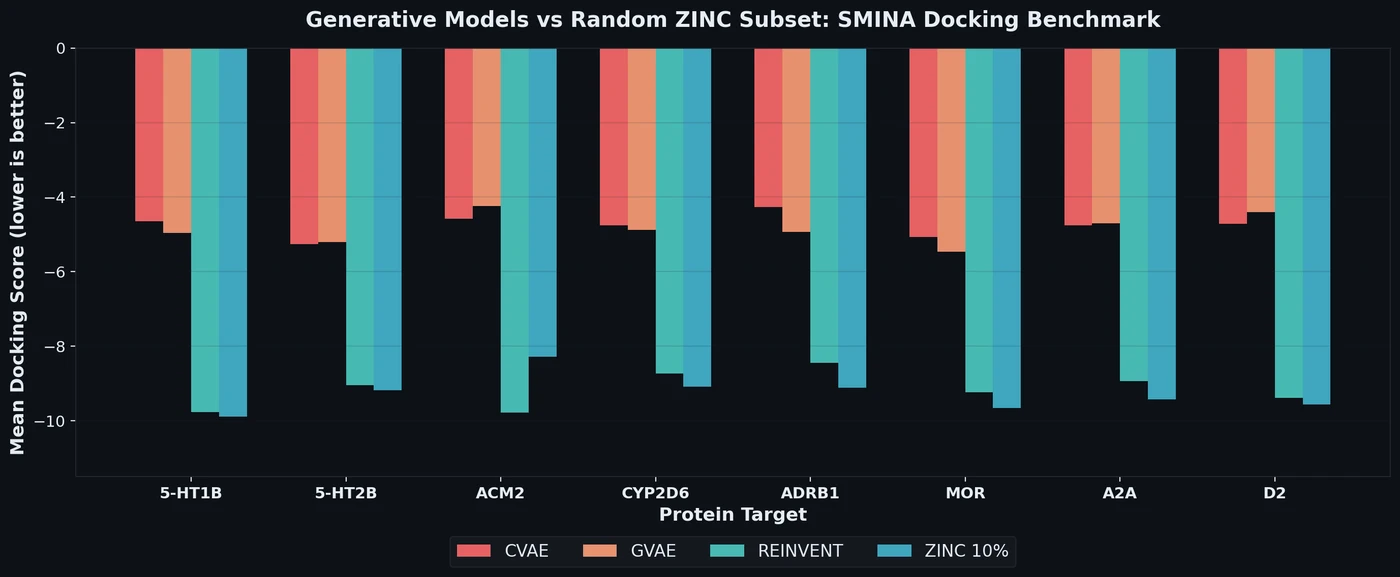
Bar chart comparing SMINA docking scores of CVAE, GVAE, and REINVENT against a random ZINC 10% baseline across eight protein targets

SMINA Docking Benchmark for De Novo Drug Design Models

Proposes a benchmark for de novo drug design using SMINA docking scores across eight drug targets, revealing that popular generative models fail to outperform random ZINC subsets.

Molecular Generation
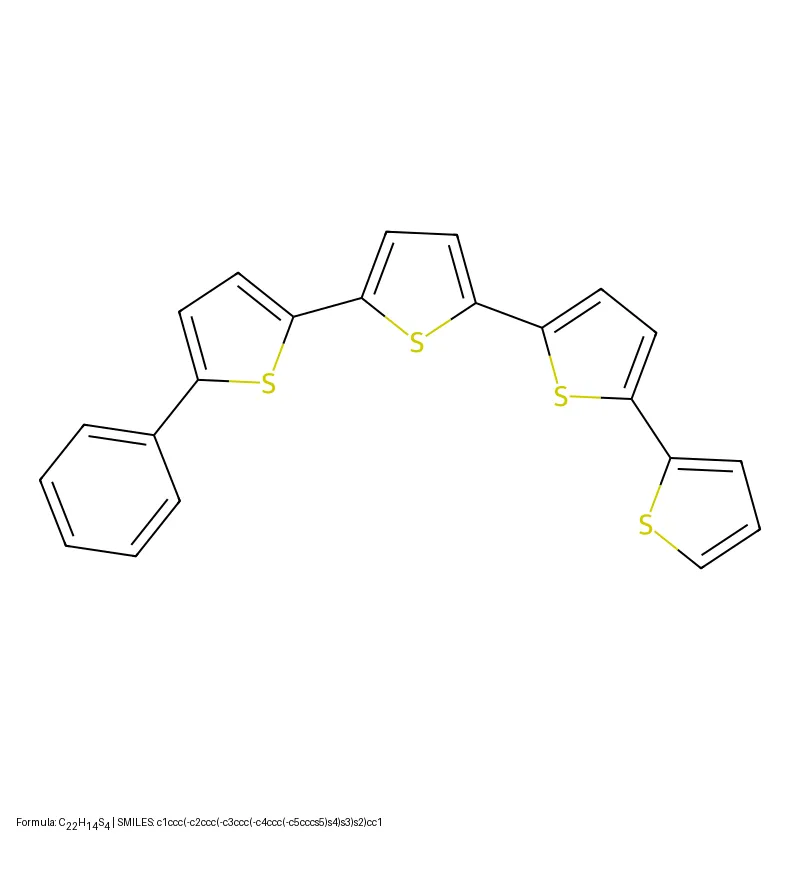
2D structure of a phenyl-quaterthiophene, a conjugated organic molecule representative of the photovoltaic donor materials benchmarked in the Tartarus platform

Tartarus: Realistic Inverse Molecular Design Benchmarks

Tartarus introduces a modular suite of realistic molecular design benchmarks grounded in computational chemistry simulations. Benchmarking eight generative models reveals that no single algorithm dominates all tasks, and simple genetic algorithms often outperform deep generative models.

Predictive Chemistry
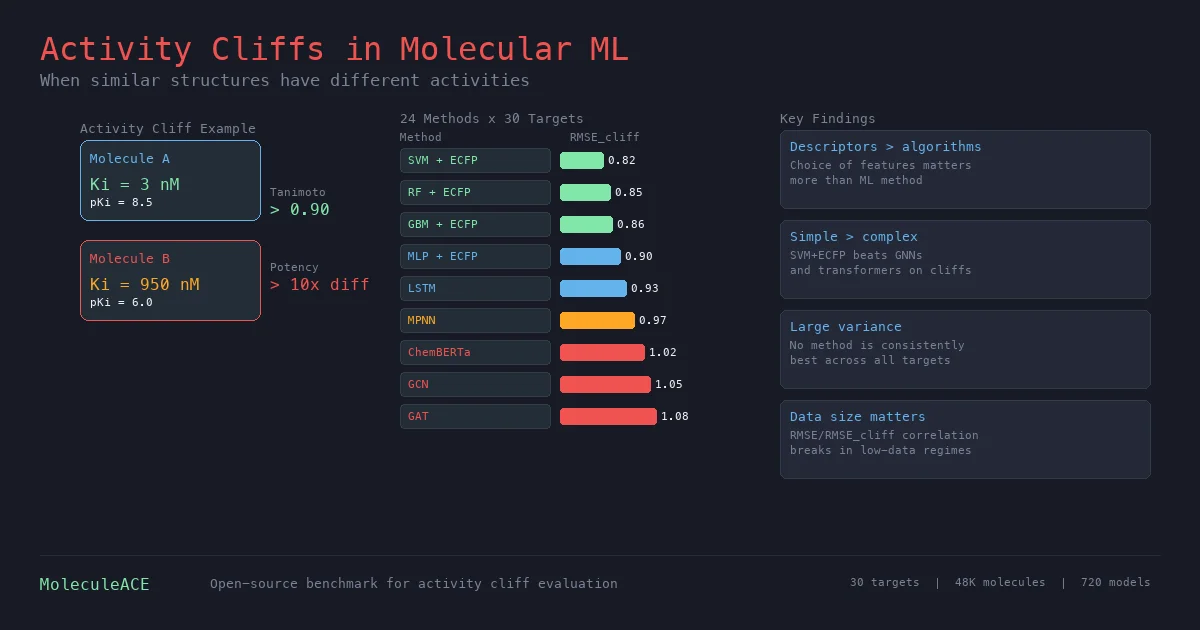
Activity cliffs benchmark showing method rankings by RMSE on cliff compounds, with SVM plus ECFP outperforming deep learning approaches

Exposing Limitations of Molecular ML with Activity Cliffs

This paper benchmarks 24 machine and deep learning methods on activity cliff compounds (structurally similar molecules with large potency differences) across 30 macromolecular targets. Traditional ML with molecular fingerprints consistently outperforms graph neural networks and SMILES-based transformers on these challenging cases, especially in low-data regimes.

Computational Chemistry
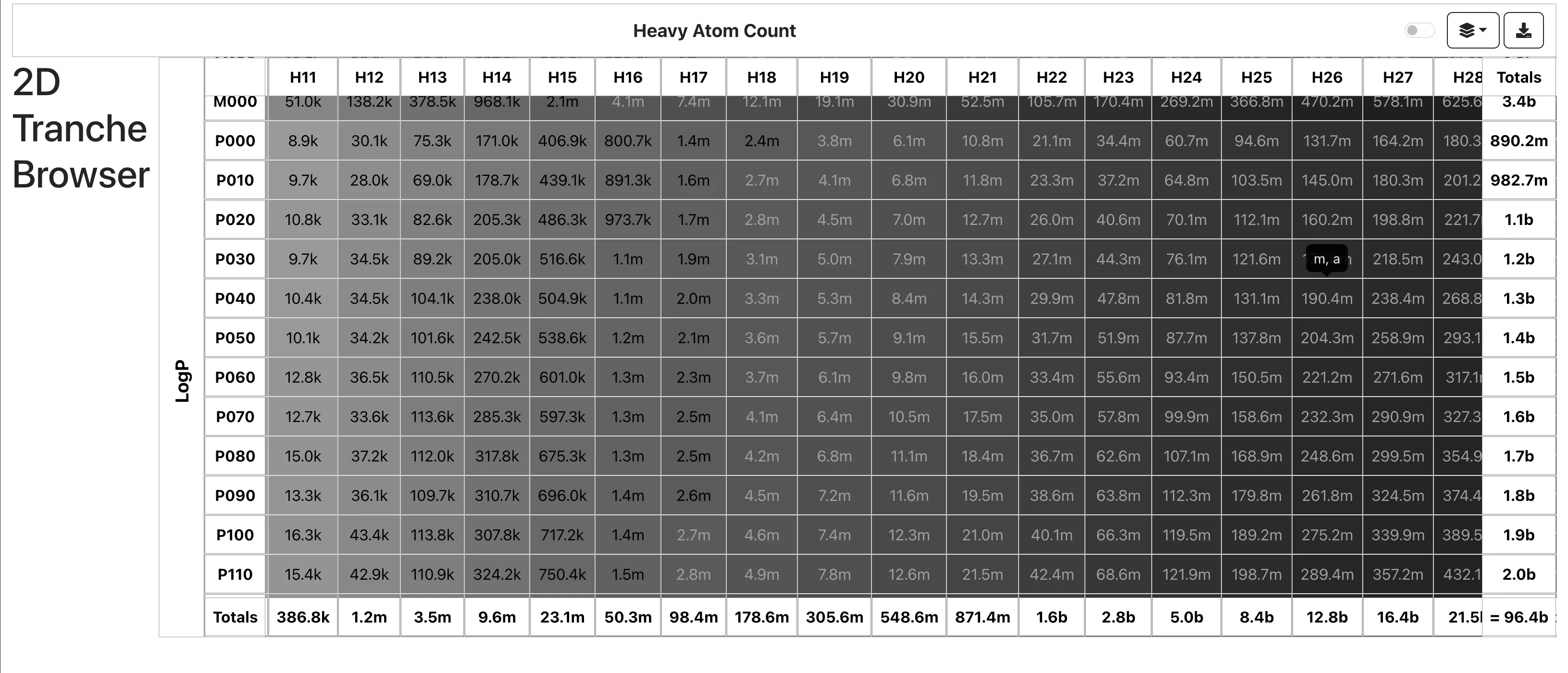
ZINC-22 Tranche Browser showing molecular count distribution

ZINC-22: A Multi-Billion Scale Database for Ligand Discovery

ZINC-22 is a multi-billion-scale public database containing over 37 billion make-on-demand molecules. It utilizes distributed infrastructure and specialized search algorithms to support modern ultra-large virtual screening campaigns.