Computational Chemistry
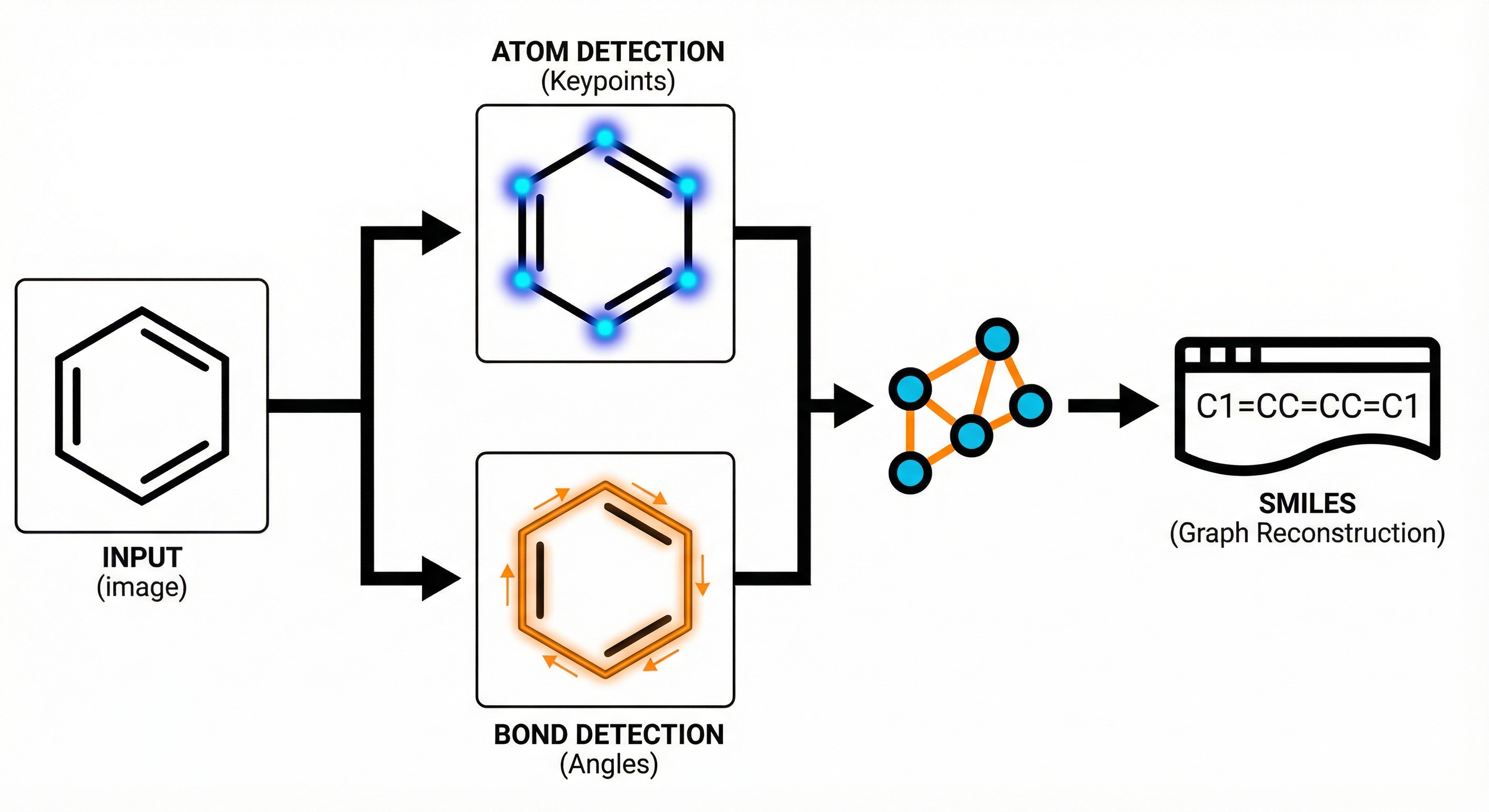
ABC-Net detects atom and bond keypoints to reconstruct molecular graphs from images

ABC-Net: Divide-and-Conquer SMILES Recognition

ABC-Net reformulates molecular image recognition as a keypoint detection problem. By predicting atom/bond centers and properties via a single Fully Convolutional Network, it achieves >94% accuracy with high data efficiency.

Computational Chemistry
ChemPix: Hand-Drawn Hydrocarbon Recognition

ChemPix: Hand-Drawn Hydrocarbon Recognition

Proposes a CNN-LSTM architecture that treats chemical structure recognition as an image captioning task. Introduces a robust synthetic data generation pipeline with augmentation, degradation, and background addition to train models that generalize to hand-drawn inputs without seeing real data during pre-training.

Computational Chemistry
DECIMER 1.0: Transformers for Chemical Image Recognition

DECIMER 1.0: Transformers for Chemical Image Recognition

DECIMER 1.0 introduces a Transformer-based architecture coupled with EfficientNet-B3 to solve Optical Chemical Structure Recognition. By leveraging the robust SELFIES representation and scaling training to over 35 million molecules, it achieves state-of-the-art accuracy on synthetic benchmarks, offering an open-source solution for mining chemical data from legacy literature.

Computational Chemistry
End-to-End Transformer for Molecular Image Captioning

End-to-End Transformer for Molecular Image Captioning

This paper introduces a convolution-free, end-to-end transformer model for molecular image translation. By replacing CNN encoders with Vision Transformers, it achieves superior performance on noisy datasets compared to ResNet-LSTM baselines.

Computational Chemistry
Handwritten chemical structure recognition with RCGD and SSML

Handwritten Chemical Structure Recognition with RCGD

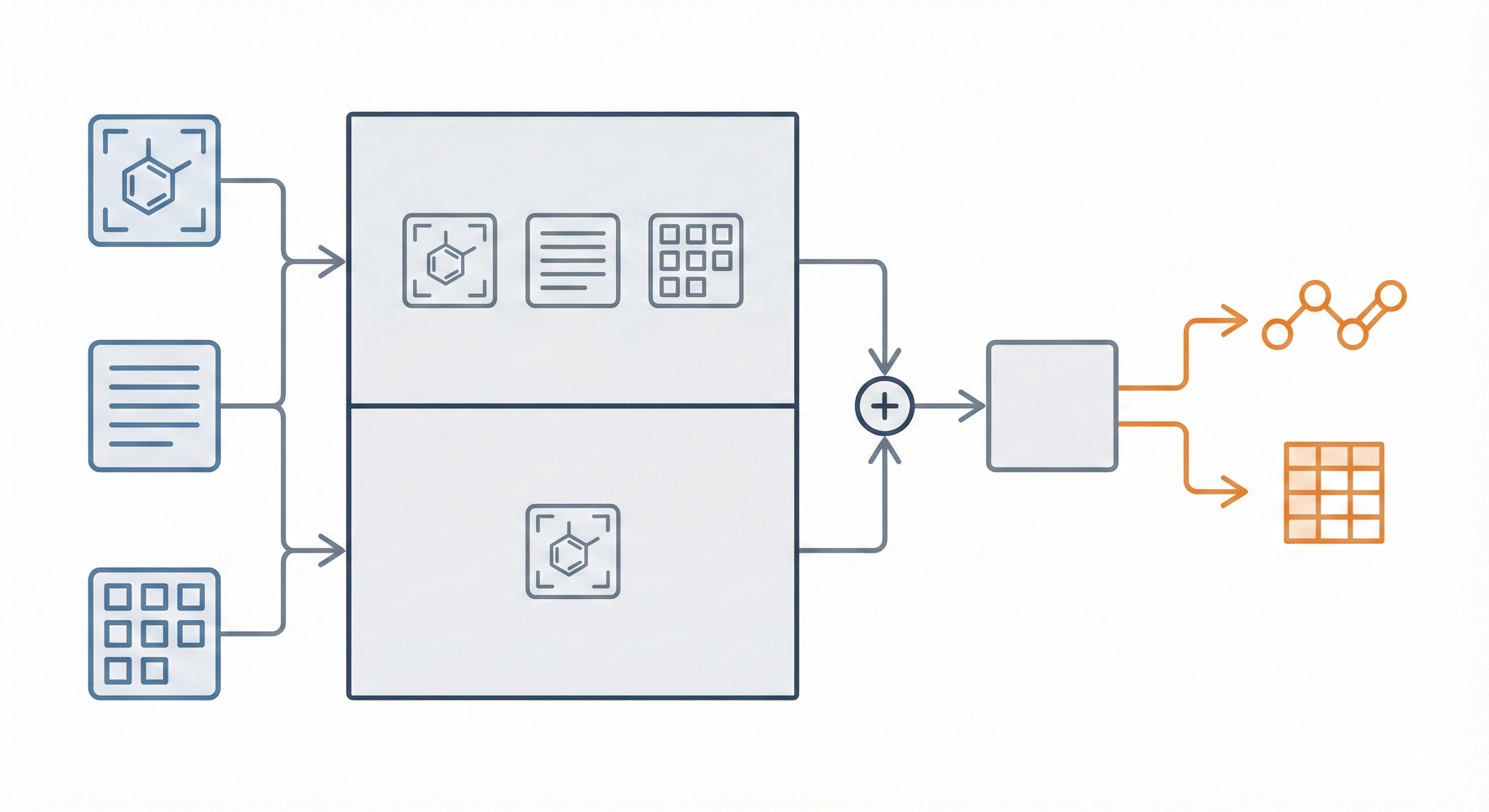
Proposes a Random Conditional Guided Decoder (RCGD) and a Structure-Specific Markup Language (SSML) to handle the ambiguity and complexity of handwritten chemical structure recognition, validated on a new benchmark dataset (EDU-CHEMC) with 50,000 handwritten images.

Computational Chemistry
ICMDT: Automated Chemical Image Recognition with Deep TNT

ICMDT: Automated Chemical Image Recognition

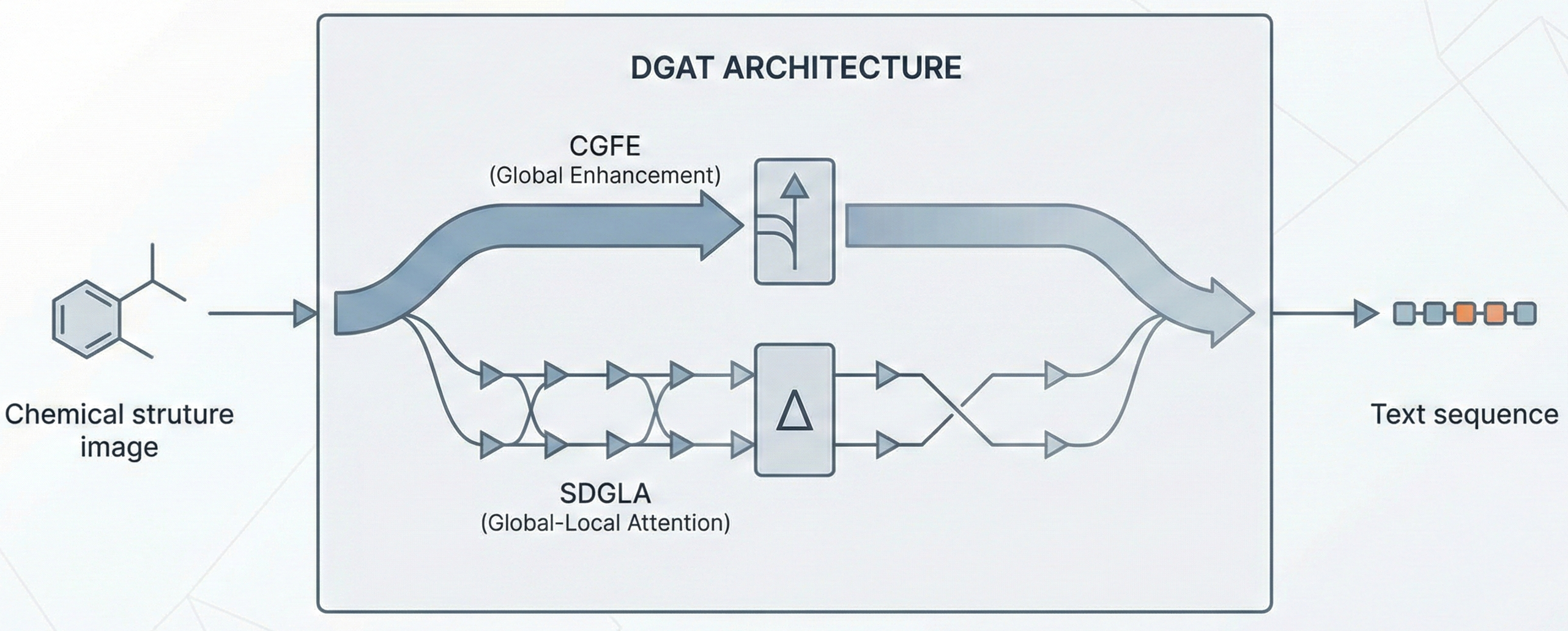
This paper introduces ICMDT, a Transformer-based architecture for molecular translation (image-to-InChI). By enhancing the TNT block to fuse pixel, small patch, and large patch embeddings, the model achieves superior accuracy on the Bristol-Myers Squibb dataset compared to CNN-RNN and standard Transformer baselines.

Computational Chemistry
Image-to-Graph Transformers for Chemical Structure Recognition

Image-to-Graph Transformers

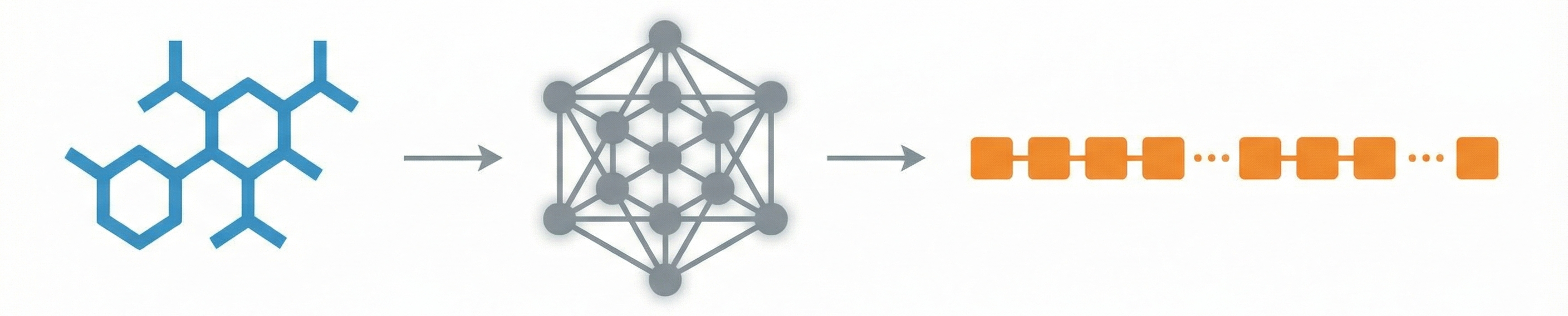
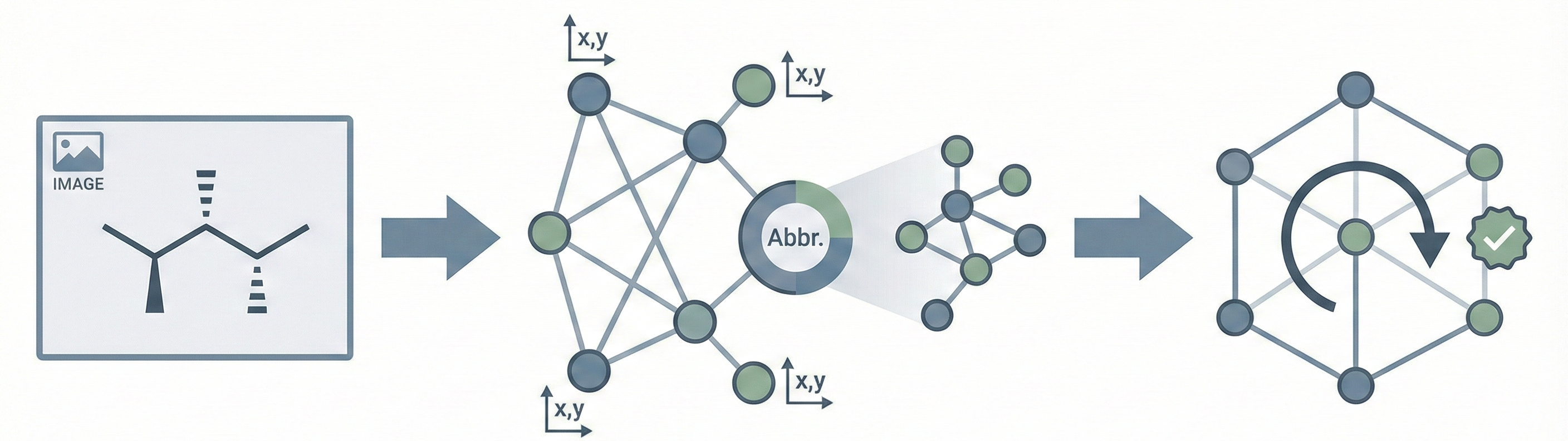
This paper proposes an end-to-end deep learning architecture that translates chemical images directly into molecular graphs using a ResNet-Transformer encoder and a graph-aware decoder. It addresses the limitations of SMILES-based approaches by effectively handling non-atomic symbols (abbreviations) and varying drawing styles found in scientific literature.

Computational Chemistry

Image2SMILES: Transformer OCSR with Synthetic Data Pipeline

A Transformer-based system for optical chemical structure recognition introducing a comprehensive data generation pipeline (FG-SMILES, Markush structures, visual contamination) achieving 79% accuracy on real-world images, outperforming rule-based systems like OSRA.

Computational Chemistry

MICER: Molecular Image Captioning with Transfer Learning

MICER treats optical chemical structure recognition as an image captioning task, leveraging transfer learning with a fine-tuned ResNet encoder and attention-based LSTM decoder to convert molecular images into SMILES strings, significantly outperforming rule-based and previous deep learning methods.

Computational Chemistry

MolMiner: Deep Learning OCSR with YOLOv5 Detection

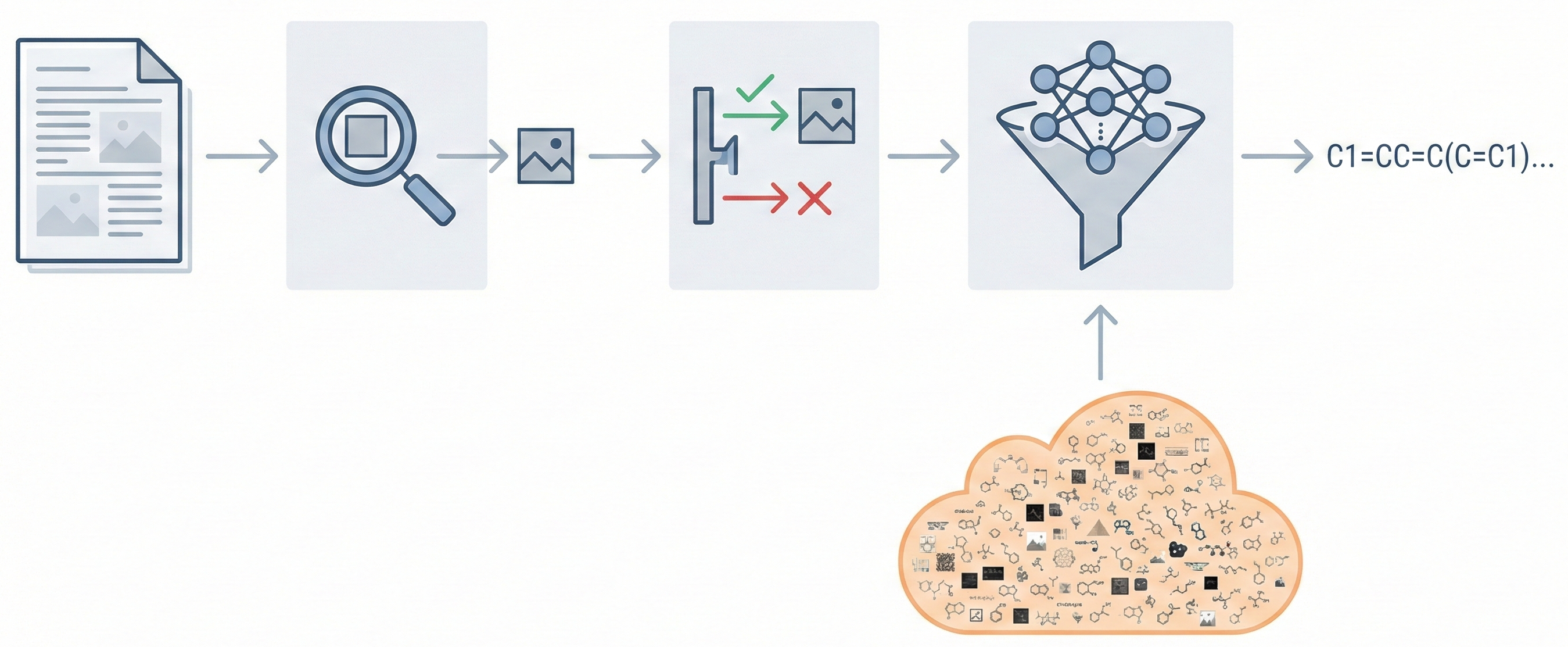
MolMiner replaces traditional rule-based vectorization with a deep learning object detection pipeline (YOLOv5) to extract chemical structures from PDFs. It achieves state-of-the-art performance on benchmarks and introduces a new real-world dataset of 3,040 images.

Computational Chemistry

One Strike, You're Out: Detecting Markush Structures

Proposes a patch-based image processing pipeline using Inception V3 to filter Markush structures from chemical documents, significantly outperforming traditional fixed-feature (ORB) methods on low-SNR images.

Computational Chemistry

Review of OCSR Techniques (2022)

This systematization paper traces the history of OCSR, comparing early rule-based systems like OSRA with modern deep learning approaches like DECIMER. It highlights the shift from image classification to image captioning and identifies critical gaps in dataset standardization and evaluation metrics.