Computational Chemistry
DECIMER.ai: Optical Chemical Structure Recognition

DECIMER.ai: Optical Chemical Structure Recognition

DECIMER.ai addresses the lack of open tools for Optical Chemical Structure Recognition (OCSR) by providing a comprehensive, deep-learning-based workflow. It features a novel data generation pipeline (RanDepict), a web application, and models for segmentation and recognition that rival or exceed proprietary solutions.

Computational Chemistry
Dual-Path Global Awareness Transformer (DGAT)

Dual-Path Global Awareness Transformer (DGAT)

Proposes a new architecture (DGAT) to solve global context loss in chemical structure recognition. Introduces Cascaded Global Feature Enhancement and Sparse Differential Global-Local Attention, achieving SOTA results (84.0% BLEU-4) and handling complex chiral structures implicitly.

Computational Chemistry
Enhanced DECIMER for Hand-Drawn Structure Recognition

Enhanced DECIMER for Hand-Drawn Structure Recognition

This paper presents an enhanced deep learning architecture for Optical Chemical Structure Recognition (OCSR) specifically optimized for hand-drawn inputs. By pairing an EfficientNetV2 encoder with a Transformer decoder and training on over 150 million synthetic images, the model achieves state-of-the-art accuracy on real-world hand-drawn benchmarks.

Computational Chemistry
Image2InChI: SwinTransformer for Molecular Recognition

Image2InChI: SwinTransformer for Molecular Recognition

Proposes Image2InChI, an OCSR model with improved SwinTransformer encoder and novel feature fusion network with attention mechanisms that achieves 99.8% InChI accuracy on the BMS dataset.

Computational Chemistry
MarkushGrapher: Multi-modal Markush Structure Recognition

MarkushGrapher: Multi-modal Markush Structure Recognition

This paper introduces a novel multi-modal approach for extracting chemical Markush structures from patents, combining a Vision-Text-Layout encoder with a specialized chemical vision encoder. It addresses the lack of training data with a robust synthetic generation pipeline and introduces M2S, a new real-world benchmark.

Computational Chemistry
MMSSC-Net: Multi-Stage Sequence Cognitive Networks

MMSSC-Net: Multi-Stage Sequence Cognitive Networks

MMSSC-Net introduces a multi-stage cognitive approach for OCSR, utilizing a SwinV2 encoder and GPT-2 decoder to recognize atomic and bond sequences. It achieves high accuracy (94%+) on benchmark datasets by effectively handling varying image resolutions and noise.

Computational Chemistry
MolGrapher: Graph-based Visual Recognition of Chemical Structures

MolGrapher: Graph-based Chemical Recognition

MolGrapher introduces a novel three-stage pipeline (keypoint detection, supergraph construction, GNN classification) for recognizing chemical structures from images. It achieves state-of-the-art results by treating molecules as graphs, and introduces the USPTO-30K benchmark.

Computational Chemistry
MolMole: Unified Vision Pipeline for Molecule Mining

MolMole: Unified Vision Pipeline for Molecule Mining

MolMole unifies molecule detection, reaction parsing, and structure recognition into a single vision-based pipeline, achieving SOTA performance on a newly introduced 550-page benchmark by processing full documents without external layout parsers.

Computational Chemistry
MolScribe: Image-to-Graph Molecular Recognition

MolScribe: Image-to-Graph Molecular Recognition

MolScribe reformulates molecular recognition as an image-to-graph generation task, explicitly predicting atom coordinates and bonds to better handle stereochemistry and abbreviated structures compared to image-to-SMILES baselines.

Computational Chemistry
MolSight: OCSR with RL and Multi-Granularity Learning

MolSight: OCSR with RL and Multi-Granularity Learning

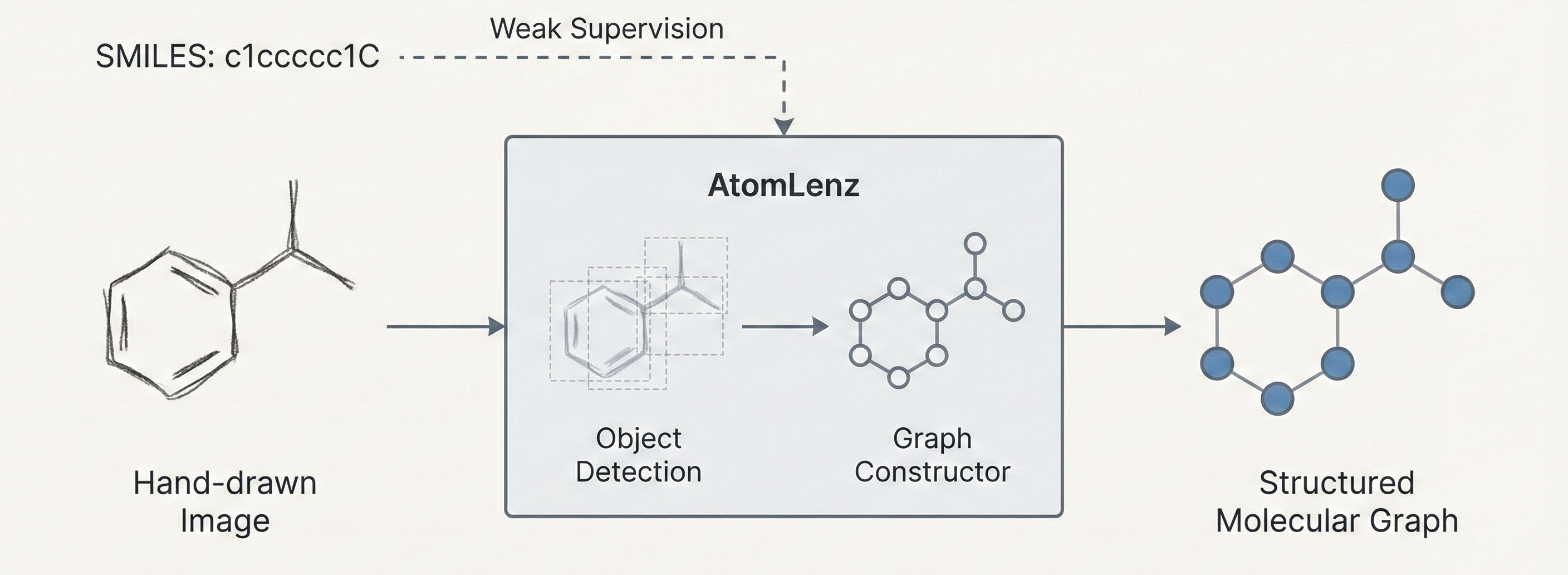
MolSight introduces a three-stage training paradigm for Optical Chemical Structure Recognition (OCSR), utilizing large-scale pretraining, multi-granularity fine-tuning with auxiliary bond and coordinate prediction tasks, and reinforcement learning (GRPO) to achieve state-of-the-art performance in recognizing complex stereochemical structures like chiral centers and cis-trans isomers.

Computational Chemistry
OCSU: Optical Chemical Structure Understanding

OCSU: Optical Chemical Structure Understanding

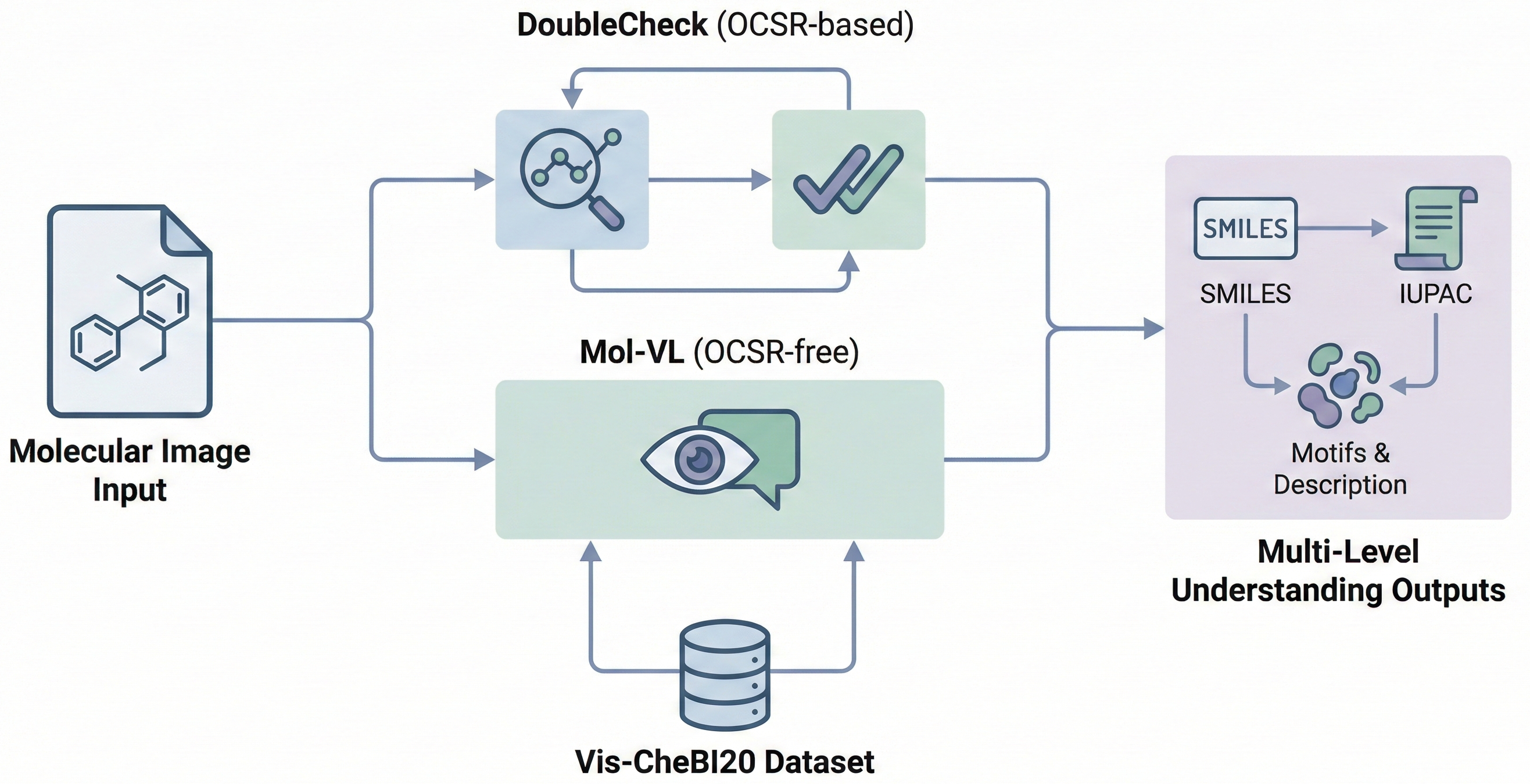
Proposes the ‘Optical Chemical Structure Understanding’ (OCSU) task to translate molecular images into multi-level descriptions (motifs, IUPAC, SMILES). Introduces the Vis-CheBI20 dataset and two paradigms: DoubleCheck (OCSR-based) and Mol-VL (OCSR-free).

Computational Chemistry
RFL: Simplifying Chemical Structure Recognition

RFL: Simplifying Chemical Structure Recognition

Proposes Ring-Free Language (RFL) to hierarchically decouple molecular graphs into skeletons, rings, and branches, solving issues with 1D serialization of complex 2D structures. Introduces the Molecular Skeleton Decoder (MSD) to progressively predict these components, achieving state-of-the-art results on handwritten and printed chemical structures.