Computational Chemistry
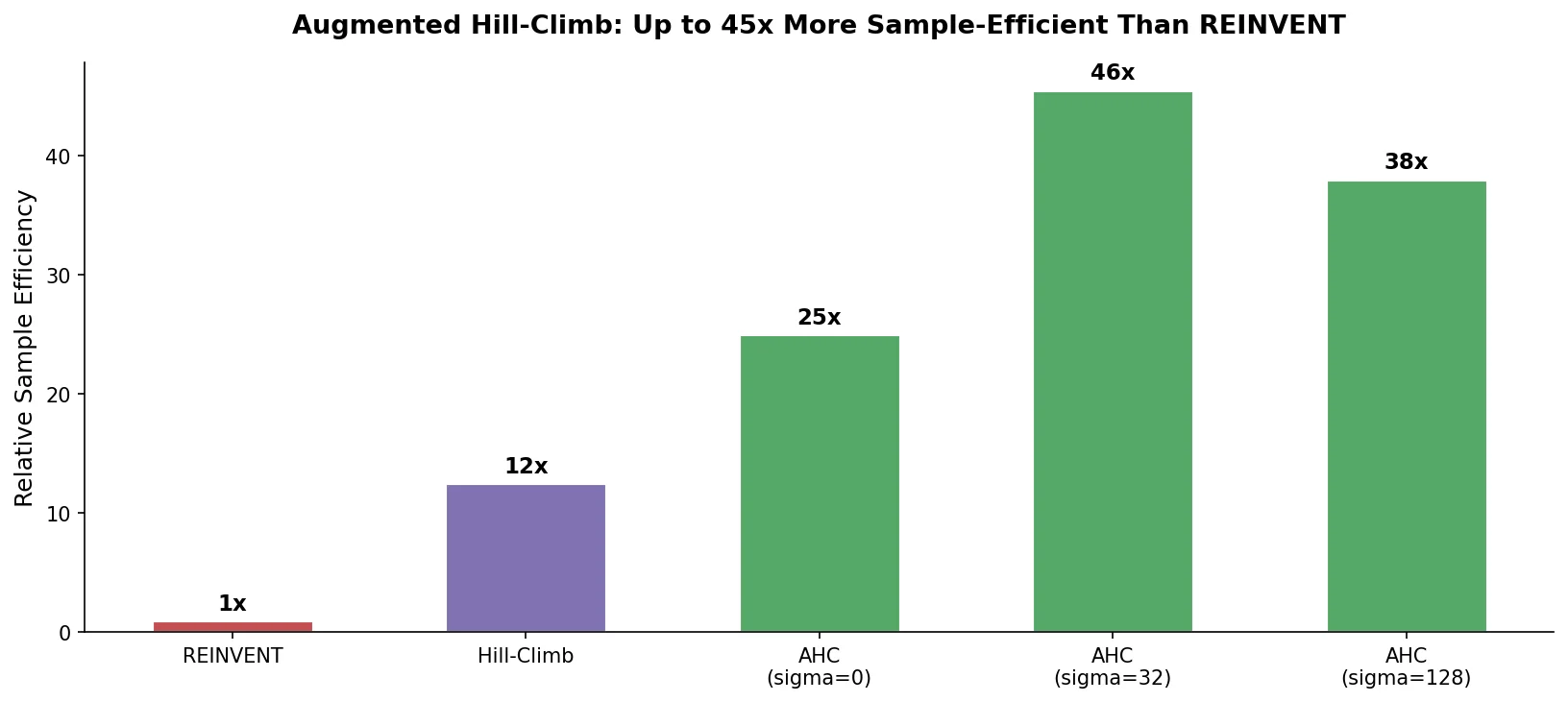
Bar chart showing Augmented Hill-Climb achieves up to 45x sample efficiency over REINVENT

Augmented Hill-Climb for RL-Based Molecule Design

Proposes Augmented Hill-Climb, a hybrid RL strategy for SMILES-based generative models that improves sample efficiency ~45-fold over REINVENT by filtering low-scoring molecules from the loss computation, with diversity filters to prevent mode collapse.
Computational Chemistry
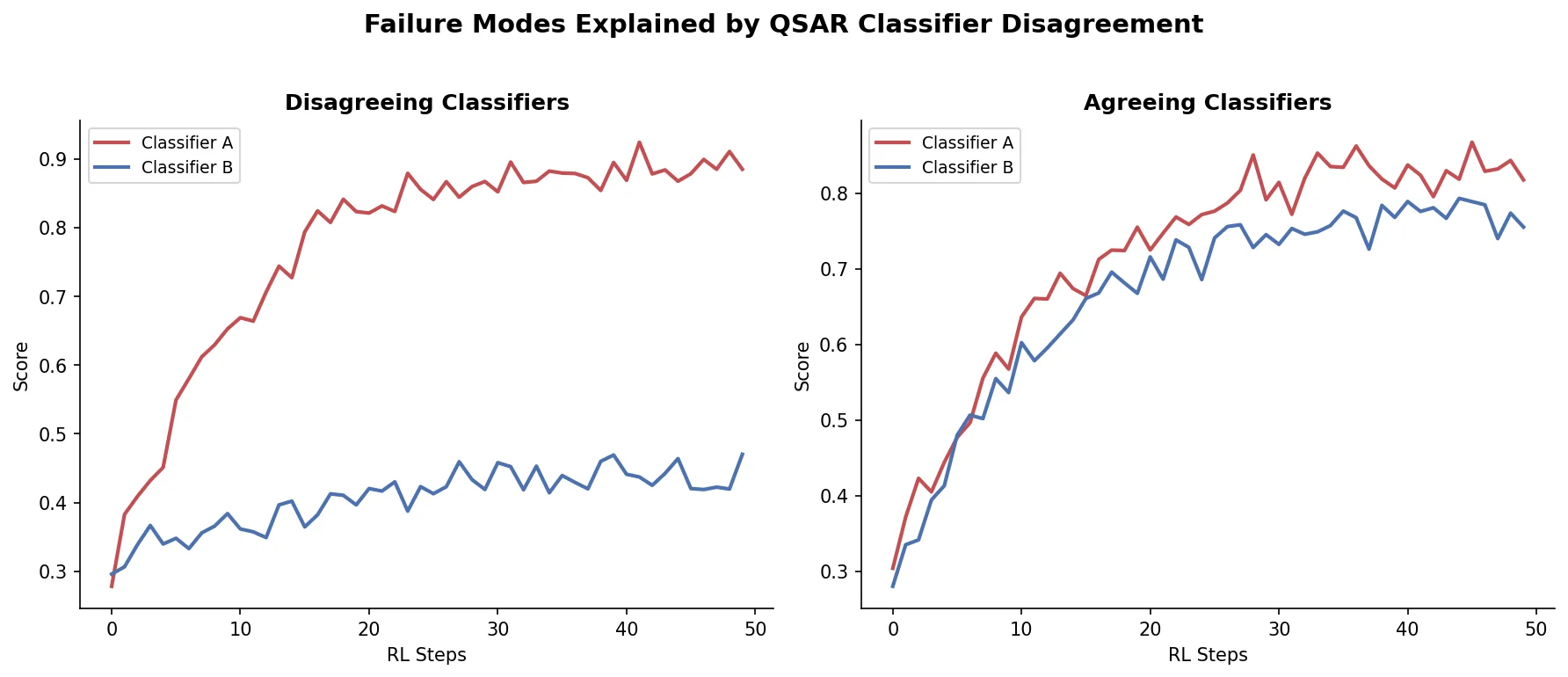
Two-panel plot showing score divergence with disagreeing classifiers vs convergence with agreeing classifiers

Avoiding Failure Modes in Goal-Directed Generation

Shows that divergence between optimization and control scores during goal-directed molecular generation is explained by pre-existing disagreement among QSAR models on the training distribution, not by algorithmic exploitation of model-specific biases.

Computational Chemistry
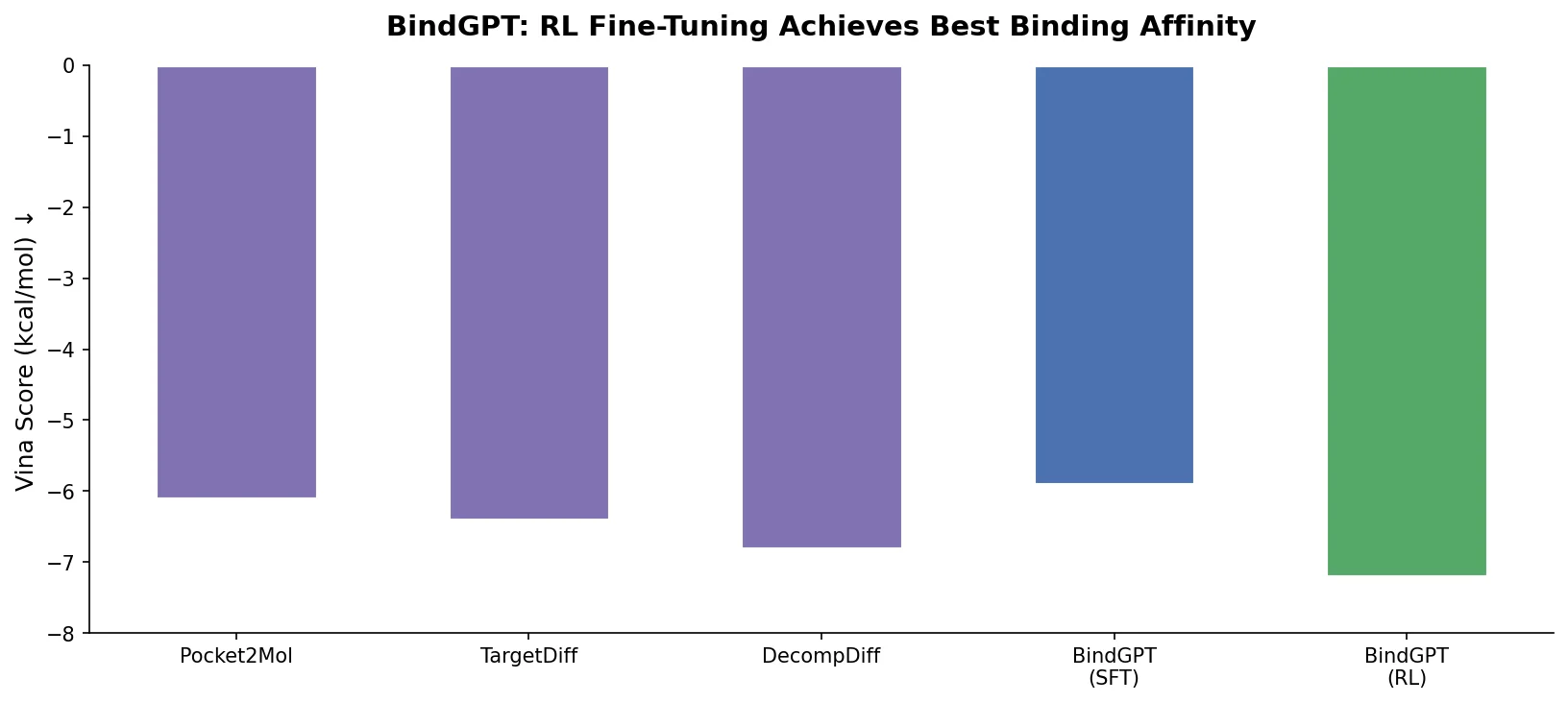
Bar chart showing BindGPT RL achieves best Vina binding scores compared to baselines

BindGPT: GPT for 3D Molecular Design and Docking

BindGPT formulates 3D molecular design as autoregressive text generation over combined SMILES and XYZ tokens, using large-scale pre-training and reinforcement learning to achieve competitive pocket-conditioned molecule generation.

Computational Chemistry
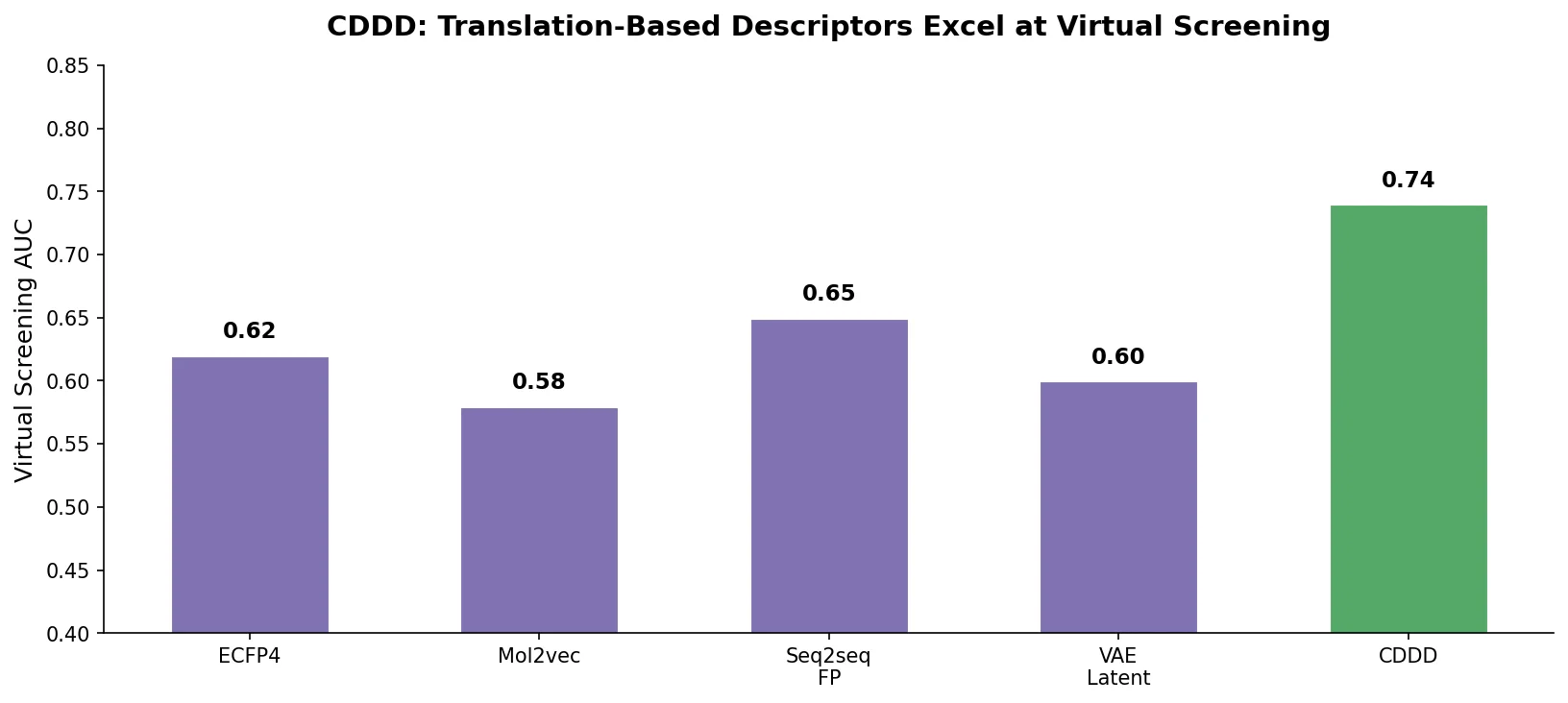
Bar chart comparing CDDD virtual screening AUC against ECFP4, Mol2vec, Seq2seq FP, and VAE baselines

CDDD: Learning Descriptors by Translating SMILES

Winter et al. propose CDDD, a translation-based encoder-decoder that learns continuous molecular descriptors by translating between equivalent chemical representations like SMILES and InChI, pretrained on 72 million compounds.

Computational Chemistry
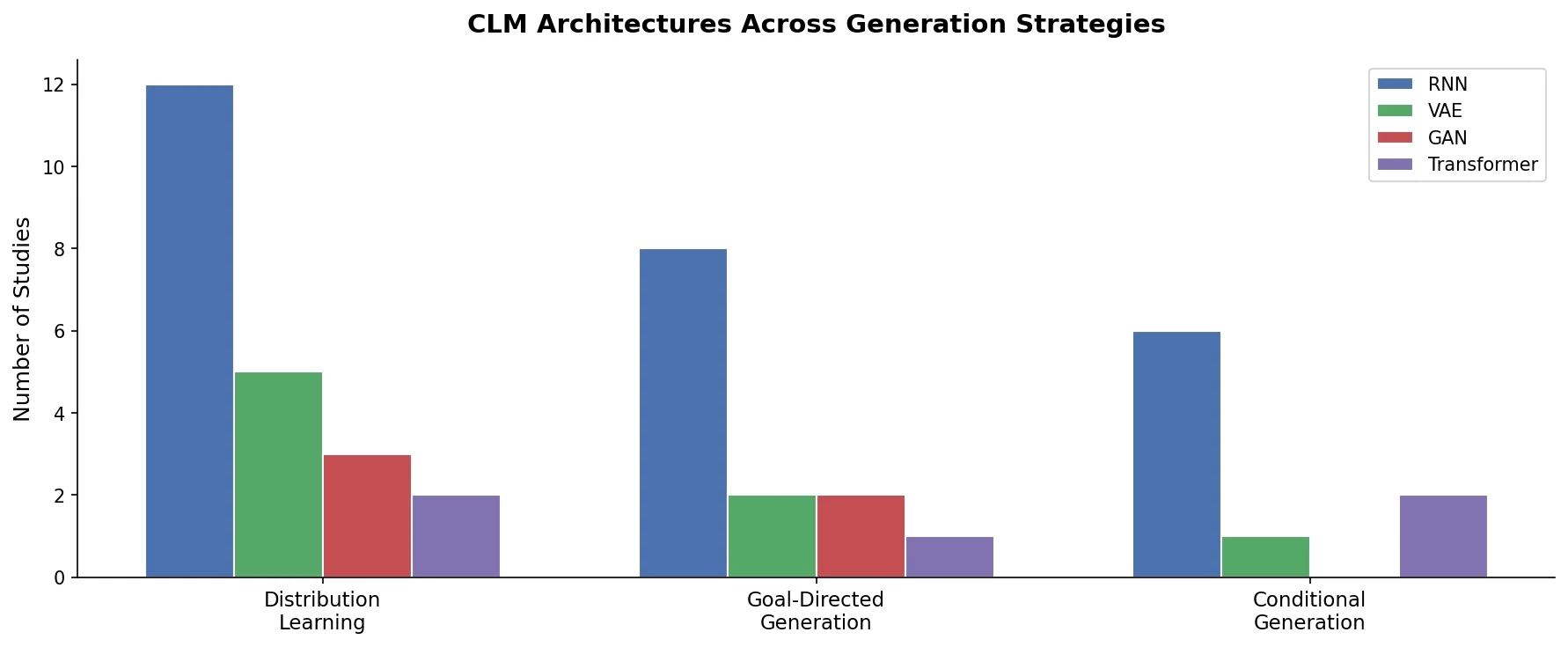
Grouped bar chart showing CLM architectures (RNN, VAE, GAN, Transformer) across generation strategies

Chemical Language Models for De Novo Drug Design Review

A minireview of chemical language models for de novo molecule design, covering SMILES and SELFIES representations, RNN and Transformer architectures, distribution learning, goal-directed and conditional generation, and prospective experimental validation.

Computational Chemistry
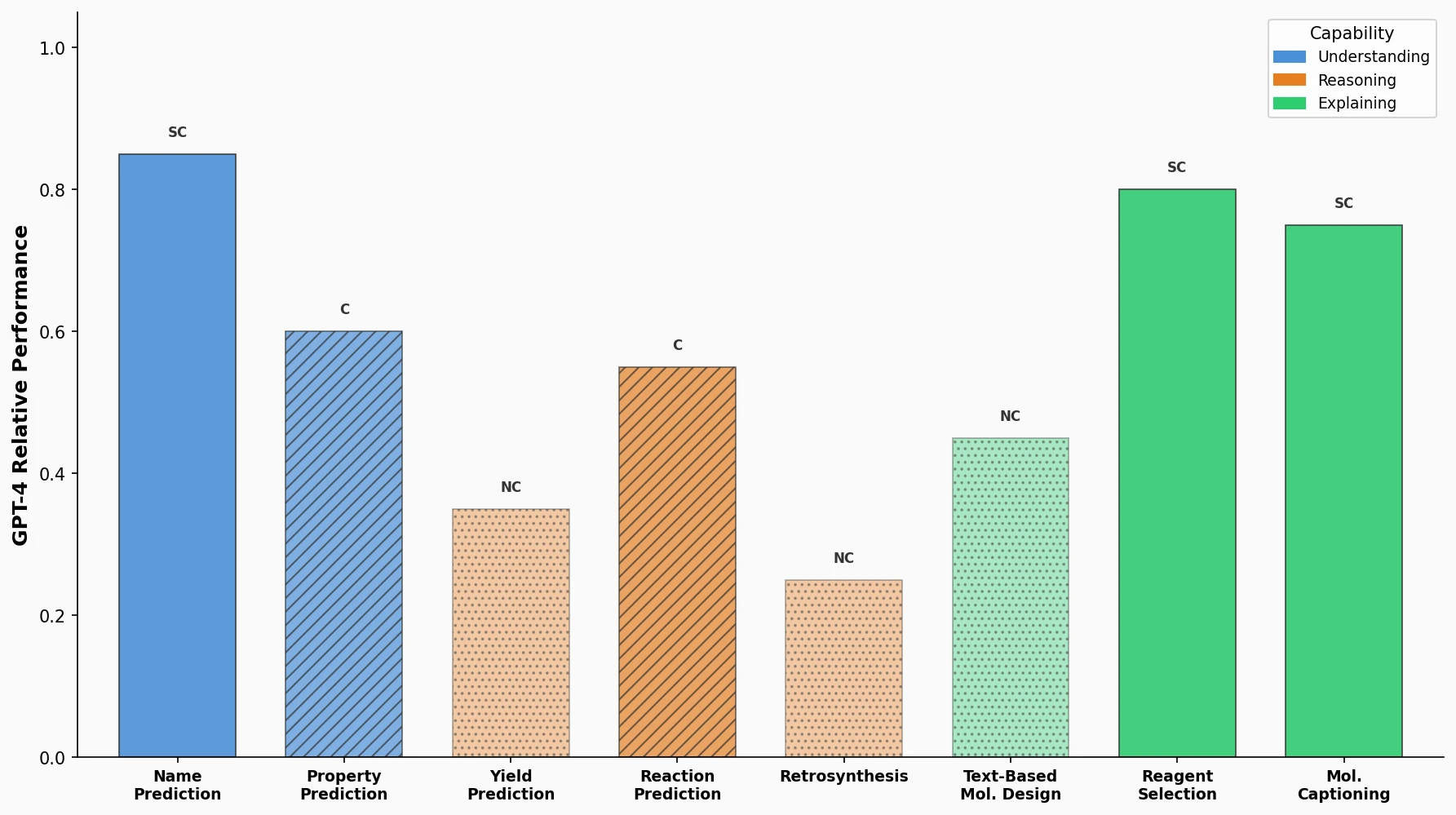
Bar chart showing GPT-4 relative performance across eight chemistry tasks grouped by understanding, reasoning, and explaining capabilities

ChemLLMBench: Benchmarking LLMs on Chemistry Tasks

A comprehensive benchmark evaluating GPT-4, GPT-3.5, Davinci-003, Llama, and Galactica on eight practical chemistry tasks, revealing that LLMs are competitive on classification and text tasks but struggle with SMILES-dependent generation.

Computational Chemistry
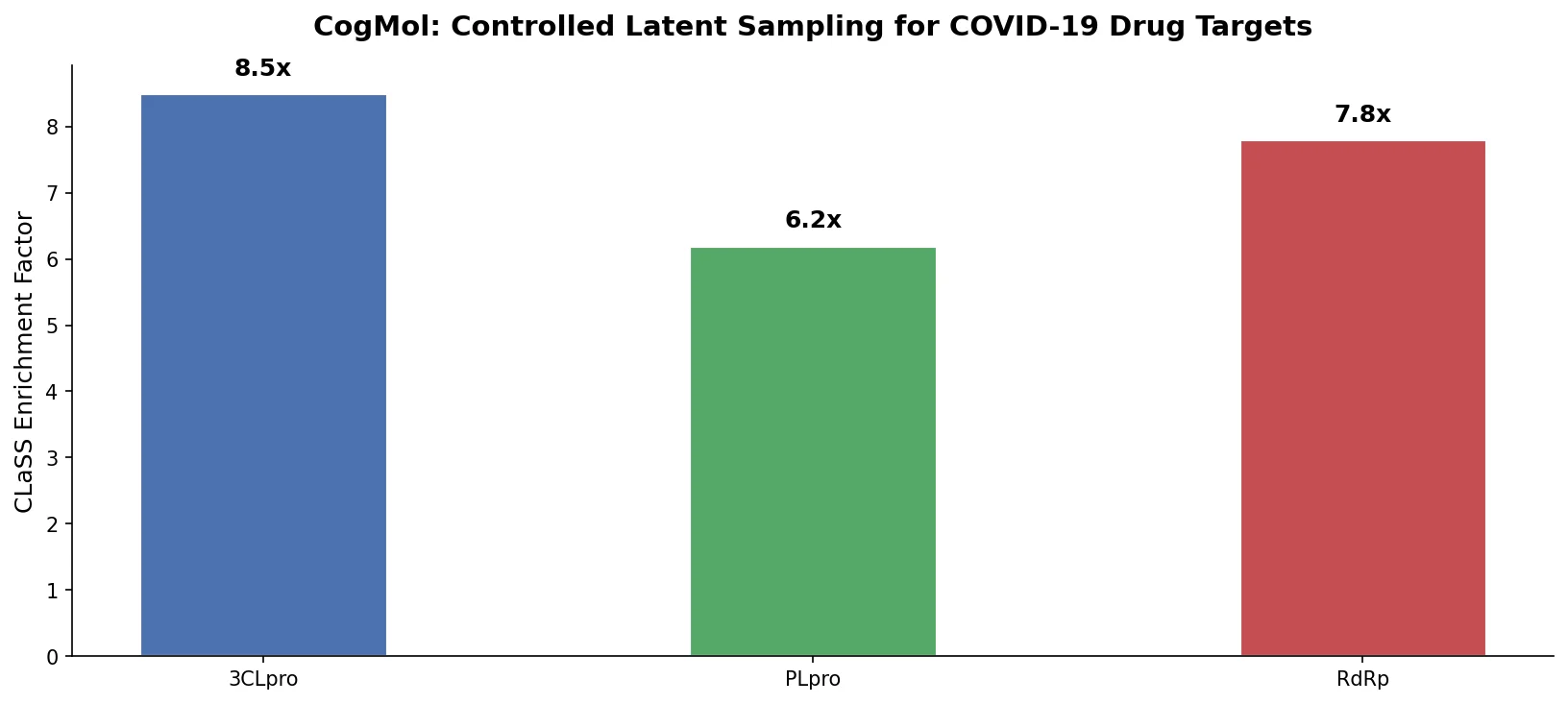
Bar chart showing CogMol CLaSS enrichment factors across three COVID-19 drug targets

CogMol: Controlled Molecule Generation for COVID-19

CogMol uses a SMILES VAE and multi-attribute controlled sampling (CLaSS) to generate novel, target-specific drug molecules for unseen SARS-CoV-2 proteins without model retraining.

Computational Chemistry
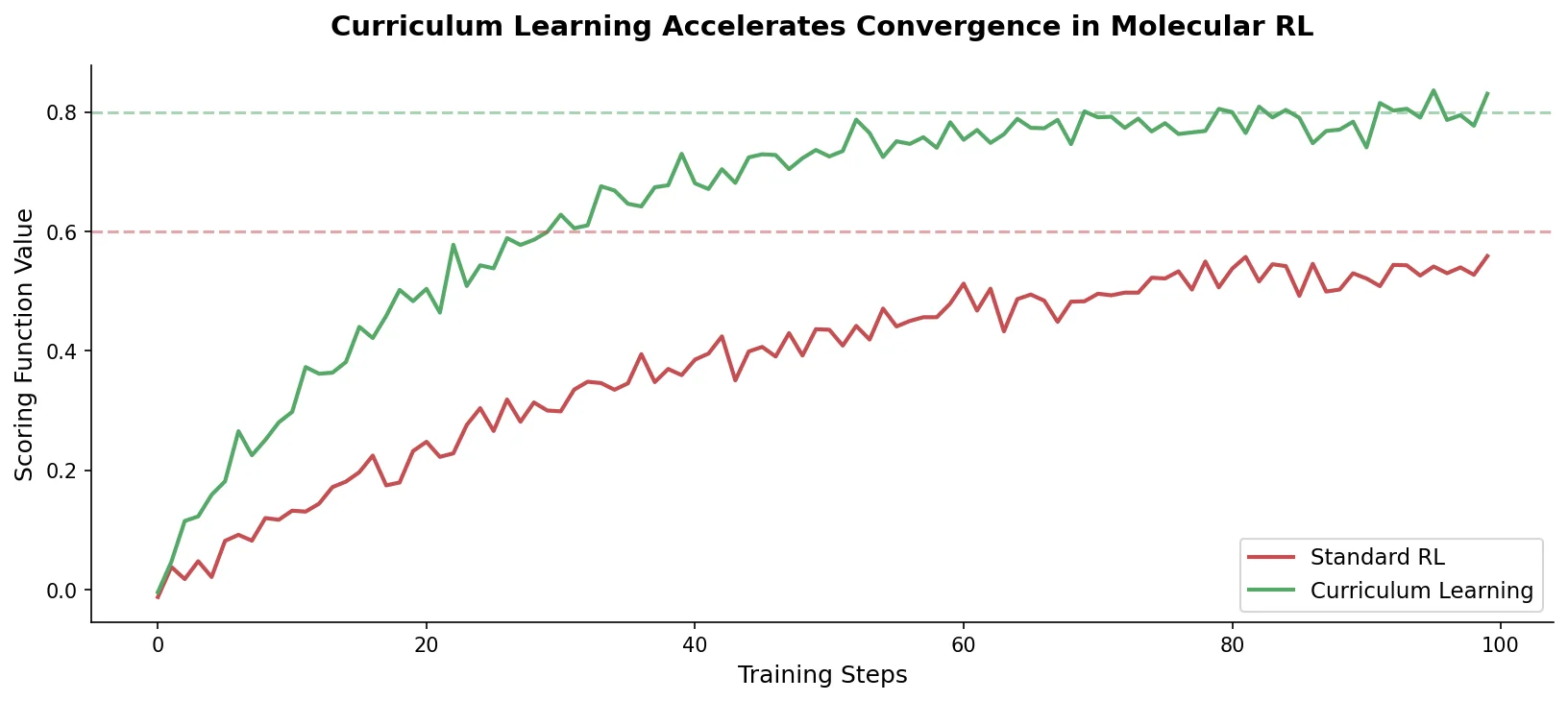
Line chart showing curriculum learning converges faster than standard RL for molecular generation

Curriculum Learning for De Novo Drug Design (REINVENT)

Introduces curriculum learning to the REINVENT de novo design platform, decomposing complex drug design objectives into simpler sequential tasks that accelerate agent convergence and improve output quality over standard reinforcement learning.

Computational Chemistry
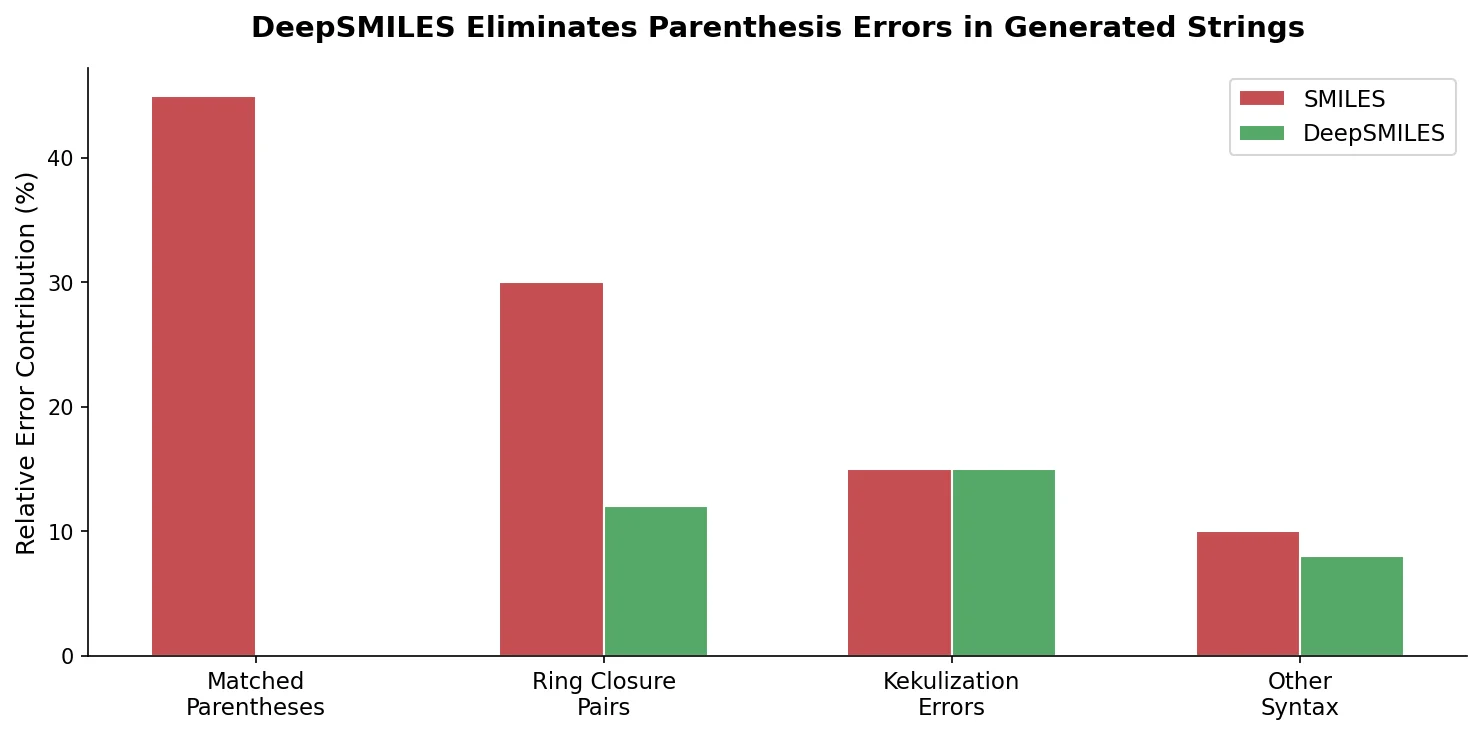
Bar chart comparing SMILES and DeepSMILES error types, showing DeepSMILES eliminates parenthesis errors

DeepSMILES: Adapting SMILES Syntax for Machine Learning

DeepSMILES replaces paired parentheses and ring closure symbols in SMILES with a postfix notation and single ring-size digits, making it easier for generative models to produce syntactically valid molecular strings.

Computational Chemistry
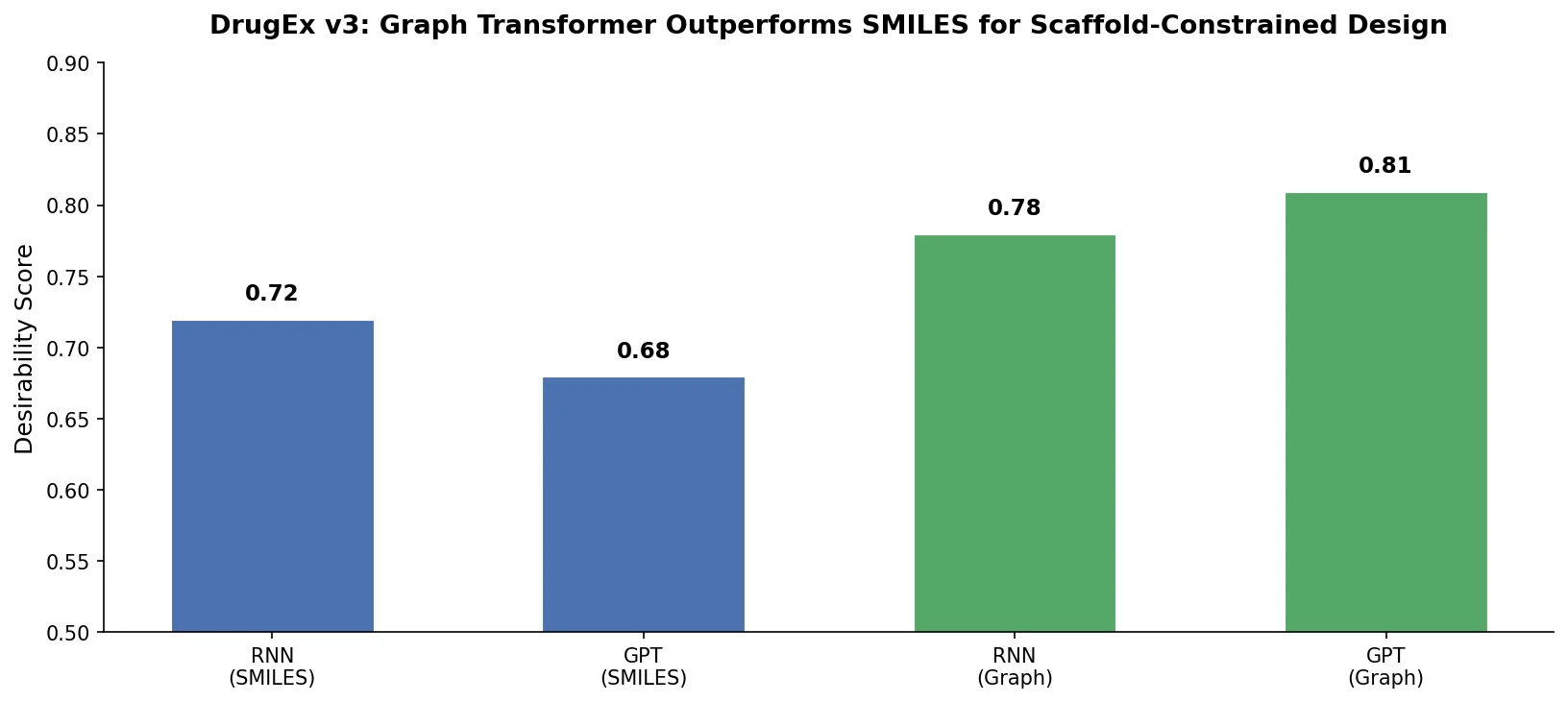
Bar chart comparing RNN and GPT architectures with SMILES and Graph representations on desirability scores

DrugEx v3: Scaffold-Constrained Graph Transformer

DrugEx v3 extends scaffold-constrained drug design by introducing a Graph Transformer with adjacency-matrix-based positional encoding, achieving 100% molecular validity and high predicted affinity for adenosine A2A receptor ligands.

Computational Chemistry
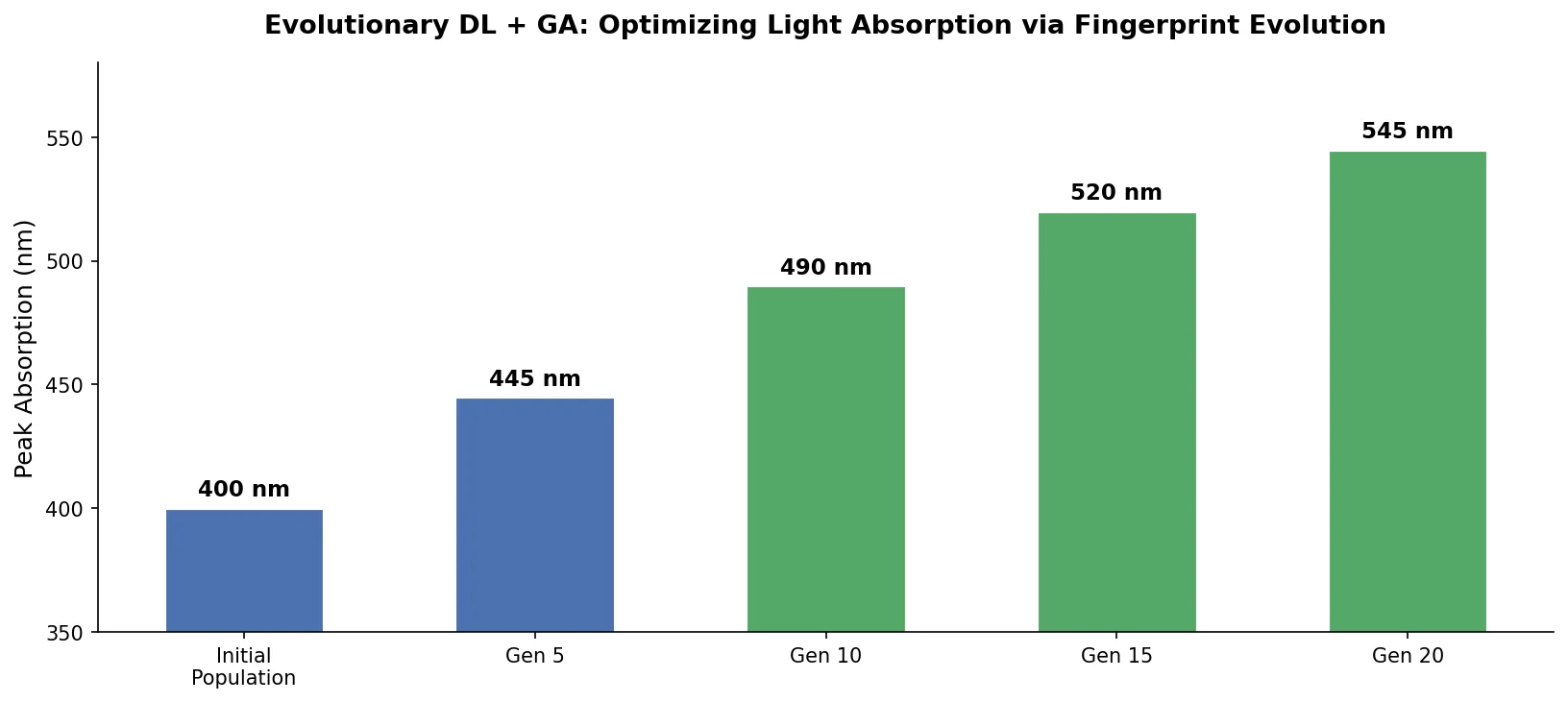
Bar chart showing peak absorption wavelength increasing across evolutionary generations

Evolutionary Molecular Design via Deep Learning + GA

An evolutionary molecular design framework that evolves ECFP fingerprint vectors using a genetic algorithm, reconstructs valid SMILES via an RNN decoder, and evaluates fitness with a DNN property predictor.

Computational Chemistry
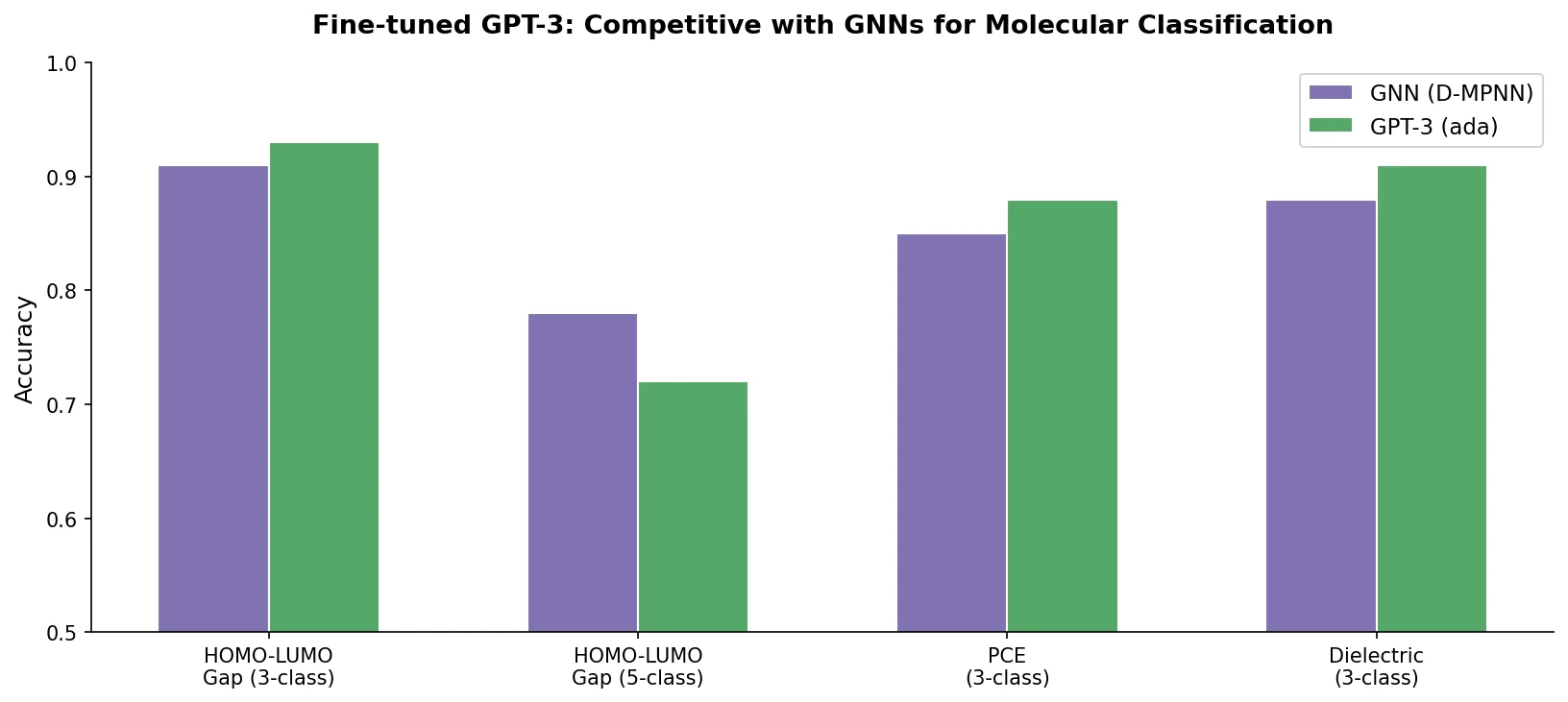
Bar chart comparing GPT-3 ada and GNN accuracy across molecular classification tasks

Fine-Tuning GPT-3 for Molecular Property Prediction

This paper fine-tunes GPT-3’s ada model on SMILES strings for classifying electronic properties (HOMO, LUMO) of organic semiconductor molecules, finding competitive accuracy with graph neural networks and exploring robustness through ablation studies.