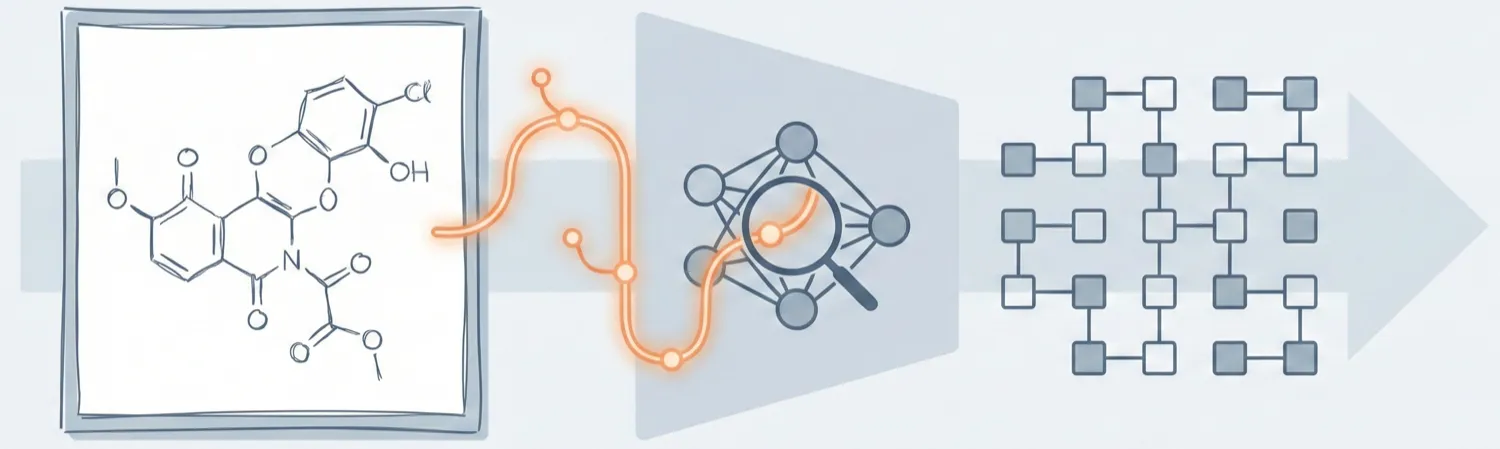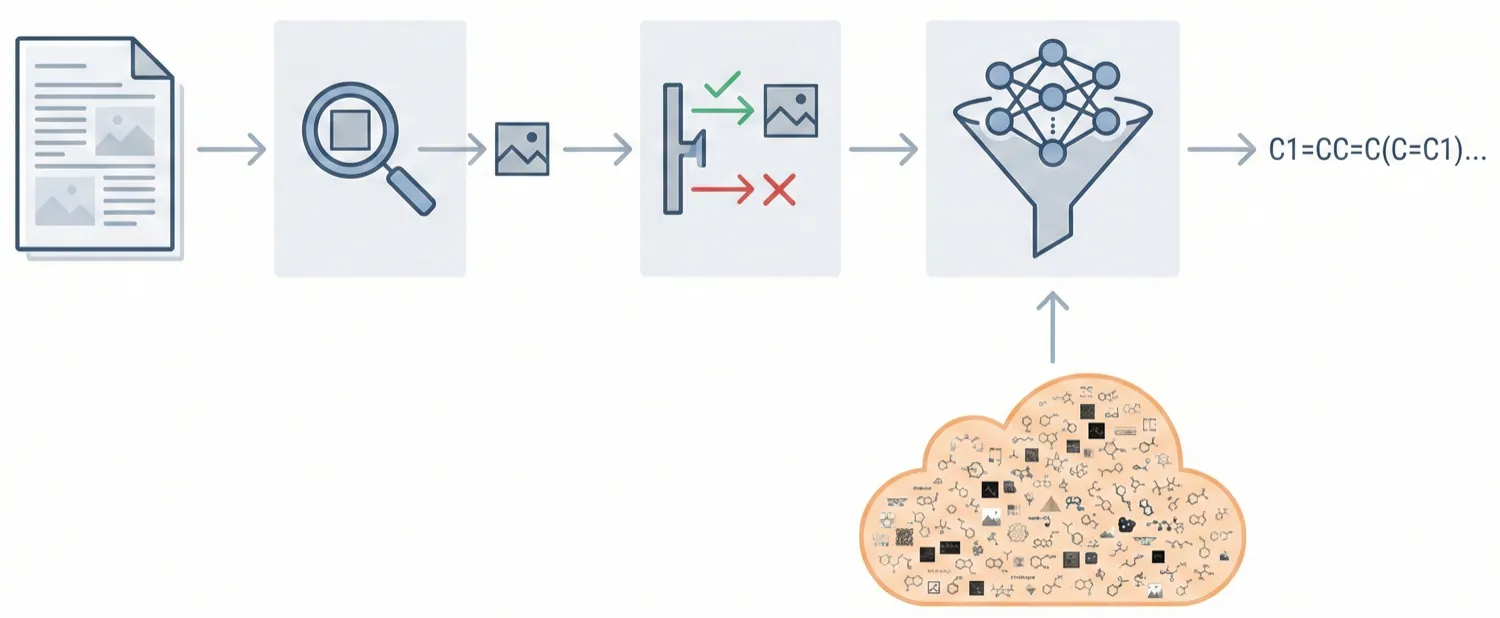
Optical Chemical Structure Recognition
Precision and recall comparison of 8 OCSR tools on patent images

Benchmarking Eight OCSR Tools on Patent Images (2024)

Comprehensive evaluation of 8 optical chemical structure recognition tools using a newly curated dataset of 2,702 patent images. Proposes ChemIC, a ResNet-50 classifier to route images to specialized tools based on content type, demonstrating that no single tool excels at all tasks.

Optical Chemical Structure Recognition
Overview of the ChemReco pipeline showing synthetic data generation and EfficientNet+Transformer architecture for hand-drawn chemical structure recognition

ChemReco: Hand-Drawn Chemical Structure Recognition

ChemReco automates the recognition of hand-drawn chemical structures using a synthetic data pipeline and an EfficientNet+Transformer architecture, achieving 96.90% accuracy on C-H-O molecules.

Optical Chemical Structure Recognition
Overview of the DECIMER.ai platform combining segmentation, classification, and image-to-SMILES recognition

DECIMER.ai: Optical Chemical Structure Recognition

DECIMER.ai addresses the lack of open tools for Optical Chemical Structure Recognition (OCSR) by providing a comprehensive, deep-learning-based workflow. It features a novel data generation pipeline (RanDepict), a web application, and models for segmentation and recognition that rival or exceed proprietary solutions.

Optical Chemical Structure Recognition
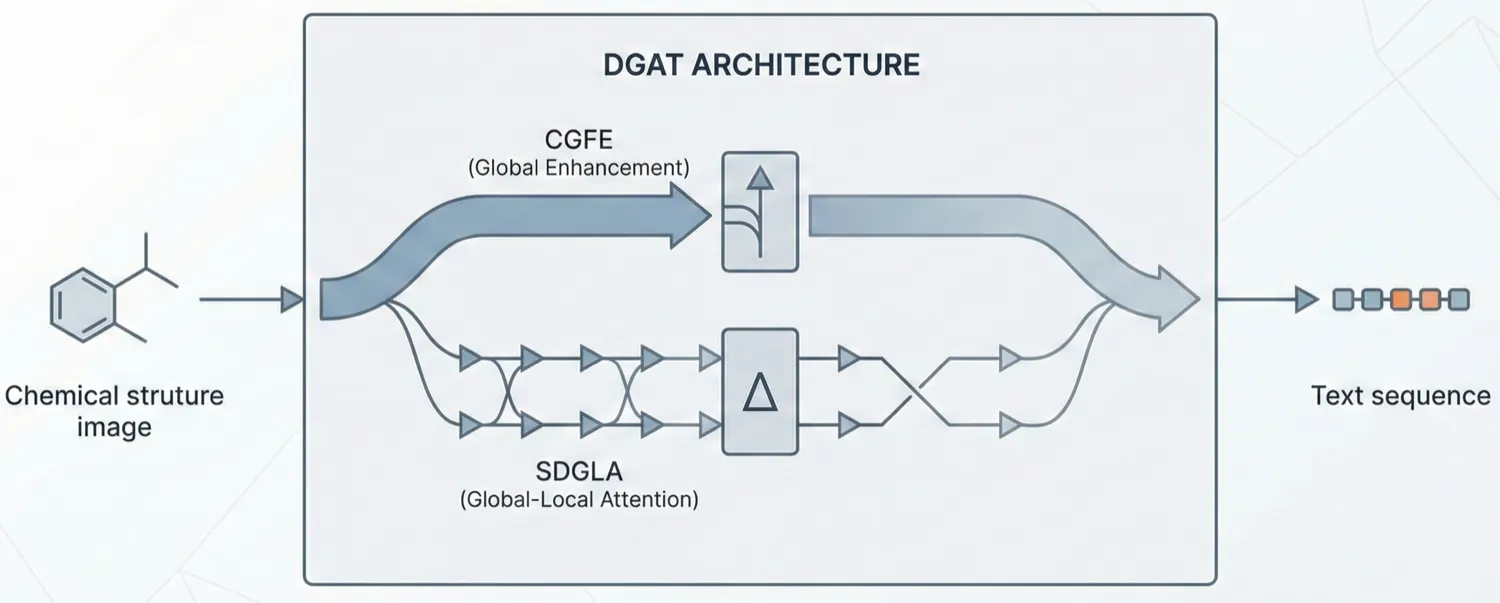
Architecture diagram of the DGAT model showing dual-path decoder with CGFE and SDGLA modules

Dual-Path Global Awareness Transformer (DGAT) for OCSR

Proposes a new architecture (DGAT) to resolve global context loss in chemical structure recognition. Introduces Cascaded Global Feature Enhancement and Sparse Differential Global-Local Attention, achieving 84.0% BLEU-4 and handling complex chiral structures implicitly.

Optical Chemical Structure Recognition
Diagram showing the DECIMER hand-drawn OCSR pipeline from hand-drawn chemical structure image through EfficientNetV2 encoder and Transformer decoder to predicted SMILES output

Enhanced DECIMER for Hand-Drawn Structure Recognition

This paper presents an enhanced deep learning architecture for Optical Chemical Structure Recognition (OCSR) specifically optimized for hand-drawn inputs. By pairing an EfficientNetV2 encoder with a Transformer decoder and training on over 150 million synthetic images, the model achieves 73.25% exact match accuracy on a real-world hand-drawn benchmark of 5,088 images.

Optical Chemical Structure Recognition
Diagram of the MMSSC-Net architecture showing the SwinV2 encoder and GPT-2 decoder pipeline for molecular image recognition

MMSSC-Net: Multi-Stage Sequence Cognitive Networks

MMSSC-Net introduces a multi-stage cognitive approach for OCSR, utilizing a SwinV2 encoder and GPT-2 decoder to recognize atomic and bond sequences. It achieves 75-98% accuracy across benchmark datasets by handling varying image resolutions and noise through fine-grained perception of atoms and bonds.

Optical Chemical Structure Recognition
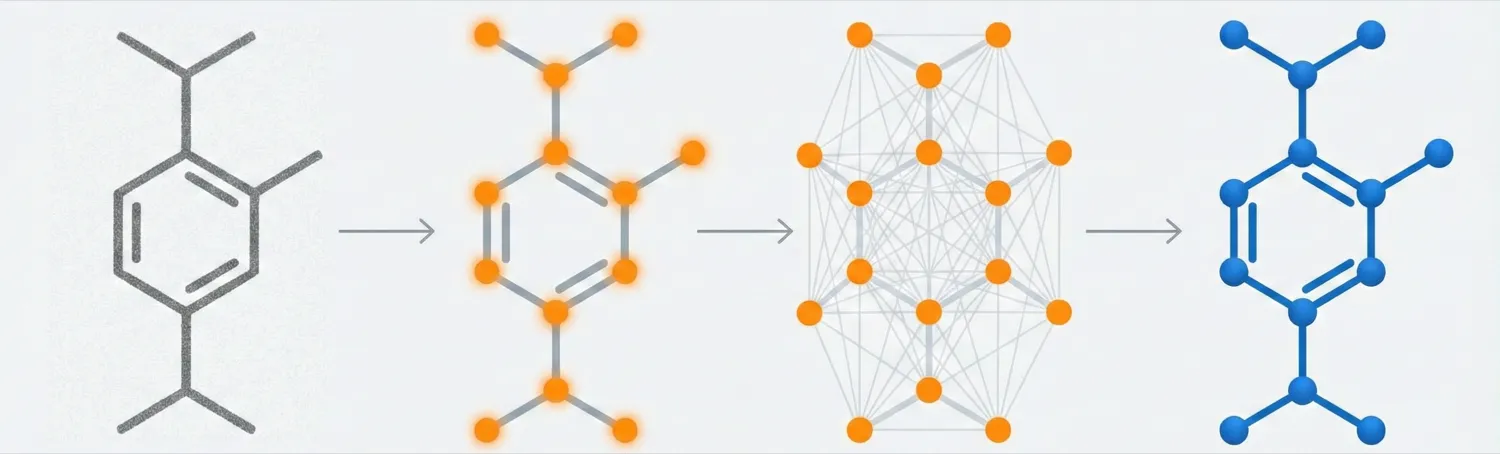
Pipeline diagram showing keypoint detection, supergraph construction, and GNN classification for molecular structure recognition

MolGrapher: Graph-based Chemical Structure Recognition

MolGrapher introduces a three-stage pipeline (keypoint detection, supergraph construction, GNN classification) for recognizing chemical structures from images. It achieves 91.5% accuracy on USPTO by treating molecules as graphs, and introduces the USPTO-30K benchmark.

Optical Chemical Structure Recognition
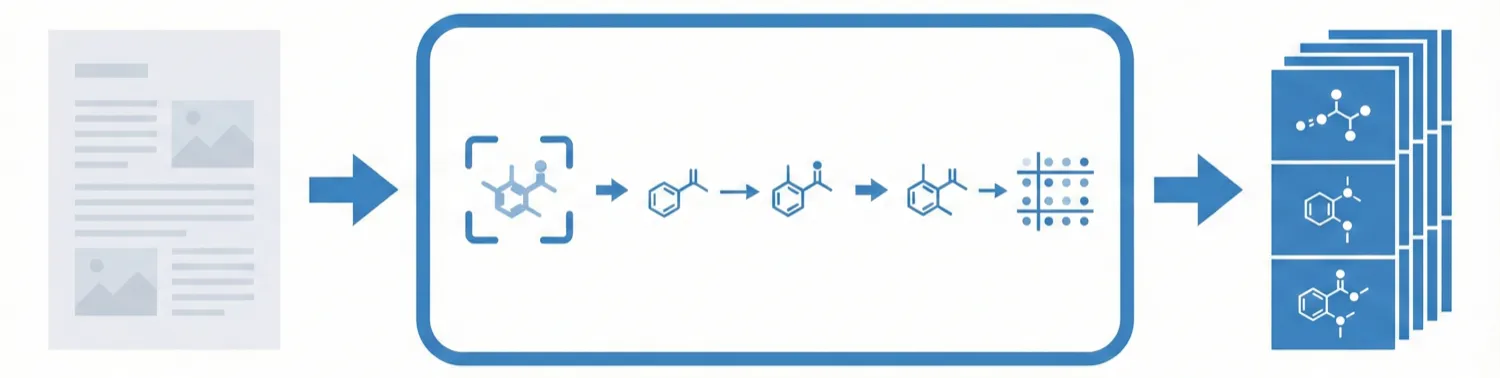
Overview of the MolMole pipeline showing ViDetect, ViReact, and ViMore processing document pages to extract molecules and reactions.

MolMole: Unified Vision Pipeline for Molecule Mining

MolMole unifies molecule detection, reaction parsing, and structure recognition into a single vision-based pipeline, achieving top performance on a newly introduced 550-page benchmark by processing full documents without external layout parsers.

Optical Chemical Structure Recognition
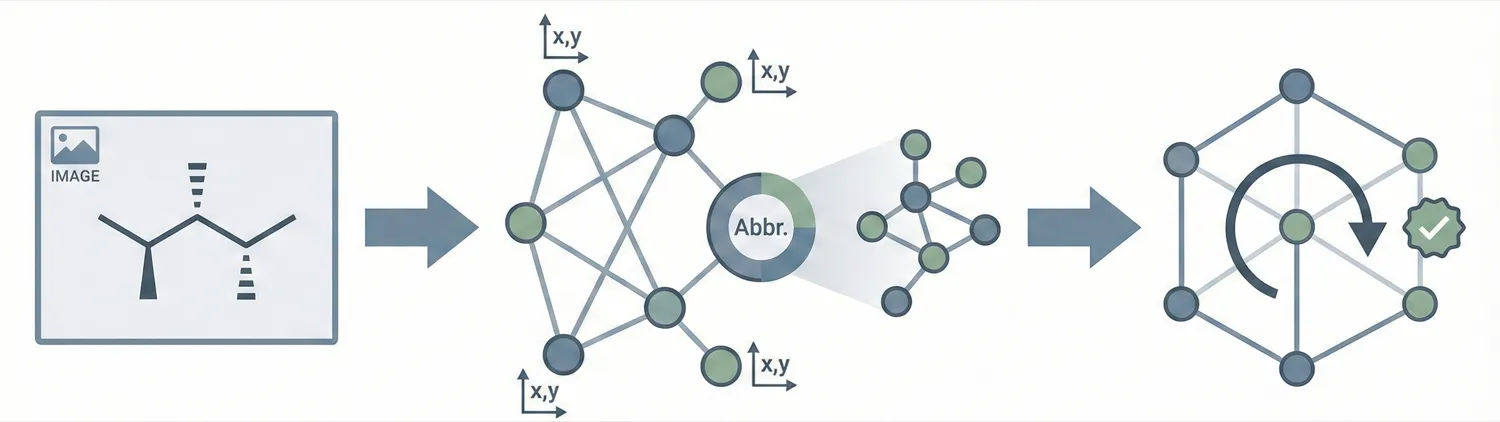
Overview of the MolScribe encoder-decoder architecture predicting atoms with coordinates and bonds from a molecular image.

MolScribe: Robust Image-to-Graph Molecular Recognition

MolScribe reformulates molecular recognition as an image-to-graph generation task, explicitly predicting atom coordinates and bonds to better handle stereochemistry and abbreviated structures compared to image-to-SMILES baselines.

Optical Chemical Structure Recognition
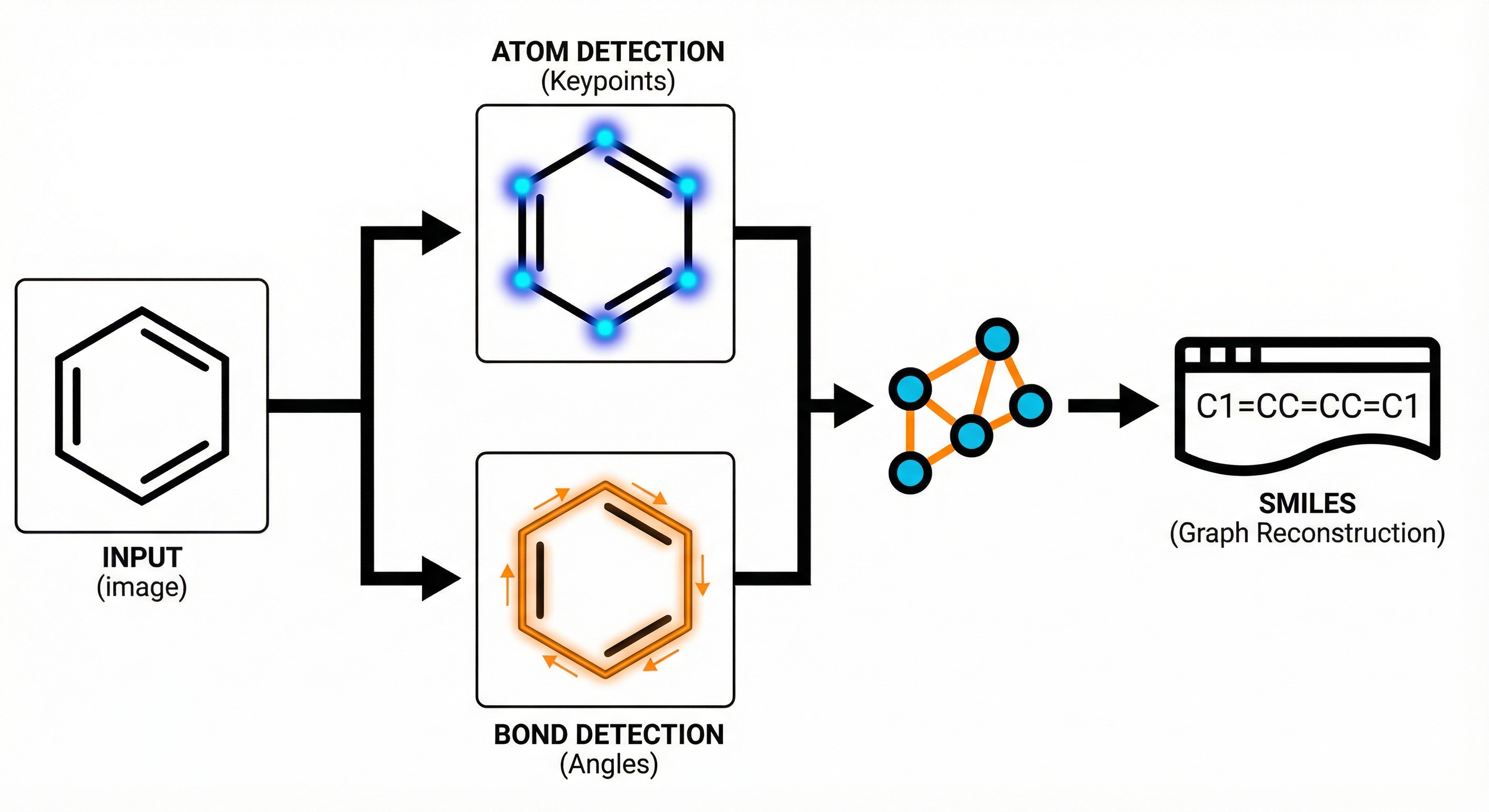
ABC-Net detects atom and bond keypoints to reconstruct molecular graphs from images

ABC-Net: Keypoint-Based Molecular Image Recognition

ABC-Net reformulates molecular image recognition as a keypoint detection problem. By predicting atom/bond centers and properties via a single Fully Convolutional Network, it achieves >94% accuracy with high data efficiency.

Optical Chemical Structure Recognition
Handwritten chemical structure recognition with RCGD and SSML

Handwritten Chemical Structure Recognition with RCGD

Proposes a Random Conditional Guided Decoder (RCGD) and a Structure-Specific Markup Language (SSML) to handle the ambiguity and complexity of handwritten chemical structure recognition, validated on a new benchmark dataset (EDU-CHEMC) with 50,000 handwritten images.

Optical Chemical Structure Recognition

MolMiner: Deep Learning OCSR with YOLOv5 Detection

MolMiner replaces traditional rule-based vectorization with a deep learning object detection pipeline (YOLOv5) to extract chemical structures from PDFs. It outperforms open-source baselines on four benchmarks and introduces a new real-world dataset of 3,040 images.