Predictive Chemistry
Three distribution plots showing RNN language models closely matching training distributions across peaked, multi-modal, and large-scale molecular generation tasks while graph models fail

Language Models Learn Complex Molecular Distributions

This study benchmarks RNN-based chemical language models against graph generative models on three challenging tasks: high penalized LogP distributions, multi-modal molecular distributions, and large-molecule generation from PubChem. The LSTM language models consistently outperform JTVAE and CGVAE.

Predictive Chemistry
Activity cliffs benchmark showing method rankings by RMSE on cliff compounds, with SVM plus ECFP outperforming deep learning approaches

Exposing Limitations of Molecular ML with Activity Cliffs

This paper benchmarks 24 machine and deep learning methods on activity cliff compounds (structurally similar molecules with large potency differences) across 30 macromolecular targets. Traditional ML with molecular fingerprints consistently outperforms graph neural networks and SMILES-based transformers on these challenging cases, especially in low-data regimes.

Molecular Representations
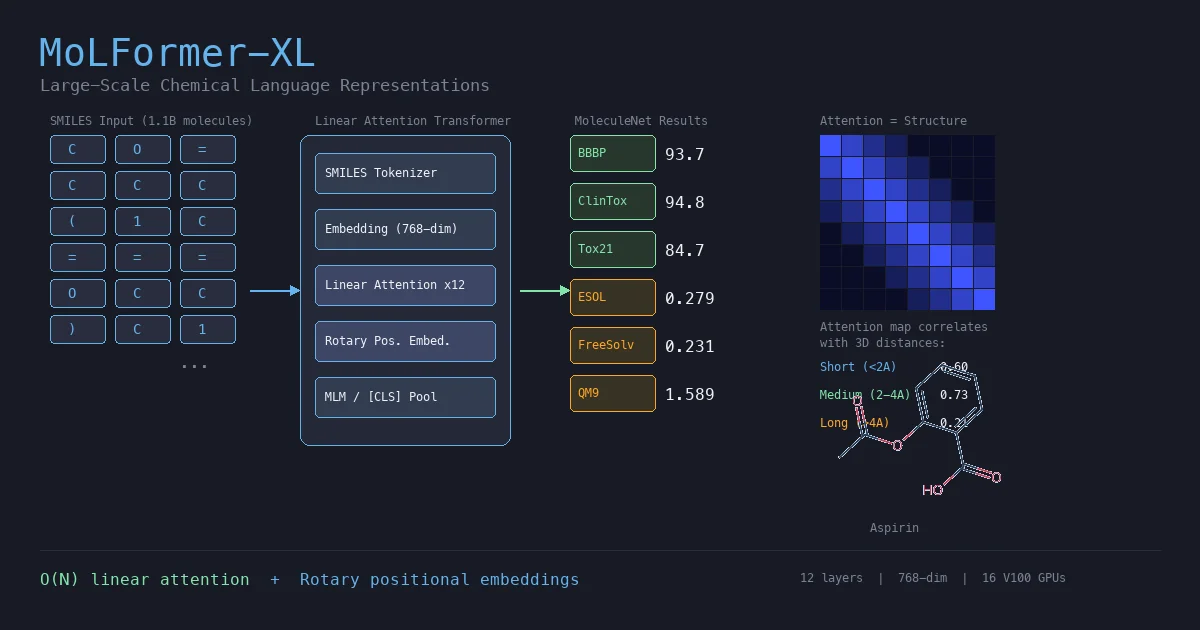
MoLFormer-XL architecture diagram showing SMILES tokens flowing through a linear attention transformer to MoleculeNet benchmark results and attention-structure correlation

MoLFormer: Large-Scale Chemical Language Representations

MoLFormer is a transformer encoder with linear attention and rotary positional embeddings, pretrained via masked language modeling on 1.1 billion molecules from PubChem and ZINC. MoLFormer-XL outperforms GNN baselines on most MoleculeNet classification and regression tasks, and attention analysis reveals that the model learns interatomic spatial relationships directly from SMILES strings.
Molecular Representations
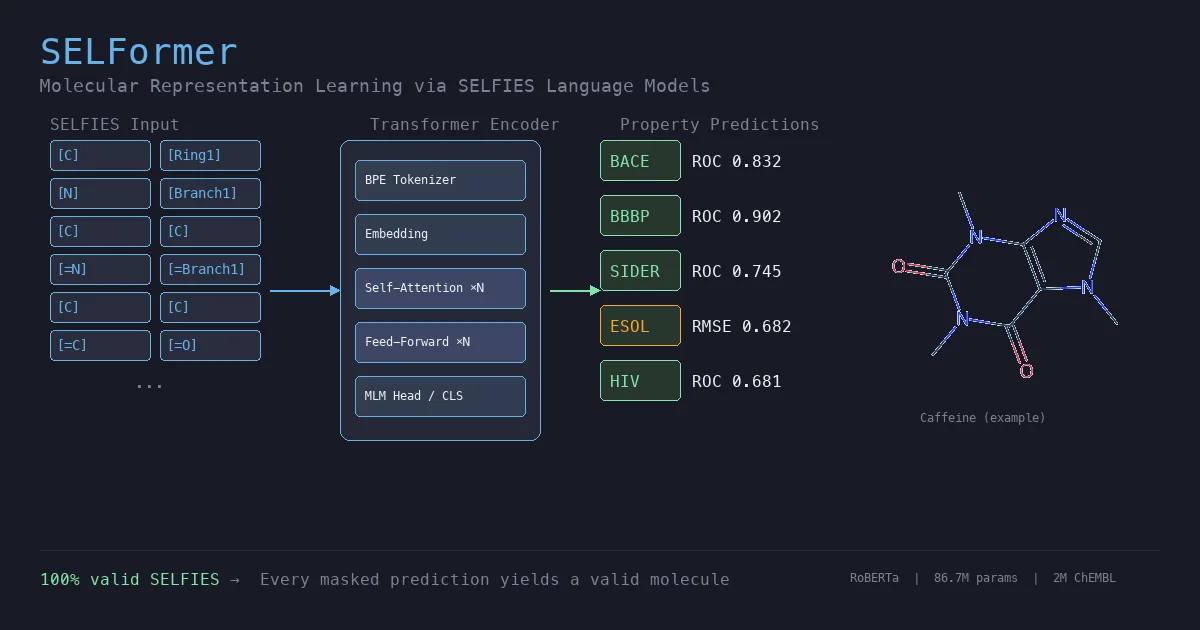
SELFormer architecture diagram showing SELFIES token input flowing through a RoBERTa transformer encoder to molecular property predictions

SELFormer: A SELFIES-Based Molecular Language Model

SELFormer is a transformer-based chemical language model that uses SELFIES instead of SMILES as input. Pretrained on 2M ChEMBL compounds via masked language modeling, it achieves strong classification performance on MoleculeNet tasks, outperforming ChemBERTa-2 by ~12% on average across BACE, BBBP, and HIV.

Optical Chemical Structure Recognition
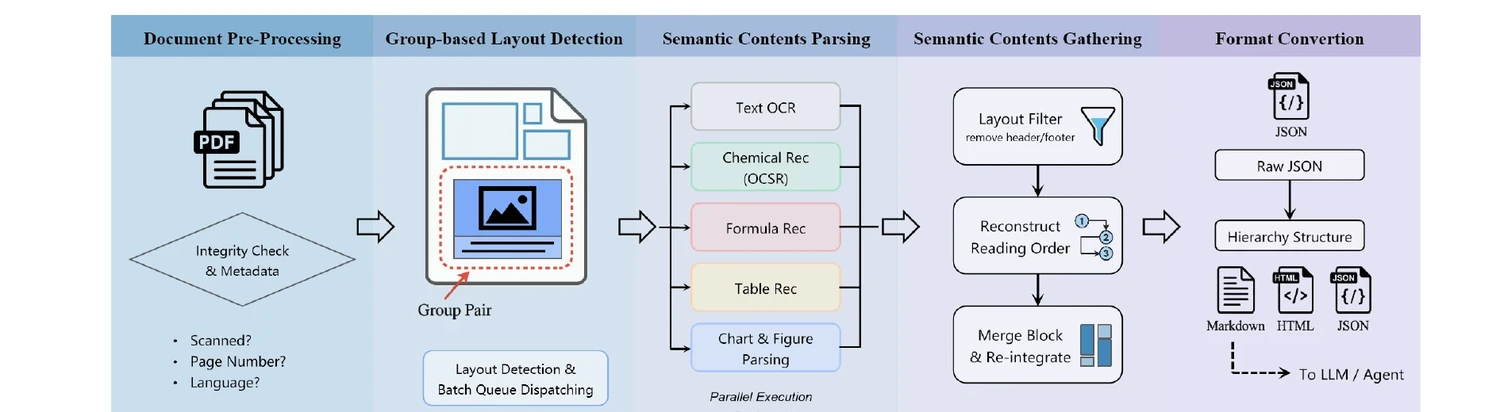
Uni-Parser pipeline diagram showing document pre-processing, layout detection, semantic parsing, content gathering, and format conversion stages

Uni-Parser: Industrial-Grade Multi-Modal PDF Parsing (2025)

Technical report on Uni-Parser, an industrial-grade document parsing engine that uses a modular multi-expert architecture to parse scientific PDFs into structured representations. Integrates MolParser 1.5 for OCSR, achieving 88.6% accuracy on chemical structures while processing up to 20 pages per second.

Optical Chemical Structure Recognition
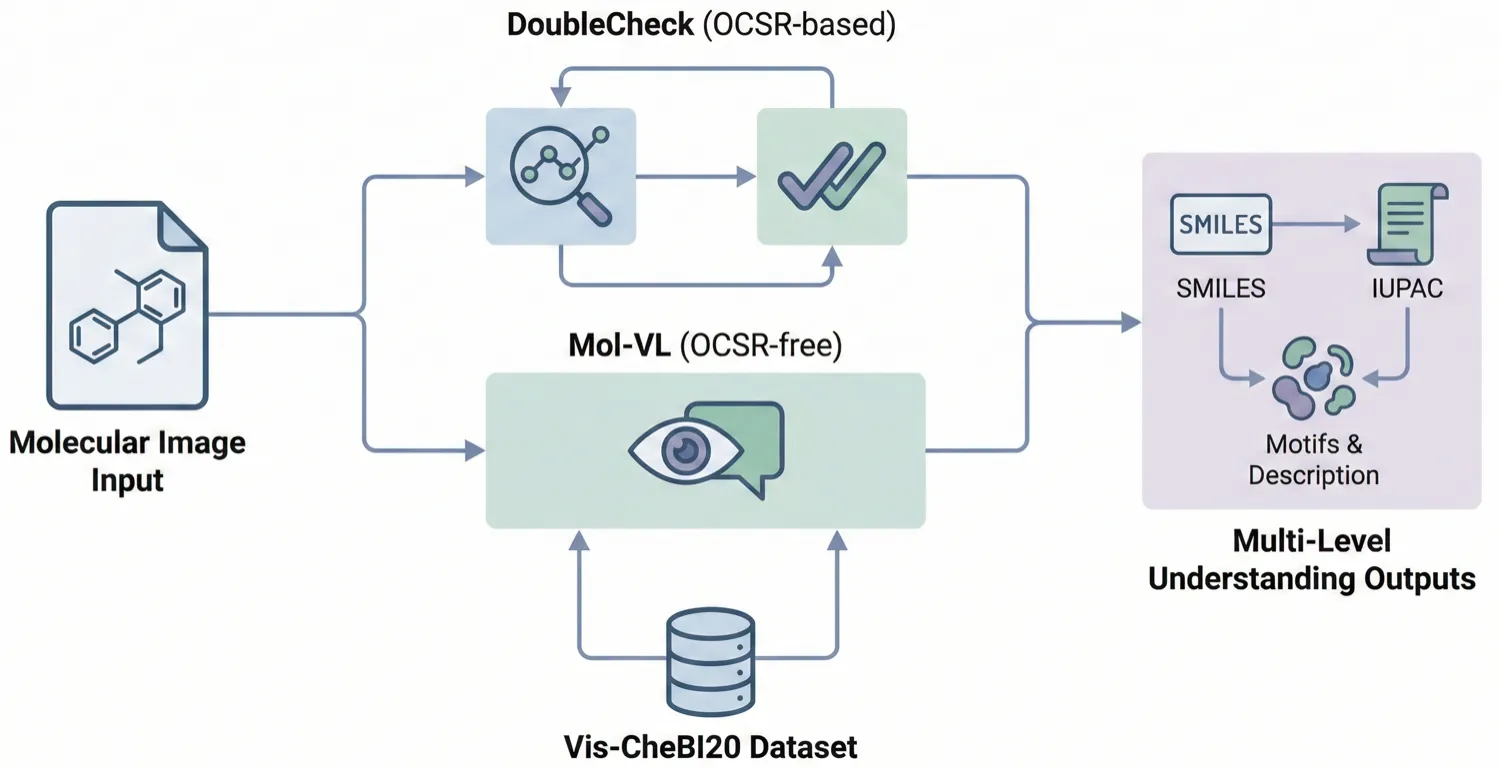
OCSU: Optical Chemical Structure Understanding

OCSU: Optical Chemical Structure Understanding (2025)

Proposes the ‘Optical Chemical Structure Understanding’ (OCSU) task to translate molecular images into multi-level descriptions (motifs, IUPAC, SMILES). Introduces the Vis-CheBI20 dataset and two paradigms: DoubleCheck (OCSR-based) and Mol-VL (OCSR-free).

Molecular Generation
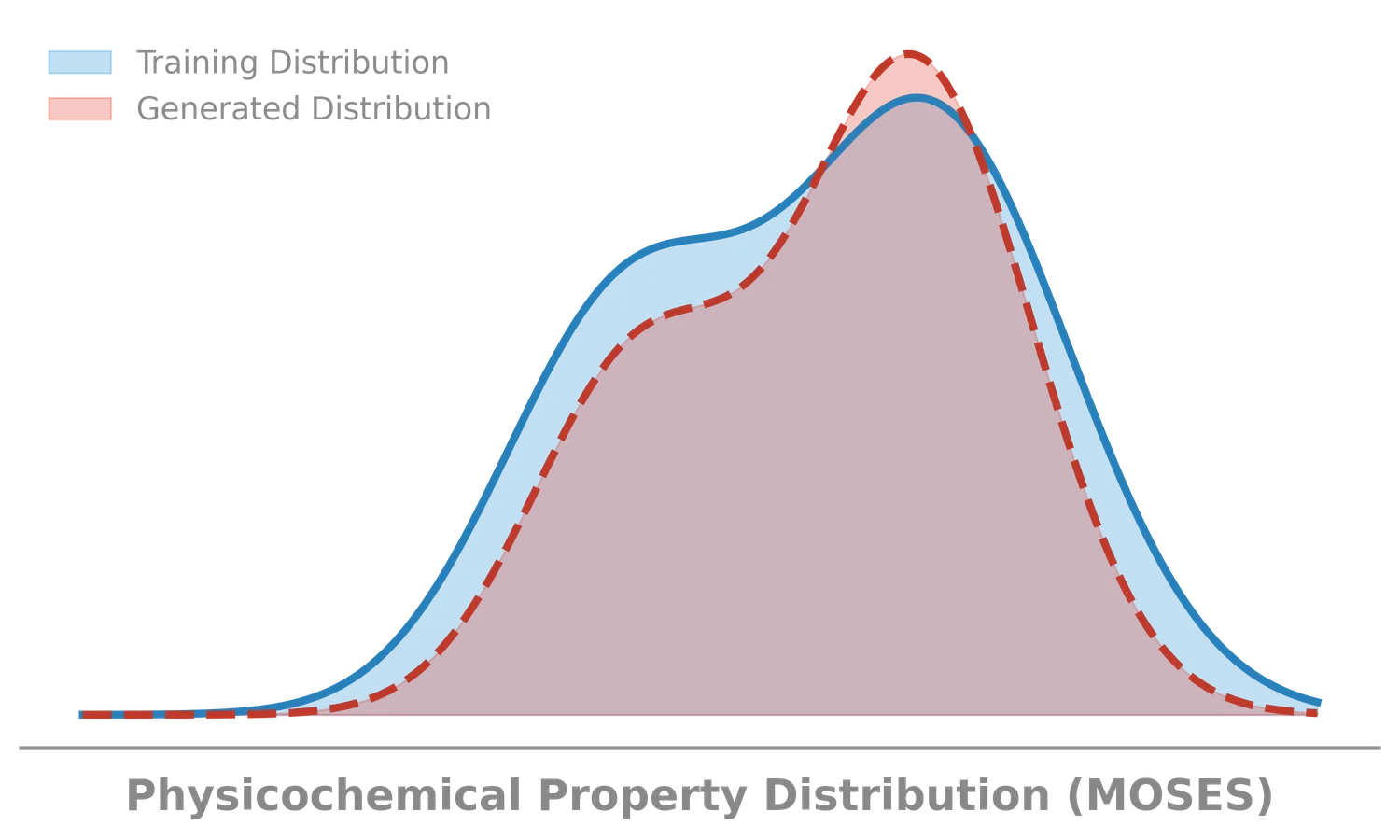
Density plot showing training vs generated physicochemical property distribution

Molecular Sets (MOSES): A Generative Modeling Benchmark

MOSES introduces a comprehensive benchmarking platform for molecular generative models, offering standardized datasets, evaluation metrics, and baselines. By providing a unified measuring stick, it aims to resolve reproducibility challenges in chemical distribution learning.

Molecular Representations
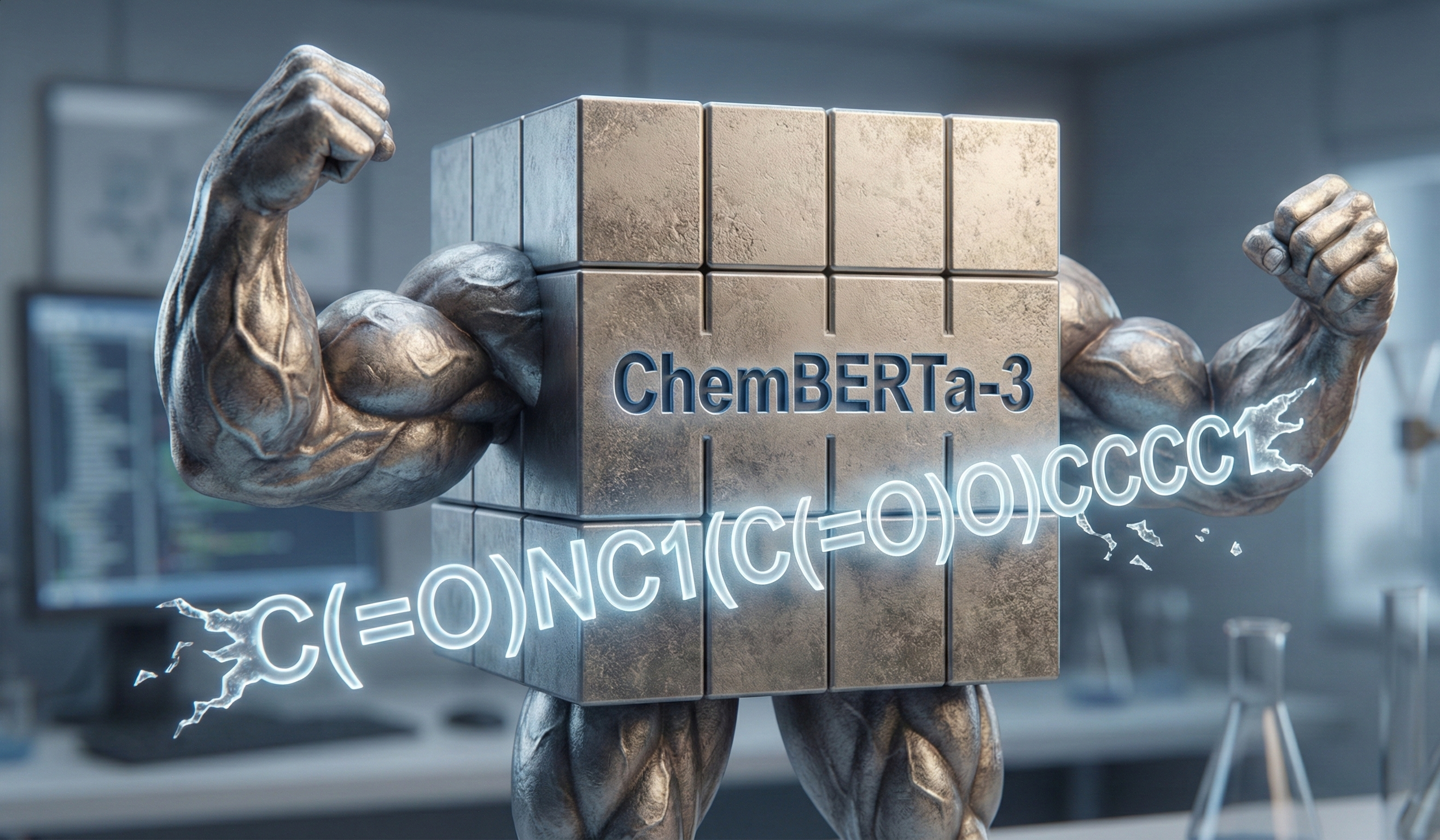
ChemBERTa-3 visualization showing muscular arms lifting a stack of building blocks representing molecular data with SMILES notation, symbolizing the power and scalability of the open-source training framework

ChemBERTa-3: Open Source Chemical Foundation Models

ChemBERTa-3 provides a unified, scalable infrastructure for pretraining and benchmarking chemical foundation models. It addresses reproducibility gaps in previous studies like MoLFormer through standardized scaffold splitting and open-source tooling.

Computational Chemistry
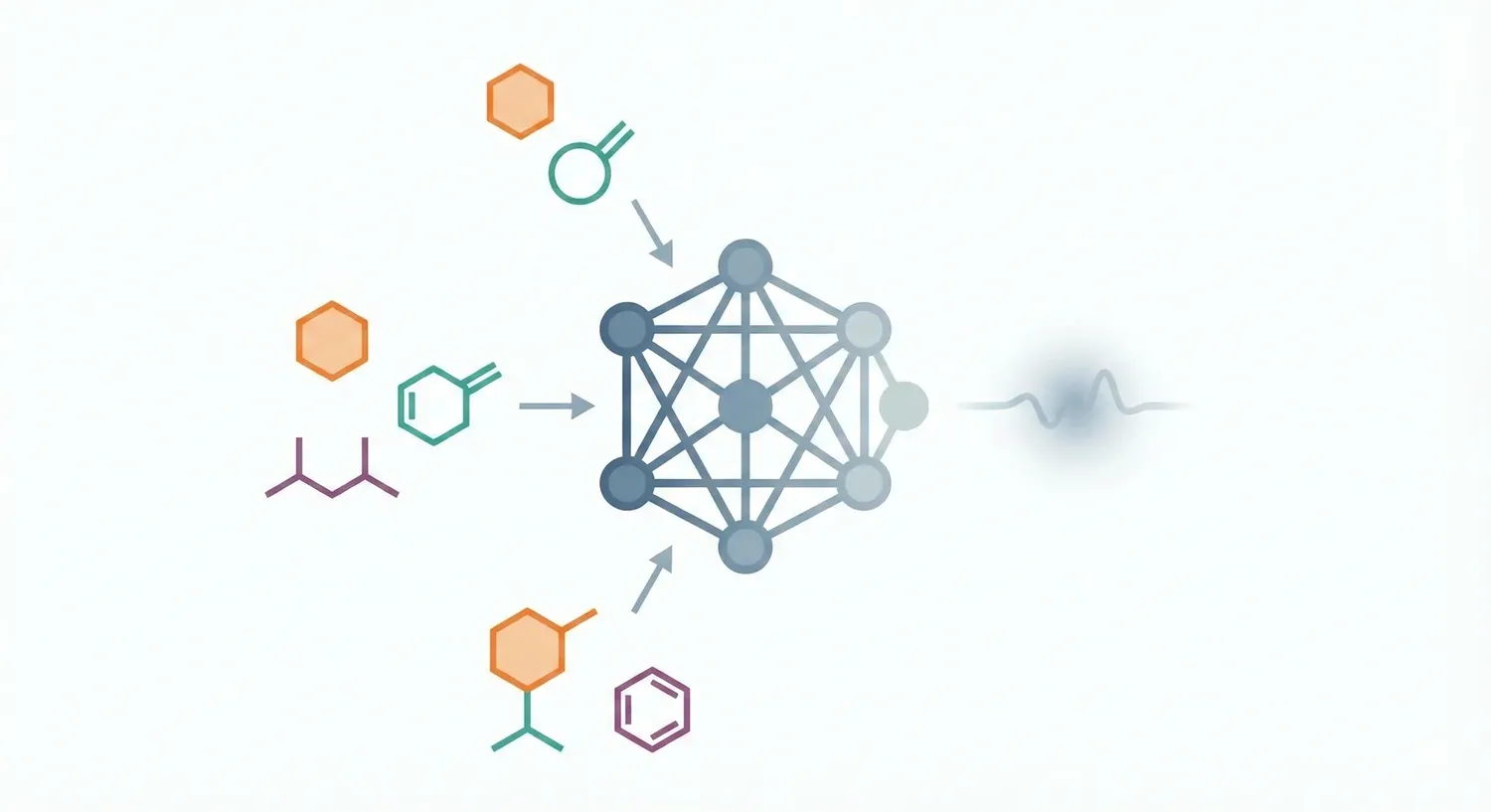
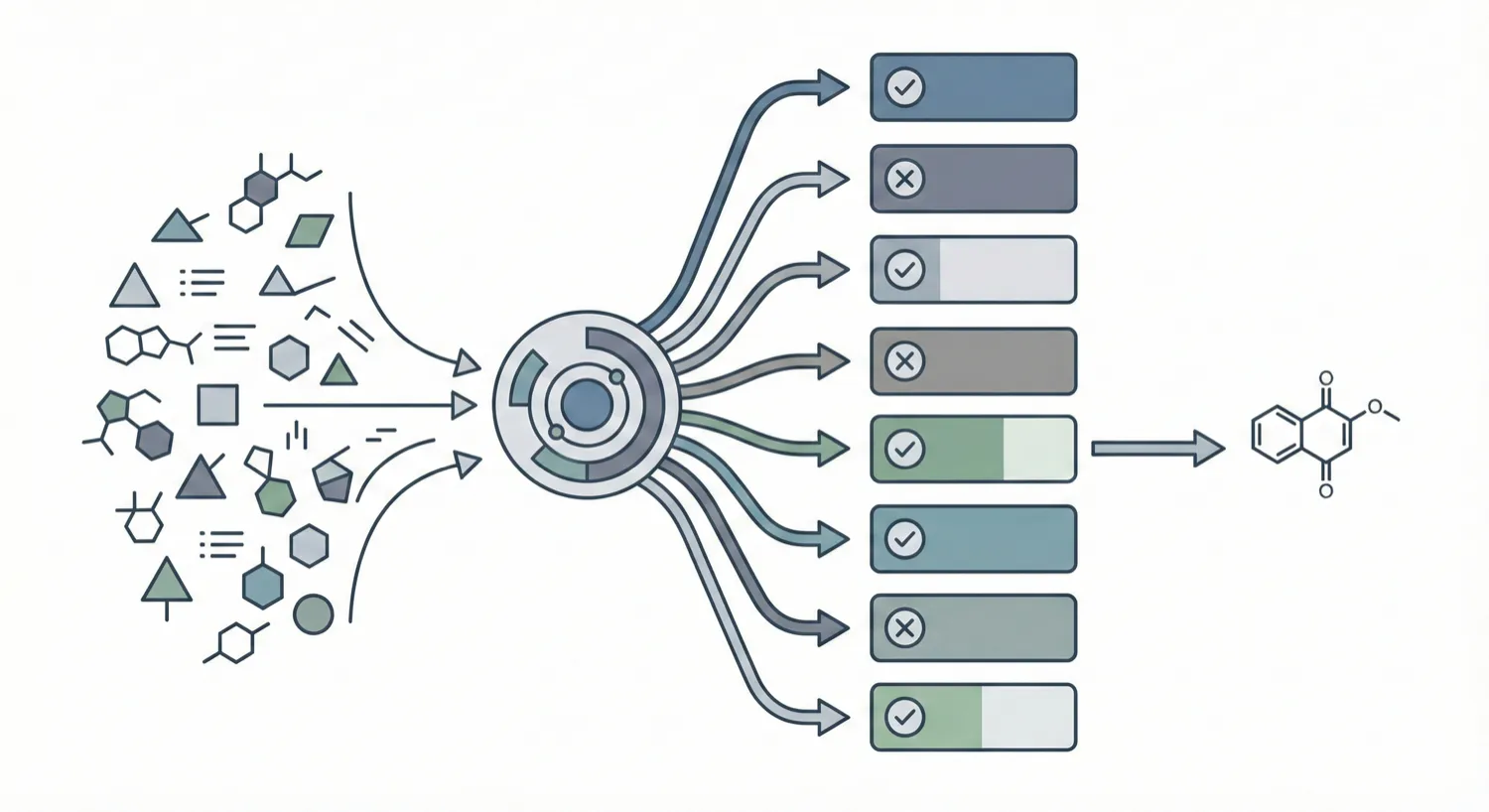
Chemical structures and molecular representations feeding into a neural network model that processes atomized chemical knowledge

ChemDFM-R: Chemical Reasoning LLM with Atomized Knowledge

ChemDFM-R is a 14B-parameter chemical reasoning model that integrates a 101B-token dataset of atomized chemical knowledge. Using a mix-sourced distillation strategy and domain-specific reinforcement learning, it outperforms similarly sized models and DeepSeek-R1 on ChemEval.

Molecular Representations
ChemBERTa-2 visualization showing flowing SMILES strings in blue tones representing molecular data streams

ChemBERTa-2: Scaling Molecular Transformers to 77M

This work investigates the scaling hypothesis for molecular transformers, training RoBERTa models on 77M SMILES from PubChem. It compares Masked Language Modeling (MLM) against Multi-Task Regression (MTR) pretraining, finding that MTR yields better downstream performance but is computationally heavier.

Molecular Representations
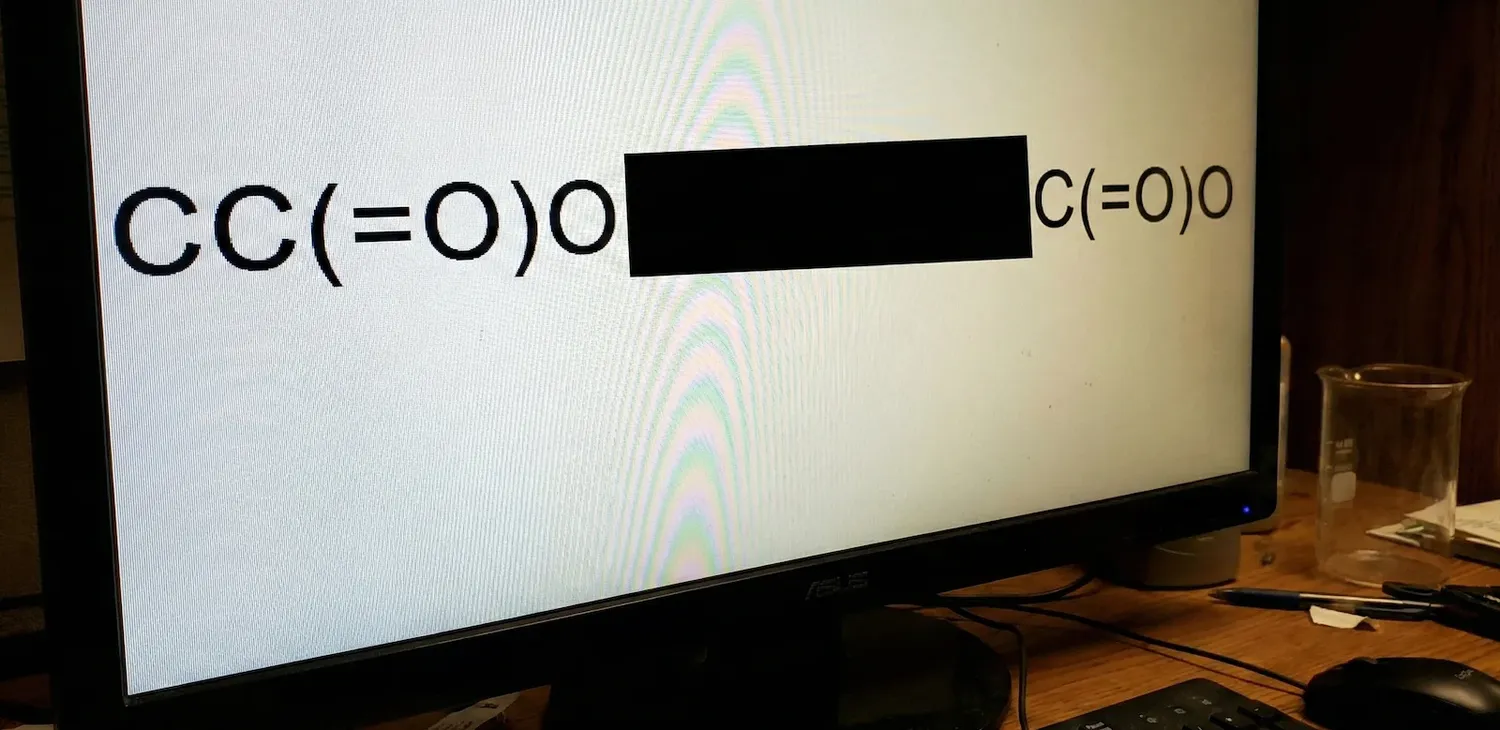
ChemBERTa masked language modeling visualization showing SMILES string CC(=O)O with masked tokens

ChemBERTa: Molecular Property Prediction via Transformers

This paper introduces ChemBERTa, a RoBERTa-based model pretrained on 77M SMILES strings. It systematically evaluates the impact of pretraining dataset size, tokenization strategies, and input representations (SMILES vs. SELFIES) on downstream MoleculeNet tasks, finding that performance scales positively with data size.

Computational Chemistry
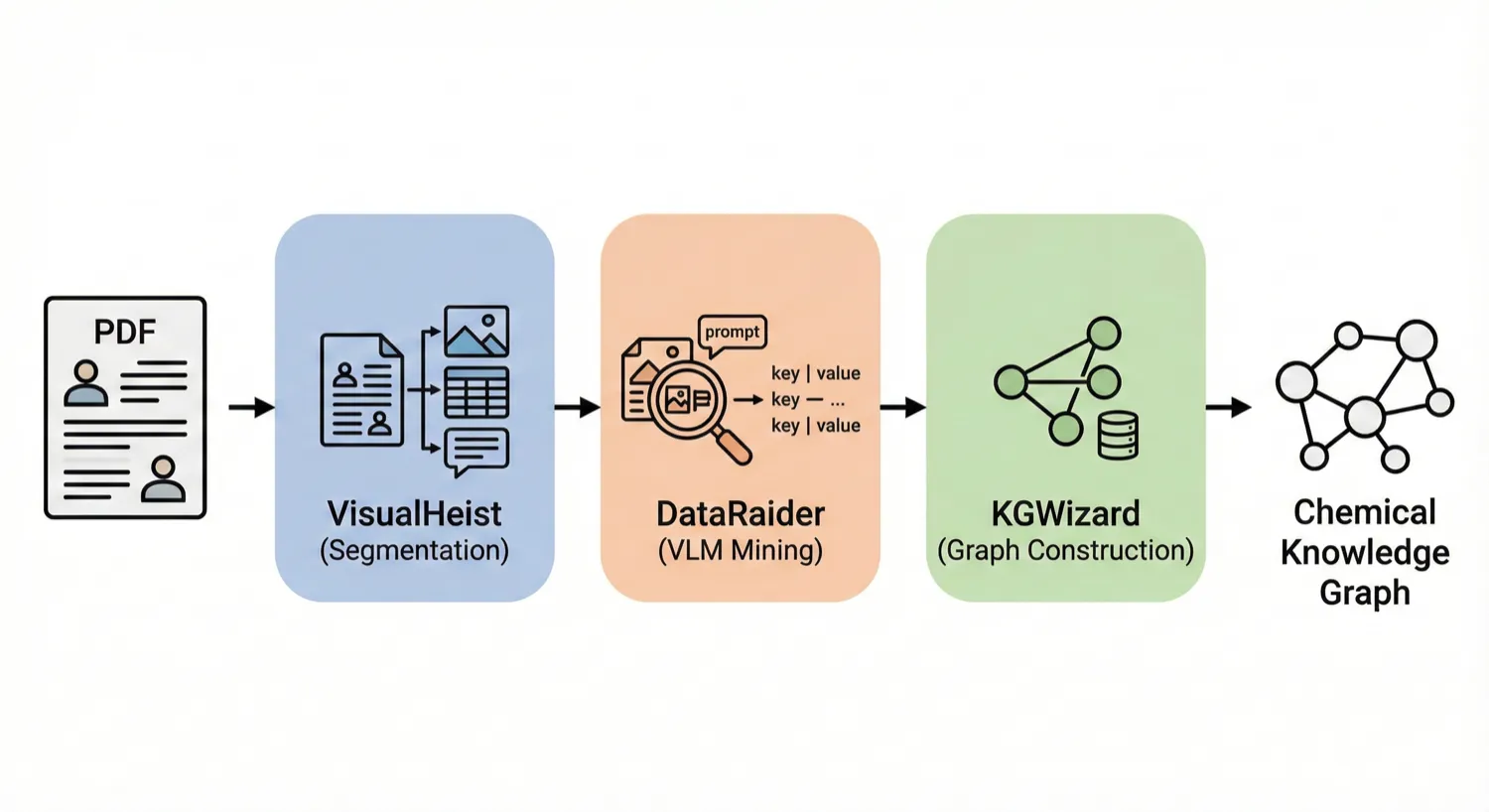
MERMaid pipeline diagram showing PDF processing through VisualHeist segmentation, DataRaider VLM mining, and KGWizard graph construction to produce chemical knowledge graphs

MERMaid: Multimodal Chemical Reaction Mining from PDFs

MERMaid leverages fine-tuned vision models and VLM reasoning to mine chemical reaction data directly from PDF figures and tables. By handling context inference and coreference resolution, it builds high-fidelity knowledge graphs with 87% end-to-end accuracy.