Computational Chemistry
Chemical structure diagram for optical recognition

OSRA: Open Source Optical Structure Recognition

This paper presents OSRA, the first open-source utility for converting graphical chemical structures from documents into machine-readable formats (SMILES/SD). It outlines a pipeline combining existing image processing tools (ImageMagick, Potrace, GOCR) with custom heuristics for bond and atom detection, establishing a foundation for accessible chemical information extraction.

Computational Chemistry
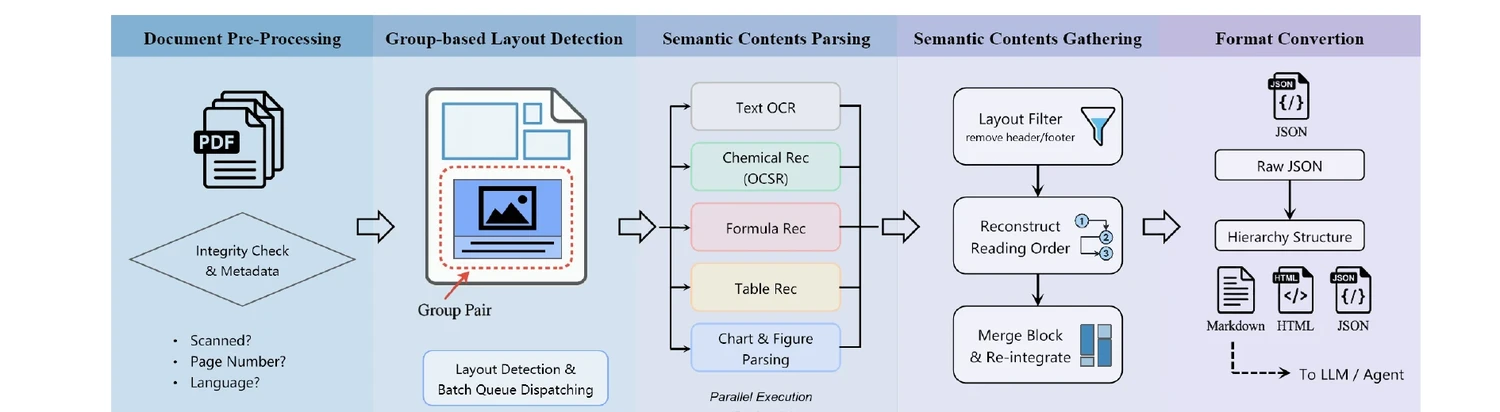
Five-stage pipeline for reconstructing chemical molecules from raster images

Reconstruction of Chemical Molecules from Images

This methodological paper proposes a comprehensive pipeline to digitize chemical structure images. It achieves 97% reconstruction accuracy on benchmarks by combining a topology-preserving vectorizer with a chemical knowledge validation module.

Computational Chemistry
D-glucose open-chain aldehyde form converting to beta-D-glucopyranose ring form, illustrating ring-chain tautomerism

InChI and Tautomerism: Toward Comprehensive Treatment

A comprehensive 2020 analysis of the tautomerism problem in chemical databases, introducing 86 new tautomeric transformation rules and proposing algorithmic improvements for InChI V2 to recognize when different molecular representations are the same molecule in different tautomeric states.

Computational Chemistry
ChemInfty: Chemical Structure Recognition in Patent Images

ChemInfty: Chemical Structure Recognition in Patent Images

A 2011 rule-based OCSR system designed specifically for the challenging low-quality images in Japanese patent applications, using segment-based methods to handle pervasive problems like touching characters (22% of images), merged atom labels with bonds (19.5%), and broken lines (8.5%).

Computational Chemistry
Optical chemical structure recognition example

MolParser: End-to-End Molecular Structure Recognition

A 2025 end-to-end OCSR system addressing both technical and data challenges, introducing MolParser-7M (7M+ image-text pairs) and MolDet (YOLO-based detector) for extracting and recognizing molecular structures from real-world documents with diverse quality and styles.

Computational Chemistry
MARCEL dataset Kraken ligand example in 3D conformation

MARCEL: Molecular Representation & Conformers

MARCEL provides a comprehensive benchmark for molecular representation learning with 722K+ conformers across four diverse subsets (Drugs-75K, Kraken, EE, BDE), enabling evaluation of conformer ensemble methods for property prediction in drug discovery and catalysis.

Computational Chemistry
Müller-Brown Potential Energy Surface showing the three minima and two saddle points

Müller-Brown Potential

A two-dimensional analytical potential energy surface introduced in 1979 that has become the gold standard for testing optimization algorithms, featuring three minima and challenging transition pathways that mirror real chemical reaction landscapes.

Computational Chemistry
Log-scale plot showing exponential growth of alkane isomer counts from C1 to C40

The Number of Isomeric Hydrocarbons of the Methane Series

A foundational 1931 paper that derives exact mathematical laws for counting alkane structural isomers through recursive formulas, correcting historical errors and establishing validated benchmark counts up to C₄₀.

Computational Chemistry
GEOM dataset example molecule: N-(4-pyrimidin-2-yloxyphenyl)acetamide

GEOM: Energy-Annotated Molecular Conformations

GEOM contains 450k+ molecules with 37M+ conformations, featuring energy annotations from semi-empirical (GFN2-xTB) and DFT methods for property prediction and molecular generation research.

Computational Chemistry
Müller-Brown Potential Energy Surface showing the three minima and two saddle points

Implementing the Müller-Brown Potential in PyTorch

Step-by-step implementation of the classic Müller-Brown potential in PyTorch, with performance comparisons between analytical and automatic differentiation approaches for molecular dynamics and machine learning applications.

Computational Social Science
Top features for Social Welfare policy classification showing social, poverty, benefits keywords

Congressional Knowledge Graph & Policy Classification

A computational social science project that engineered a custom extraction engine to build a 47,000+ bill knowledge graph from Congress.gov (115th-117th Congresses), creating a novel legislative graph with co-sponsorship networks and establishing an 87% accuracy benchmark for policy area classification now available on Hugging Face.