Computational Chemistry
SMolInstruct dataset feeding into four base models for chemistry instruction tuning

LlaSMol: Instruction-Tuned LLMs for Chemistry Tasks

LlaSMol fine-tunes Mistral, Llama 2, and other open-source LLMs on SMolInstruct, a 3.3M-sample instruction tuning dataset covering 14 chemistry tasks. The Mistral-based model outperforms GPT-4 and Claude 3 Opus across all tasks.

Computational Chemistry
PharmaGPT two-stage training from domain continued pretraining to weighted supervised fine-tuning with RLHF

PharmaGPT: Domain-Specific LLMs for Pharma and Chem

PharmaGPT is a suite of domain-specific LLMs (13B and 70B parameters) built on LLaMA with continued pretraining on biopharmaceutical and chemical data, achieving strong results on NAPLEX and Chinese pharmacist exams.

Computational Chemistry
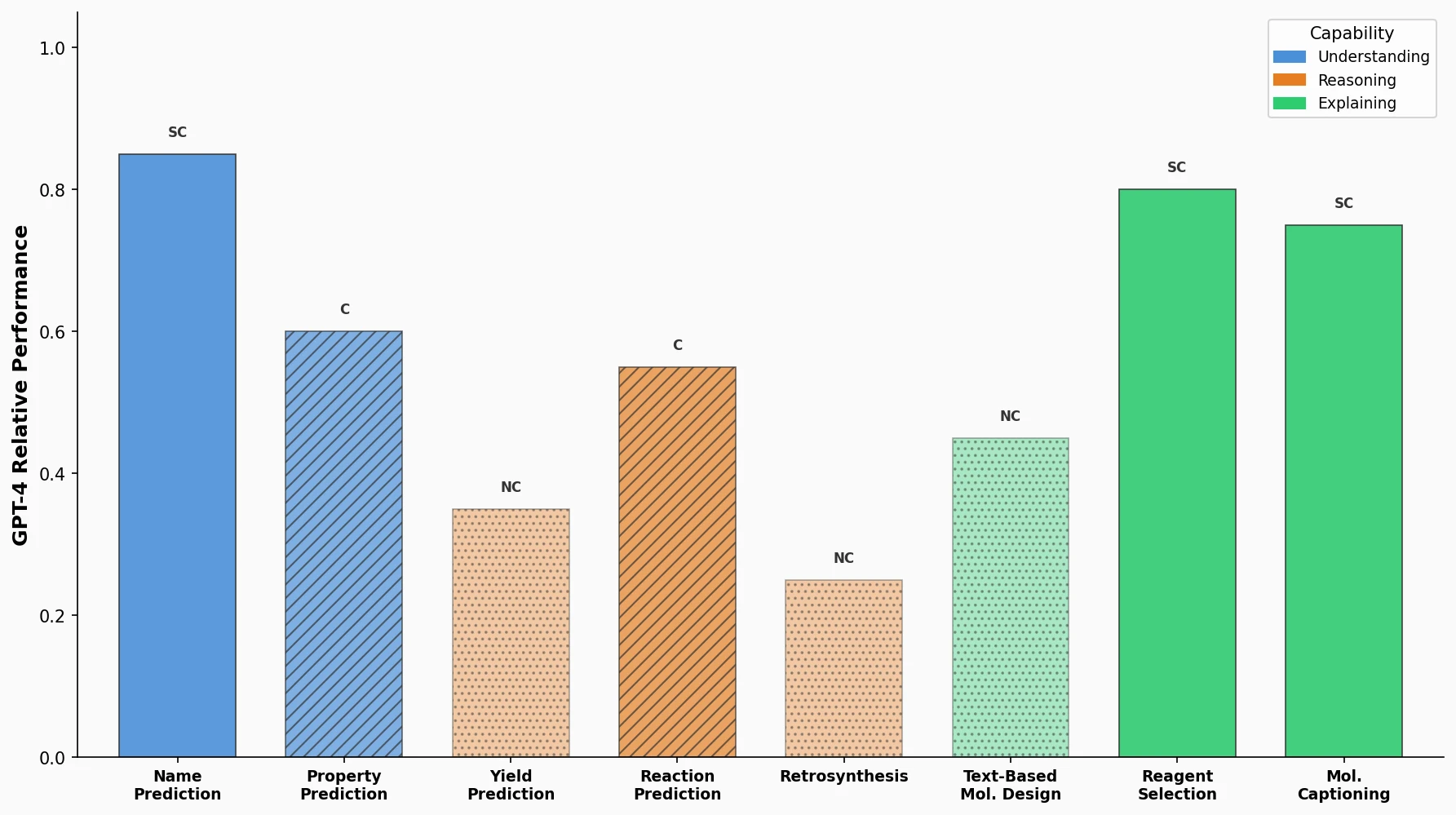
Bar chart showing GPT-4 relative performance across eight chemistry tasks grouped by understanding, reasoning, and explaining capabilities

ChemLLMBench: Benchmarking LLMs on Chemistry Tasks

A comprehensive benchmark evaluating GPT-4, GPT-3.5, Davinci-003, Llama, and Galactica on eight practical chemistry tasks, revealing that LLMs are competitive on classification and text tasks but struggle with SMILES-dependent generation.
Predictive Chemistry
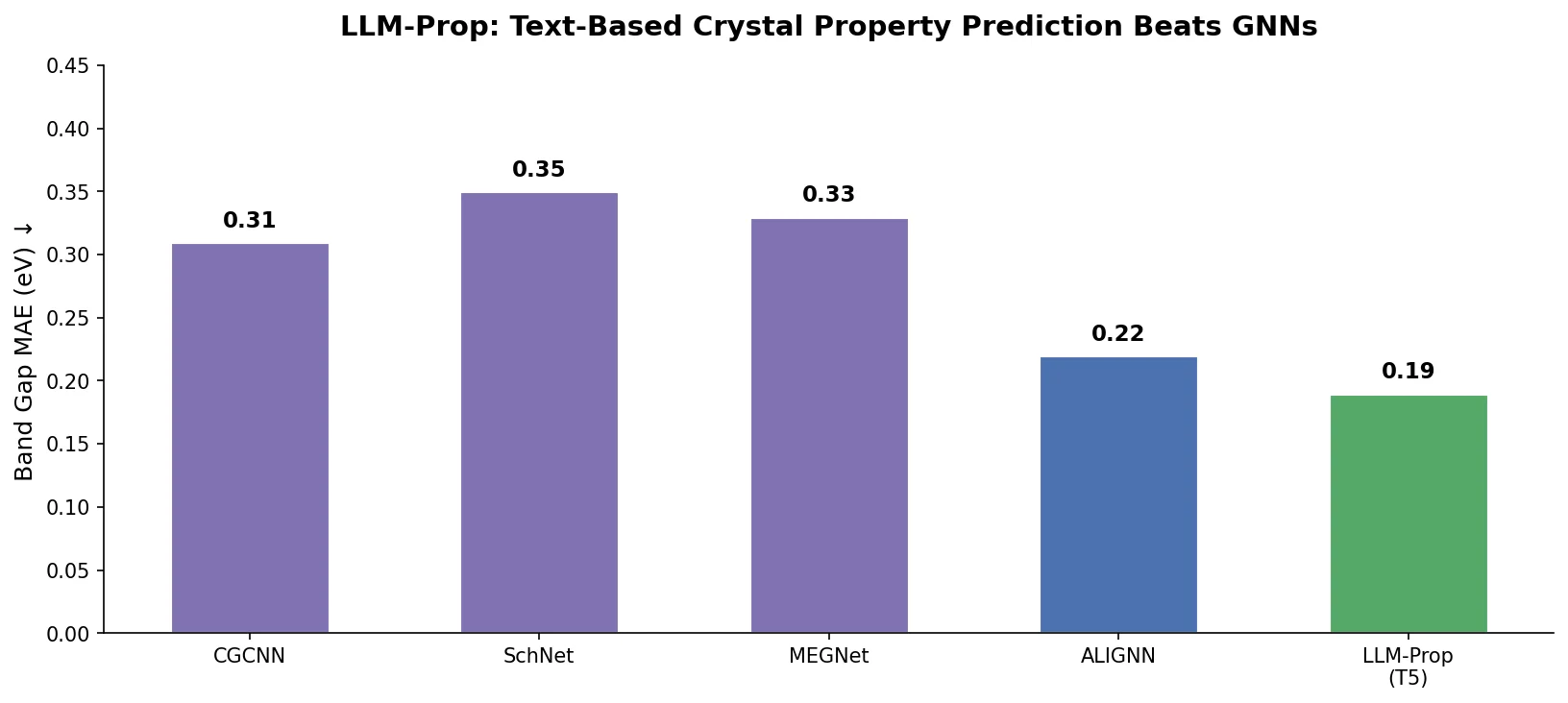
Bar chart comparing LLM-Prop band gap MAE against CGCNN, SchNet, MEGNet, and ALIGNN

LLM-Prop: Predicting Crystal Properties from Text

LLM-Prop uses the encoder half of T5, fine-tuned on Robocrystallographer text descriptions, to predict crystal properties. It outperforms GNN baselines like ALIGNN on band gap and volume prediction while using fewer parameters.

Computational Chemistry
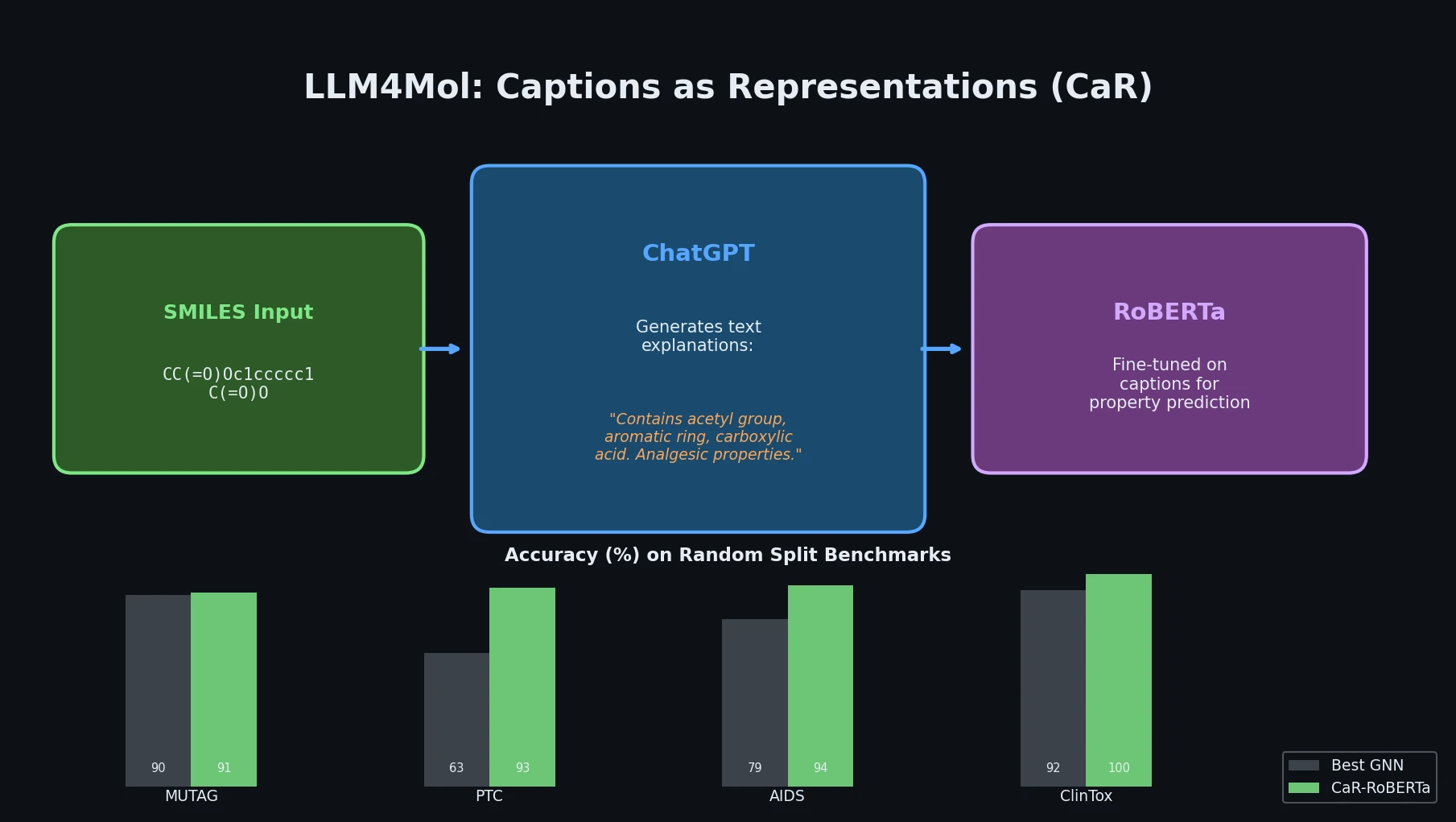
Diagram showing the CaR pipeline from SMILES to ChatGPT-generated captions to fine-tuned RoBERTa predictions

LLM4Mol: ChatGPT Captions as Molecular Representations

Proposes Captions as Representations (CaR), where ChatGPT generates textual explanations for SMILES strings that are then used to fine-tune small language models for molecular property prediction.

Computational Chemistry
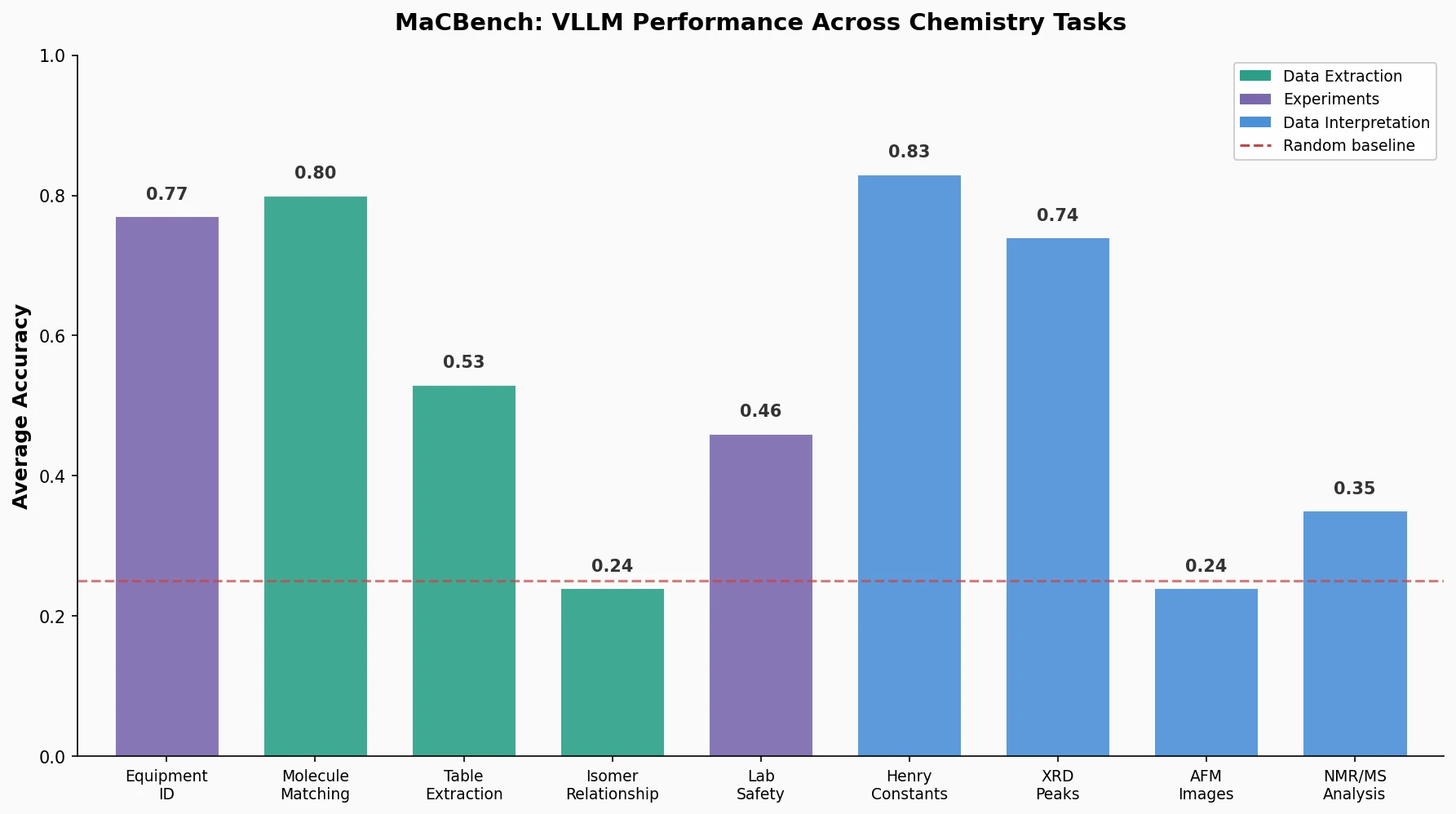
Bar chart showing vision language model performance across chemistry tasks including equipment identification, molecule matching, spectroscopy, and laboratory safety

MaCBench: Multimodal Chemistry and Materials Benchmark

MaCBench evaluates frontier vision language models across 1,153 chemistry and materials science tasks spanning data extraction, experimental execution, and data interpretation, uncovering fundamental limitations in spatial reasoning and cross-modal integration.

Molecular Representations
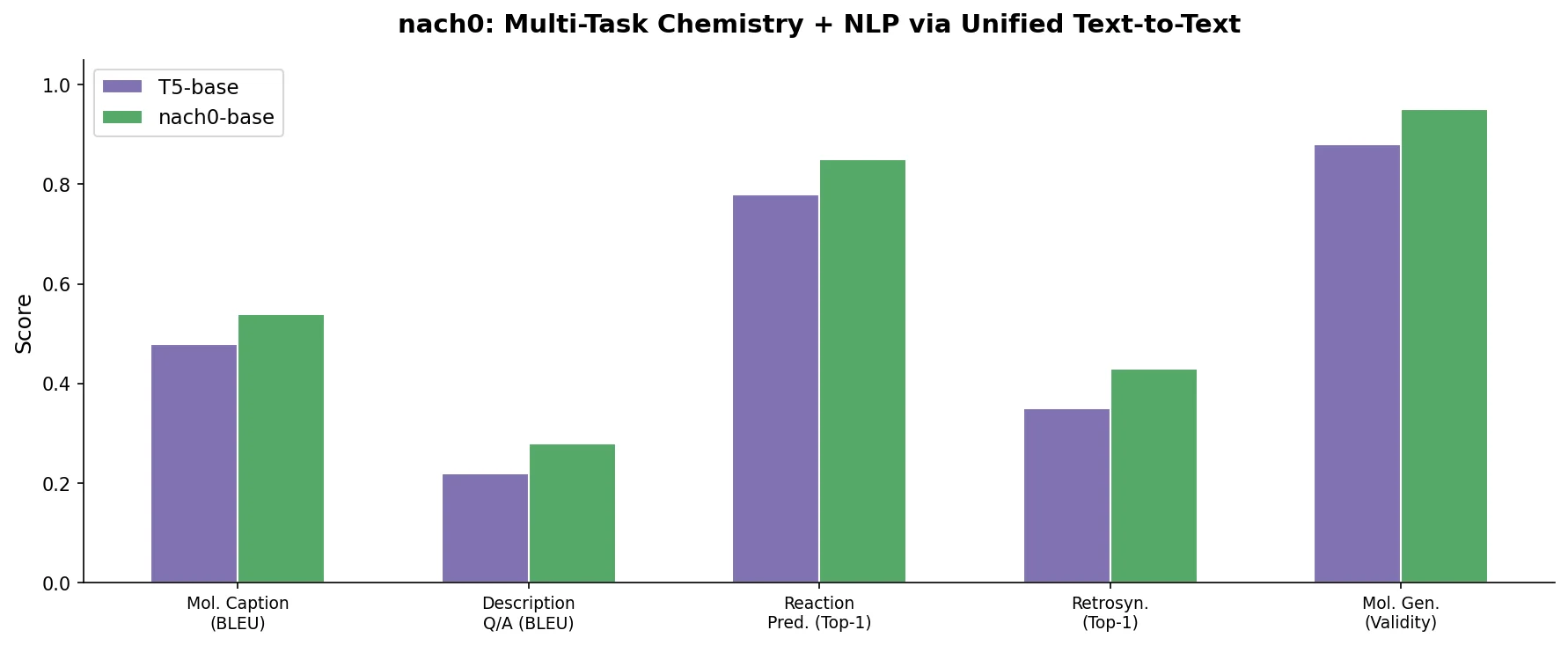
Bar chart comparing nach0 vs T5-base across molecular captioning, Q/A, reaction prediction, retrosynthesis, and generation

nach0: A Multimodal Chemical and NLP Foundation Model

nach0 unifies natural language and SMILES-based chemical tasks in a single encoder-decoder model, achieving competitive results across molecular property prediction, reaction prediction, molecular generation, and biomedical NLP benchmarks.

Molecular Representations
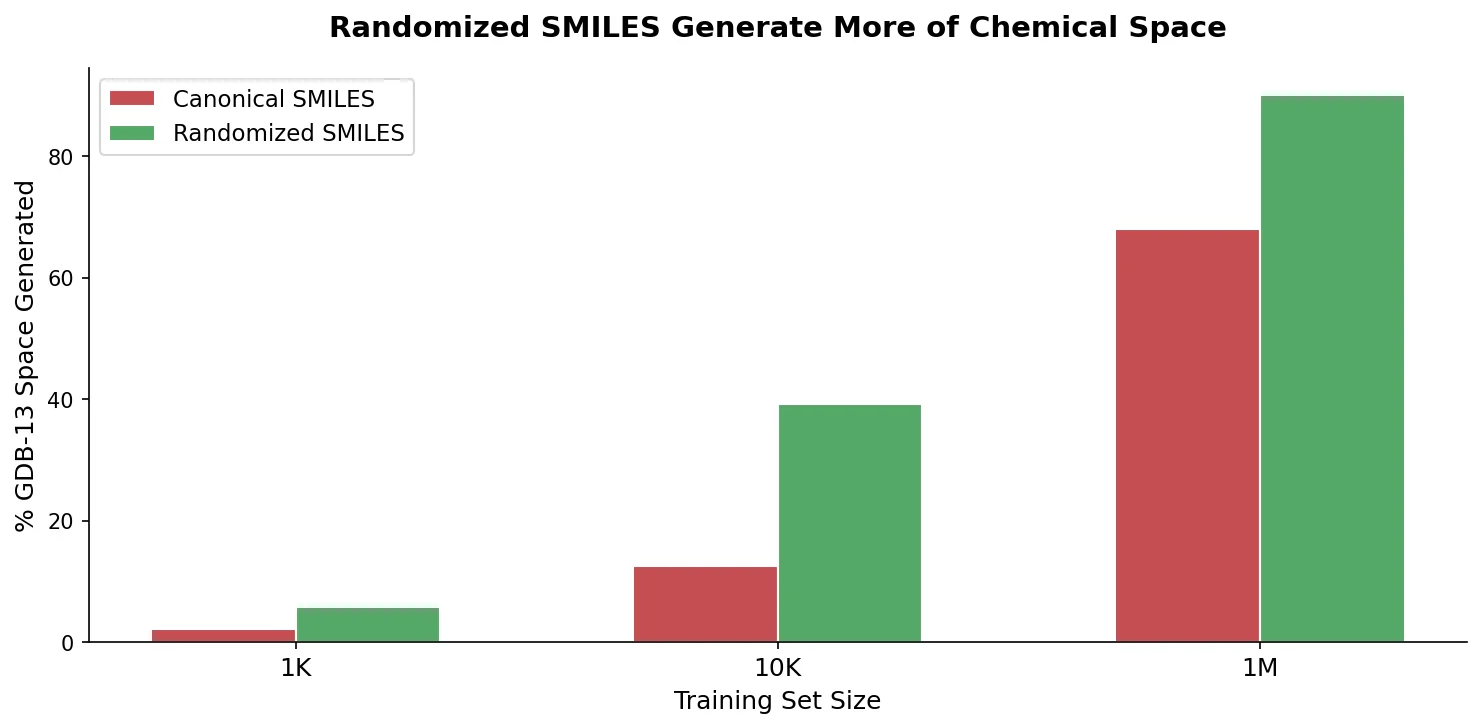
Bar chart showing randomized SMILES generate more of GDB-13 chemical space than canonical SMILES across training set sizes

Randomized SMILES Improve Molecular Generative Models

An extensive benchmark showing that training RNN generative models with randomized (non-canonical) SMILES strings yields more uniform, complete, and closed molecular output domains than canonical SMILES.

Molecular Generation
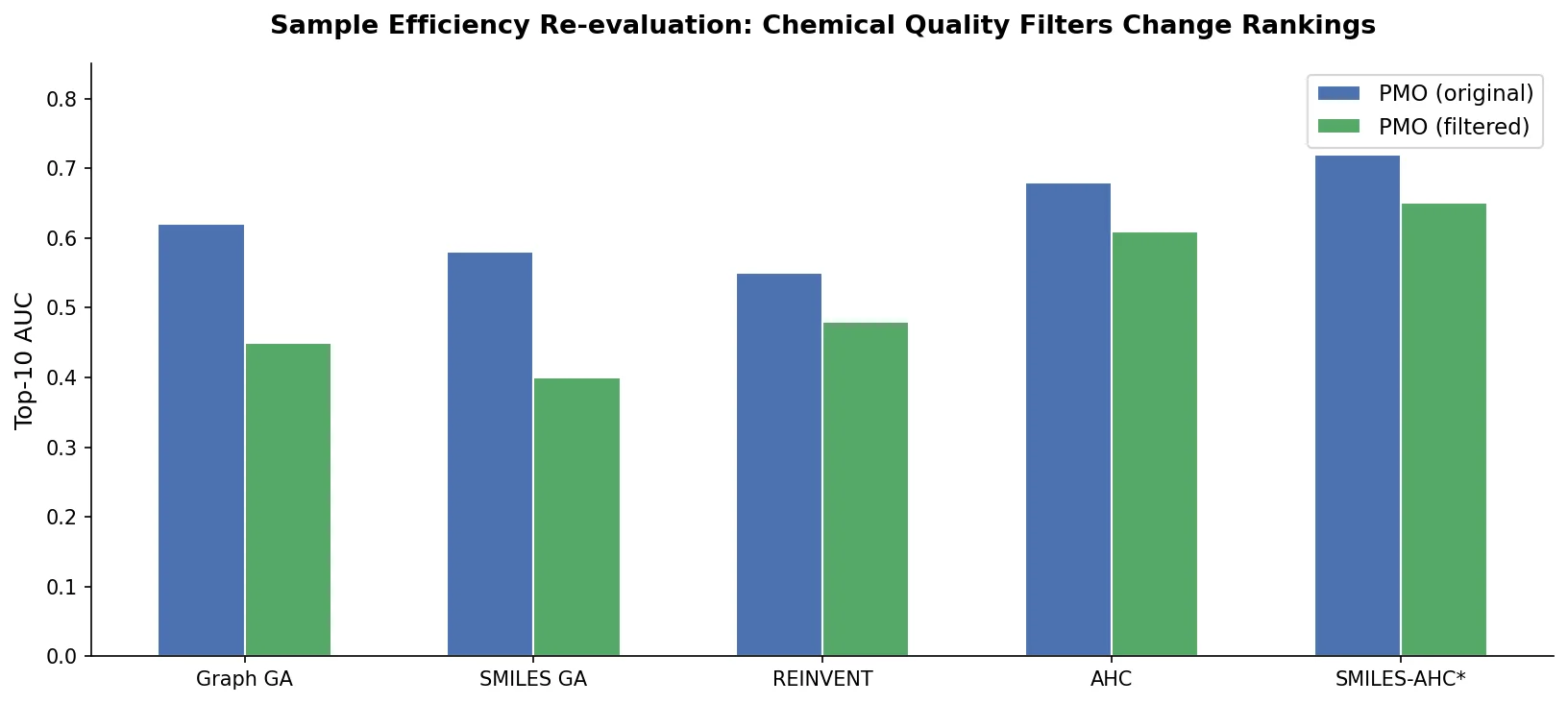
Bar chart comparing PMO benchmark scores with and without chemical quality filters across five generative methods

Re-evaluating Sample Efficiency in Molecule Generation

A critical reassessment of the PMO benchmark for de novo molecule generation, showing that adding molecular weight, LogP, and diversity filters substantially re-ranks generative models, with Augmented Hill-Climb emerging as the top method.

Molecular Representations
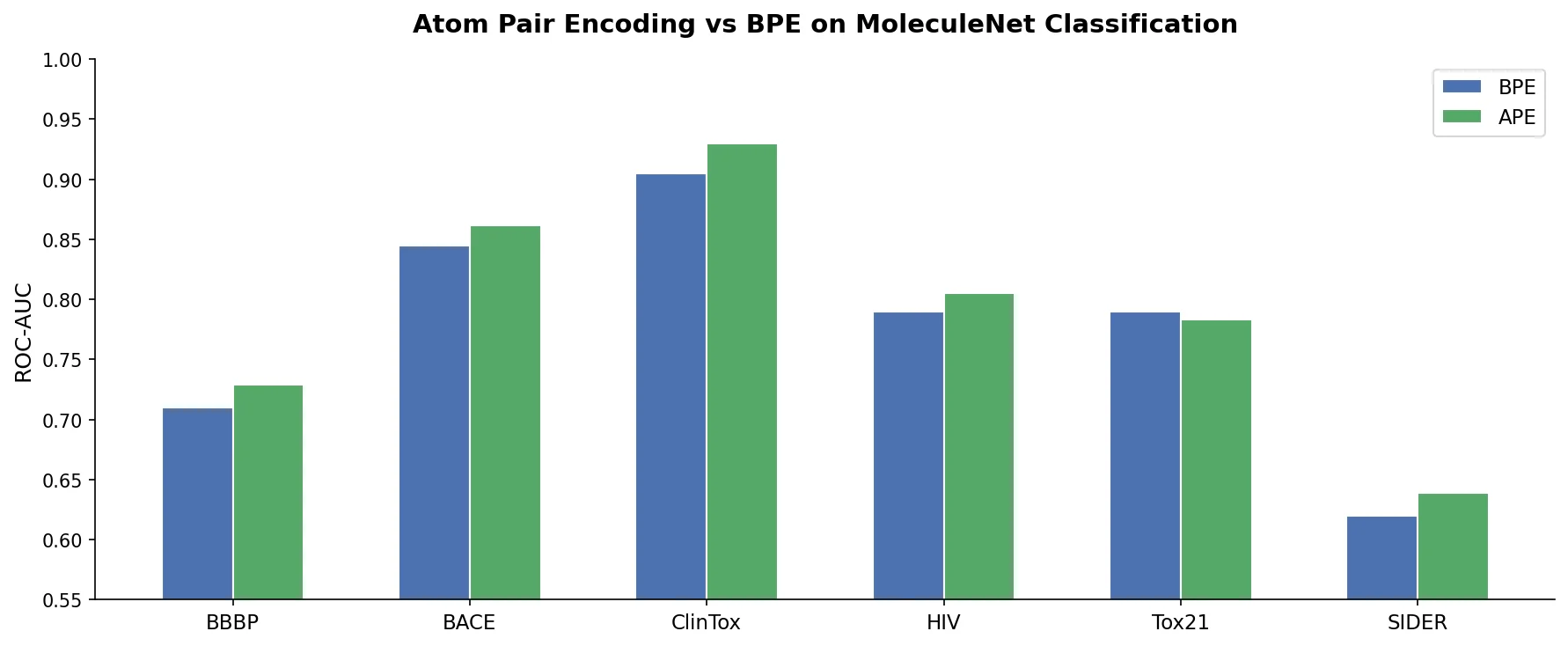
Bar chart comparing Atom Pair Encoding vs BPE tokenization on MoleculeNet classification tasks

SMILES vs SELFIES Tokenization for Chemical LMs

Introduces Atom Pair Encoding (APE), a chemistry-aware tokenizer for SMILES and SELFIES, and shows it consistently outperforms Byte Pair Encoding in RoBERTa-based molecular property classification on BBBP, HIV, and Tox21 benchmarks.

Predictive Chemistry
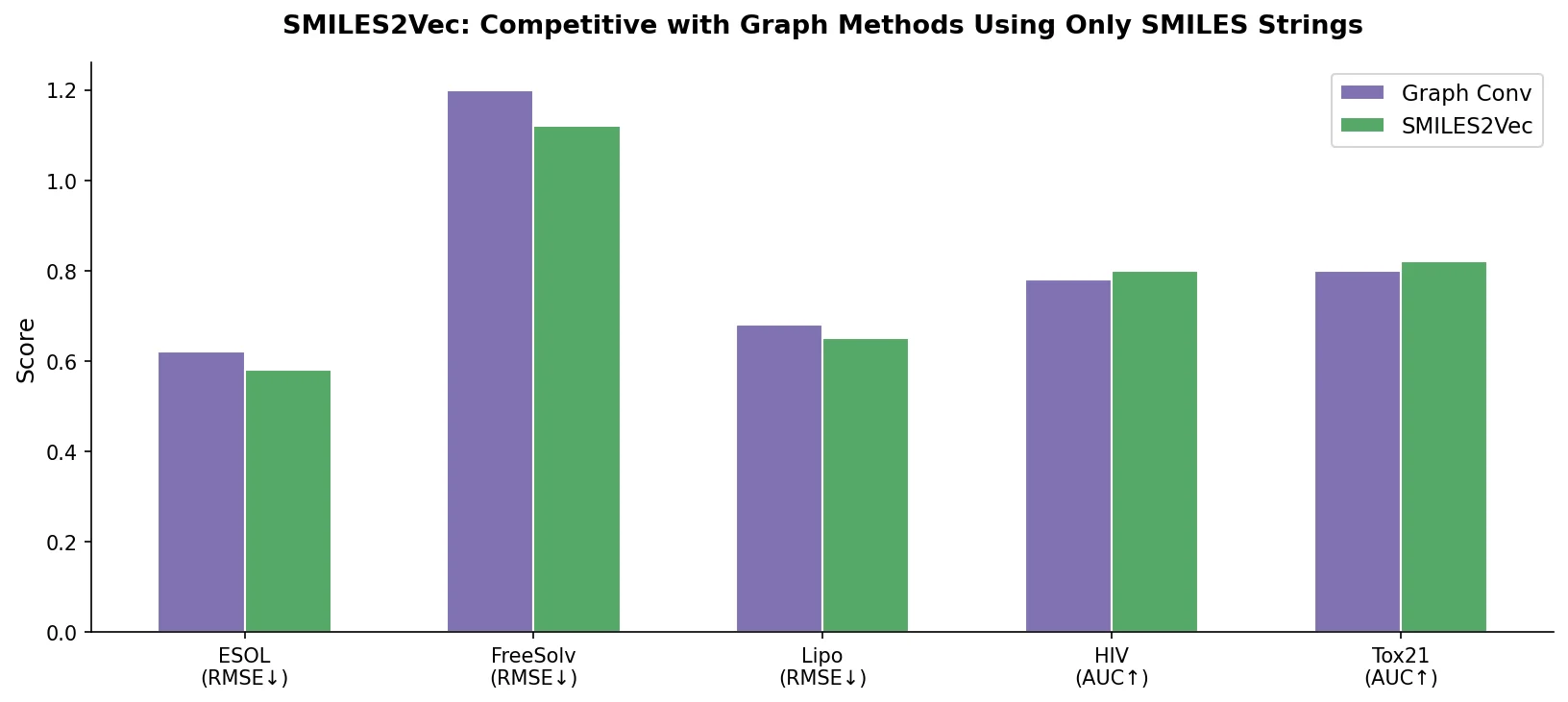
Bar chart comparing SMILES2Vec and Graph Conv scores across five MoleculeNet tasks

SMILES2Vec: Interpretable Chemical Property Prediction

SMILES2Vec is a deep RNN that learns chemical features directly from SMILES strings using a Bayesian-optimized CNN-GRU architecture. It matches graph convolution baselines on toxicity and activity prediction, and its explanation mask identifies chemically meaningful functional groups with 88% accuracy.

Molecular Representations
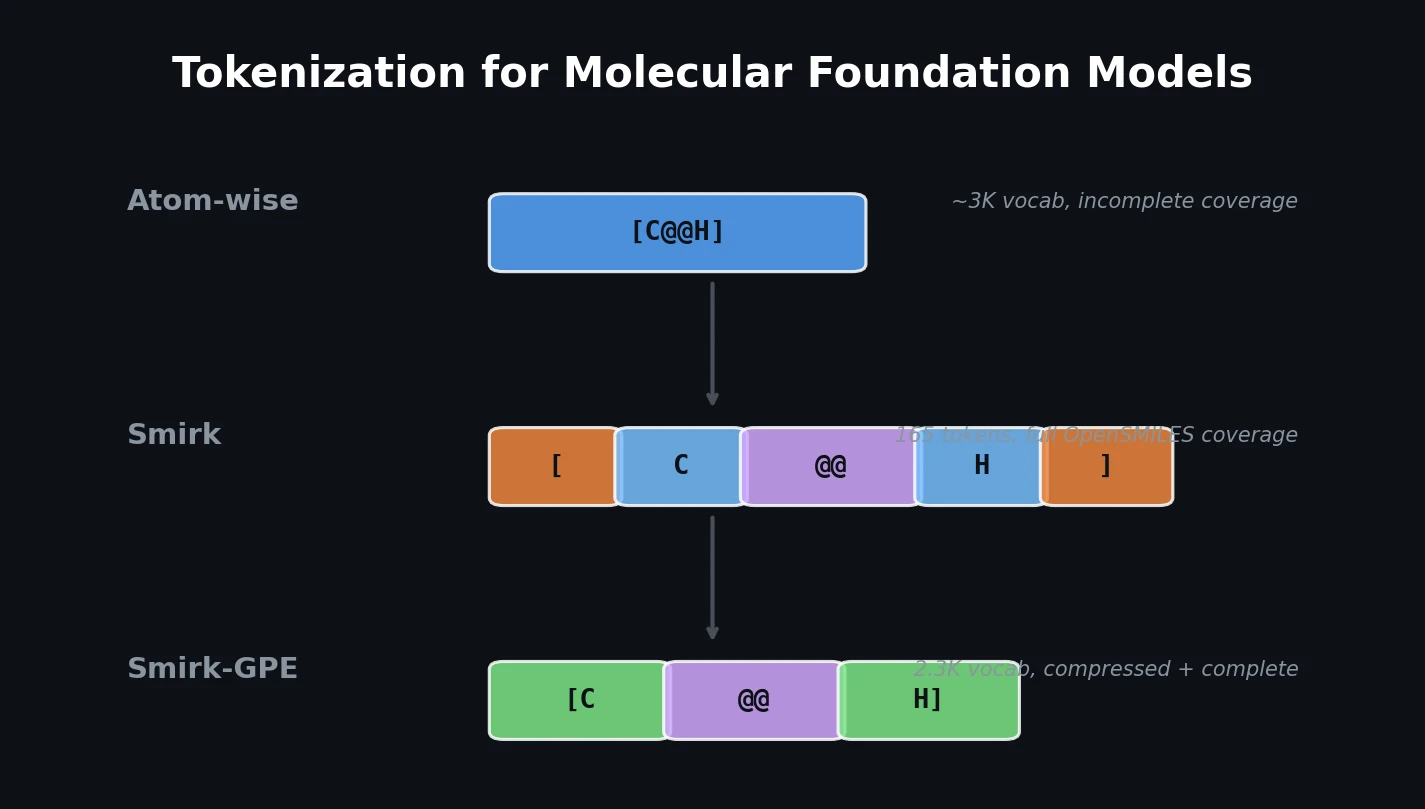
Visualization of tokenizer vocabulary coverage across chemical space

Smirk: Complete Tokenization for Molecular Models

Introduces Smirk and Smirk-GPE tokenizers that fully cover the OpenSMILES specification, proposes n-gram language models as low-cost proxies for evaluating tokenizer quality, and benchmarks 34 tokenizers across intrinsic and extrinsic metrics.