Computational Biology
Graph-grammar expansion of a carbon fixation reaction network with ILP flow queries selecting short autocatalytic cycles

Graph Grammar and ILP for Carbon Fixation Pathways

A graph-grammar cheminformatics workflow expands the carbon fixation reaction network, then uses integer linear programming flow queries to surface short autocatalytic pathways producing Acetyl-CoA and Malate with efficiencies approaching the CETCH cycle.

Time Series Forecasting
LSTNet architecture diagram showing convolutional, recurrent, recurrent-skip, and autoregressive components

LSTNet: Long- and Short-Term Time Series Network

LSTNet is a deep learning framework for multivariate time series forecasting that uses convolutional layers for local dependencies, a recurrent-skip component for periodic long-term patterns, and an autoregressive component for scale robustness.

Scientific Computing
Side-by-side search tree diagrams comparing nauty depth-first and Traces breadth-first traversal strategies for graph isomorphism

nauty and Traces: Graph Isomorphism Algorithms

An updated description of nauty and introduction of Traces, two programs for graph isomorphism testing and canonical labeling using the individualization-refinement paradigm.

Predictive Chemistry
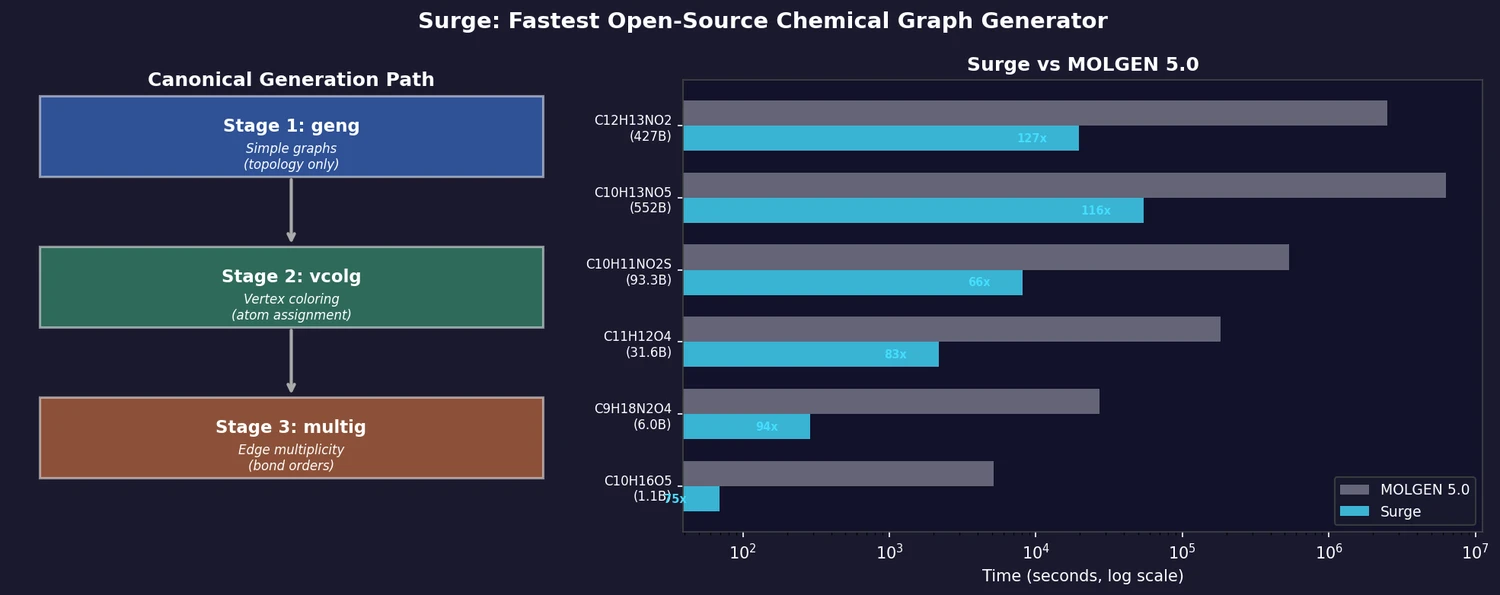
Three-stage canonical generation pipeline (geng, vcolg, multig) alongside a log-scale speed comparison showing Surge outperforming MOLGEN 5.0 by 42-161x across natural product molecular formulas

Surge: Fastest Open-Source Chemical Graph Generator

Surge is a constitutional isomer generator based on the canonical generation path method, using nauty for graph automorphism computation. Its three-stage pipeline (simple graph generation, vertex coloring for atom assignment, edge multiplicity for bond orders) generates 7-22 million molecules per second, outperforming MOLGEN 5.0 by 42-161x on natural product molecular formulas.
Machine Learning
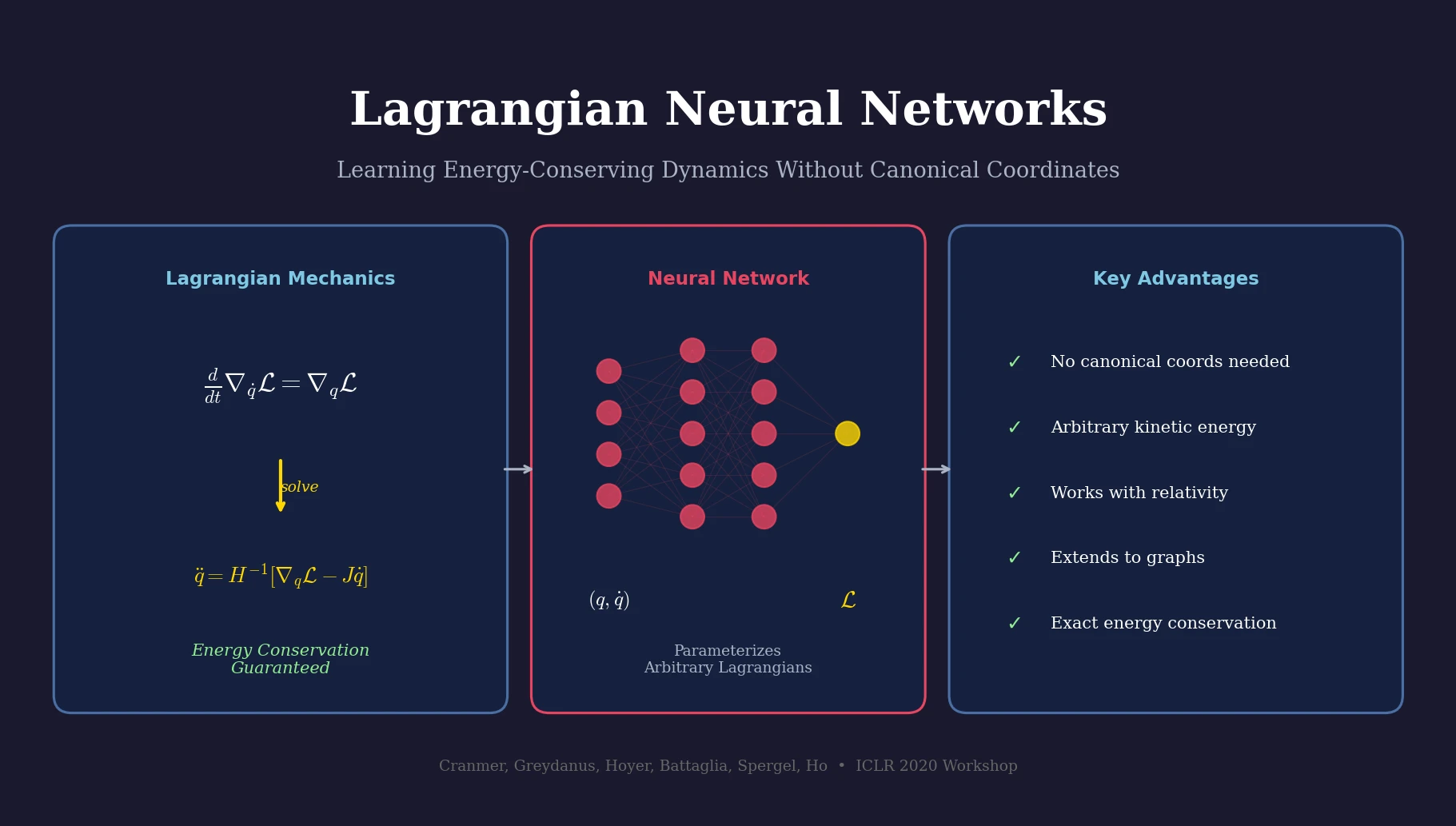
Diagram showing the Lagrangian Neural Network pipeline from coordinates through a learned Lagrangian to energy-conserving dynamics

Lagrangian Neural Networks for Physics

Lagrangian Neural Networks (LNNs) use neural networks to parameterize arbitrary Lagrangians, enabling energy-conserving learned dynamics without canonical coordinates. Unlike Hamiltonian approaches, LNNs handle relativistic systems and extend to graphs via Lagrangian Graph Networks.

Machine Learning
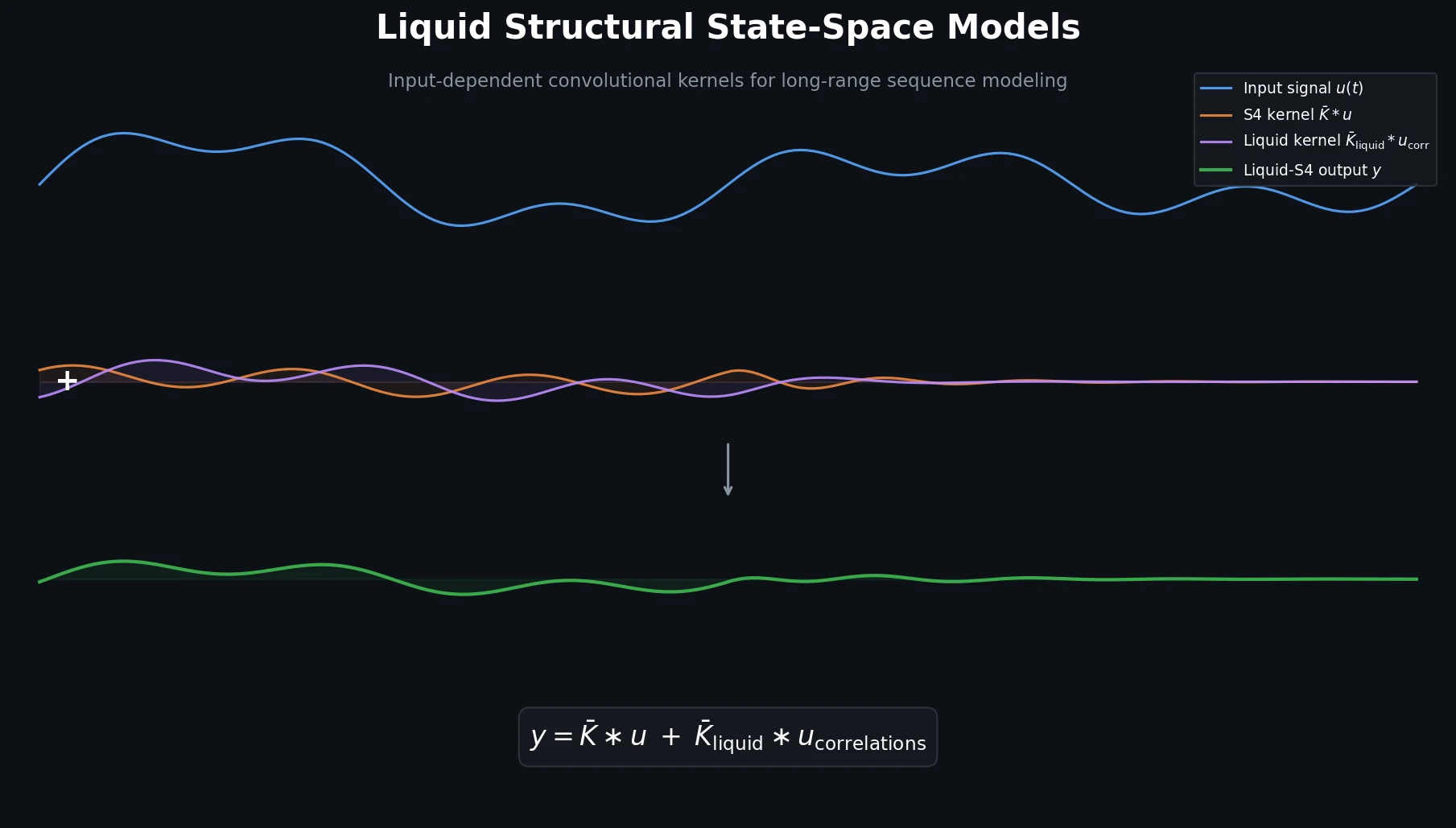
Visualization of Liquid-S4 kernel decomposition showing input signal, S4 kernel, liquid kernel, and combined output

Liquid-S4: Input-Dependent State-Space Models

Liquid-S4 extends the S4 framework by incorporating a linearized liquid time-constant formulation that introduces input-dependent state transitions. This yields an additional convolutional kernel capturing input correlations, improving generalization across long-range sequence tasks.

Molecular Generation
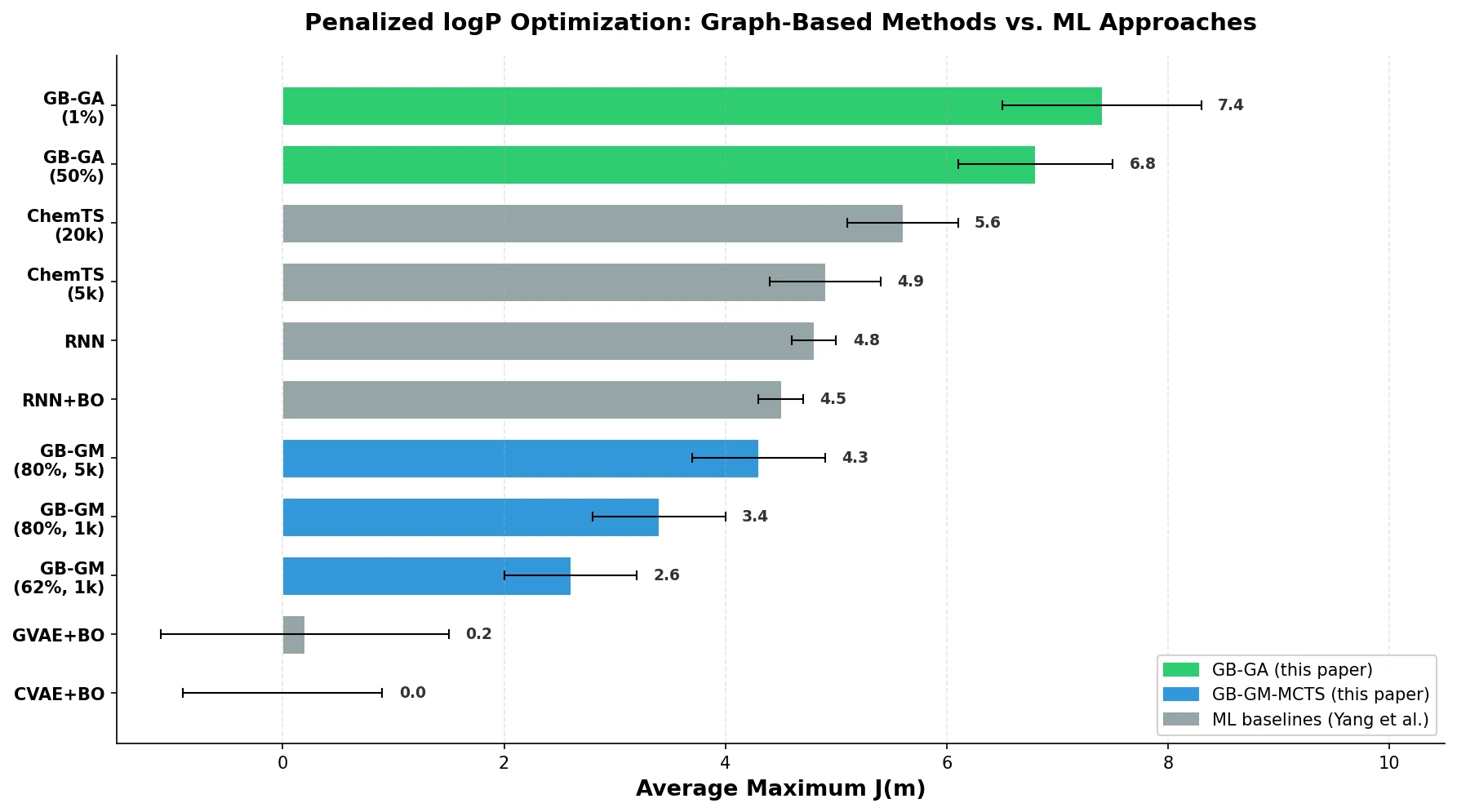
Comparison bar chart showing penalized logP scores for GB-GA, GB-GM-MCTS, and ML-based molecular optimization methods

Graph-Based GA and MCTS Generative Model for Molecules

A graph-based genetic algorithm (GB-GA) and a graph-based generative model with Monte Carlo tree search (GB-GM-MCTS) for molecular optimization that match or outperform ML-based generative approaches while being orders of magnitude faster.

Molecular Generation
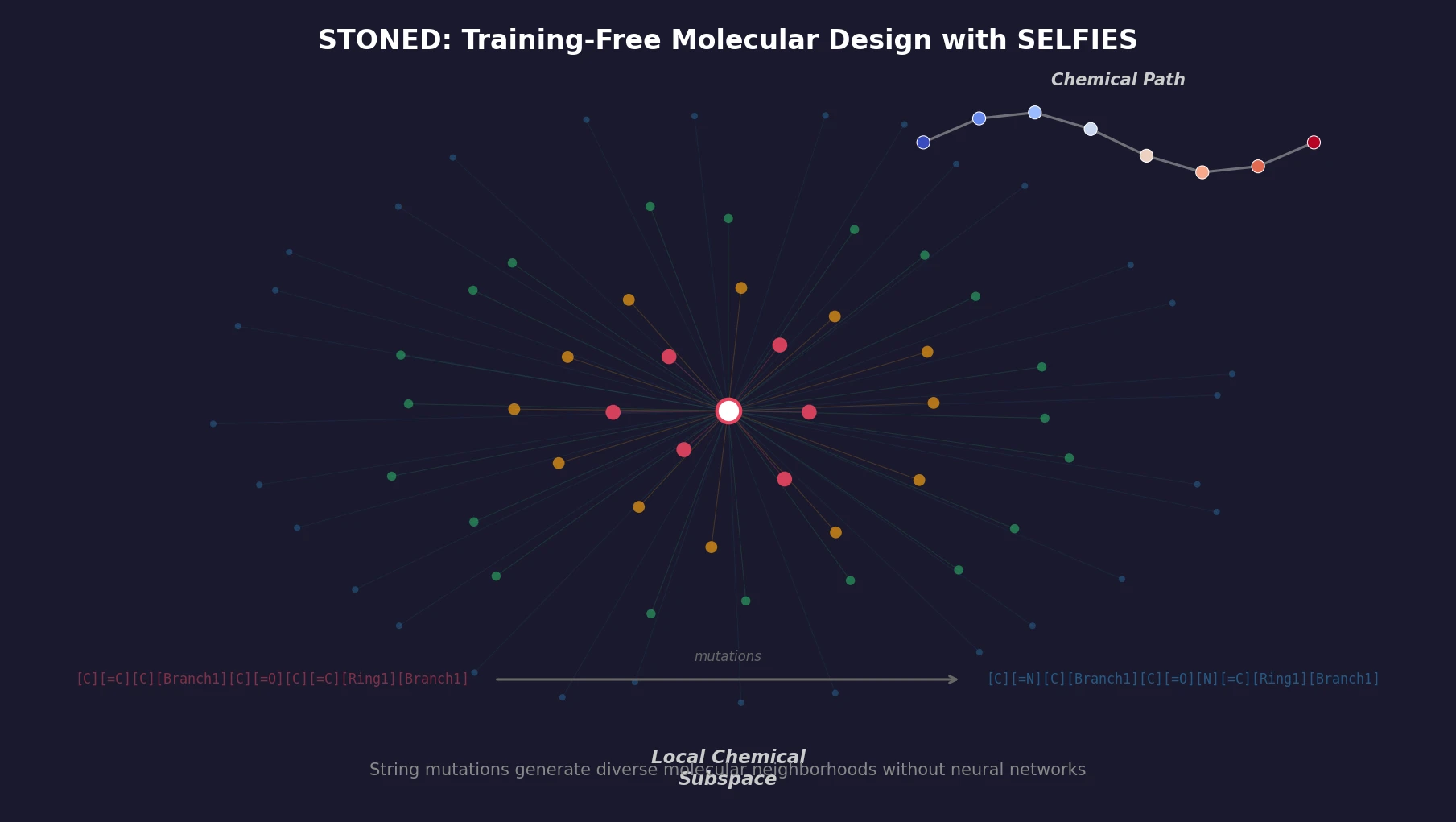
Visualization of STONED algorithm generating a local chemical subspace around a seed molecule through SELFIES string mutations, with a chemical path shown between two endpoints

STONED: Training-Free Molecular Design with SELFIES

STONED introduces simple string manipulation algorithms on SELFIES for molecular design, achieving competitive results with deep generative models while requiring no training data or GPU resources.

Molecular Generation
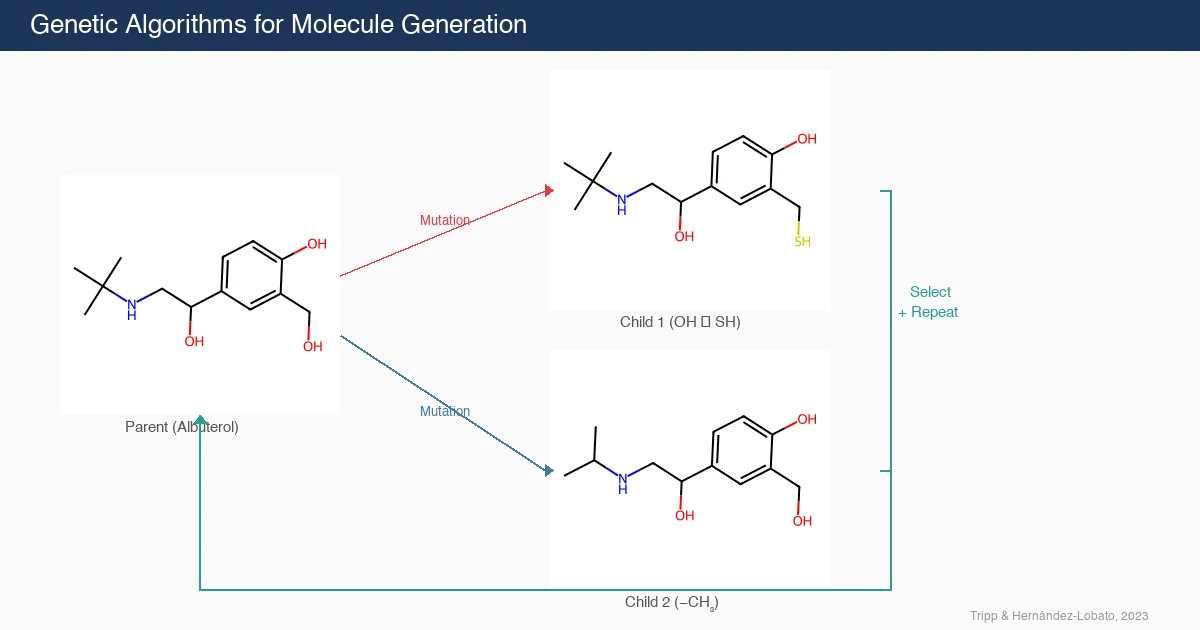
Diagram showing a genetic algorithm for molecules where a parent albuterol molecule undergoes mutation to produce two child molecules, with a selection and repeat loop

Genetic Algorithms as Baselines for Molecule Generation

This position paper demonstrates that genetic algorithms (GAs) perform surprisingly well on molecular generation benchmarks, often outperforming complex deep learning methods. The authors propose the GA criterion: new molecule generation algorithms should demonstrate a clear advantage over GAs.

Scientific Computing
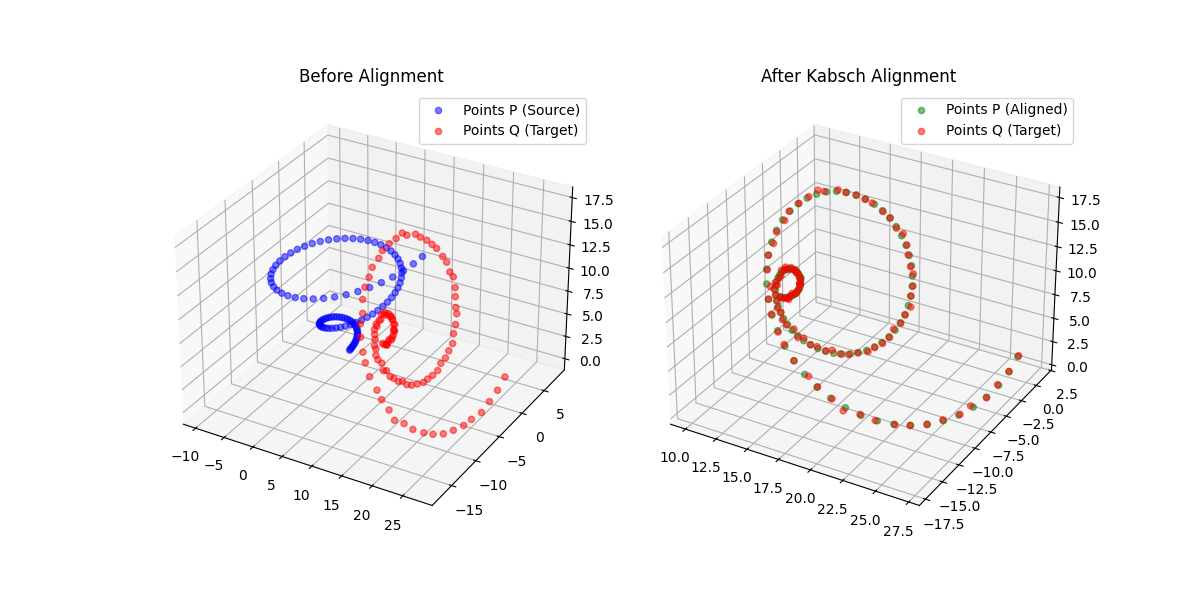
Before and after visualization of point-set alignment using the Kabsch algorithm

Kabsch-Horn Cookbook: Differentiable Alignment

A differentiable point-set alignment library implementing N-dimensional Kabsch, Horn quaternion, and Umeyama scaling algorithms with per-point weights, batch dimensions, and custom autograd across NumPy, PyTorch, JAX, TensorFlow, and MLX.

Computational Biology
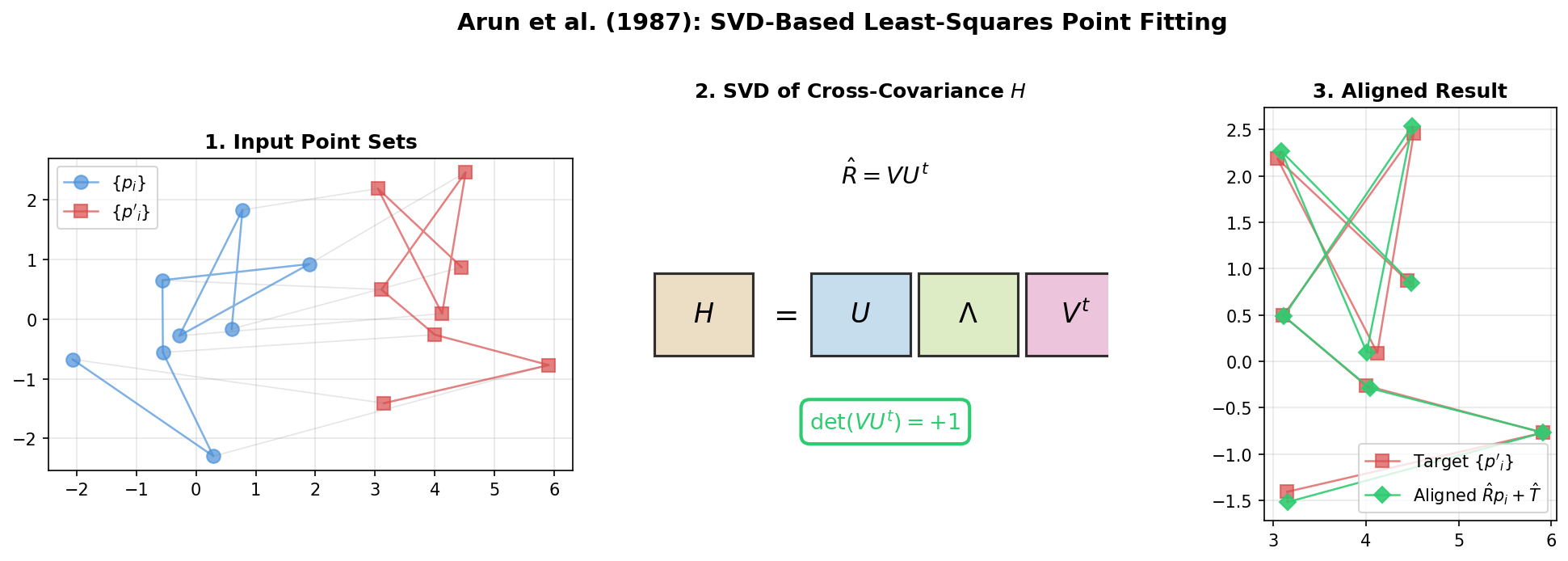
Three-panel diagram showing input point sets, SVD factorization of the cross-covariance matrix, and the aligned result

Arun et al.: SVD-Based Least-Squares Fitting of 3D Points

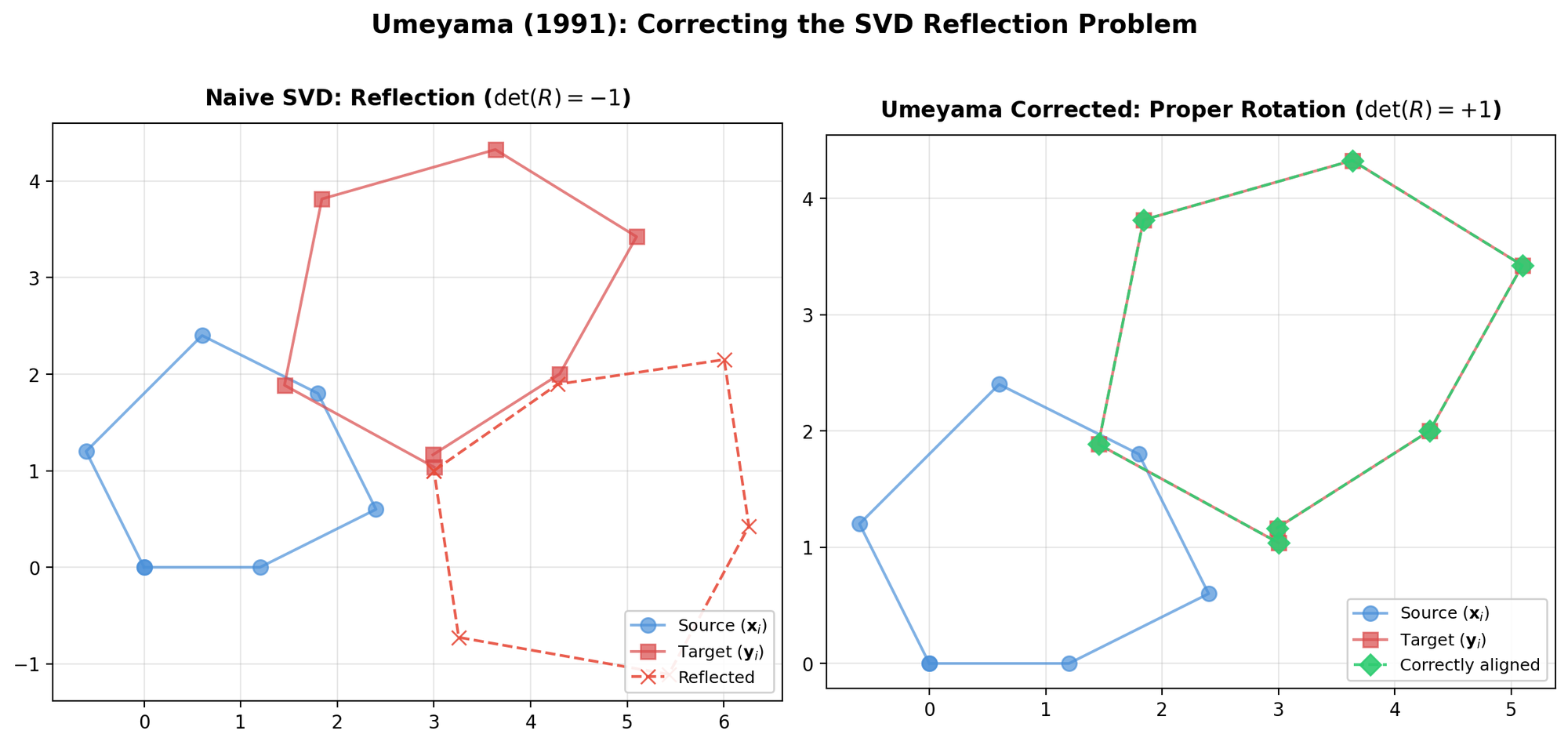
Presents a concise SVD-based algorithm for finding the optimal rotation and translation between two 3D point sets, with analysis of the degenerate reflection case that Umeyama later corrected.

Computational Biology
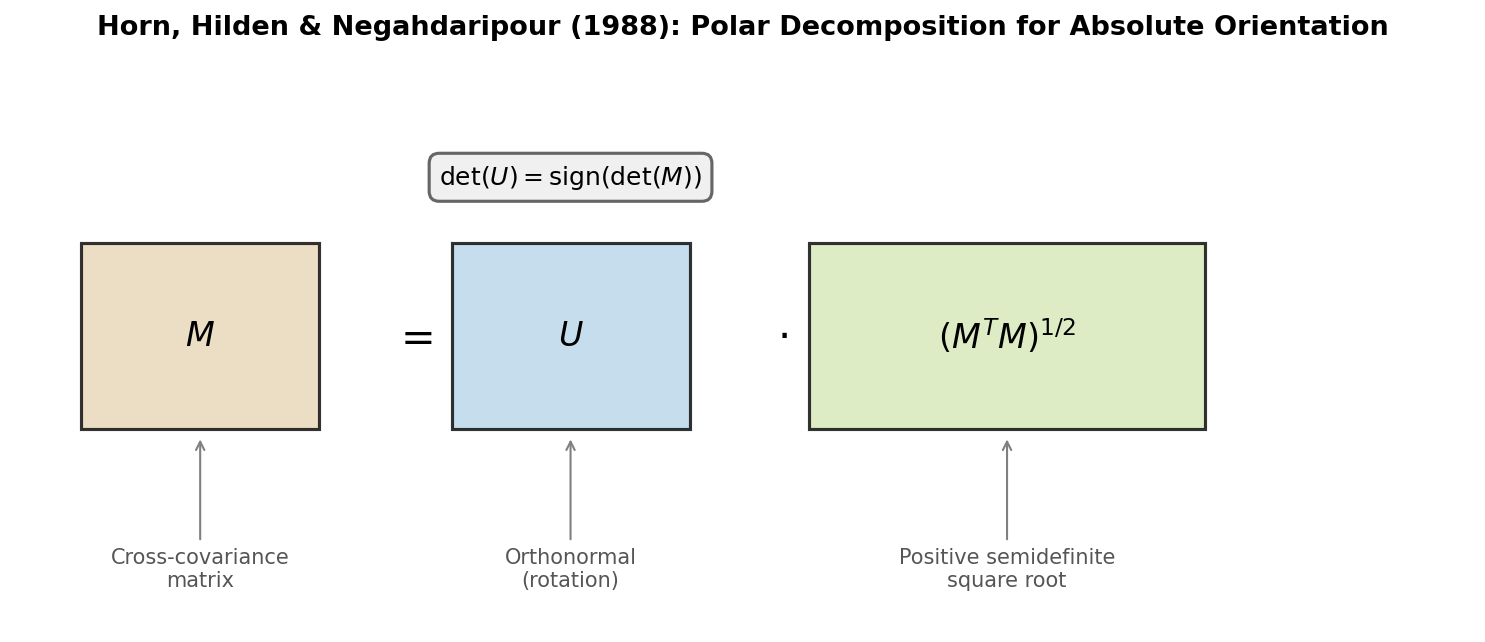
Diagram showing the polar decomposition of the cross-covariance matrix M into orthonormal factor U and positive semidefinite square root

Horn et al.: Absolute Orientation Using Orthonormal Matrices

The matrix-based companion to Horn’s 1987 quaternion method, deriving the optimal rotation as the orthonormal factor in the polar decomposition of the cross-covariance matrix via eigendecomposition of a 3x3 symmetric matrix.