Abstract
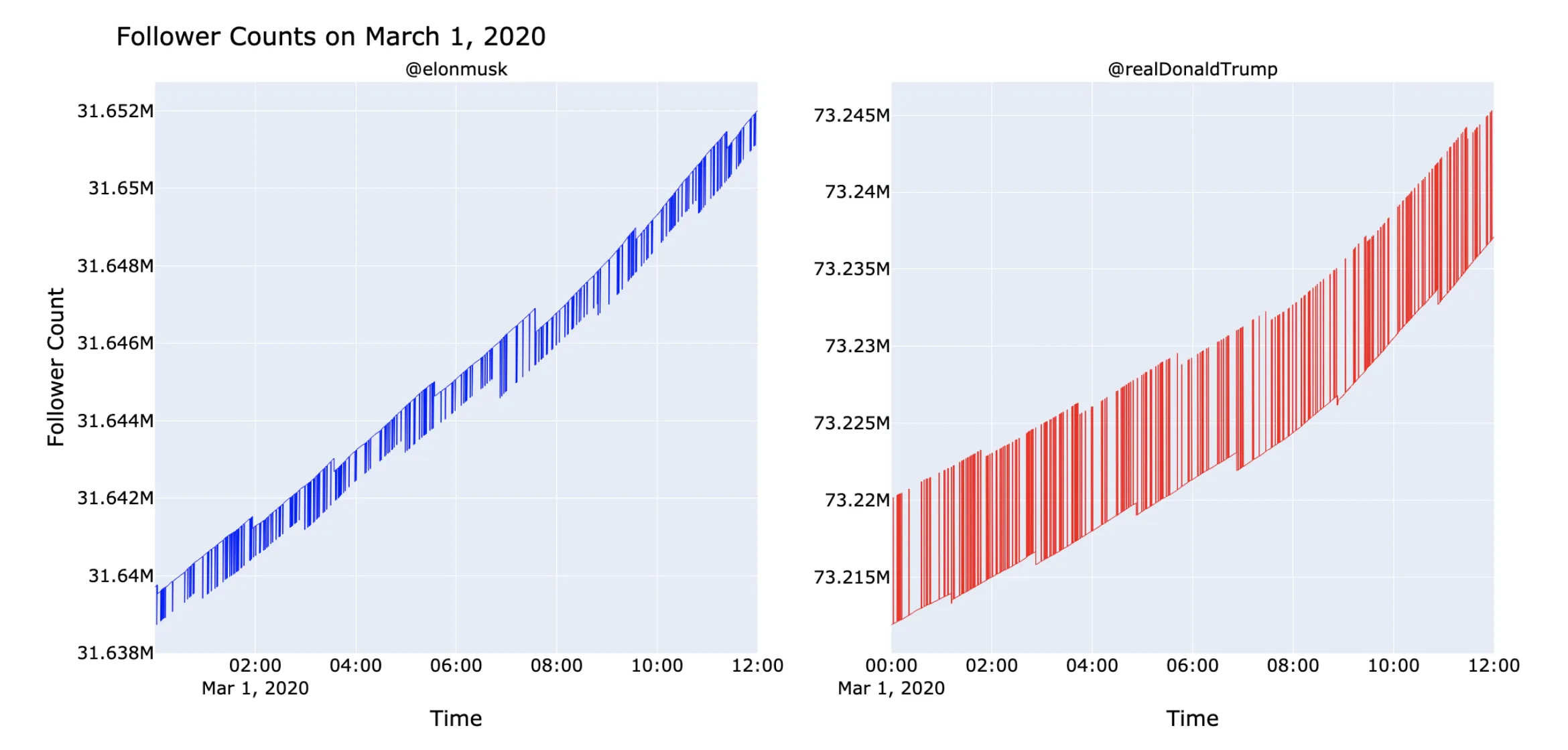
In the lead-up to the 2020 U.S. presidential election, we developed tools to monitor the follower dynamics of prominent Twitter users. This work details our investigation into several strange phenomena we observed, which suggest the presence of coordinated manipulation campaigns. We present preliminary evidence of networks of automated (bot) and potentially compromised accounts aiming to artificially inflate or diminish the perceived social status of high-profile individuals. (Note: this work was presented as an extended abstract at IC2S2 2020. It is available as an arXiv preprint but was not submitted as a full peer-reviewed paper.)
Key Contributions
- High-frequency sampling infrastructure: custom tooling sustaining 1-second follower-count polling over weeks, recursive follower-list “tunneling” through Twitter’s pagination limits, and API-rate-window management, capturing sub-second signatures invisible to standard API sampling and requiring no internal platform access.
- Four documented phenomena: spikes & sawteeth, circulating accounts, resurrected pre-2010 accounts, and follower-list anomalies, each cataloged as a separate experiment.
- Preliminary evidence of coordination: anomalous patterns consistent with systematic bot activity around prominent political accounts in the lead-up to the 2020 election, presented as observation rather than proven causation.
Methodological Strategy
To capture these transient phenomena, we built a high-frequency observational pipeline that bypassed standard sampling limitations. Our framework treated the social graph as a dynamic signal:
- High-Resolution Sampling: Implemented “cycling scripts” to monitor follower counts at 1-second resolution, revealing sub-second “spike” anomalies often missed by aggregate metrics
- Recursive “Tunneling”: Developed a recursive sampling method to extract deep history from follower lists, uncovering strata of “ancient” accounts buried by recent activity
- Cross-Referencing: Correlated circulation events with follower count distortions to validate the “sawtooth” waveform hypothesis
Key Findings
- Spikes & Sawteeth: Dramatic, sub-second spikes and saw-tooth wave patterns in follower counts, suggesting automated activity
- Circulating Accounts: Cohorts of users repeatedly following and unfollowing the same high-profile accounts
- ‘Resurrected’ Ancient Accounts: Disproportionate numbers of pre-2010 Twitter accounts with long inactivity periods suddenly appearing as recent followers
- Follower List Anomalies: Unusual temporal groupings in follower histories suggesting historical manipulation campaigns

Significance & Sociological Impact
Beyond the technical detection of botnets, this work raises questions about a potential vulnerability in the infrastructure of modern public discourse. The observed patterns suggest these coordinated campaigns may be targeting the metrics that algorithms use to verify relevance (such as follower counts and engagement rates) as a vector for artificially shifting perceived social proof.
- Manipulating social-proof signals: Our observations are consistent with attempts to manipulate the “rich-get-richer” dynamics of social platforms. If inorganic follower inflation can influence recommender systems, that could amplify specific narratives to legitimate users. This remains a documented observation rather than a proven causal chain, and warrants further investigation.
- Account-age filters are not enough: The data highlights patterns where dormant pre-2010 accounts appear as new followers in bulk, suggesting that account-age alone is insufficient as a defense against coordinated manipulation.
- A Case for Metric Scrutiny: These findings suggest that raw follower counts are noisy signals that can be manipulated at scale. Supplementing them with engagement-quality metrics may make platform recommender systems more robust to coordinated inorganic activity.
Citation
@article{heidenreich2020investigating,
  title={Investigating Coordinated 'Social' Targeting of High-Profile Twitter Accounts},
  author={Heidenreich, Hunter Scott and Mujib, Munif Ishad and Williams, Jake Ryland},
  journal={arXiv},
  volume={abs/2008.02874},
  year={2020},
  url={https://arxiv.org/abs/2008.02874},
  eprint={2008.02874},
  eprinttype={arXiv}
}
Related Work
For related work in the computational social science cluster:
- NewsTweet Dataset: Social Media in Digital Journalism: a companion dataset studying how tweets surface in journalism, from the same research group and time period.
- Look, Don’t Tweet: Unified Data Models for Social NLP: provides the unified cross-platform social media data model used in broader analysis of Twitter and related platforms.
- GPT-2 Susceptibility to Universal Adversarial Triggers: proposes UAT-based bot detection as a constructive application, addressing the same automated manipulation behavior documented here from a complementary detection angle.