Natural Language Processing
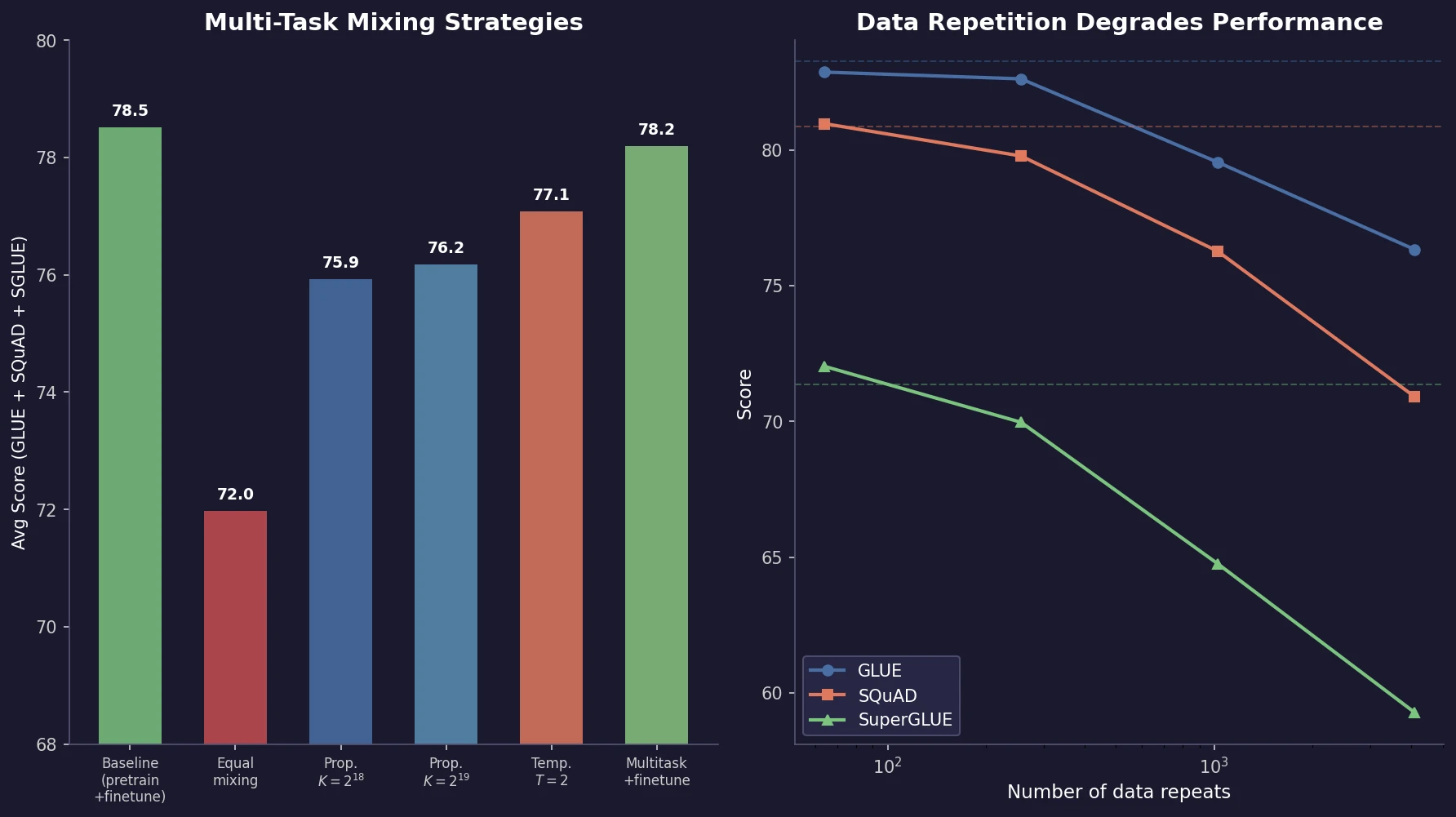
Table comparing multi-task mixing strategies showing examples-proportional and temperature-scaled mixing results

T5: Exploring Transfer Learning Limits

Raffel et al. introduce T5, a unified text-to-text framework for NLP transfer learning. Through systematic ablation of architectures, pre-training objectives, datasets, and multi-task mixing strategies, they identify best practices and scale to 11B parameters, achieving state-of-the-art results across multiple benchmarks.
Molecular Representations
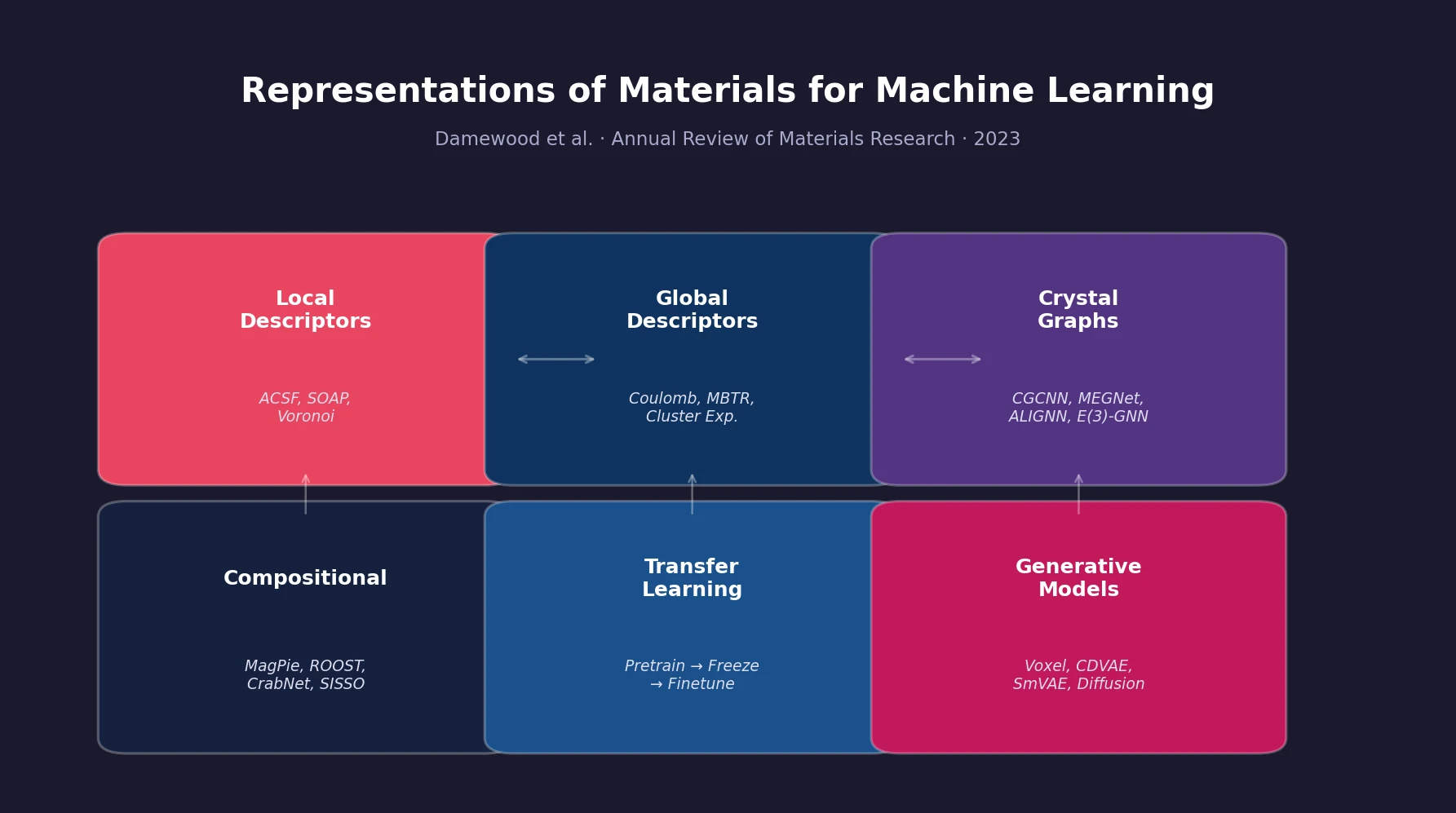
Overview of six categories of materials representations for machine learning

Materials Representations for ML Review

A comprehensive review of how solid-state materials can be numerically represented for machine learning, spanning structural features, graph neural networks, compositional descriptors, transfer learning, and generative models for inverse design.

Computational Chemistry
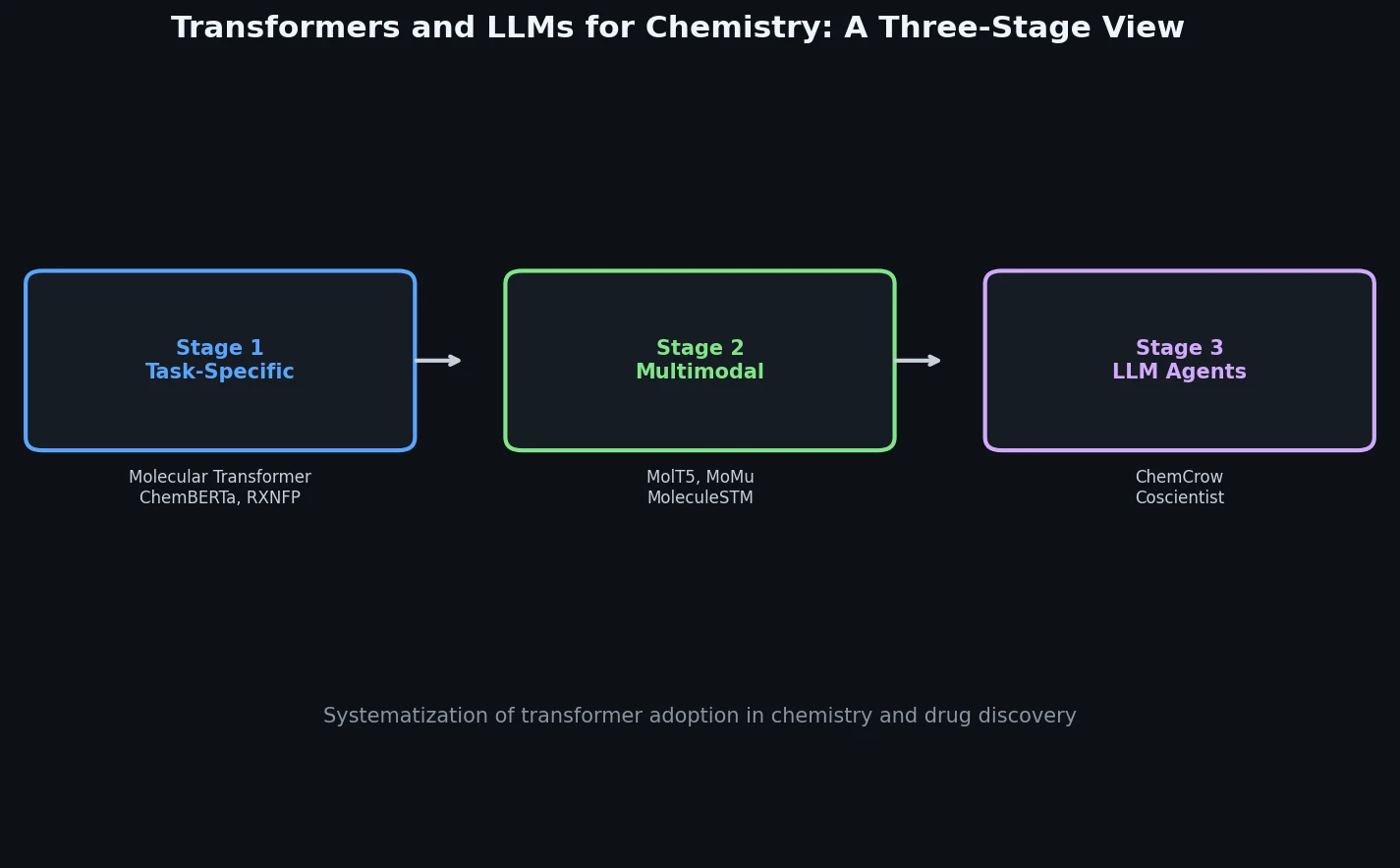
Three-stage progression from task-specific transformers through multimodal models to LLM chemistry agents

Transformers and LLMs for Chemistry Drug Discovery

A review chapter tracing three stages of transformer adoption in chemistry: task-specific single-modality models (reaction prediction, retrosynthesis), multimodal approaches bridging spectra and text, and LLM-powered agents like ChemCrow for general chemical reasoning.

Molecular Generation
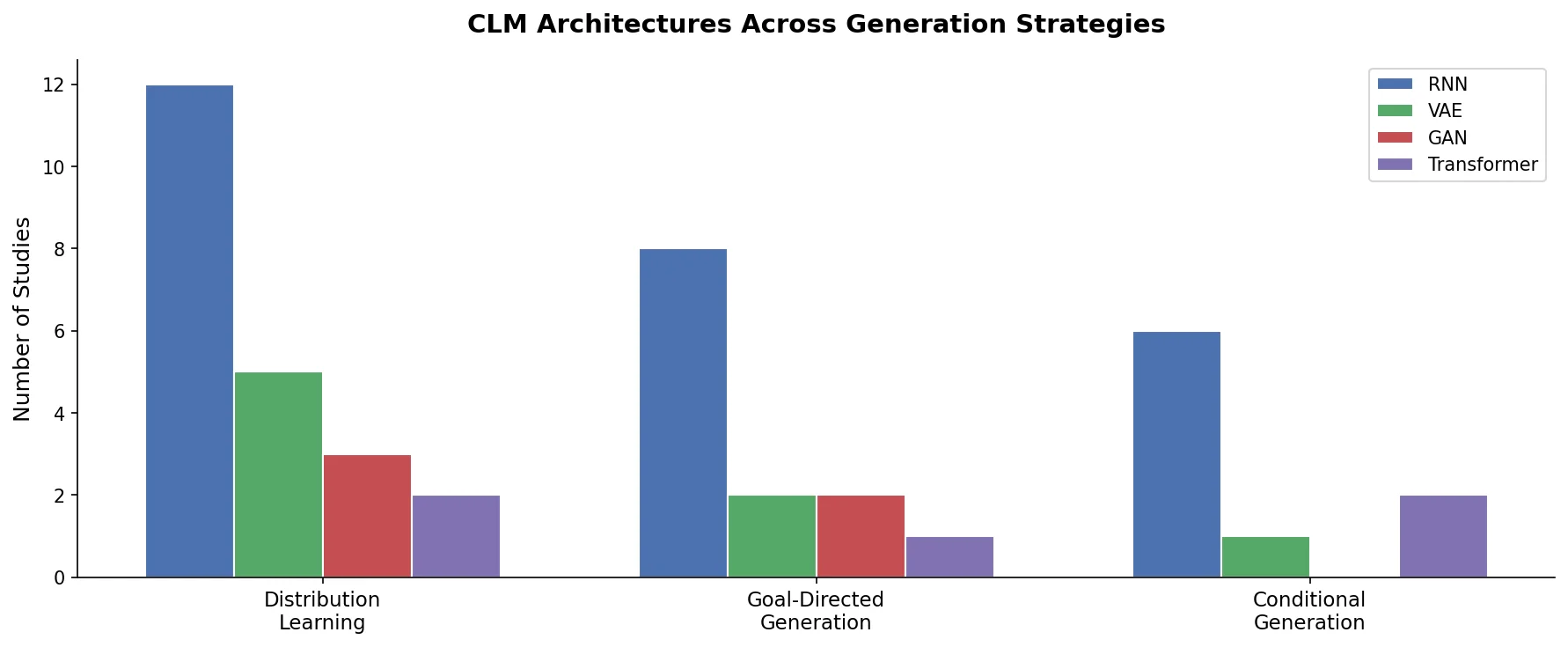
Grouped bar chart showing CLM architectures (RNN, VAE, GAN, Transformer) across generation strategies

Chemical Language Models for De Novo Drug Design Review

A minireview of chemical language models for de novo molecule design, covering SMILES and SELFIES representations, RNN and Transformer architectures, distribution learning, goal-directed and conditional generation, and prospective experimental validation.

Computational Chemistry
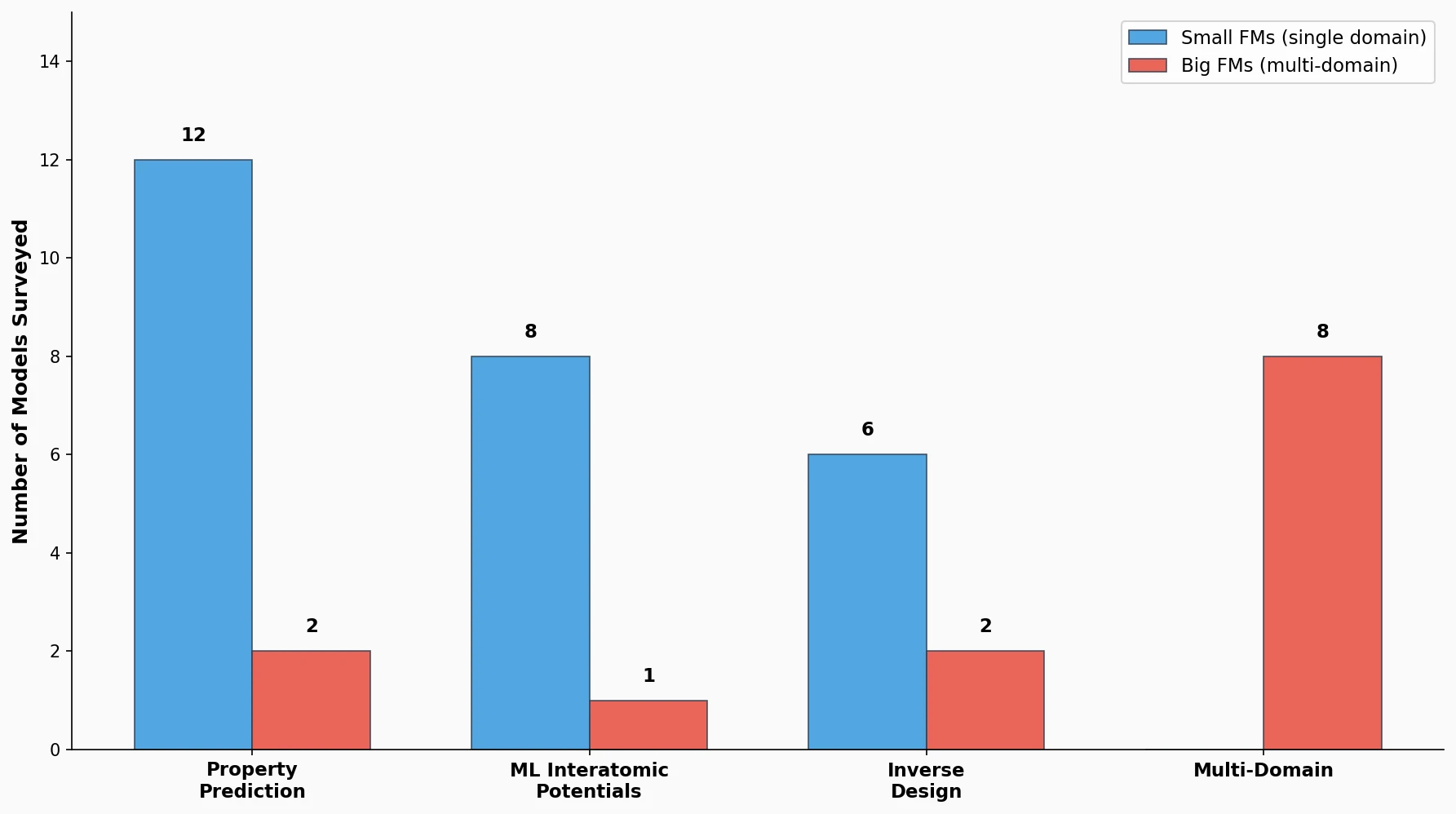
Bar chart comparing small and big foundation models surveyed across property prediction, MLIPs, inverse design, and multi-domain chemistry applications

Foundation Models in Chemistry: A 2025 Perspective

This perspective from Choi et al. reviews foundation models in chemistry, categorizing them as ‘small’ (domain-specific, e.g., property prediction, MLIPs, inverse design) and ‘big’ (multi-domain, e.g., multimodal and LLM-based). It surveys pretraining strategies, key architectures (GNNs and language models), and outlines future directions for scaling, efficiency, and interpretability.

Molecular Generation
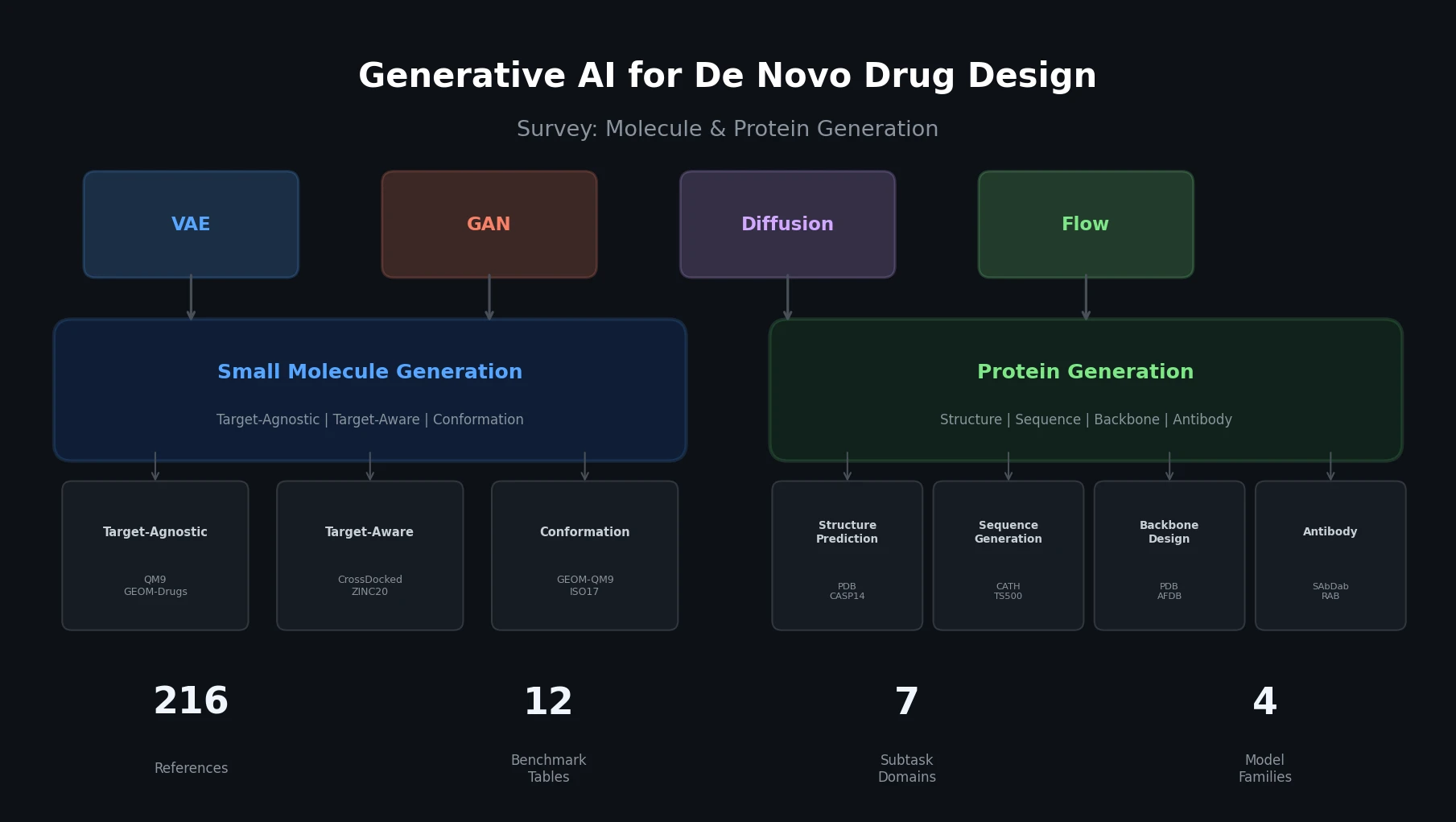
Taxonomy diagram showing four generative model families (VAE, GAN, Diffusion, Flow) connecting to small molecule generation and protein generation subtasks

Generative AI Survey for De Novo Molecule and Protein Design

This survey organizes generative AI for de novo drug design into two themes: small molecule generation (target-agnostic, target-aware, conformation) and protein generation (structure prediction, sequence generation, backbone design, antibody, peptide). It covers four generative model families (VAEs, GANs, diffusion, flow-based), catalogs key datasets and benchmarks, and provides 12 comparative benchmark tables across all subtasks.

Molecular Generation
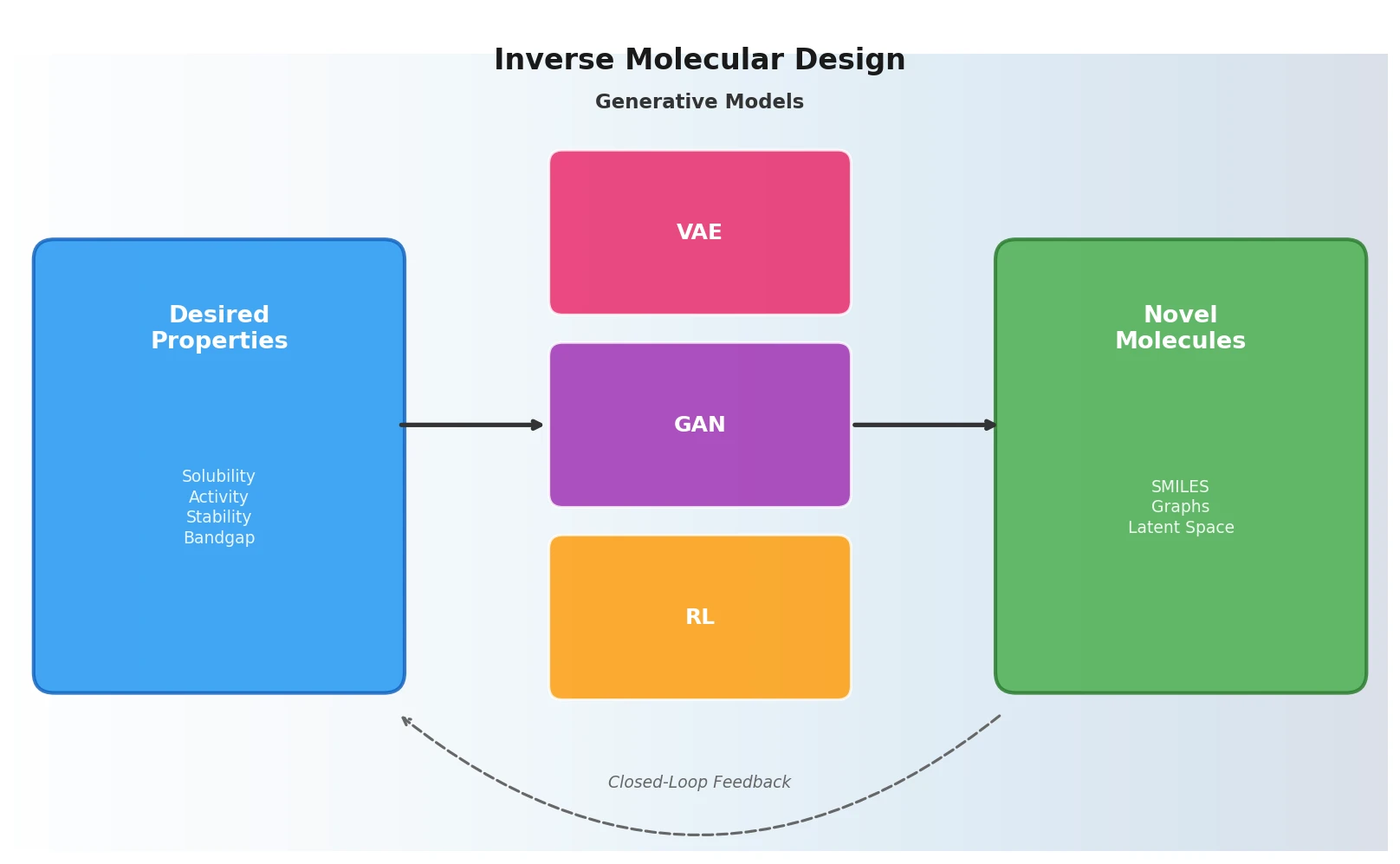
Schematic of inverse molecular design paradigm mapping desired properties to molecular structures through generative models

Inverse Molecular Design with ML Generative Models

A foundational review surveying how deep generative models (VAEs, GANs, reinforcement learning) enable inverse molecular design, covering molecular representations, chemical space navigation, and applications from drug discovery to materials engineering.

Molecular Generation
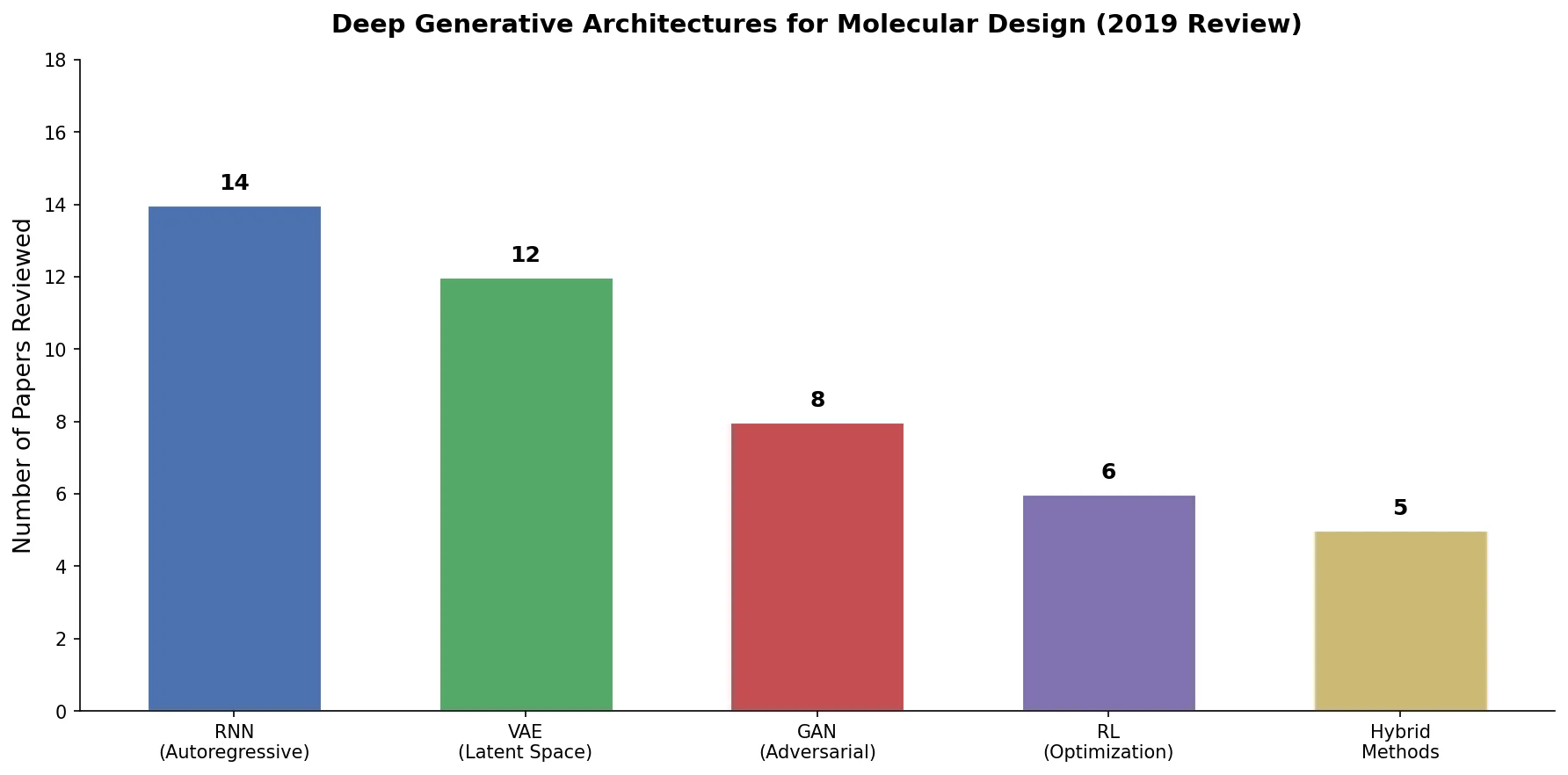
Bar chart showing deep generative architecture types for molecular design: RNN, VAE, GAN, RL, and hybrid methods

Review: Deep Learning for Molecular Design (2019)

An early and influential review cataloging 45 papers on deep generative modeling for molecules, comparing RNN, VAE, GAN, and reinforcement learning architectures across SMILES and graph-based representations.

Computational Chemistry
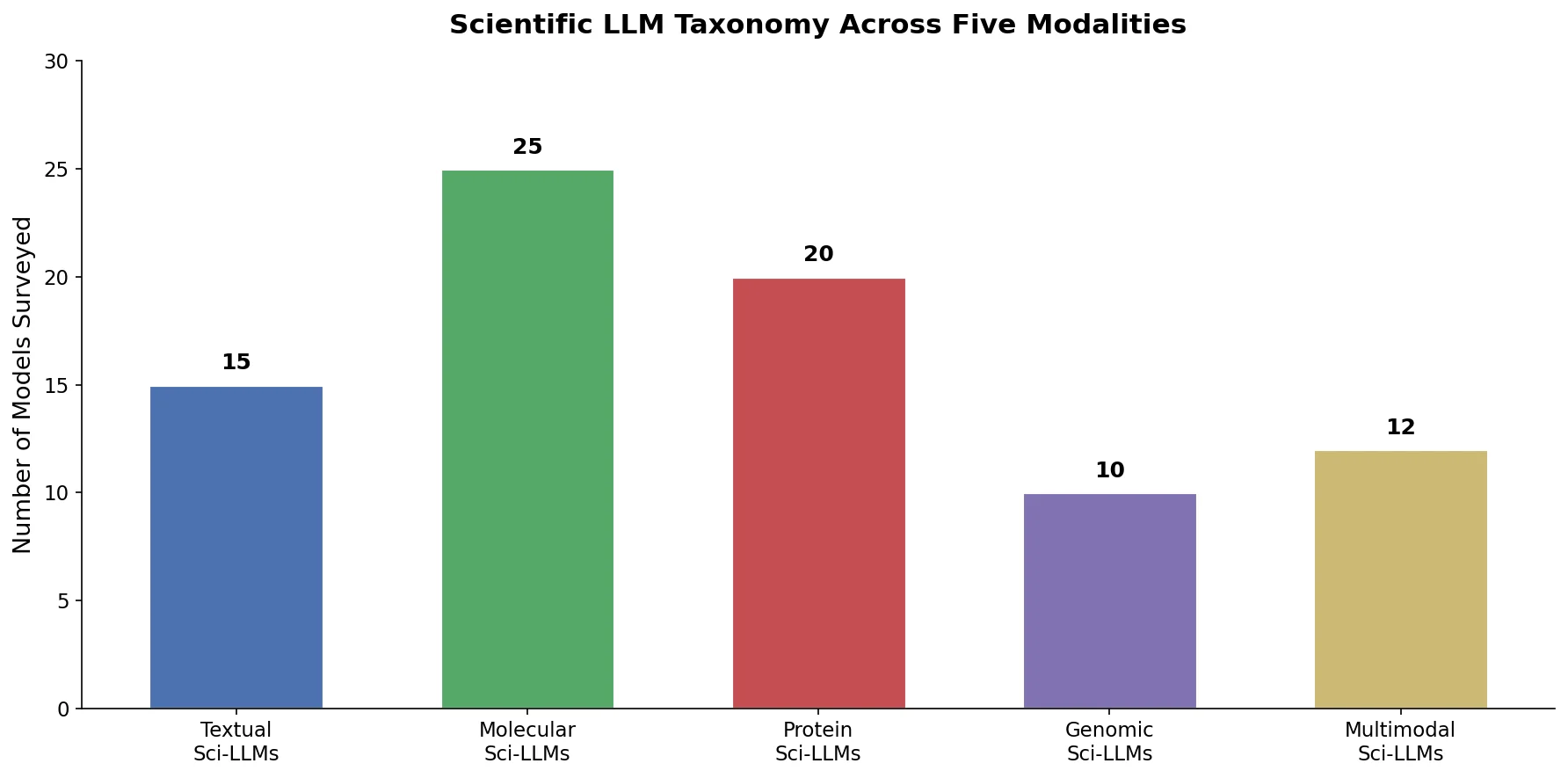
Bar chart showing scientific LLM taxonomy across five modalities: textual, molecular, protein, genomic, and multimodal

Survey of Scientific LLMs in Bio and Chem Domains

This survey systematically reviews scientific LLMs (Sci-LLMs) across five modalities: textual, molecular, protein, genomic, and multimodal, analyzing architectures, datasets, evaluation methods, and open challenges for AI-driven scientific discovery.

Molecular Representations
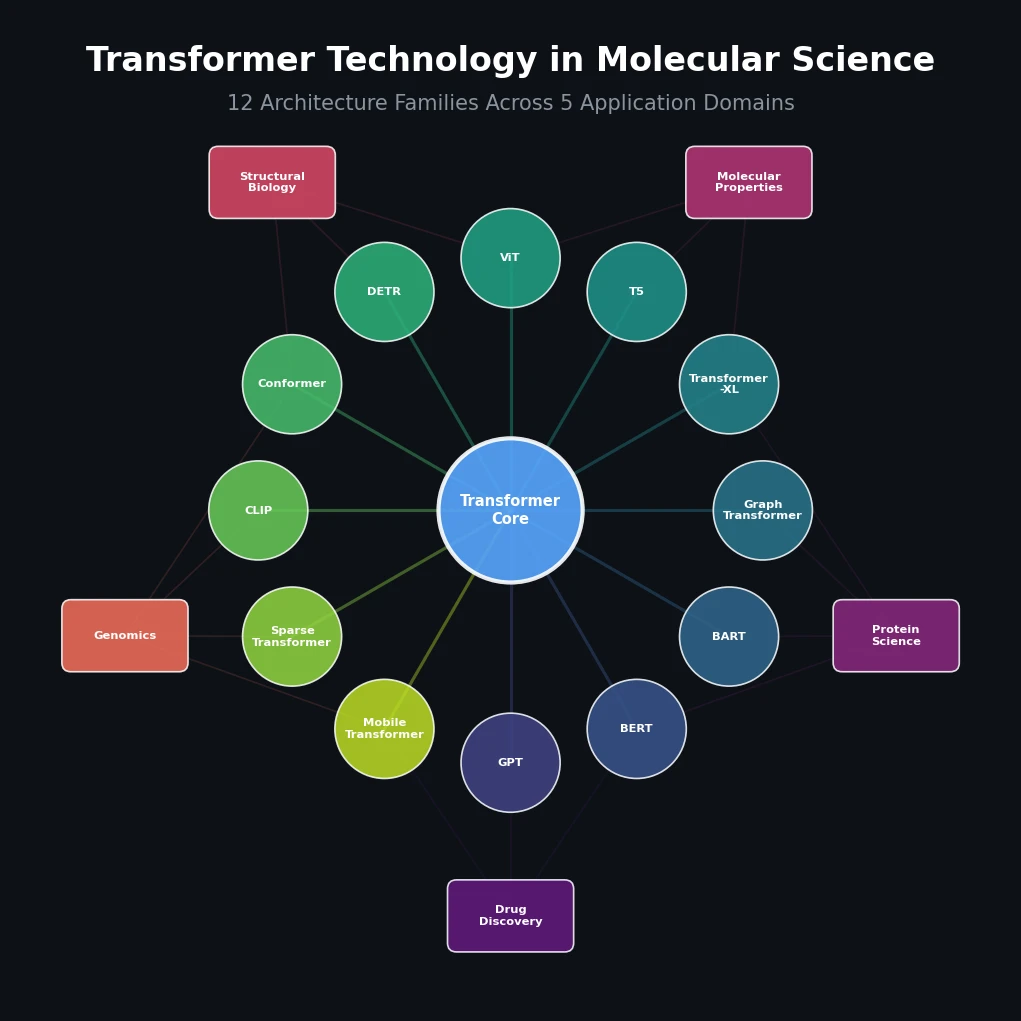
Radial diagram showing 12 transformer architecture families connected to 5 molecular science application domains

Survey of Transformer Architectures in Molecular Science

Jiang et al. survey 12 families of transformer architectures in molecular science, covering GPT, BERT, BART, graph transformers, Transformer-XL, T5, ViT, DETR, Conformer, CLIP, sparse transformers, and mobile/efficient variants, with detailed algorithmic descriptions and molecular applications.

Molecular Representations
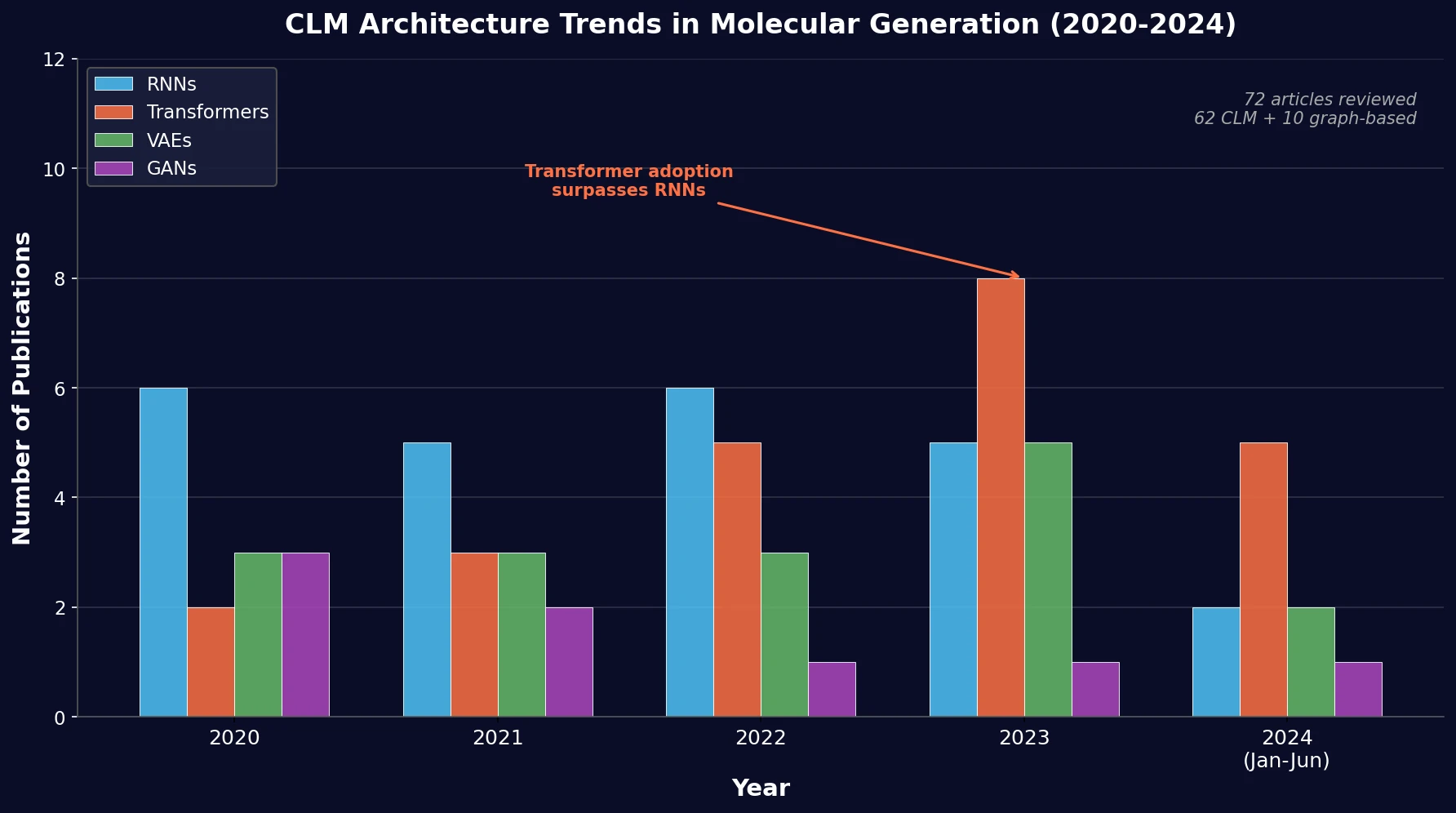
Bar chart showing CLM architecture publication trends from 2020 to 2024, with transformers overtaking RNNs

Systematic Review of Deep Learning CLMs (2020-2024)

PRISMA-based systematic review of 72 papers on chemical language models for molecular generation, comparing architectures and biased methods using MOSES metrics.

Molecular Representations
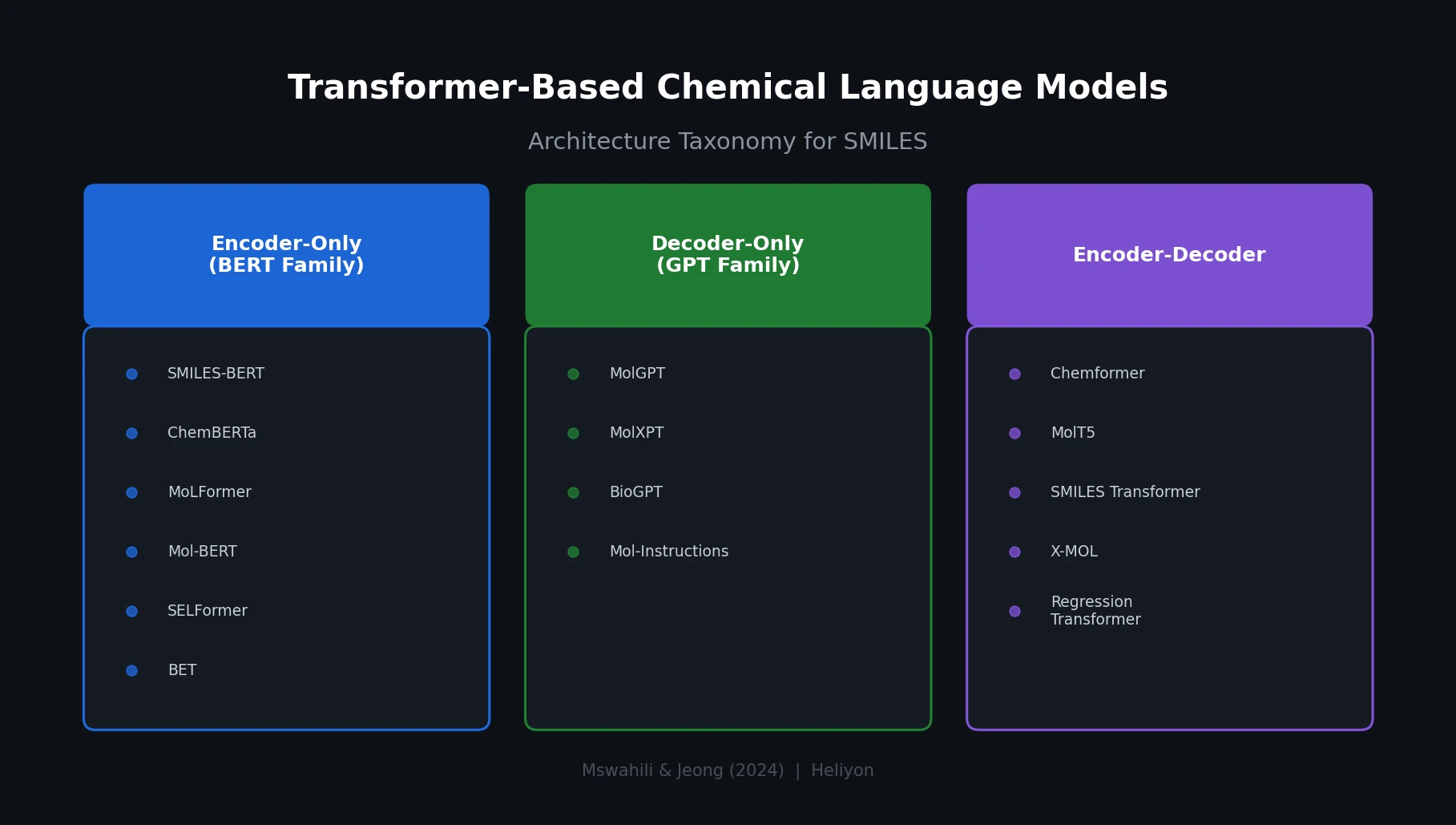
Taxonomy of transformer-based chemical language models organized by architecture type

Transformer CLMs for SMILES: Literature Review 2024

A comprehensive review of transformer-based chemical language models operating on SMILES, categorizing encoder-only (BERT variants), decoder-only (GPT variants), and encoder-decoder models with analysis of tokenization strategies, pre-training approaches, and future directions.