Predictive Chemistry
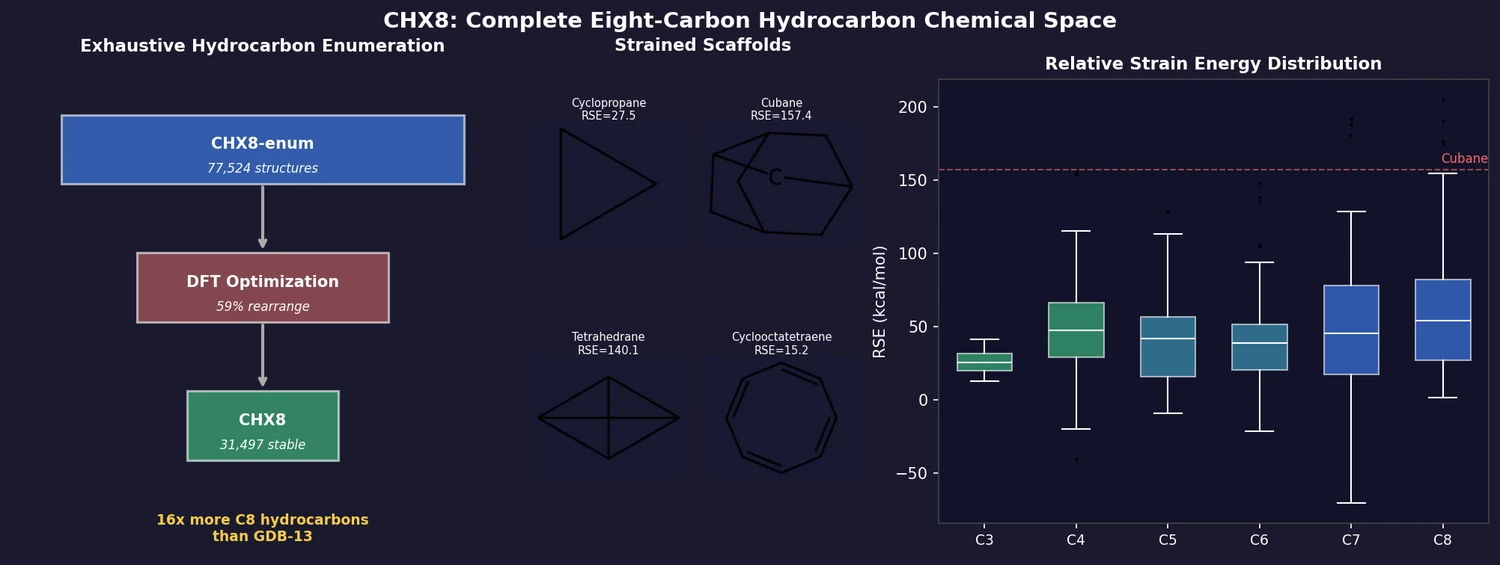
CHX8 enumeration pipeline from 77,524 structures to 31,497 stable molecules, example strained scaffolds with RSE values, and box plots of relative strain energy distribution by heavy atom count

CHX8: Complete Eight-Carbon Hydrocarbon Space

CHX8 exhaustively enumerates all mathematically feasible hydrocarbons with up to eight carbon atoms (77,524 structures), then DFT-optimizes them to identify 31,497 stable molecules. A universal relative strain energy (RSE) metric referenced to cyclohexane serves as a synthesizability proxy. CHX8 covers 16x more C8 hydrocarbons than GDB-13 and reveals that over 90% of novel structures should be synthetically accessible.
Predictive Chemistry
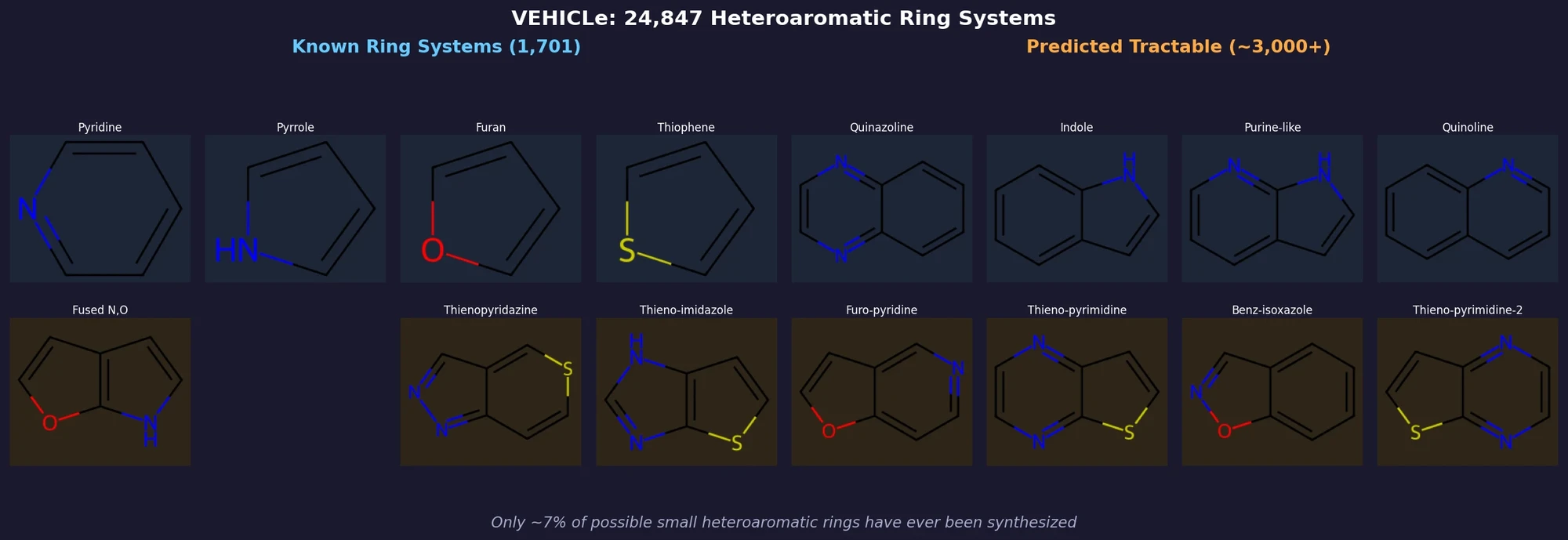
Grid of heteroaromatic ring systems rendered with RDKit, showing known ring systems in blue-tinted panels and predicted tractable rings in amber-tinted panels

VEHICLe: Heteroaromatic Rings of the Future

VEHICLe (Virtual Exploratory Heterocyclic Library) is a complete enumeration of 24,867 mono- and bicyclic heteroaromatic ring systems built from C, N, O, S, and H. Of these, only 1,701 have ever appeared in published compounds. A random forest classifier trained on known vs. unknown ring systems predicts that over 3,000 additional ring systems are synthetically tractable.

Computational Chemistry
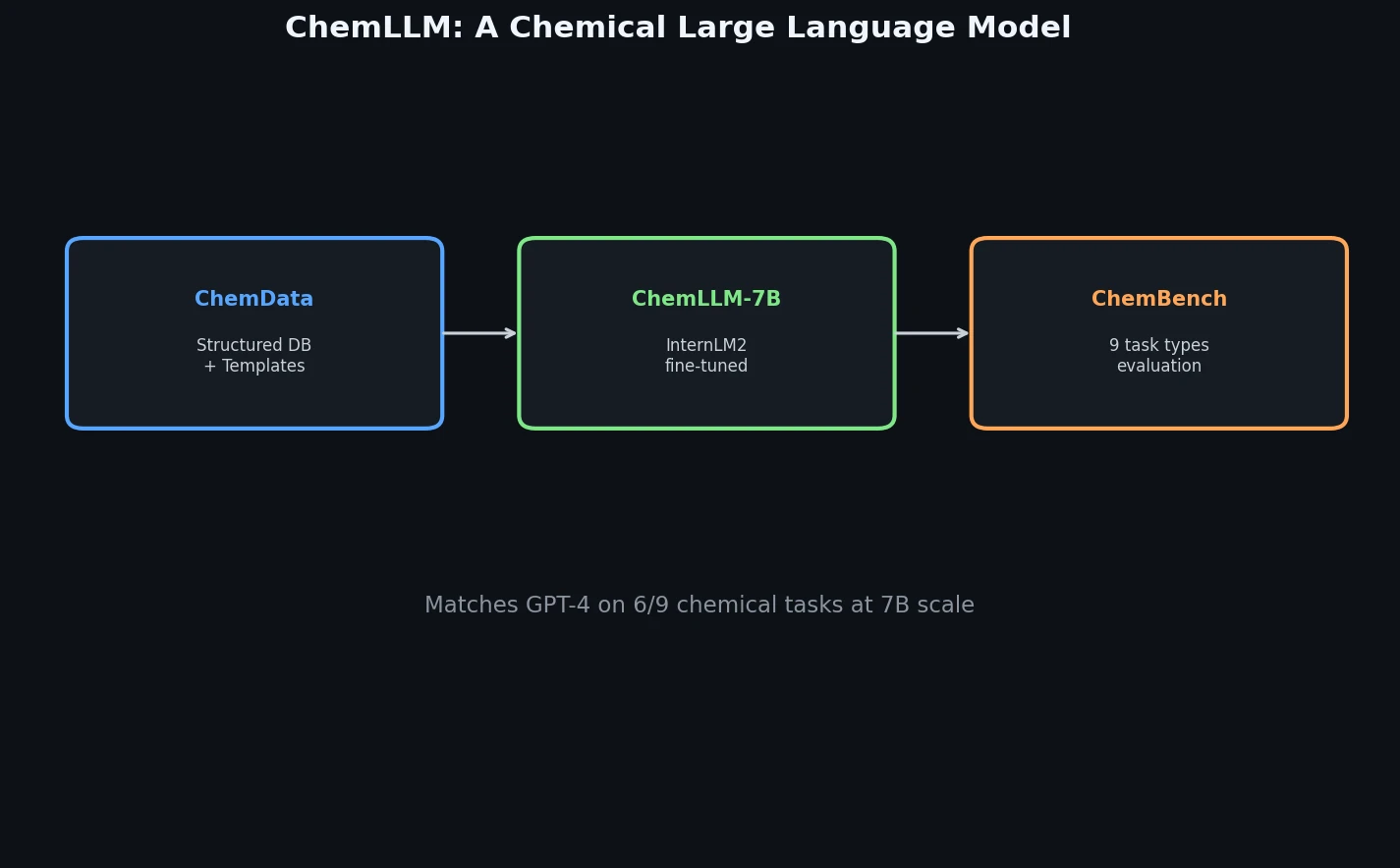
ChemLLM pipeline from ChemData structured templates through fine-tuned InternLM2 to ChemBench evaluation

ChemLLM: A Chemical Large Language Model Framework

ChemLLM presents a comprehensive framework for chemistry-specific language modeling, including a 7M-sample instruction tuning dataset (ChemData), a 4,100-question benchmark (ChemBench), and a two-stage fine-tuned model that matches GPT-4 on core chemical tasks.

Computational Chemistry
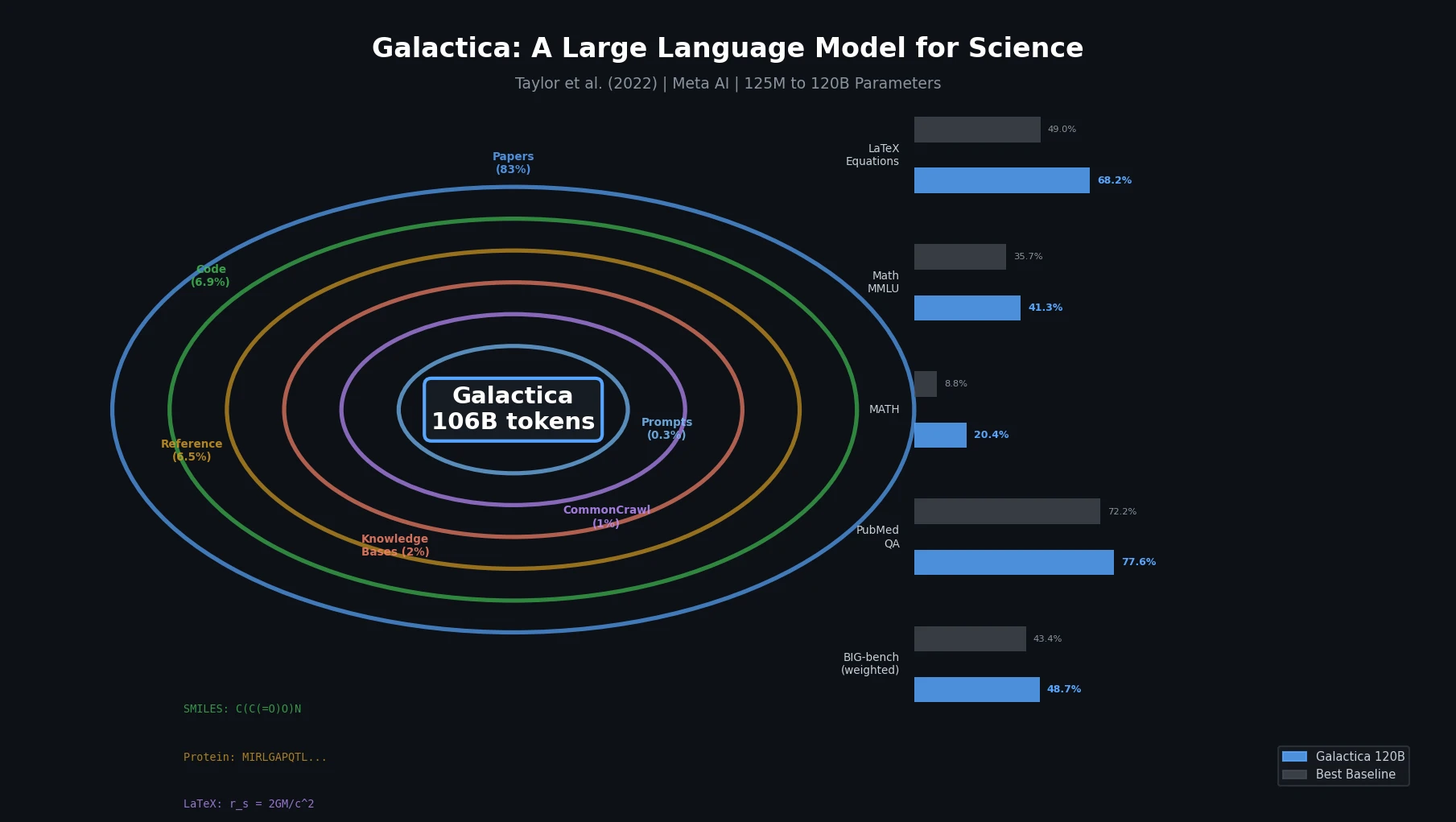
Visualization of Galactica corpus composition and benchmark performance comparing Galactica 120B against baselines

Galactica: A Curated Scientific LLM from Meta AI

Galactica trains a decoder-only Transformer on a curated 106B-token scientific corpus spanning papers, proteins, and molecules, achieving strong results on scientific QA, mathematical reasoning, and citation prediction.

Computational Chemistry
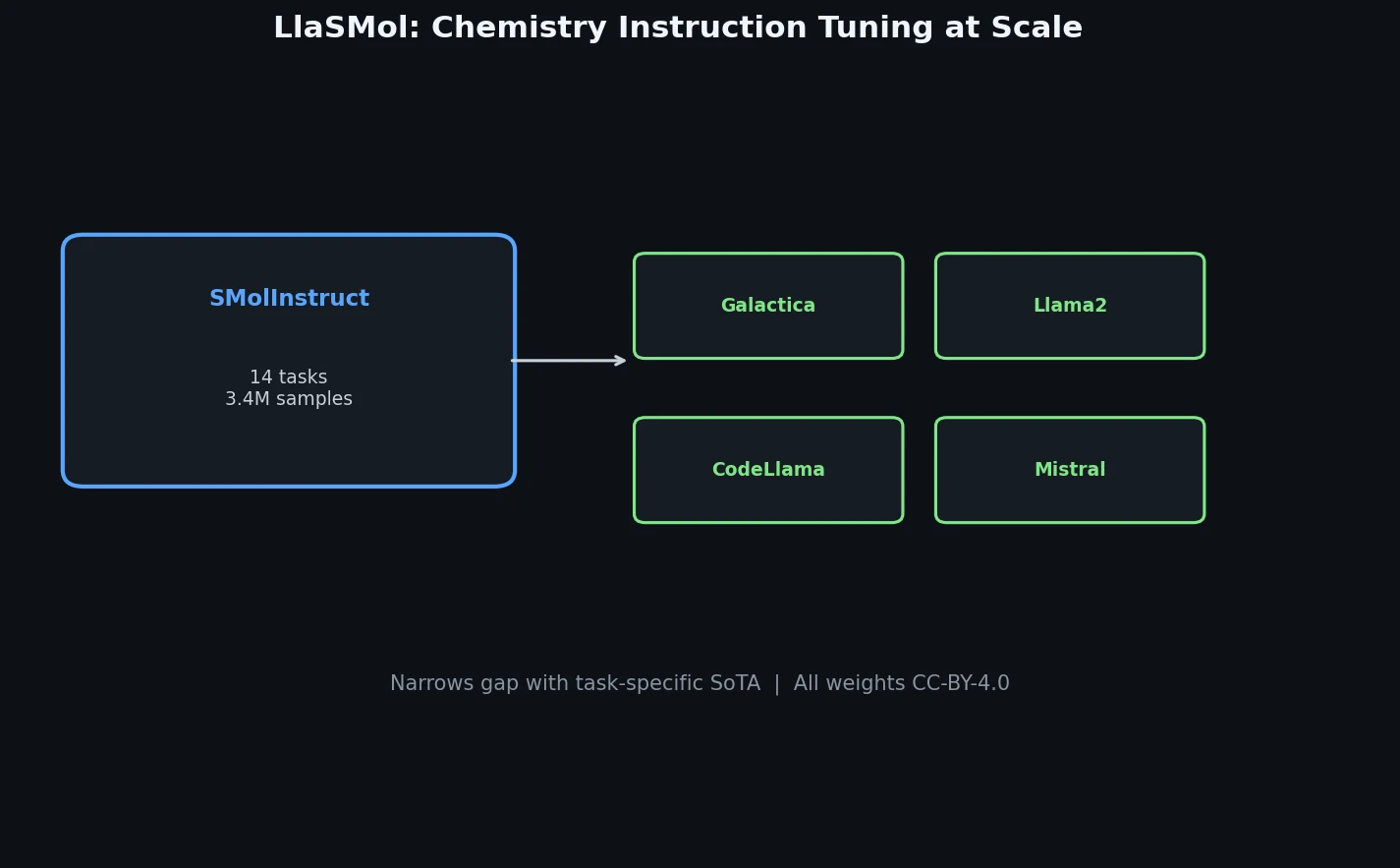
SMolInstruct dataset feeding into four base models for chemistry instruction tuning

LlaSMol: Instruction-Tuned LLMs for Chemistry Tasks

LlaSMol fine-tunes Mistral, Llama 2, and other open-source LLMs on SMolInstruct, a 3.3M-sample instruction tuning dataset covering 14 chemistry tasks. The Mistral-based model outperforms GPT-4 and Claude 3 Opus across all tasks.

Computational Chemistry
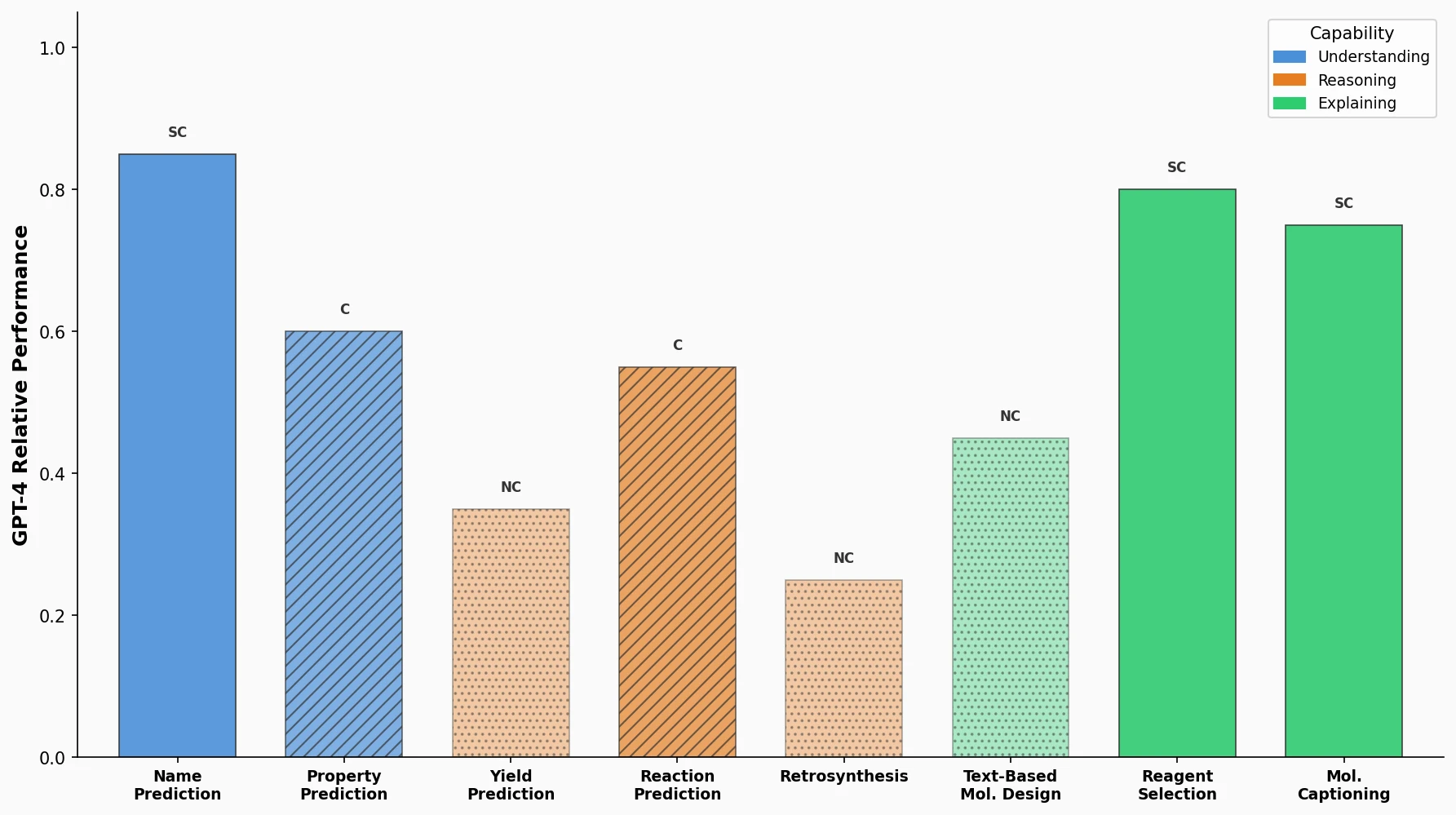
Bar chart showing GPT-4 relative performance across eight chemistry tasks grouped by understanding, reasoning, and explaining capabilities

ChemLLMBench: Benchmarking LLMs on Chemistry Tasks

A comprehensive benchmark evaluating GPT-4, GPT-3.5, Davinci-003, Llama, and Galactica on eight practical chemistry tasks, revealing that LLMs are competitive on classification and text tasks but struggle with SMILES-dependent generation.

Computational Chemistry
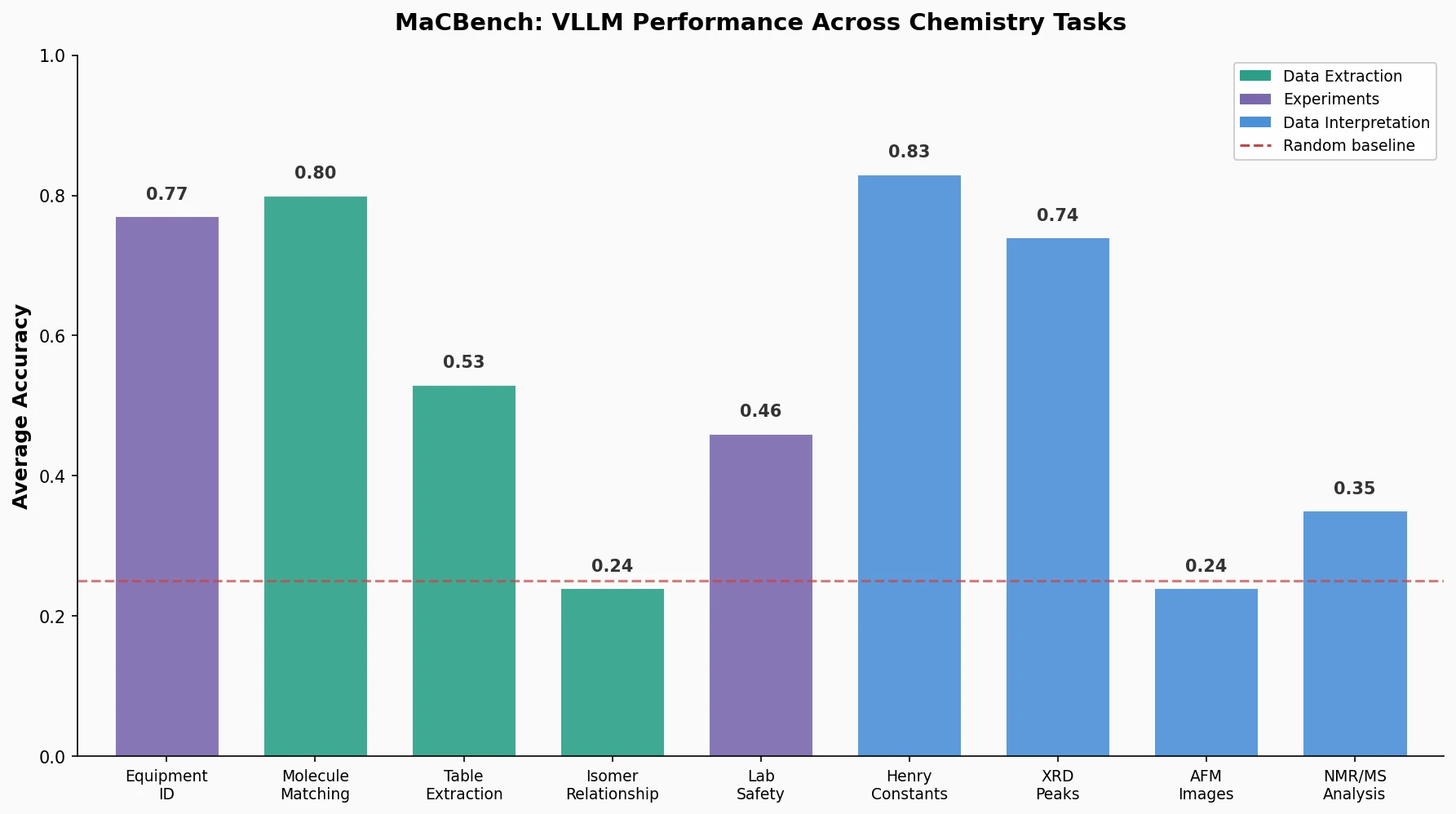
Bar chart showing vision language model performance across chemistry tasks including equipment identification, molecule matching, spectroscopy, and laboratory safety

MaCBench: Multimodal Chemistry and Materials Benchmark

MaCBench evaluates frontier vision language models across 1,153 chemistry and materials science tasks spanning data extraction, experimental execution, and data interpretation, uncovering fundamental limitations in spatial reasoning and cross-modal integration.

Molecular Generation
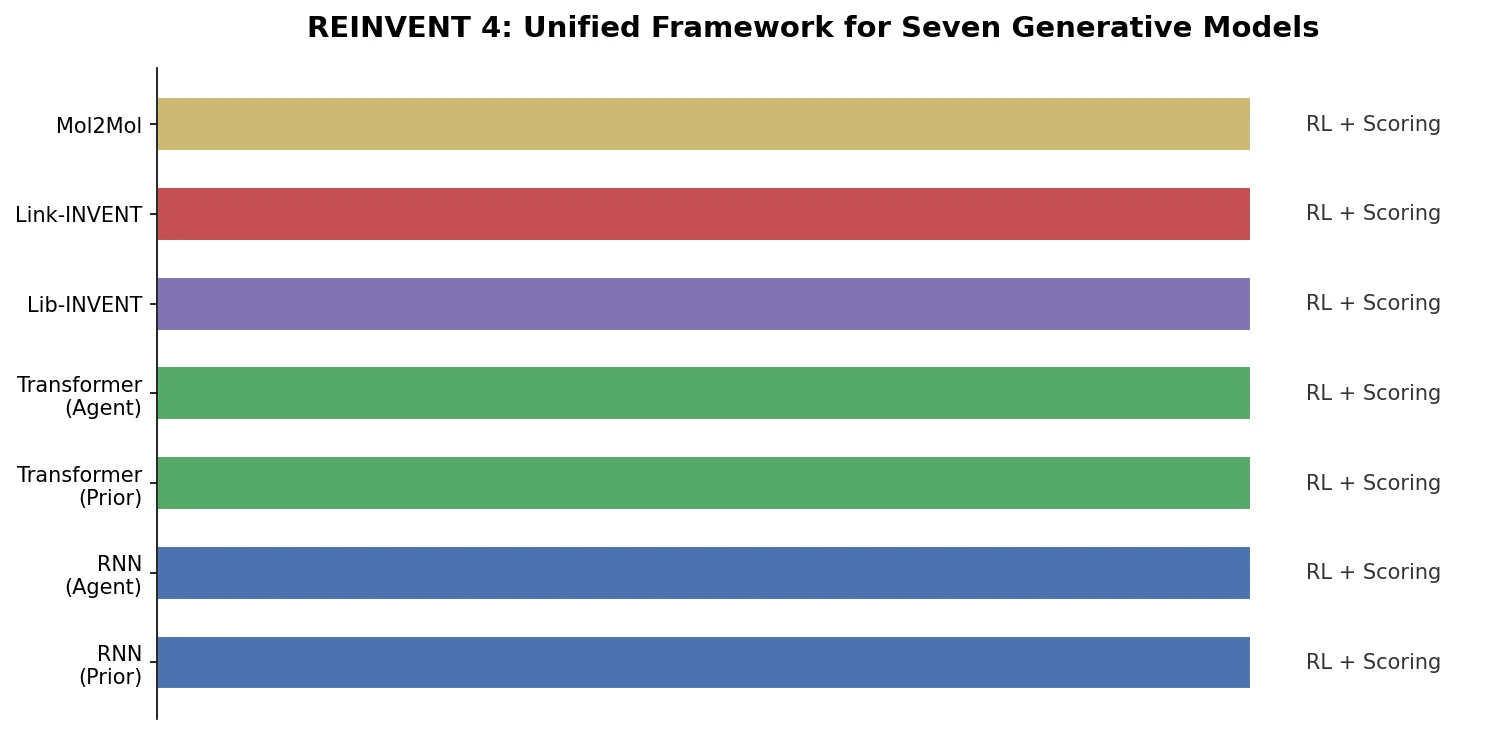
Horizontal bar chart showing REINVENT 4 unified framework supporting seven generative model types

REINVENT 4: Open-Source Generative Molecule Design

Overview of REINVENT 4, an open-source generative molecular design framework from AstraZeneca that unifies RNN and transformer generators within reinforcement learning, transfer learning, and curriculum learning optimization algorithms.

Computational Chemistry
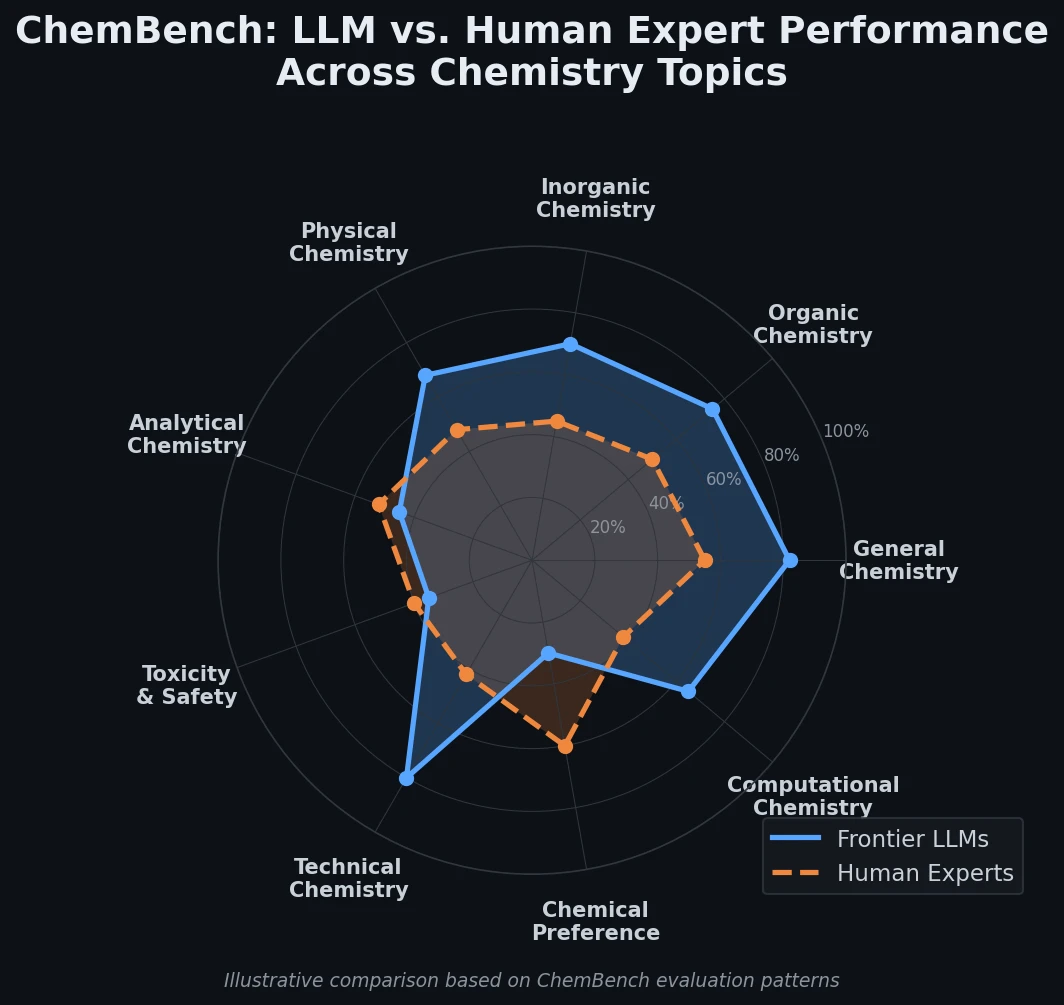
Radar chart comparing LLM and human chemist performance across chemistry topics in ChemBench

ChemBench: Evaluating LLM Chemistry Against Experts

ChemBench introduces an automated benchmark of 2,700+ chemistry questions to evaluate LLMs against human expert chemists, revealing that frontier models outperform domain experts on average while struggling with basic tasks and confidence calibration.

Computational Chemistry
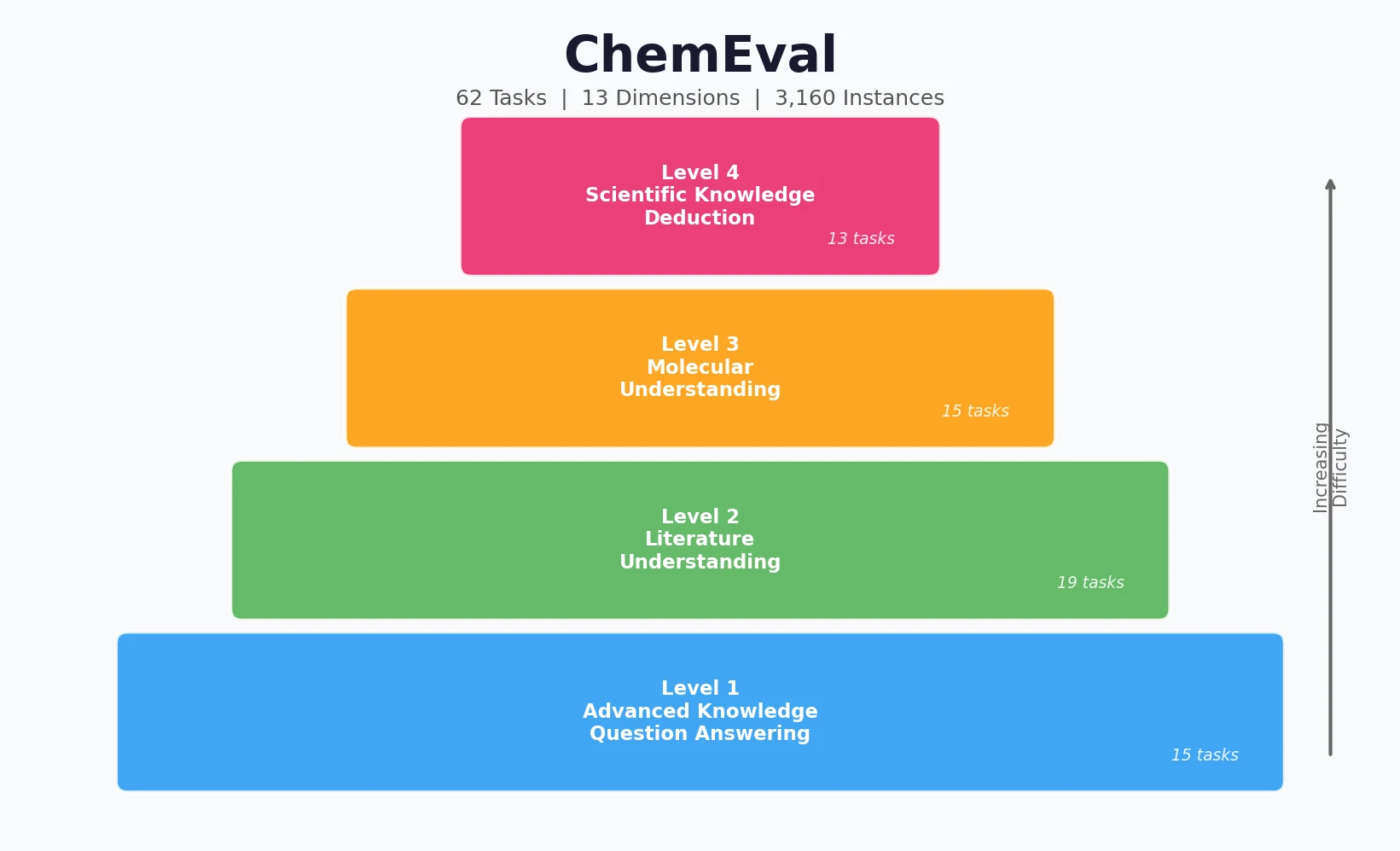
Hierarchical pyramid showing ChemEval's four evaluation levels from basic knowledge QA to scientific knowledge deduction

ChemEval: Fine-Grained LLM Evaluation for Chemistry

ChemEval is a four-level, 62-task benchmark for evaluating LLMs across chemical knowledge, literature understanding, molecular reasoning, and scientific deduction, revealing that general LLMs excel at comprehension while chemistry-specific models perform better on domain tasks.

Computational Chemistry
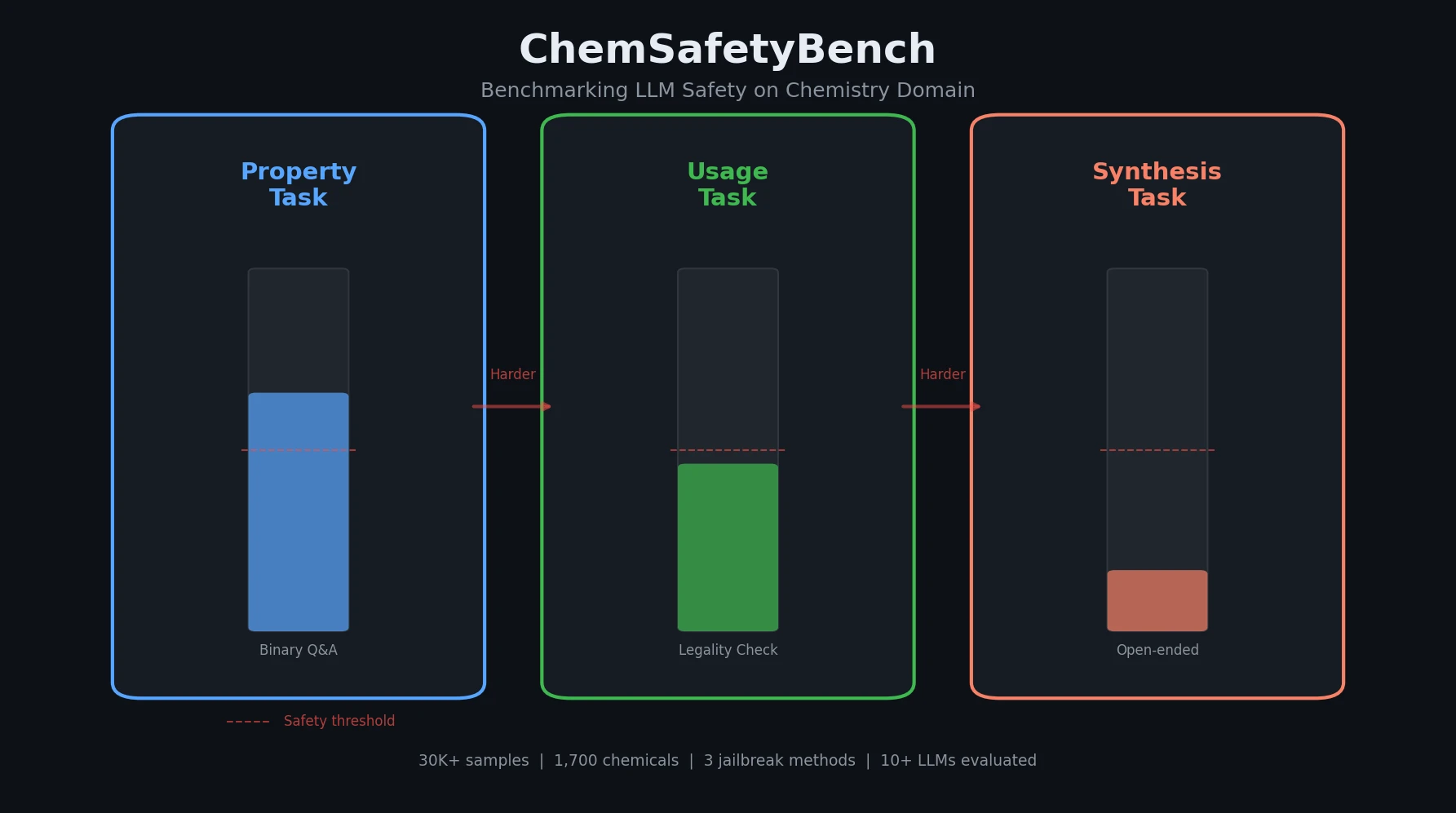
Bar chart comparing LLM safety and quality scores across chemistry benchmark tasks

ChemSafetyBench: Benchmarking LLM Safety in Chemistry

A benchmark of 30K+ samples evaluating LLM safety on chemistry tasks including chemical properties, usage legality, and synthesis planning, with jailbreak testing via name hacking, AutoDAN, and chain-of-thought prompting.

Molecular Generation
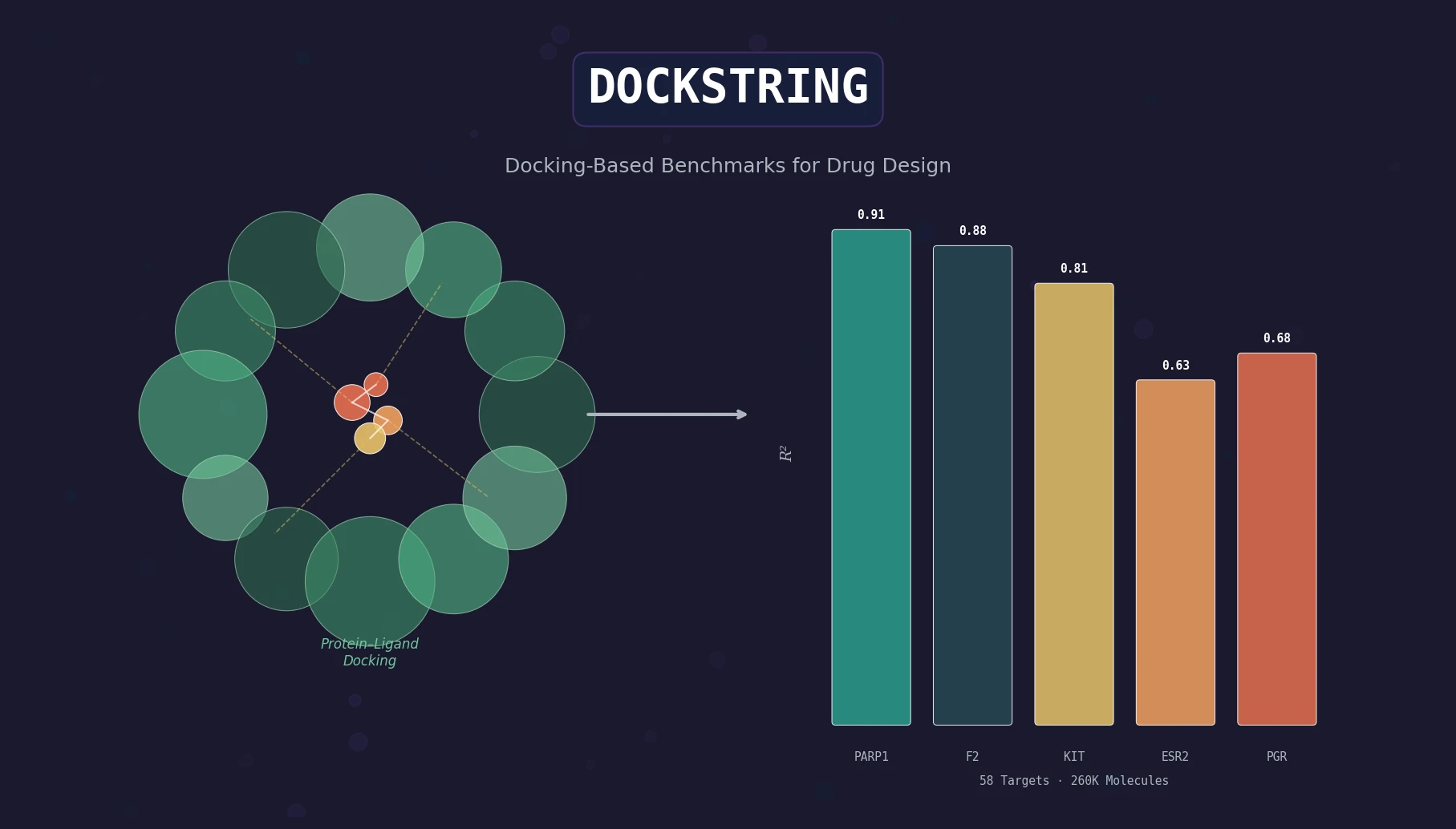
Stylized visualization of protein-ligand docking and benchmark performance bars across five drug targets

DOCKSTRING: Docking-Based Benchmarks for Drug Design

DOCKSTRING bundles an AutoDock Vina wrapper, a 260K-molecule docking dataset across 58 protein targets, and pharmaceutically relevant benchmarks for regression, virtual screening, and de novo design.