Predictive Chemistry
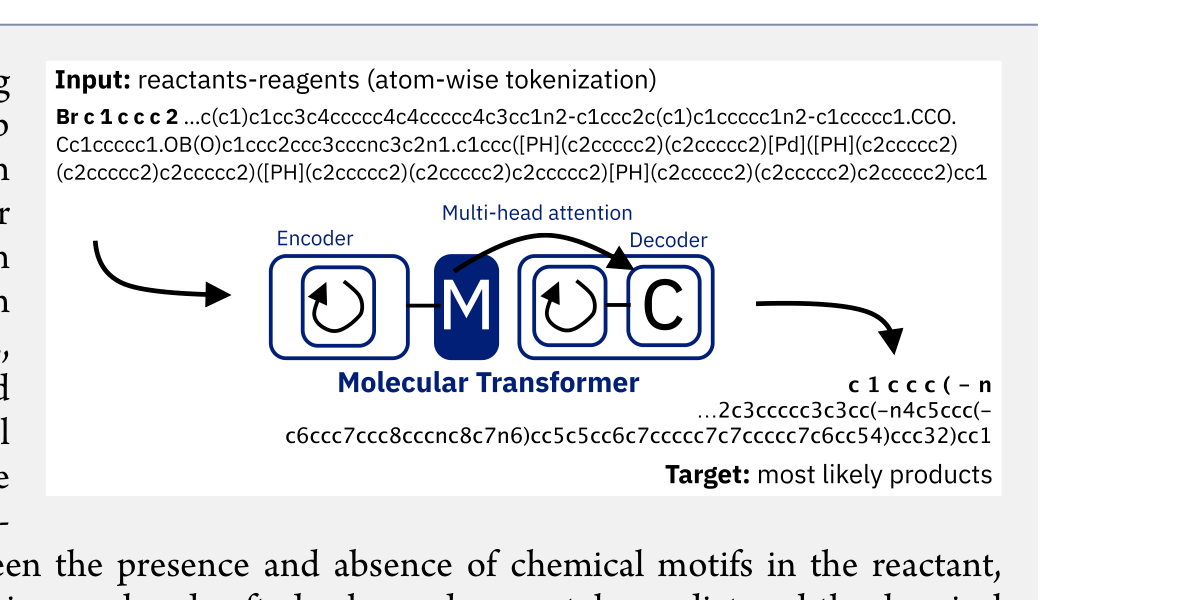
Molecular Transformer architecture showing atom-wise tokenized SMILES input through encoder-decoder with multi-head attention to predict reaction products

Molecular Transformer: Calibrated Reaction Prediction

The Molecular Transformer applies the Transformer architecture to forward reaction prediction, treating it as SMILES-to-SMILES machine translation. It achieves 90.4% top-1 accuracy on USPTO_MIT, outperforms quantum-chemistry baselines on regioselectivity, and provides calibrated uncertainty scores (0.89 AUC-ROC) for ranking synthesis pathways.
Computational Biology
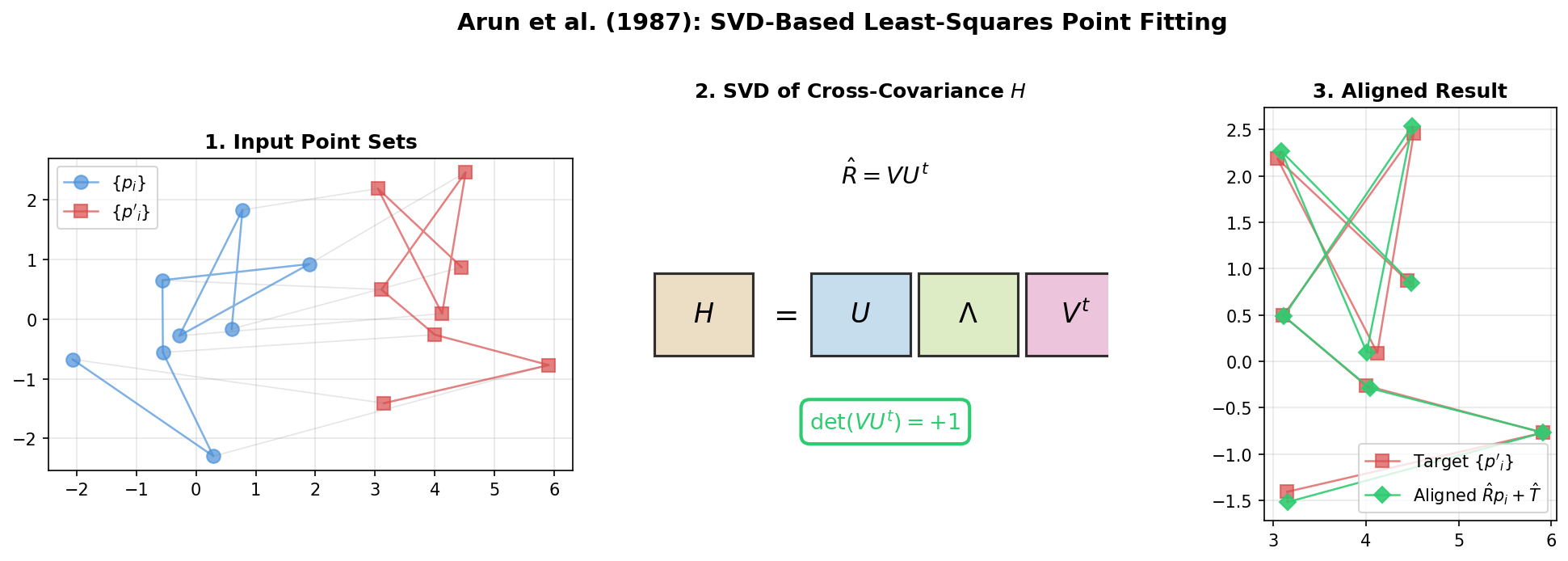
Three-panel diagram showing input point sets, SVD factorization of the cross-covariance matrix, and the aligned result

Arun et al.: SVD-Based Least-Squares Fitting of 3D Points

Presents a concise SVD-based algorithm for finding the optimal rotation and translation between two 3D point sets, with analysis of the degenerate reflection case that Umeyama later corrected.

Computational Biology
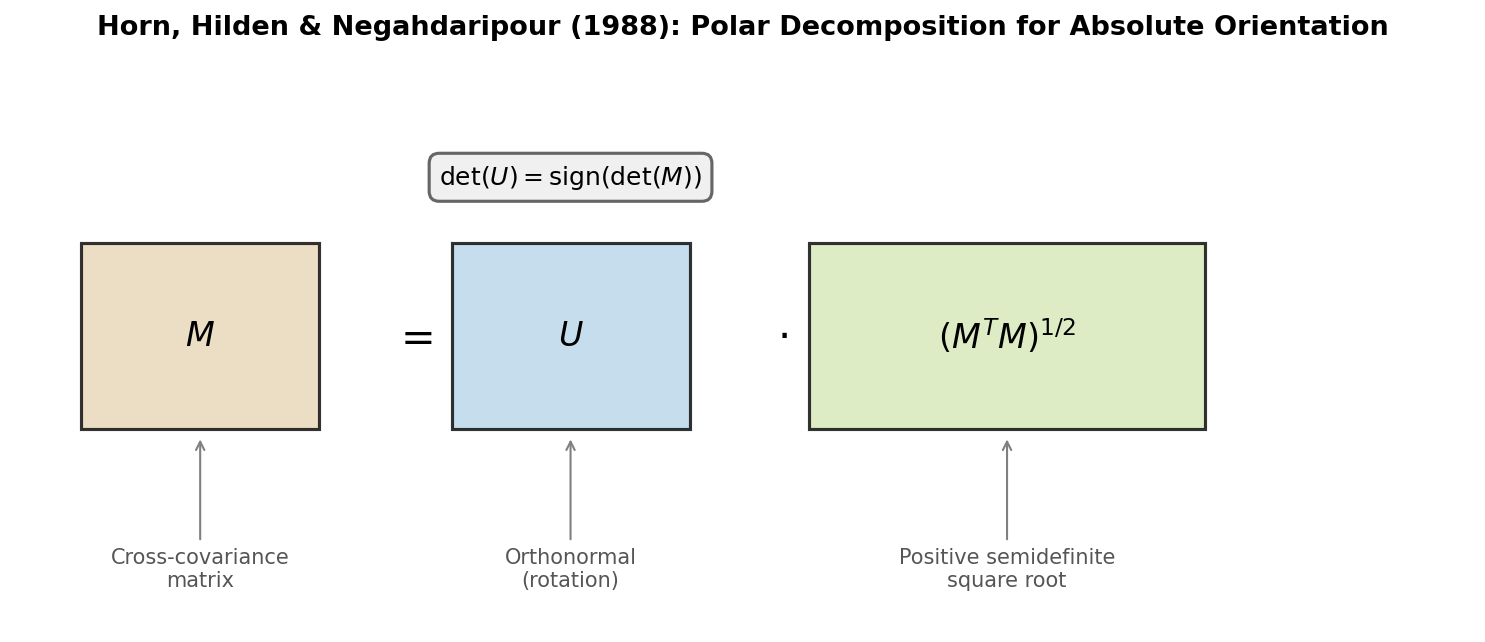
Diagram showing the polar decomposition of the cross-covariance matrix M into orthonormal factor U and positive semidefinite square root

Horn et al.: Absolute Orientation Using Orthonormal Matrices

The matrix-based companion to Horn’s 1987 quaternion method, deriving the optimal rotation as the orthonormal factor in the polar decomposition of the cross-covariance matrix via eigendecomposition of a 3x3 symmetric matrix.

Molecular Representations
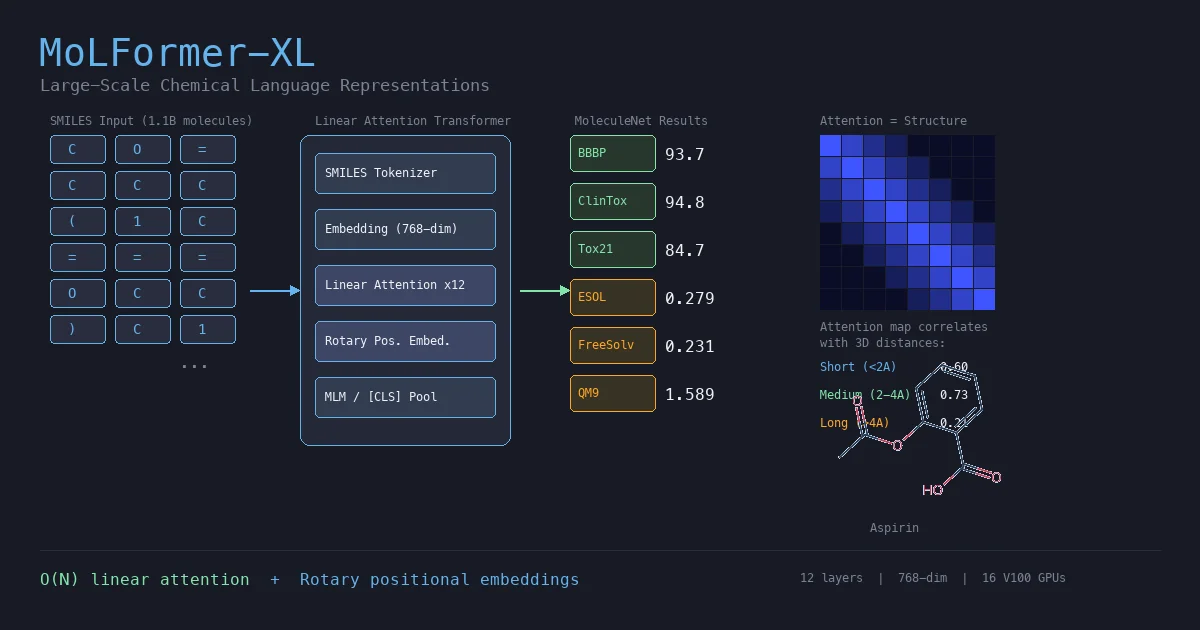
MoLFormer-XL architecture diagram showing SMILES tokens flowing through a linear attention transformer to MoleculeNet benchmark results and attention-structure correlation

MoLFormer: Large-Scale Chemical Language Representations

MoLFormer is a transformer encoder with linear attention and rotary positional embeddings, pretrained via masked language modeling on 1.1 billion molecules from PubChem and ZINC. MoLFormer-XL outperforms GNN baselines on most MoleculeNet classification and regression tasks, and attention analysis reveals that the model learns interatomic spatial relationships directly from SMILES strings.

Molecular Representations
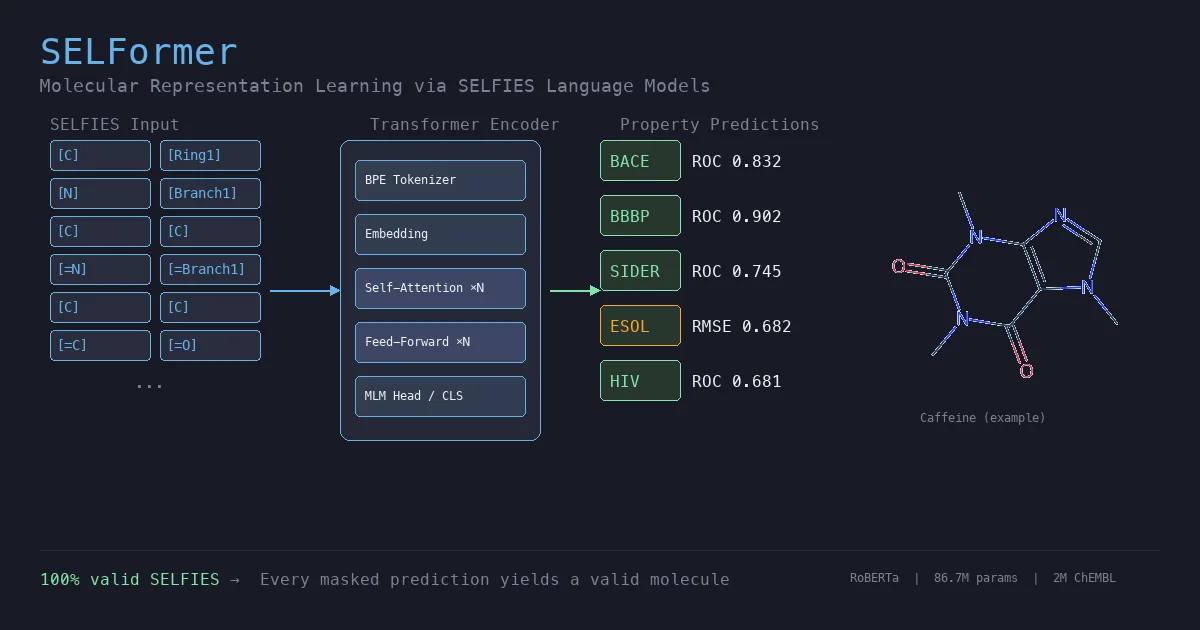
SELFormer architecture diagram showing SELFIES token input flowing through a RoBERTa transformer encoder to molecular property predictions

SELFormer: A SELFIES-Based Molecular Language Model

SELFormer is a transformer-based chemical language model that uses SELFIES instead of SMILES as input. Pretrained on 2M ChEMBL compounds via masked language modeling, it achieves strong classification performance on MoleculeNet tasks, outperforming ChemBERTa-2 by ~12% on average across BACE, BBBP, and HIV.

Computational Biology
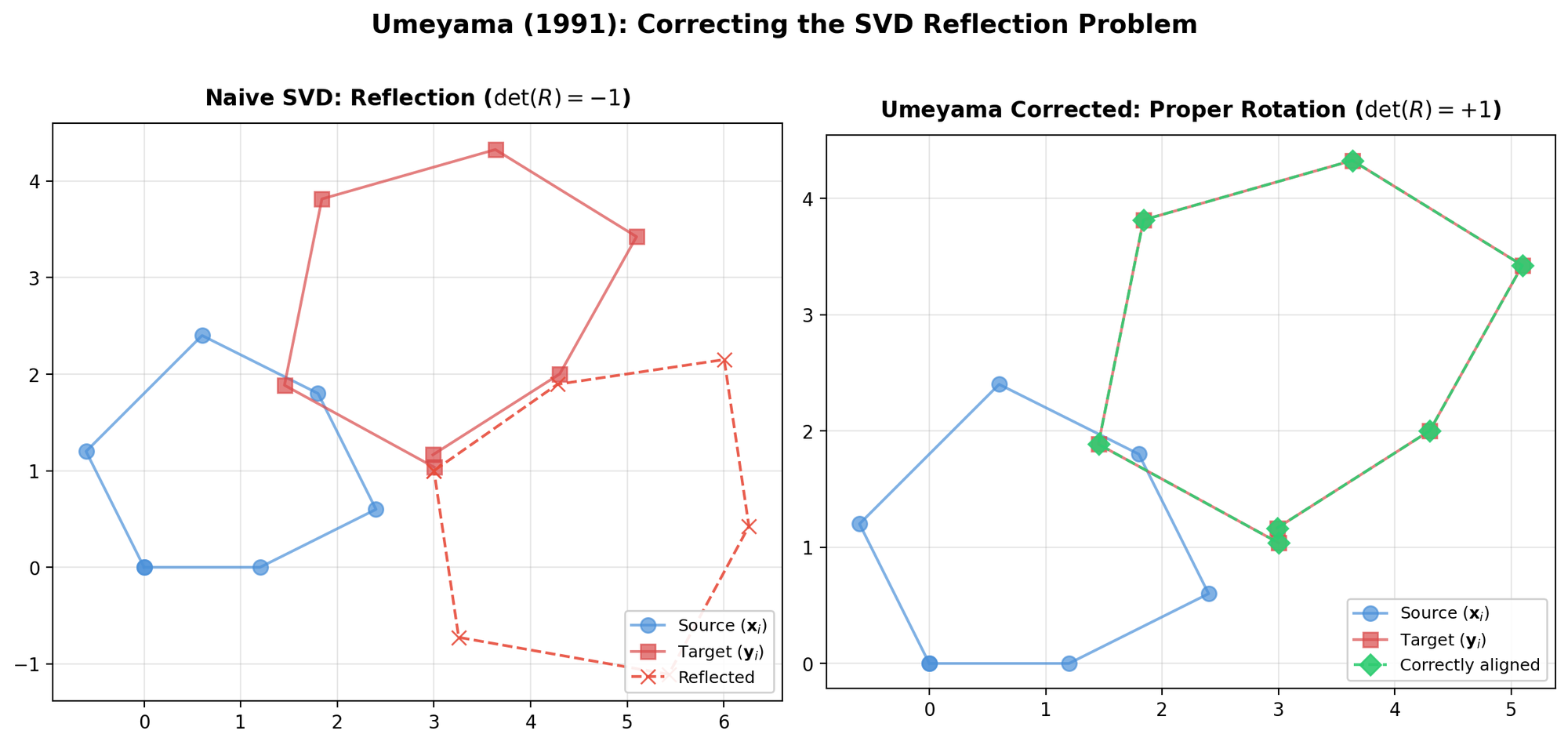
Side-by-side comparison showing naive SVD producing a reflected alignment versus Umeyama's corrected proper rotation

Umeyama's Method: Corrected SVD for Point Alignment

Corrects a flaw in prior SVD-based alignment methods (Arun et al., Horn et al.) that could produce reflections instead of rotations under noisy data, and provides a complete closed-form solution for similarity transformations in arbitrary dimensions.

Optical Chemical Structure Recognition
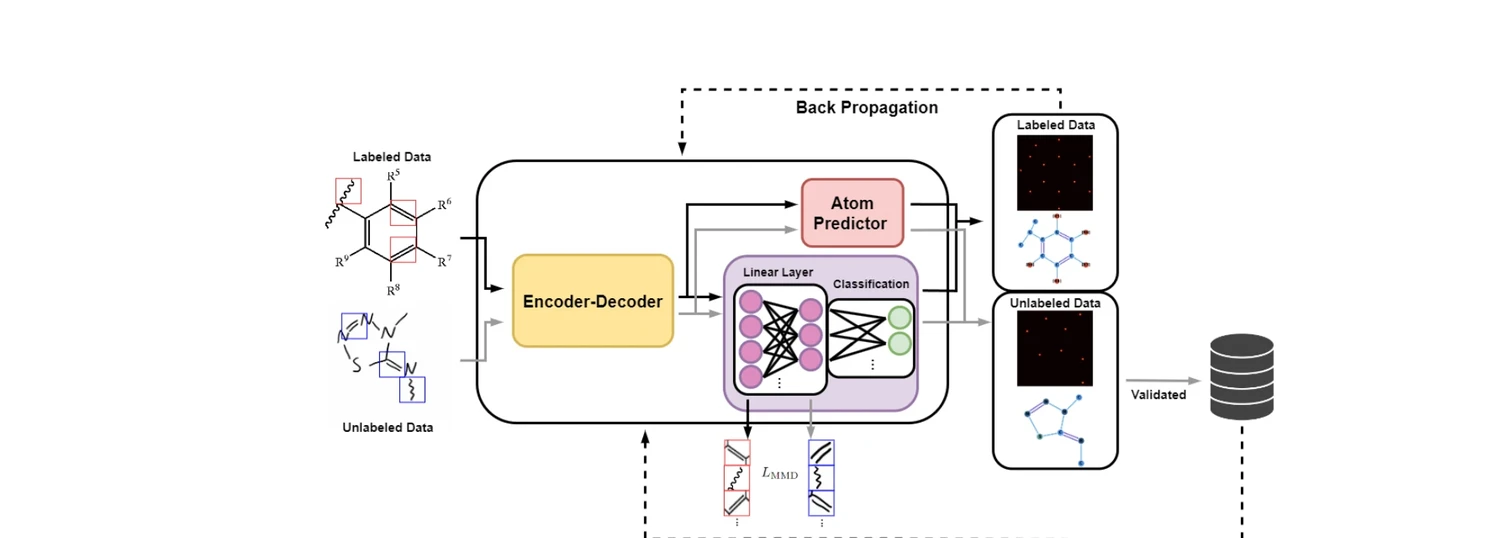
AdaptMol domain adaptation pipeline showing encoder-decoder with MMD alignment between labeled source and unlabeled target domain images

AdaptMol: Domain Adaptation for Molecular OCSR (2026)

AdaptMol combines an end-to-end graph reconstruction model with unsupervised domain adaptation via class-conditional MMD on bond features and SMILES-validated self-training. Achieves 82.6% accuracy on hand-drawn molecules (10.7 points above prior best) while maintaining state-of-the-art results on four literature benchmarks, using only 4,080 real hand-drawn images for adaptation.

Generative Modeling
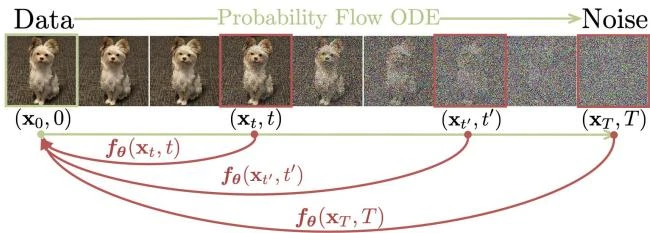
Diagram showing consistency models mapping points on a PF ODE trajectory to the same origin

Consistency Models: Fast One-Step Diffusion Generation

This paper introduces consistency models, a new family of generative models that map any point on a Probability Flow ODE trajectory to its origin. They support fast one-step generation by design, while allowing multi-step sampling for improved quality and zero-shot editing tasks like inpainting and colorization.

Generative Modeling
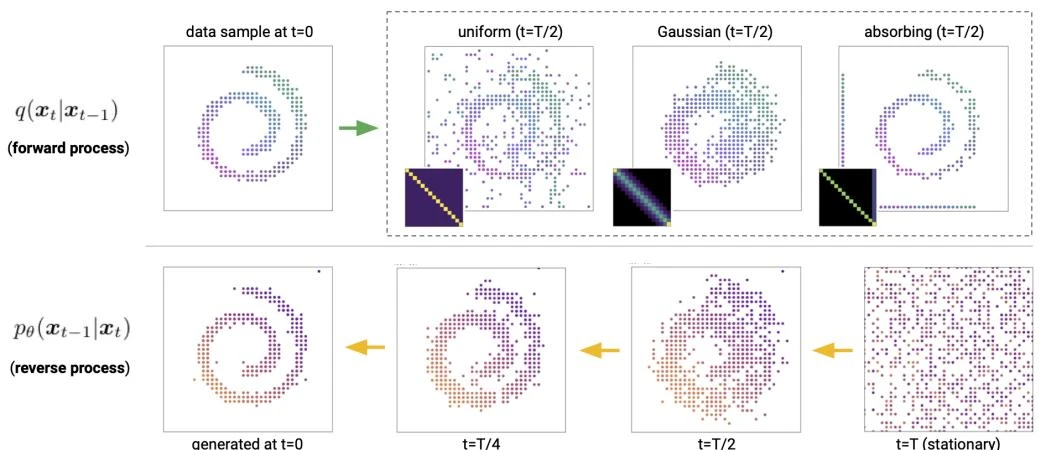
D3PM forward and reverse processes on a quantized swiss roll with uniform, Gaussian, and absorbing transition matrices

D3PM: Discrete Denoising Diffusion Probabilistic Models

This paper introduces Discrete Denoising Diffusion Probabilistic Models (D3PMs), which generalize diffusion to discrete state-spaces using structured Markov transition matrices. D3PMs include uniform, absorbing-state, and discretized Gaussian corruption processes, drawing a connection between diffusion and masked language models.

Optical Chemical Structure Recognition
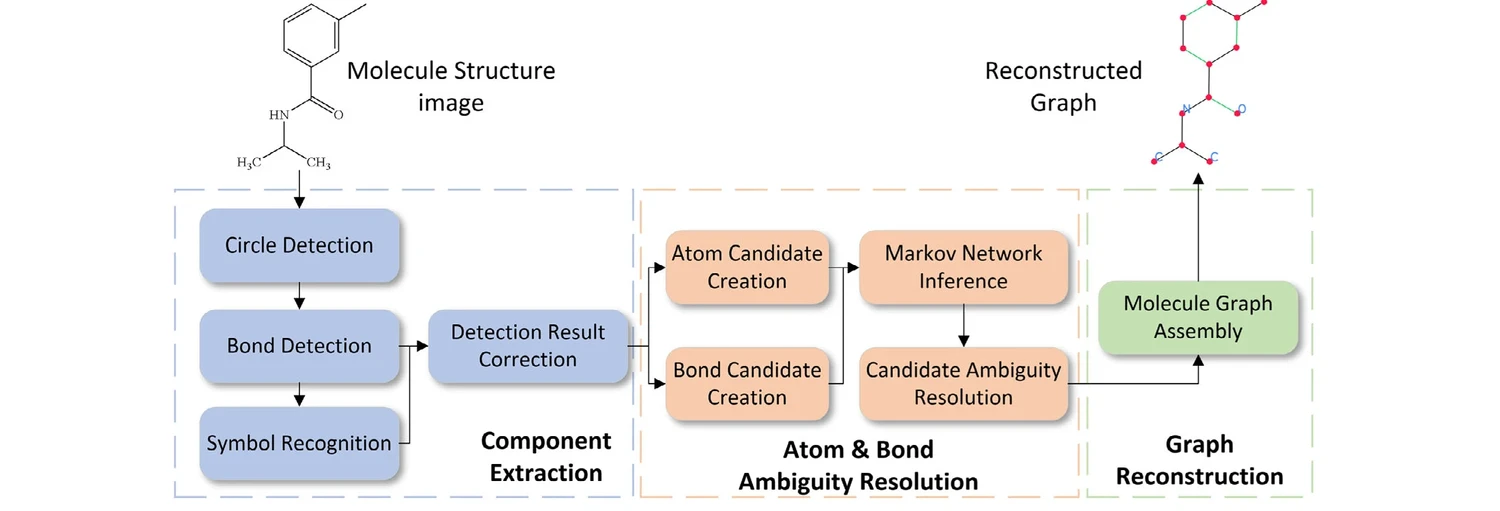
GraphReco system architecture showing component extraction, atom and bond ambiguity resolution, and graph reconstruction stages

GraphReco: Probabilistic Structure Recognition (2026)

GraphReco presents a rule-based OCSR system with two key innovations: a Fragment Merging line detection algorithm for precise bond identification and a Markov network for probabilistic resolution of atom/bond ambiguity during graph assembly. Achieves 94.2% accuracy on USPTO-10K, outperforming both traditional rule-based and some ML-based methods.

Optical Chemical Structure Recognition
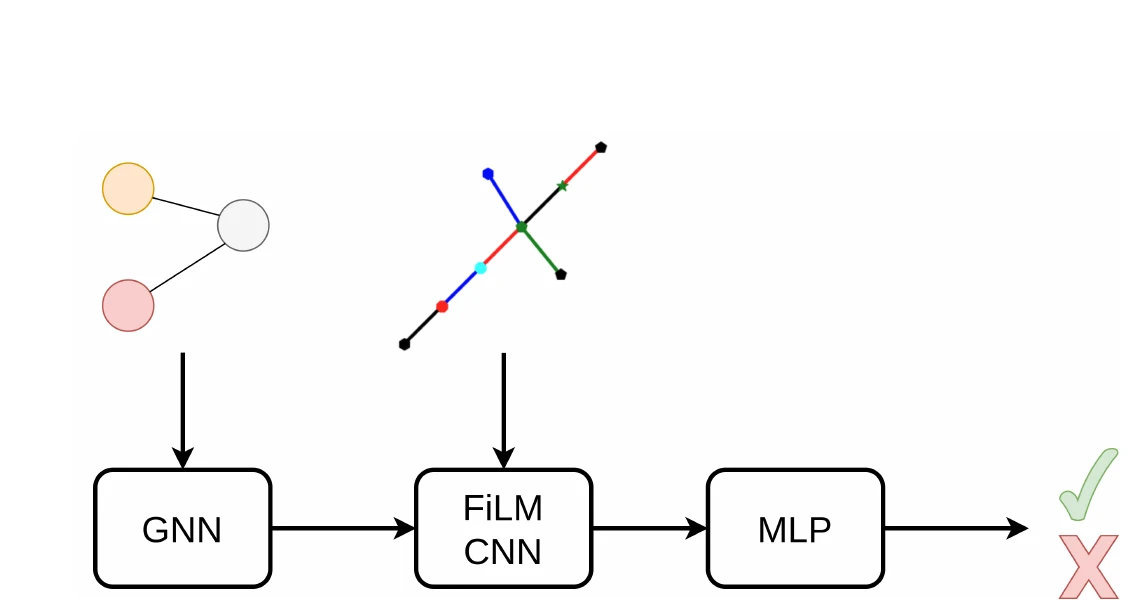
GraSP feed-forward architecture showing GNN, FiLM-conditioned CNN, and MLP classification head

GraSP: Graph Recognition via Subgraph Prediction (2026)

GraSP introduces a general framework for recognizing graphs in images by framing it as sequential subgraph prediction with a binary classifier. A GNN conditions a CNN via FiLM layers to predict whether a candidate graph is a subgraph of the target. Applied to OCSR on QM9, GraSP achieves 67.5% accuracy with no domain-specific modifications.

Computational Biology
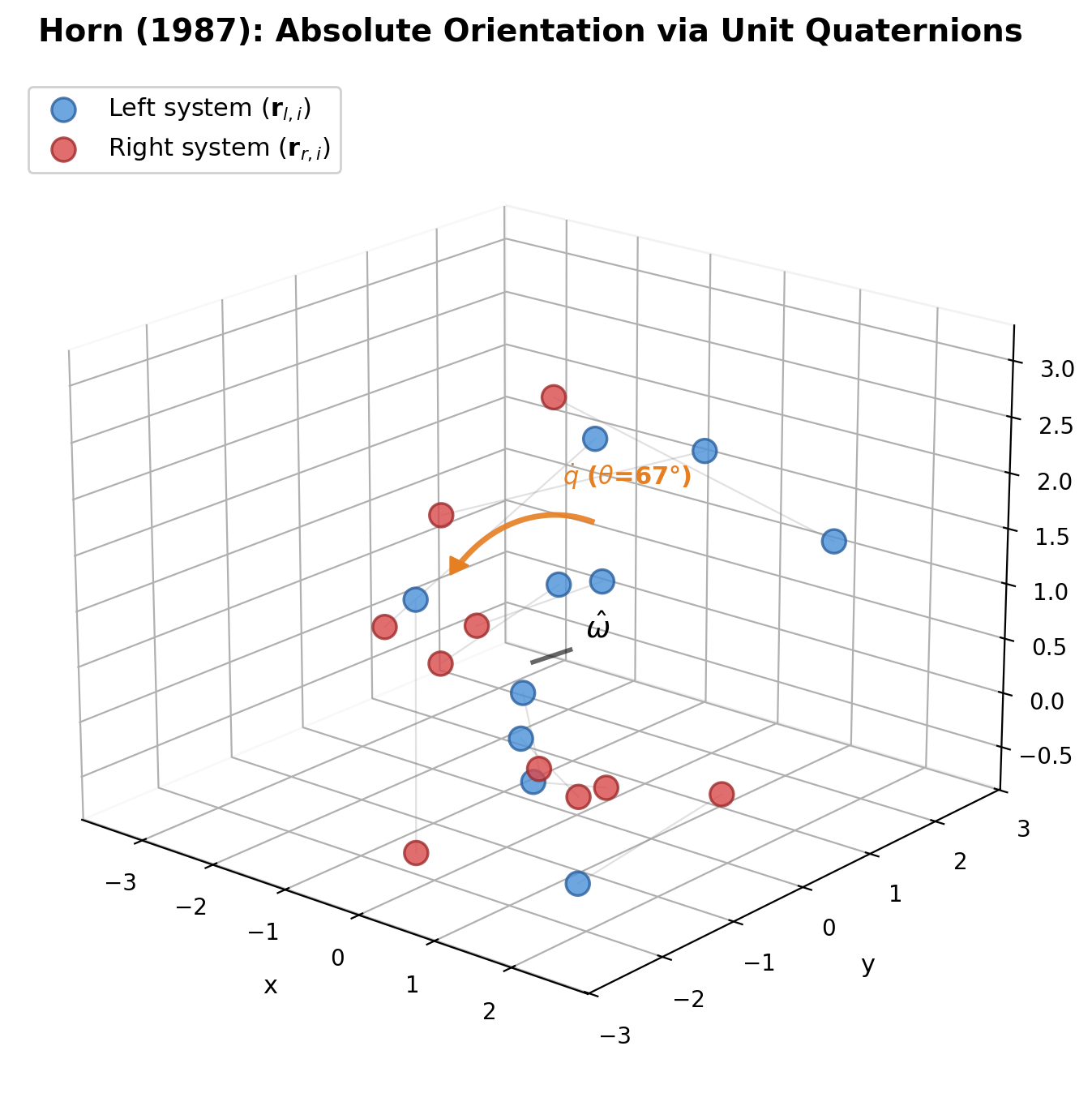
3D scatter plot showing left and right point sets with rotation axis and quaternion rotation arc

Horn's Method: Absolute Orientation via Unit Quaternions

Derives the optimal rotation between two 3D point sets as the eigenvector of a 4x4 symmetric matrix built from cross-covariance sums, using unit quaternions to enforce the orthogonality constraint.