Predictive Chemistry
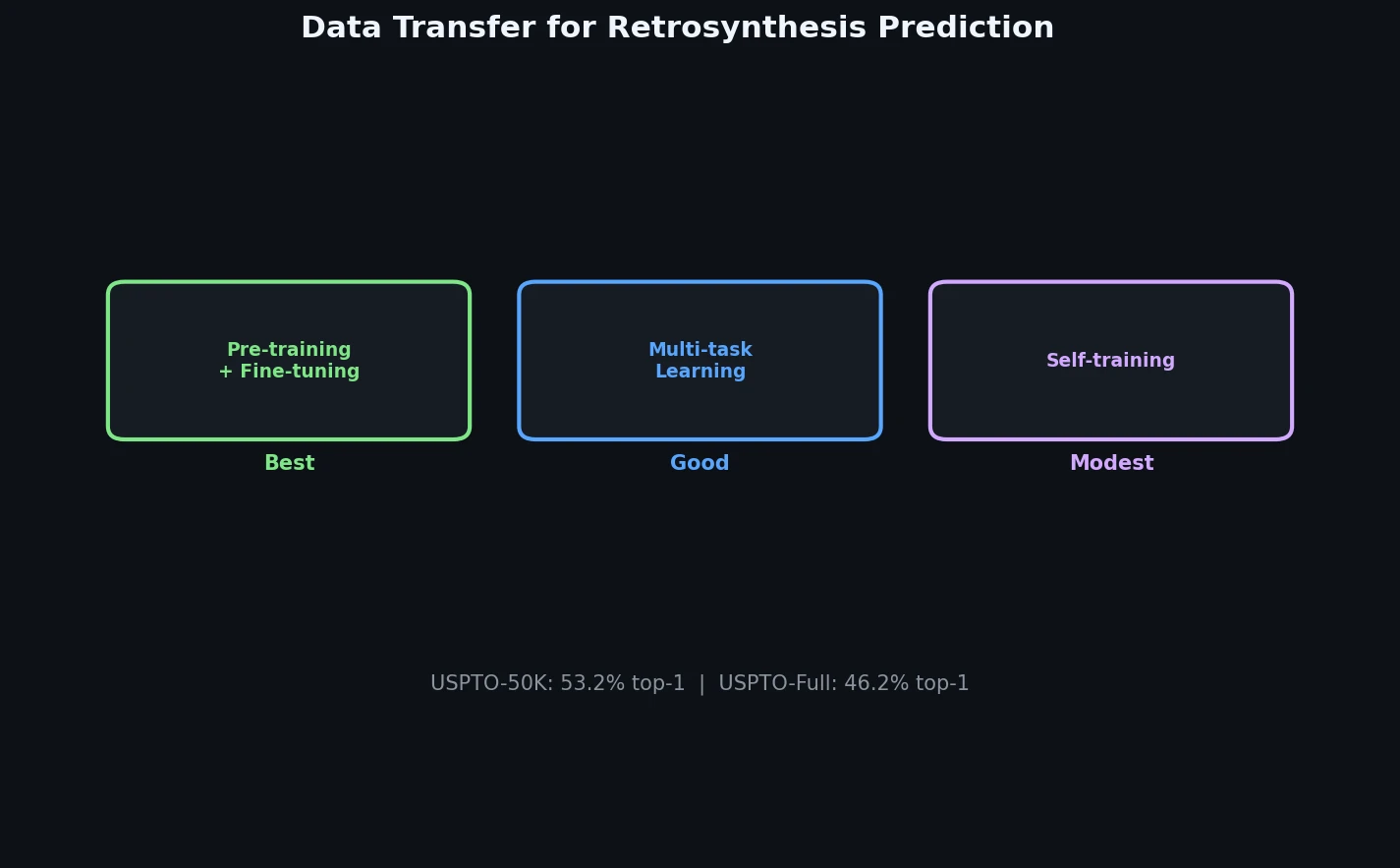
Three data transfer methods for retrosynthesis: pre-training plus fine-tuning, multi-task learning, and self-training

Data Transfer Approaches for Seq-to-Seq Retrosynthesis

A systematic study of data transfer techniques (joint training, self-training, pre-training plus fine-tuning) applied to Transformer-based retrosynthesis. Pre-training on USPTO-Full followed by fine-tuning on USPTO-50K achieves the best results, improving top-1 accuracy from 35.3% to 57.4%.
Computational Chemistry
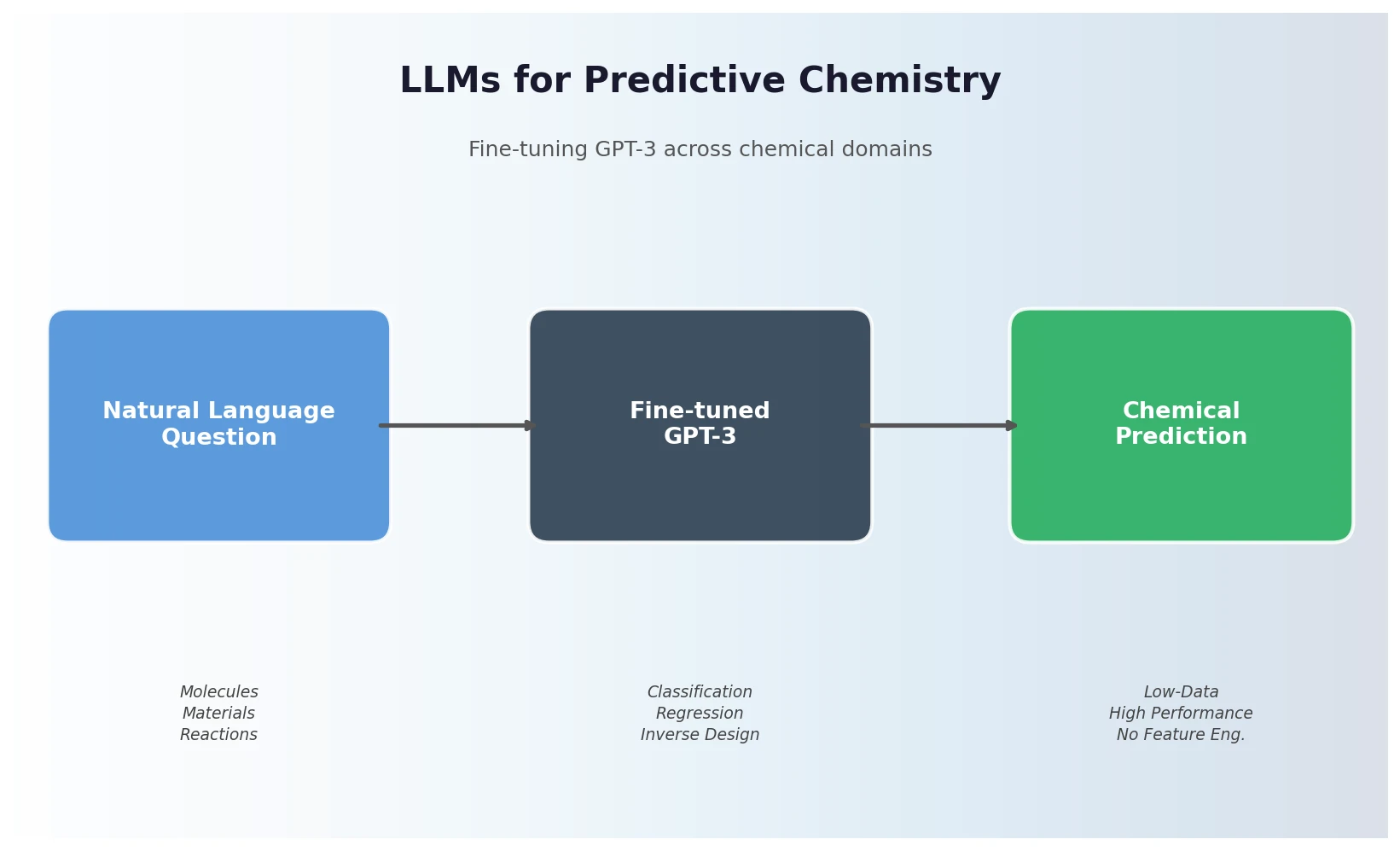
Pipeline diagram showing natural language chemistry questions flowing through fine-tuned GPT-3 to chemical predictions across molecules, materials, and reactions

Fine-Tuning GPT-3 for Predictive Chemistry Tasks

Jablonka et al. show that fine-tuning GPT-3 on natural language chemistry questions achieves competitive or superior performance to dedicated ML models across 15 benchmarks, with particular strength in low-data settings and inverse molecular design.

Predictive Chemistry
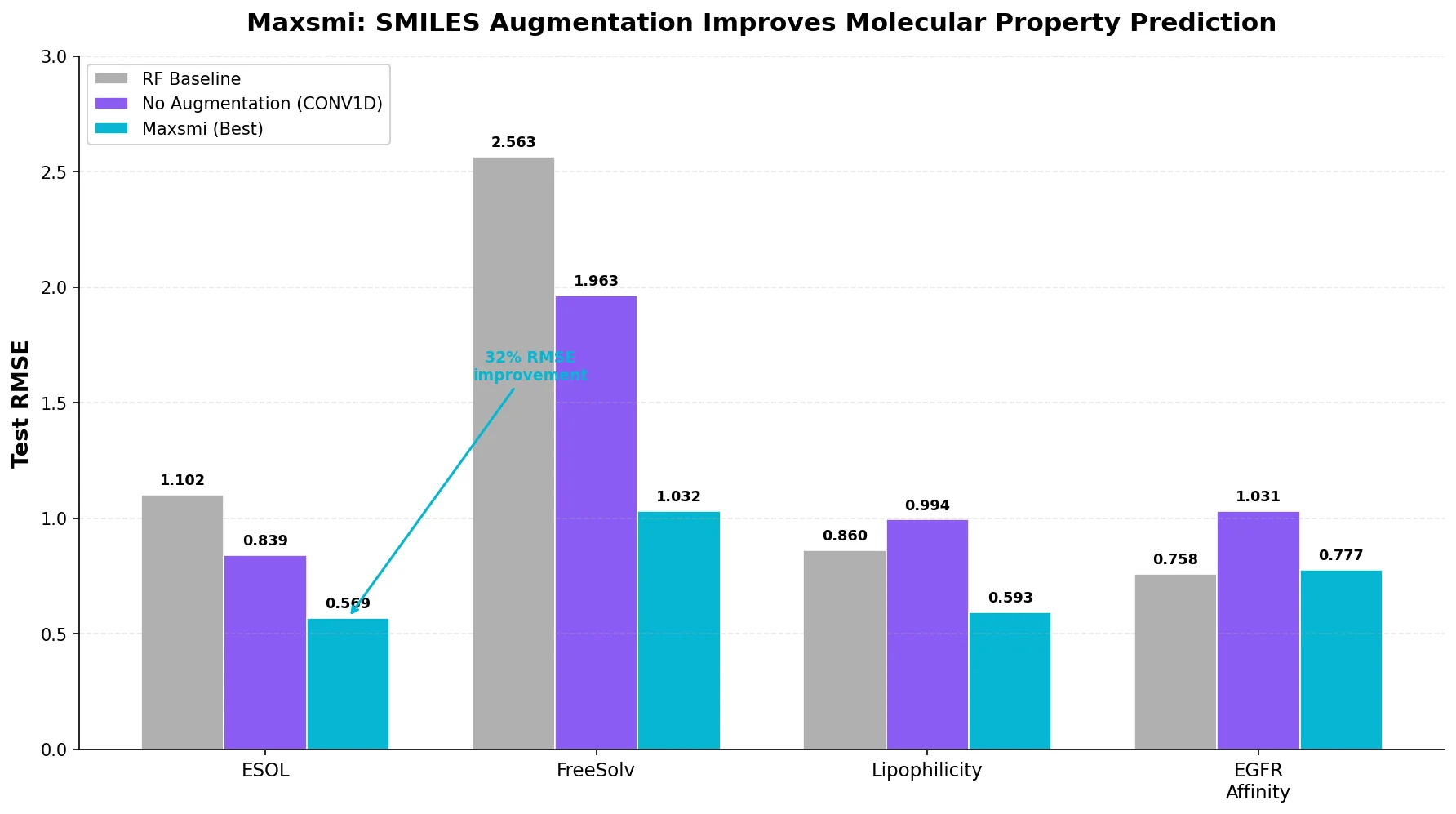
Bar chart showing RMSE improvement from SMILES augmentation across ESOL, FreeSolv, and lipophilicity datasets

Maxsmi: SMILES Augmentation for Property Prediction

A systematic study of SMILES augmentation strategies for molecular property prediction, showing that augmentation consistently improves CNN and RNN performance and that prediction variance across SMILES correlates with model uncertainty.

Computational Chemistry
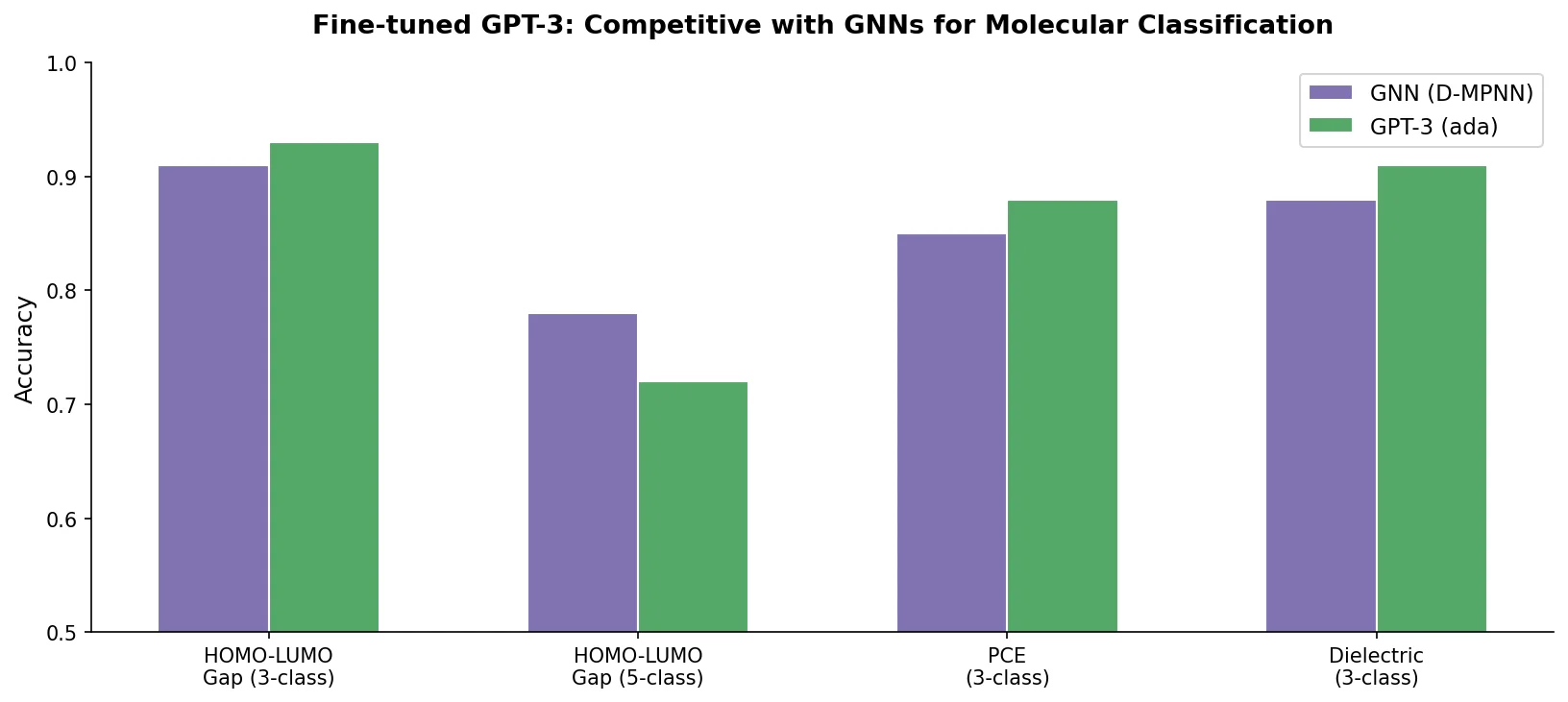
Bar chart comparing GPT-3 ada and GNN accuracy across molecular classification tasks

Fine-Tuning GPT-3 for Molecular Property Prediction

This paper fine-tunes GPT-3’s ada model on SMILES strings for classifying electronic properties (HOMO, LUMO) of organic semiconductor molecules, finding competitive accuracy with graph neural networks and exploring robustness through ablation studies.

Molecular Generation
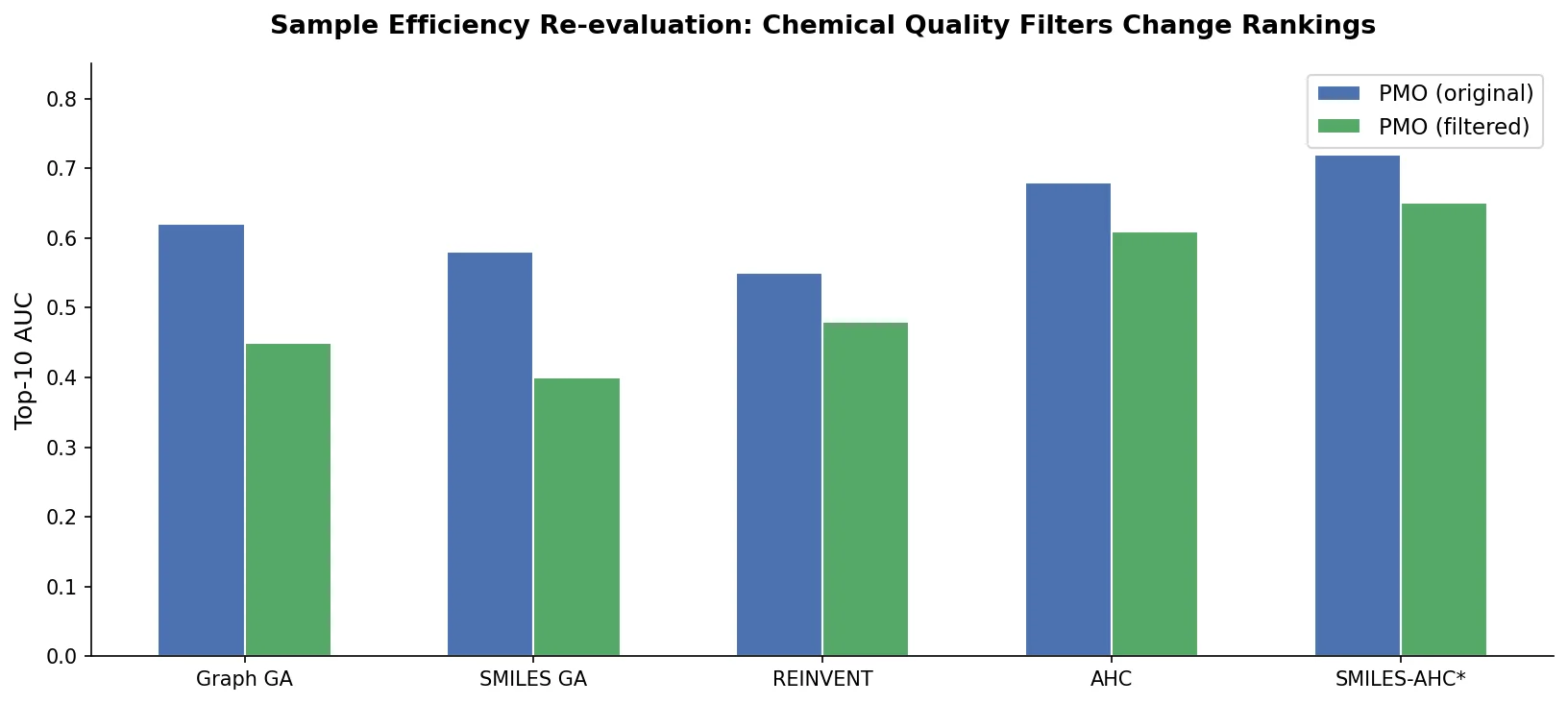
Bar chart comparing PMO benchmark scores with and without chemical quality filters across five generative methods

Re-evaluating Sample Efficiency in Molecule Generation

A critical reassessment of the PMO benchmark for de novo molecule generation, showing that adding molecular weight, LogP, and diversity filters substantially re-ranks generative models, with Augmented Hill-Climb emerging as the top method.

Molecular Generation
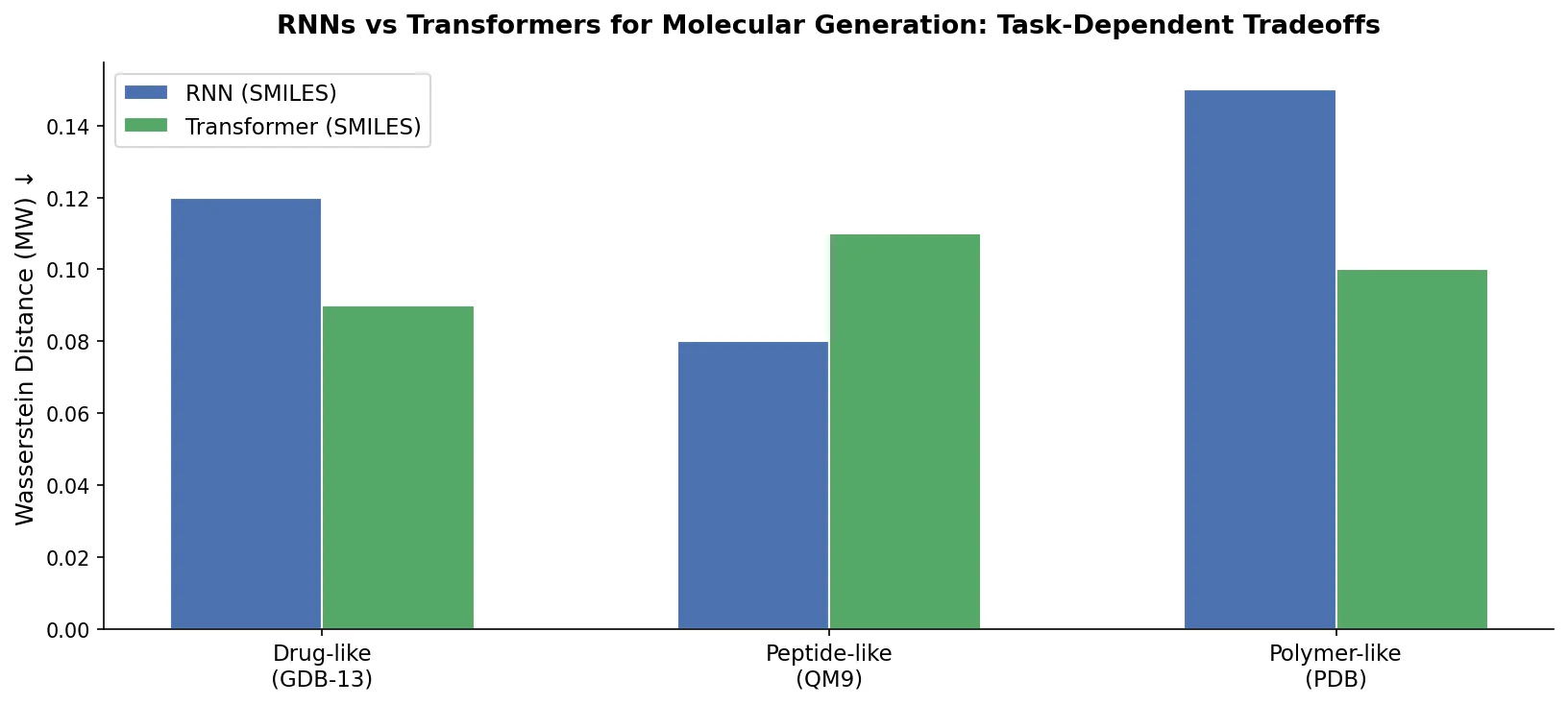
Bar chart comparing RNN and Transformer Wasserstein distances across drug-like, peptide-like, and polymer-like generation tasks

RNNs vs Transformers for Molecular Generation Tasks

Compares RNN-based and Transformer-based chemical language models across three molecular generation tasks of increasing complexity, finding that RNNs excel at local features while Transformers handle large molecules better.

Molecular Representations
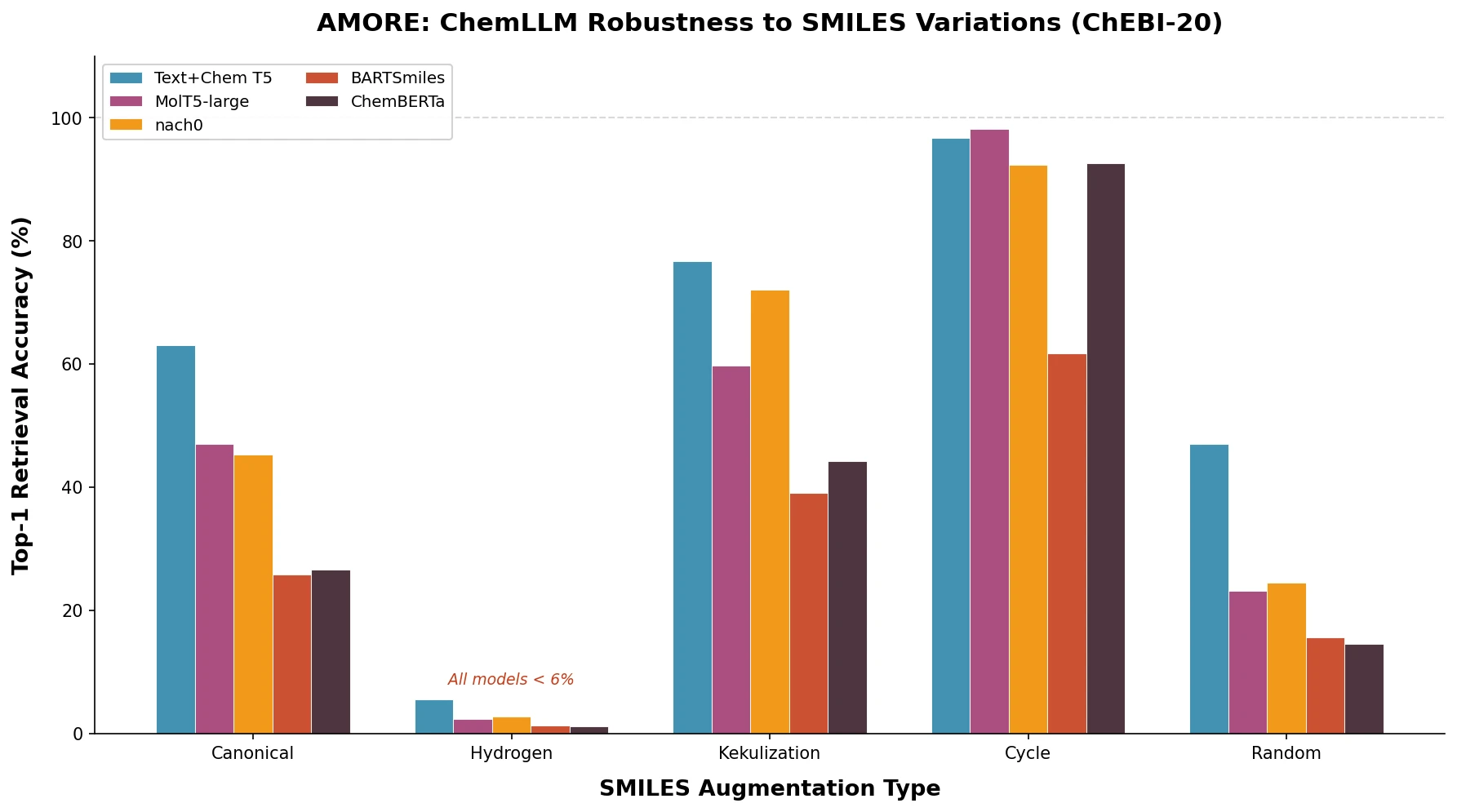
Bar chart showing retrieval accuracy of chemical language models across four SMILES augmentation types

AMORE: Testing ChemLLM Robustness to SMILES Variants

Introduces AMORE, an embedding-based retrieval framework that evaluates whether chemical language models can recognize the same molecule across different SMILES representations. Results show current models are not robust to identity-preserving augmentations.

Computational Chemistry
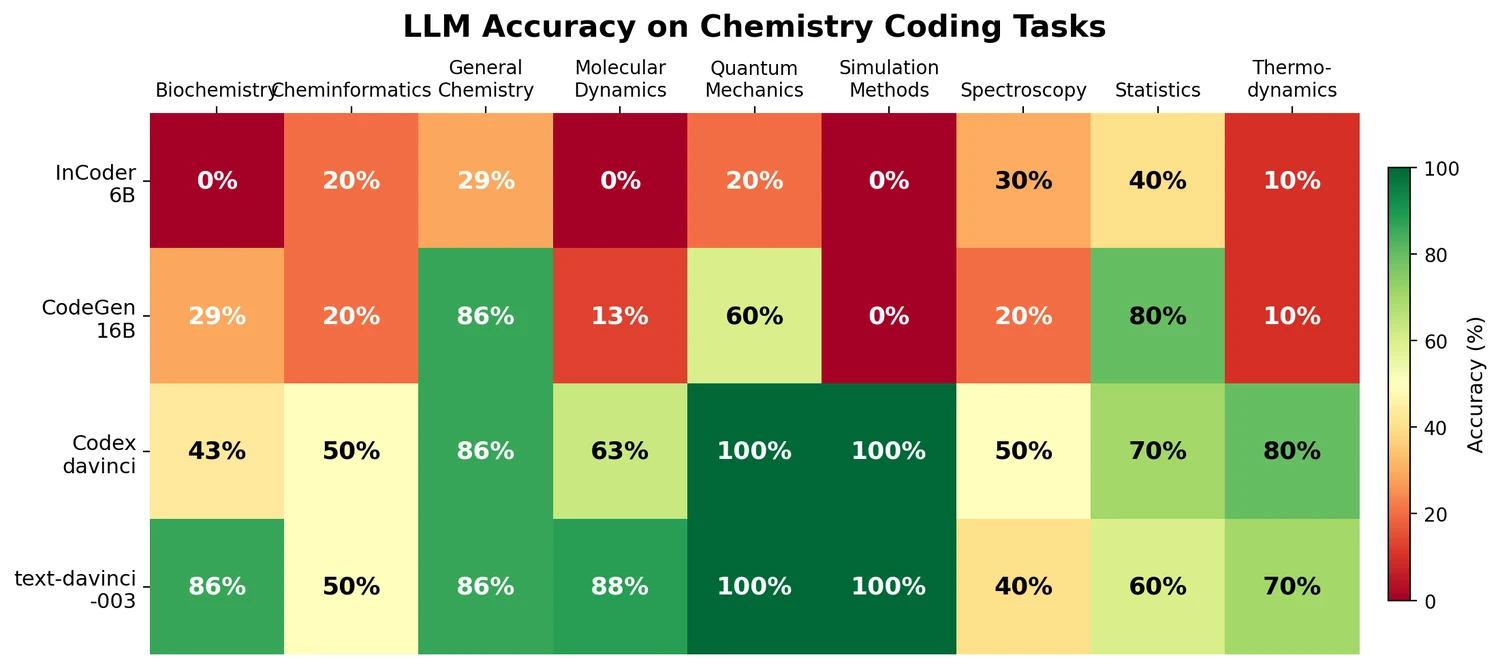
Heatmap showing LLM accuracy across nine chemistry coding task categories for four models, with green indicating high accuracy and red indicating low accuracy

Benchmarking Chemistry Knowledge in Code-Gen LLMs

A benchmark of 84 chemistry coding tasks evaluating code-generating LLMs like Codex, showing 72% accuracy with prompt engineering strategies that improve performance by 30 percentage points.

Computational Chemistry
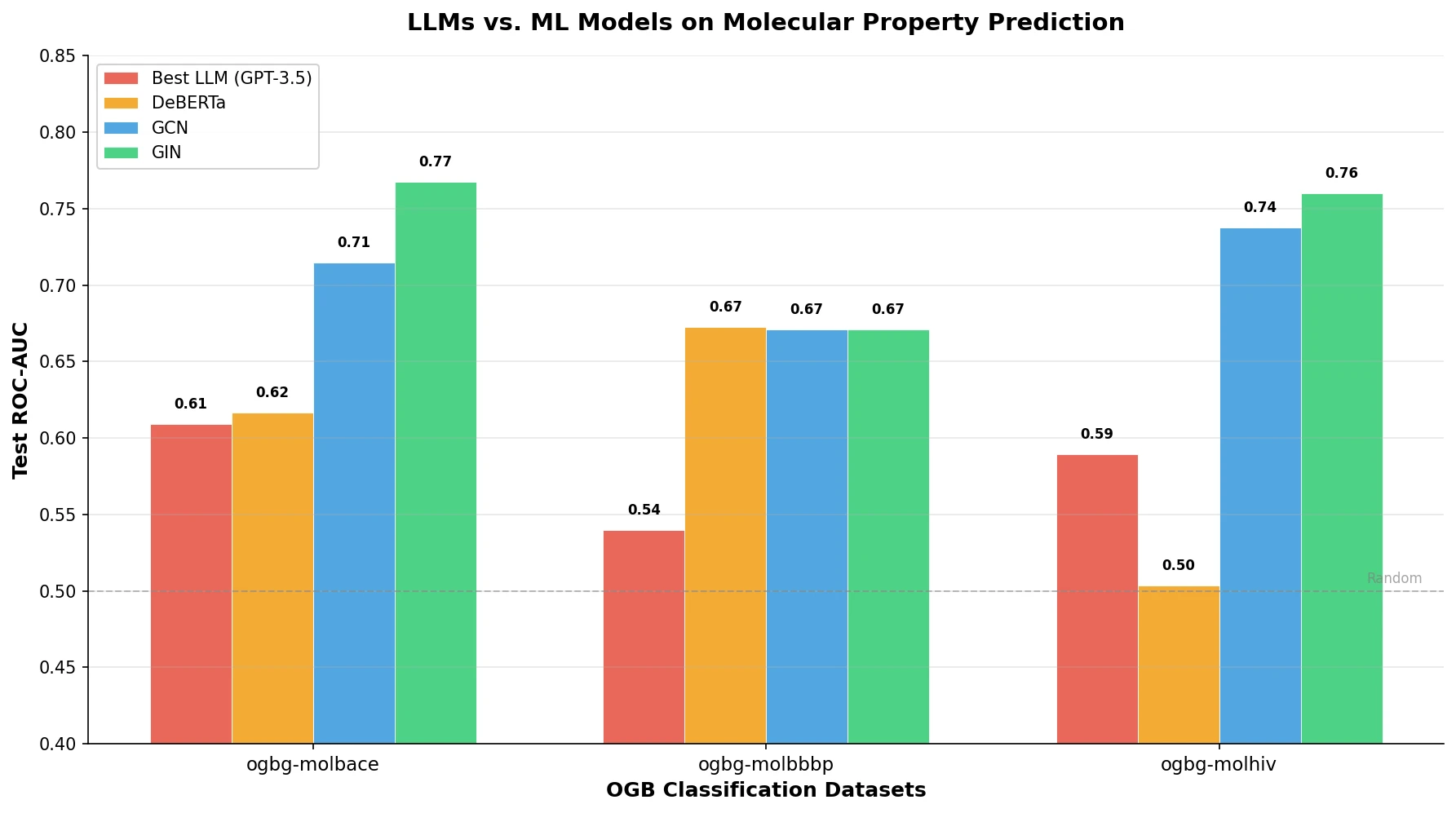
Bar chart comparing LLM, DeBERTa, GCN, and GIN performance on three OGB molecular classification benchmarks

Benchmarking LLMs for Molecular Property Prediction

Benchmarks large language models on six molecular property prediction datasets, finding that LLMs lag behind GNNs but can augment ML models when used collaboratively.

Optical Chemical Structure Recognition

String Representations for Chemical Image Recognition

This empirical study isolates the impact of chemical string representations on image-to-text translation models. It finds that while SMILES offers the highest overall accuracy, SELFIES provides a guarantee of structural validity, offering a trade-off for OCSR tasks.