Generative Modeling
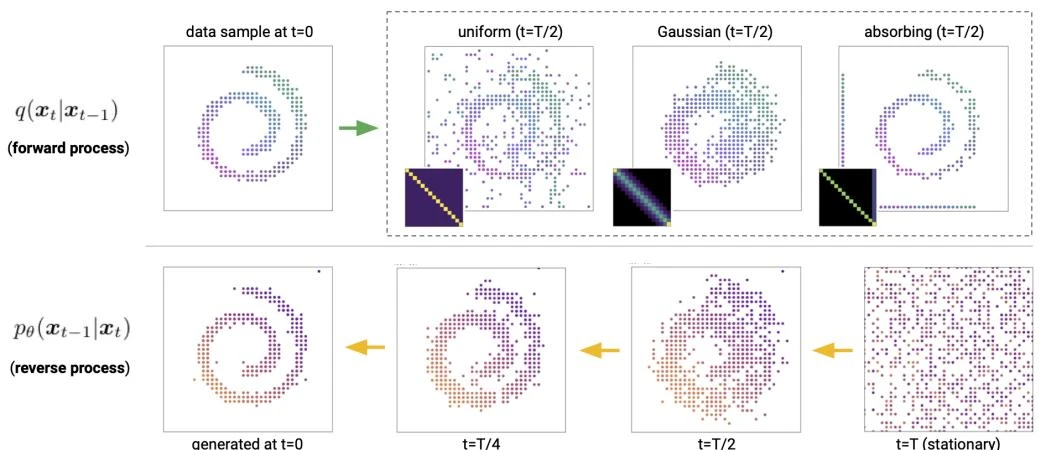
Denoising Score Matching Intuition - Vectors point from corrupted samples back to clean data, approximating the score

Score Matching and Denoising Autoencoders

This paper provides a rigorous probabilistic foundation for Denoising Autoencoders by proving they are mathematically equivalent to Score Matching on a kernel-smoothed data distribution. It derives a specific energy function for DAEs and justifies the use of tied weights.

Generative Modeling
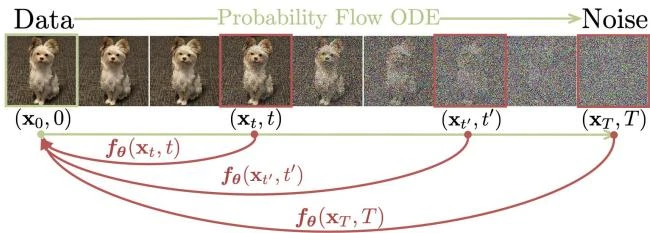
Forward and Reverse SDE trajectories showing the diffusion process from data to noise and back

Score-Based Generative Modeling with SDEs

This paper unifies previous score-based methods (SMLD and DDPM) under a continuous-time SDE framework. It introduces Predictor-Corrector samplers for improved generation and Probability Flow ODEs for exact likelihood computation, setting new records on CIFAR-10.

Computational Chemistry
ChemDFM-X architecture showing five modalities (2D graphs, 3D conformations, images, MS2 spectra, IR spectra) feeding through separate encoders into unified LLM decoder

ChemDFM-X: Large Multimodal Model for Chemistry

ChemDFM-X is a multimodal chemical foundation model that integrates five non-text modalities (2D graphs, 3D conformations, images, MS2 spectra, IR spectra) into a single LLM decoder. It overcomes data scarcity by generating a 7.6M instruction-tuning dataset through approximate calculations and model predictions, achieving state-of-the-art generalist performance.

Computational Biology
DynamicFlow illustration showing the transformation from apo pocket to holo pocket with ligand molecule generation

DynamicFlow: Integrating Protein Dynamics into Drug Design

This paper introduces DynamicFlow, a full-atom stochastic flow matching model that simultaneously generates ligand molecules and transforms protein pockets from apo to holo states. It also contributes a new dataset of MD-simulated apo-holo pairs derived from MISATO.

Computational Chemistry
Comparative analysis of image-to-sequence OCSR methods

Image-to-Sequence OCSR: A Comparative Analysis

Deep dive into 24 image-to-sequence OCSR methods (2019-2025), comparing encoder-decoder architectures, molecular string representations, training scale, and hardware requirements.

Computational Chemistry
InstructMol architecture showing molecular graph and text inputs feeding through two-stage training to produce property predictions, descriptions, and reactions

InstructMol: Multi-Modal Molecular Assistant

InstructMol integrates a pre-trained molecular graph encoder (MoleculeSTM) with a Vicuna-7B LLM using a linear projector. It employs a two-stage training process (alignment pre-training followed by task-specific instruction tuning with LoRA) to excel at property prediction, description generation, and reaction analysis.

Computational Biology
InvMSAFold generates diverse protein sequences from structure using a Potts model

InvMSAFold: Generative Inverse Folding with Potts Models

InvMSAFold replaces autoregressive decoding with a Potts model parameter generator, enabling diverse protein sequence sampling orders of magnitude faster than ESM-IF1.

Computational Chemistry
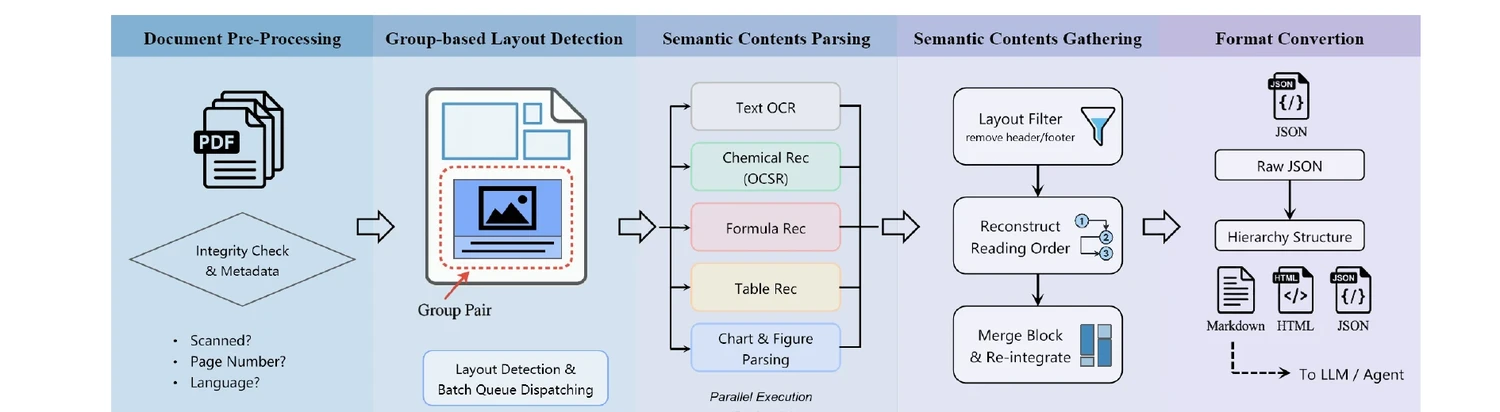
MERMaid pipeline diagram showing PDF processing through VisualHeist segmentation, DataRaider VLM mining, and KGWizard graph construction to produce chemical knowledge graphs

MERMaid: Multimodal Reaction Mining

MERMaid leverages fine-tuned vision models and VLM reasoning to mine chemical reaction data from PDF figures and tables, handling context inference and coreference resolution to build high-fidelity knowledge graphs with 87% end-to-end accuracy.

Computational Chemistry
MOFFlow assembles metal nodes and organic linkers into Metal-Organic Framework structures

MOFFlow: Flow Matching for MOF Structure Prediction

MOFFlow is the first deep generative model tailored for Metal-Organic Framework (MOF) structure prediction. It utilizes Riemannian flow matching on SE(3) to assemble rigid building blocks (metal nodes and organic linkers), achieving significantly higher accuracy and scalability than atom-based methods on large systems.

Computational Chemistry
Diagram showing text, molecular structures, and reactions feeding into a multimodal index and search system that outputs passages with context

Multimodal Search in Chemical Documents

This paper presents a multimodal search system that facilitates passage-level retrieval of chemical reactions and molecular structures by linking diagrams, text, and reaction records extracted from scientific PDFs.

Computational Chemistry
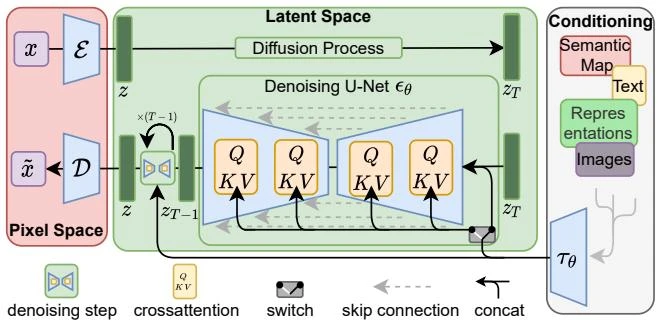
OCSAug: Diffusion-Based Augmentation for Hand-Drawn OCSR

OCSAug: Diffusion-Based Augmentation for Hand-Drawn OCSR

OCSAug leverages Denoising Diffusion Probabilistic Models (DDPM) and the RePaint algorithm with custom masking to generate synthetic hand-drawn chemical structure images, significantly improving OCSR performance on benchmarks like DECIMER.

Computational Chemistry
Diagram showing molecular structure passing through a neural network to produce IUPAC chemical nomenclature document

STOUT V2.0: SMILES to IUPAC Name Conversion

STOUT V2.0 uses Transformers trained on ~1 billion SMILES-IUPAC pairs to accurately translate chemical structures into systematic names (and vice-versa), outperforming its RNN predecessor.