Hunter Heidenreich | ML Research Scientist — Page 13

Molecular Generation
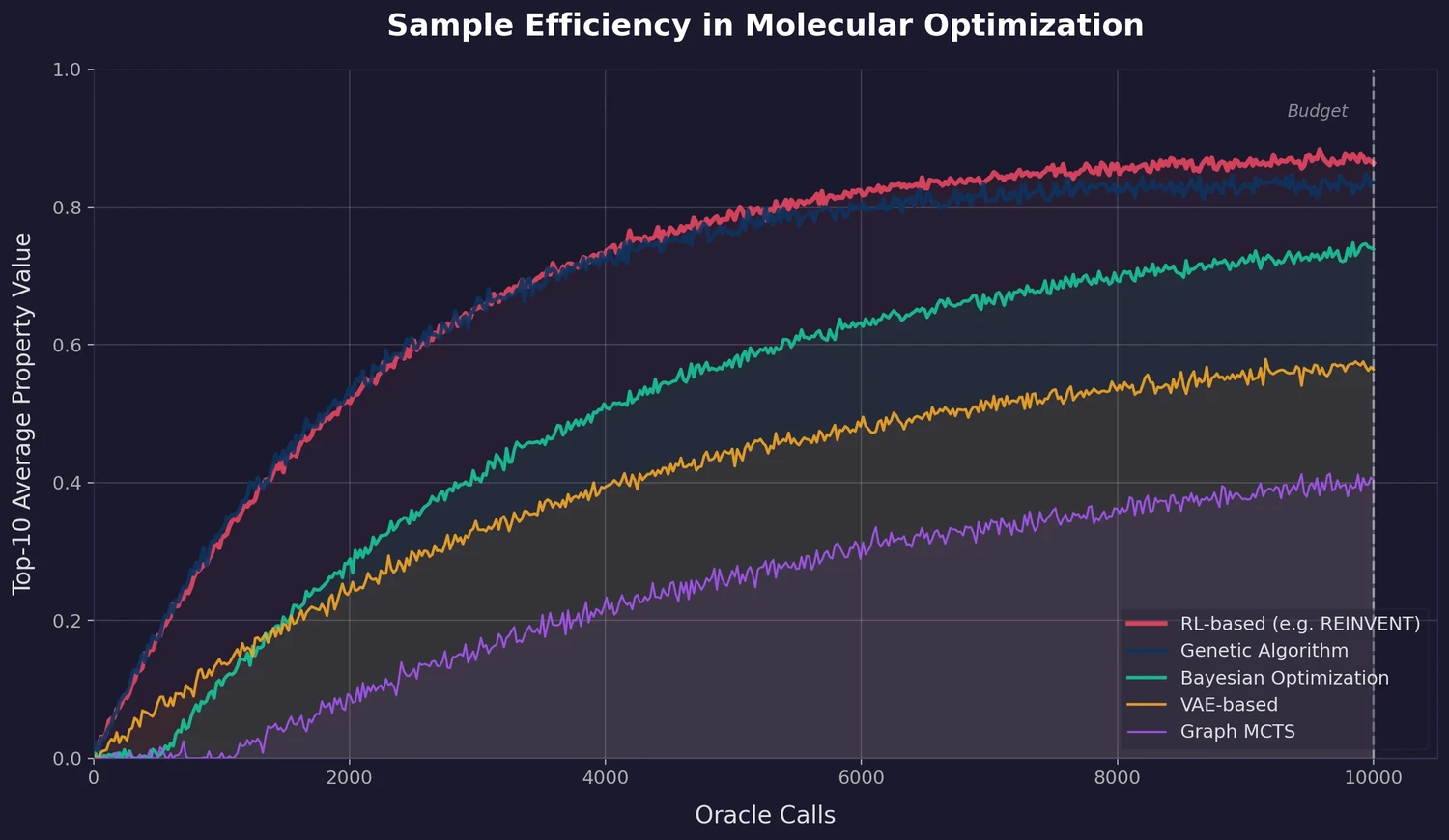
Sample efficiency curves showing different molecular optimization algorithm families converging at different rates under a fixed oracle budget

PMO: Benchmarking Sample-Efficient Molecular Design

A large-scale benchmark of 25 molecular optimization methods on 23 oracles under constrained oracle budgets, showing that sample efficiency is a critical and often neglected dimension of evaluation.
Molecular Representations
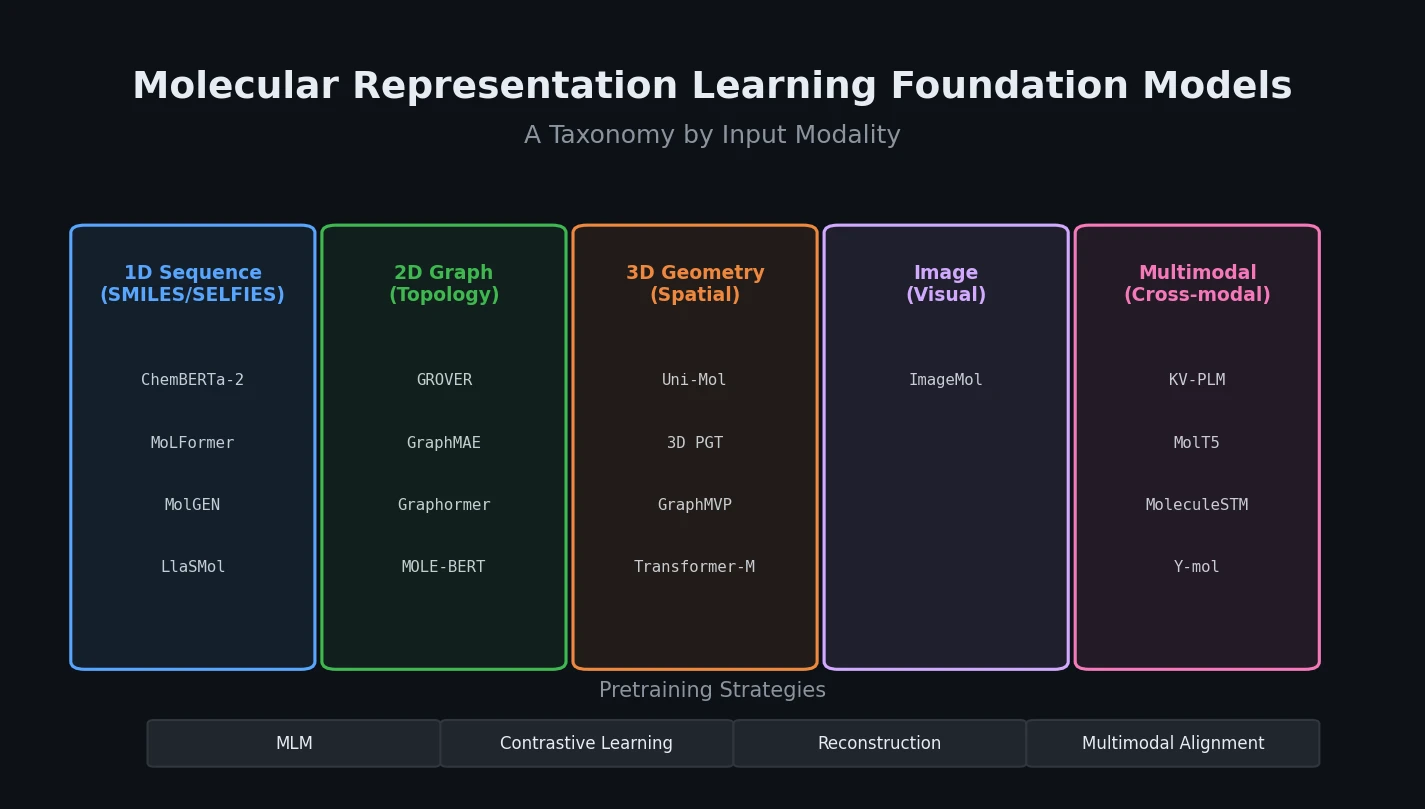
Taxonomy of molecular representation learning foundation models organized by input modality

Review of Molecular Representation Learning Models

A comprehensive survey classifying molecular representation learning foundation models by input modality (sequence, graph, 3D, image, multimodal) and analyzing four pretraining paradigms for drug discovery tasks.

Molecular Generation
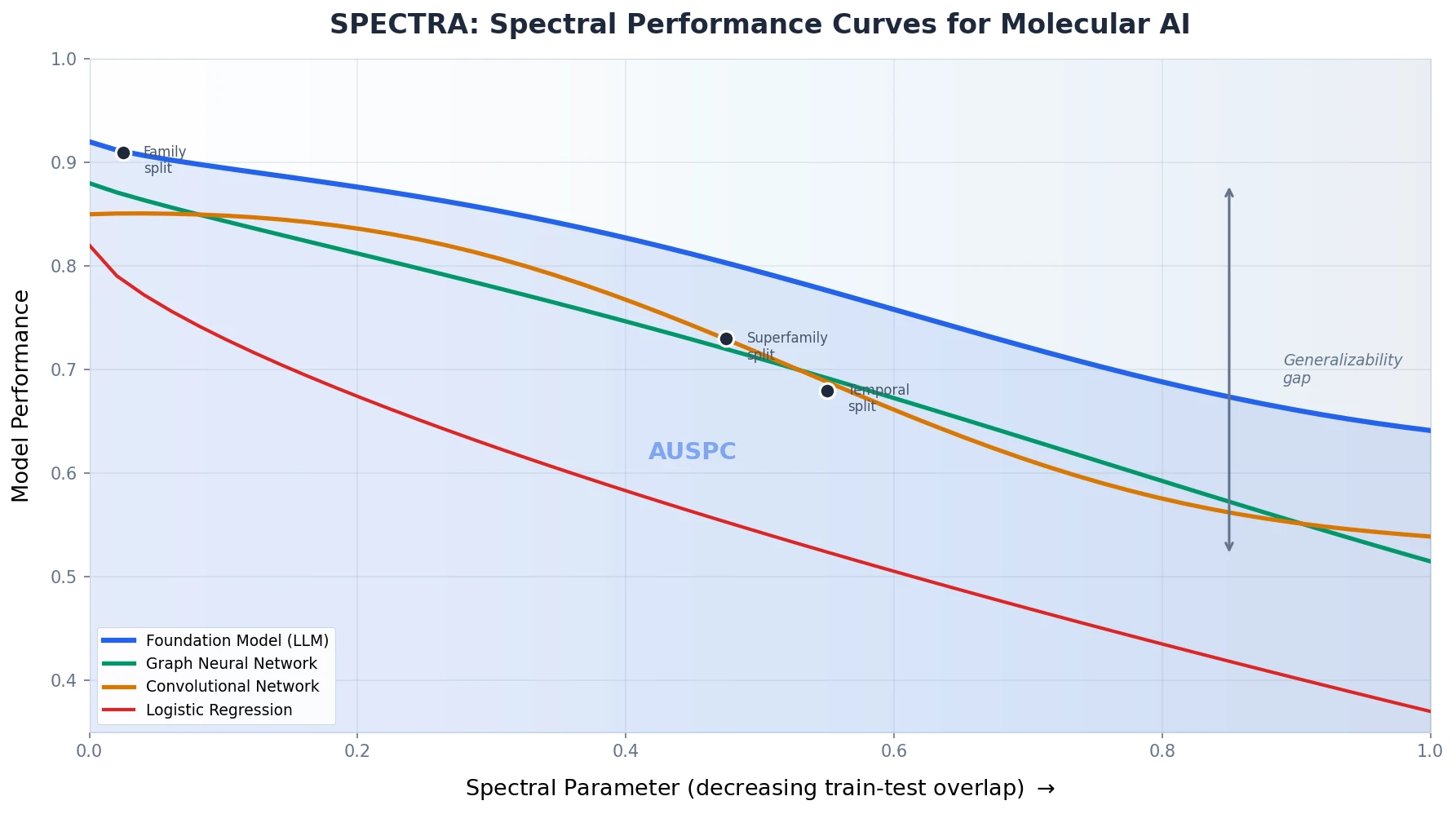
Spectral performance curve showing model accuracy declining as train-test overlap decreases

SPECTRA: Evaluating Generalizability of Molecular AI

Introduces SPECTRA, a framework that generates spectral performance curves to measure how ML model accuracy degrades as train-test overlap decreases across molecular sequencing tasks.

Molecular Generation
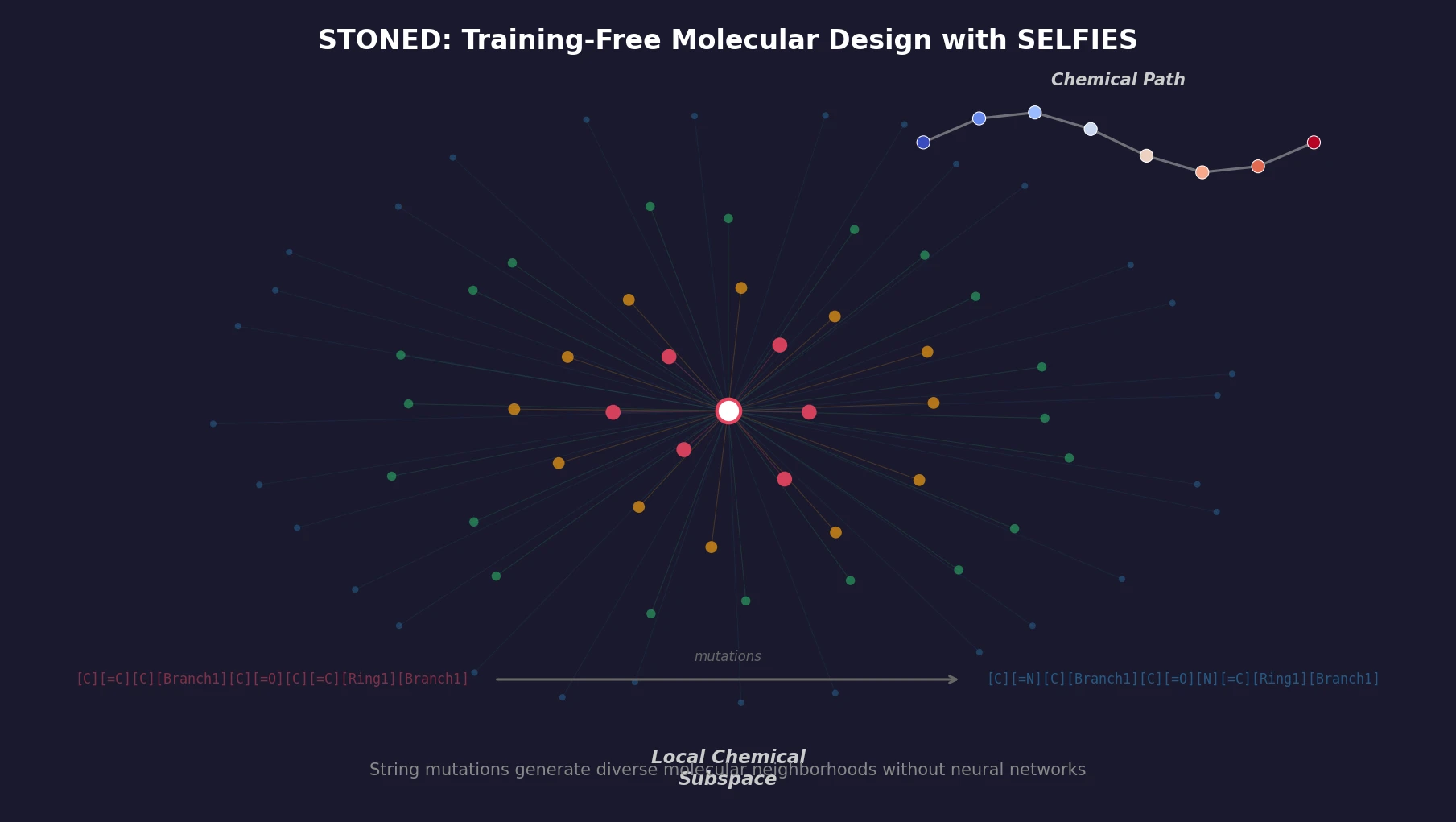
Visualization of STONED algorithm generating a local chemical subspace around a seed molecule through SELFIES string mutations, with a chemical path shown between two endpoints

STONED: Training-Free Molecular Design with SELFIES

STONED introduces simple string manipulation algorithms on SELFIES for molecular design, achieving competitive results with deep generative models while requiring no training data or GPU resources.

Molecular Generation
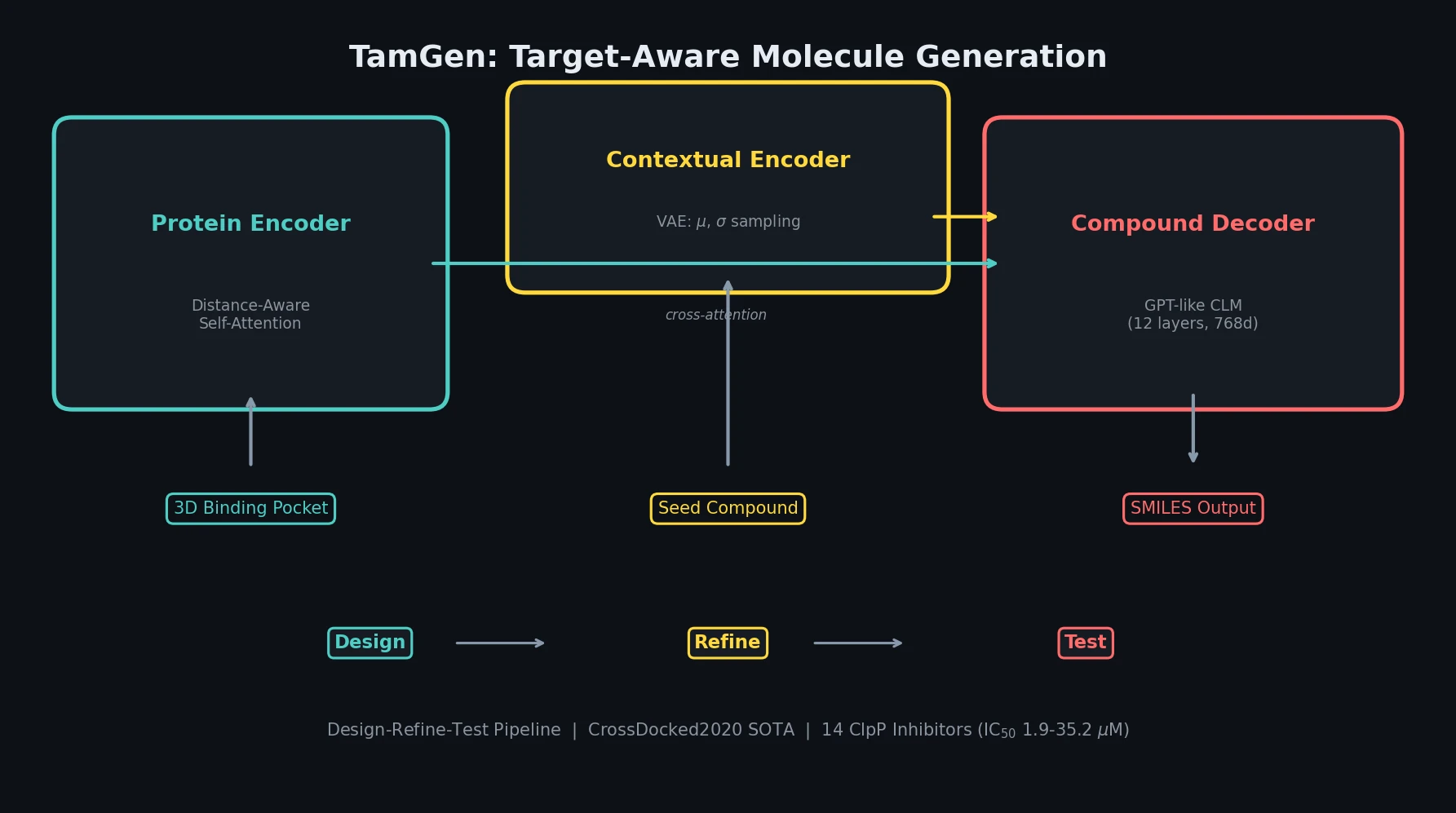
Diagram showing the TamGen three-stage pipeline from protein pocket encoding through compound generation to experimental testing

TamGen: GPT-Based Target-Aware Drug Design and Generation

Introduces TamGen, a target-aware molecular generation method using a pre-trained GPT-like chemical language model with protein structure conditioning. A Design-Refine-Test pipeline discovers 14 inhibitors against tuberculosis ClpP protease, with IC50 values as low as 1.9 uM.

Molecular Representations
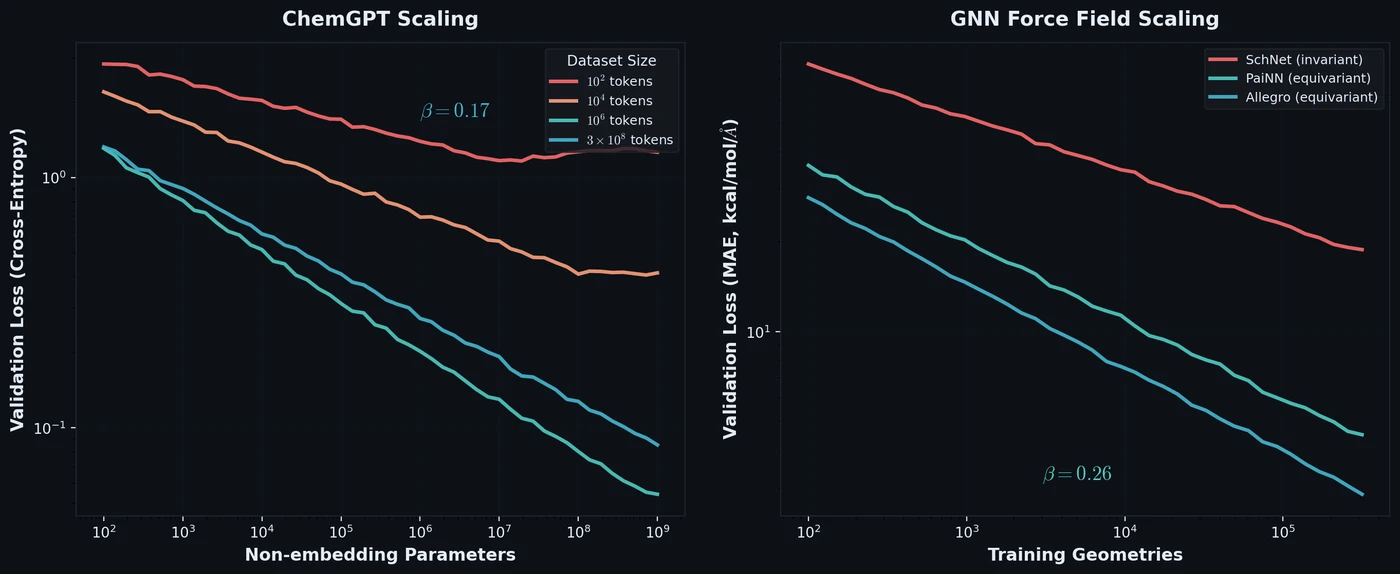
Log-log plots showing power-law scaling of ChemGPT validation loss versus model size and GNN force field loss versus dataset size

Neural Scaling of Deep Chemical Models

Frey et al. discover empirical power-law scaling relations for both chemical language models (ChemGPT, up to 1B parameters) and equivariant GNN interatomic potentials, finding that neither domain has saturated with respect to model size, data, or compute.

Predictive Chemistry
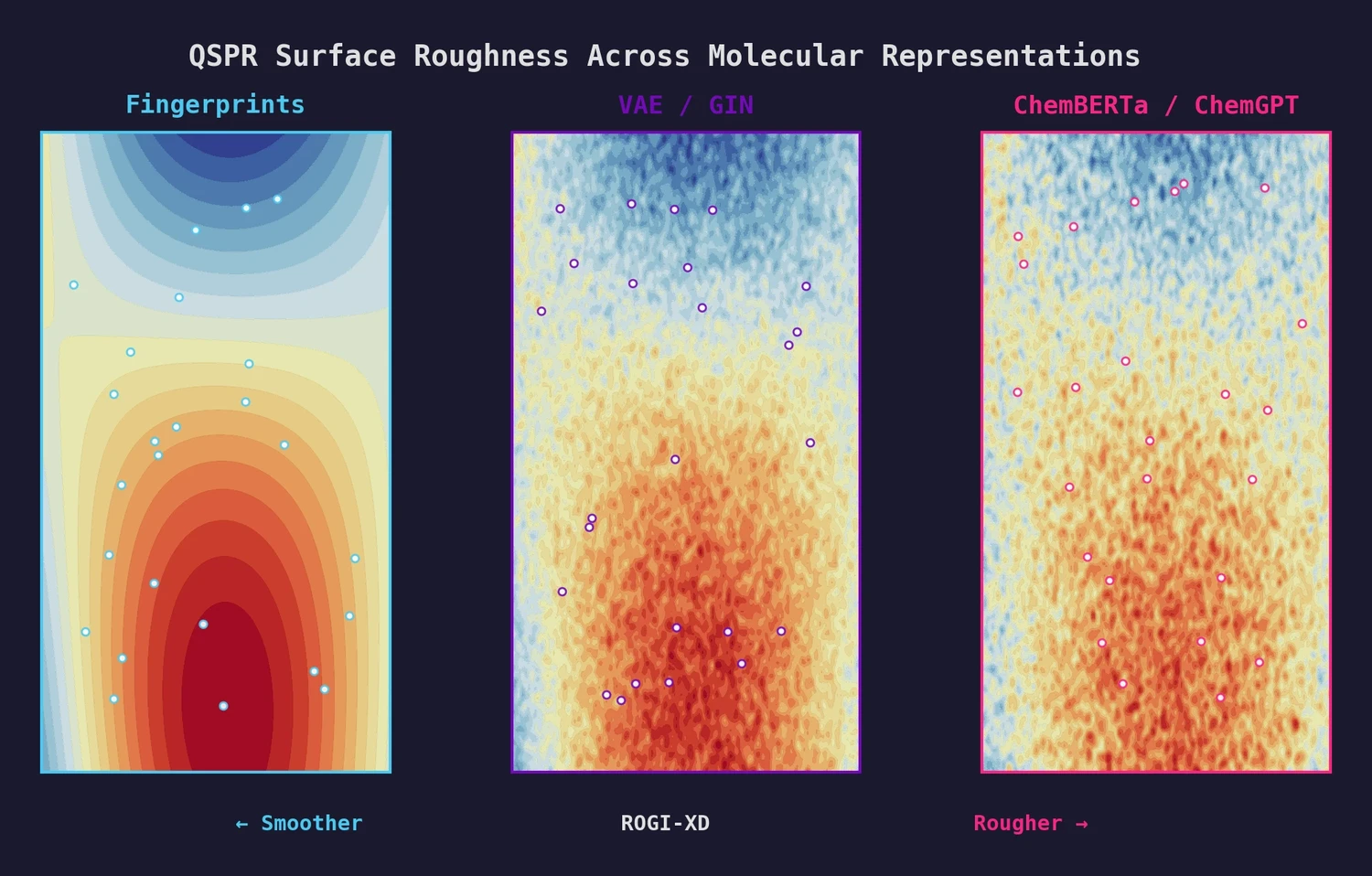
QSPR surface roughness comparison across molecular representations, showing smooth fingerprint surfaces versus rougher pretrained model surfaces

ROGI-XD: Roughness of Pretrained Molecular Representations

This paper introduces ROGI-XD, a reformulation of the ROuGhness Index that enables fair comparison of QSPR surface roughness across molecular representations of different dimensionalities. Evaluating VAE, GIN, ChemBERTa, and ChemGPT representations, the authors show that pretrained chemical models do not produce smoother structure-property landscapes than simple molecular fingerprints or descriptors.

Molecular Generation
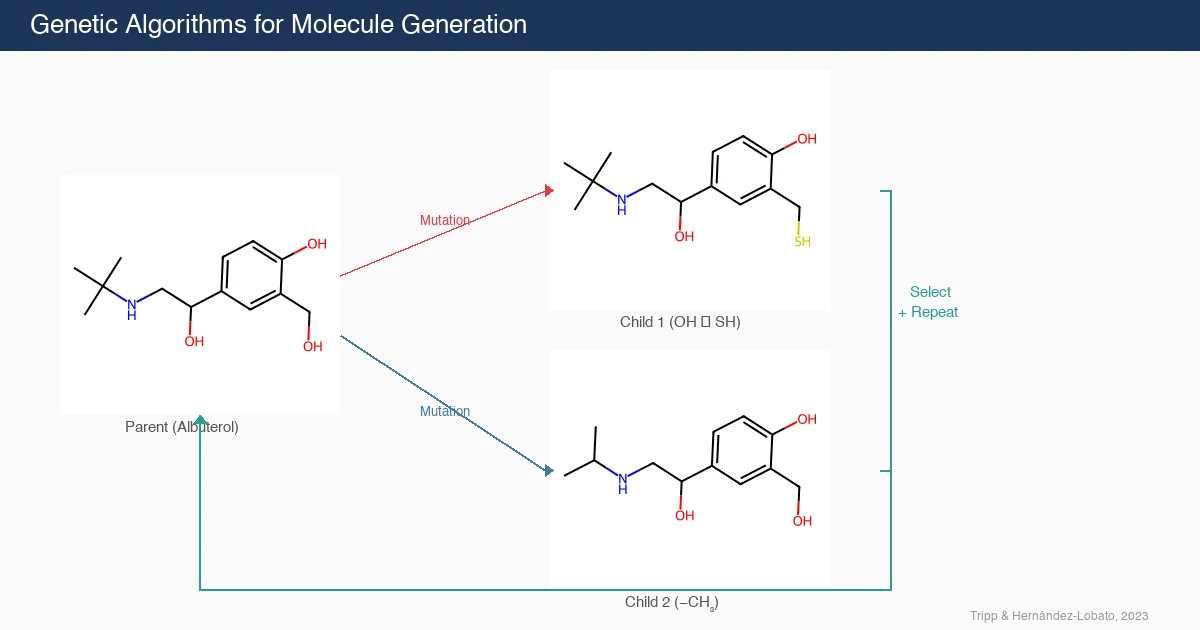
Diagram showing a genetic algorithm for molecules where a parent albuterol molecule undergoes mutation to produce two child molecules, with a selection and repeat loop

Genetic Algorithms as Baselines for Molecule Generation

This position paper demonstrates that genetic algorithms (GAs) perform surprisingly well on molecular generation benchmarks, often outperforming complex deep learning methods. The authors propose the GA criterion: new molecule generation algorithms should demonstrate a clear advantage over GAs.

Molecular Generation
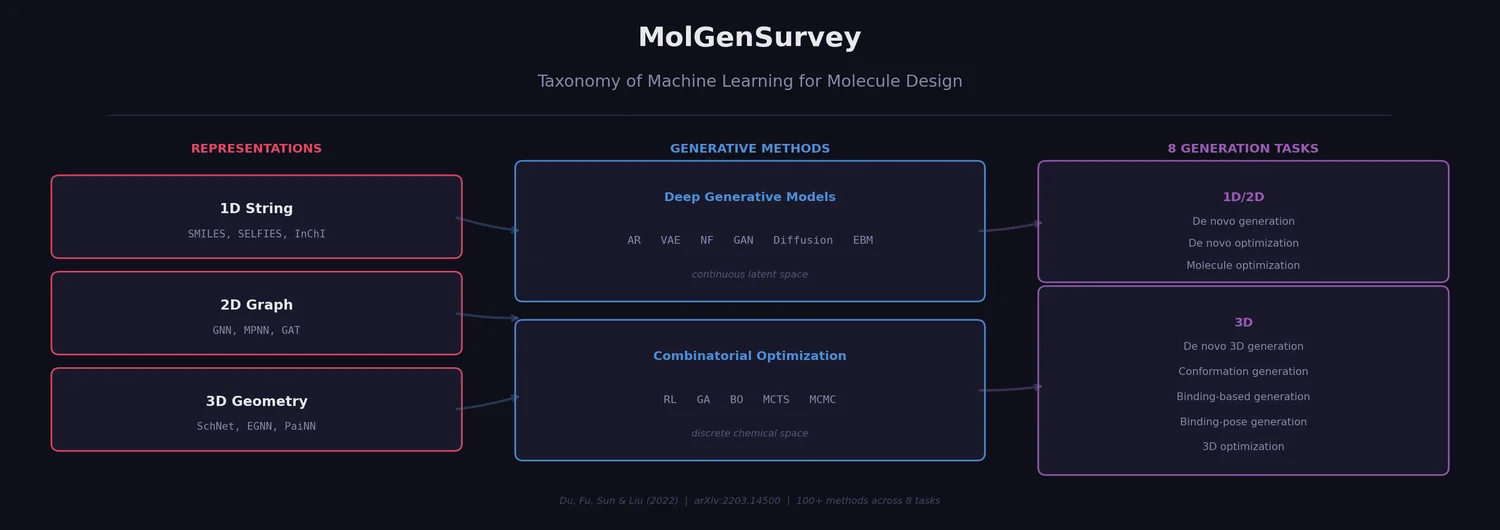
Taxonomy diagram showing the three axes of MolGenSurvey: molecular representations (1D string, 2D graph, 3D geometry), generative methods (deep generative models and combinatorial optimization), and eight generation tasks (1D/2D and 3D)

MolGenSurvey: Systematic Survey of ML for Molecule Design

MolGenSurvey systematically reviews ML models for molecule design, organizing the field by molecular representation (1D/2D/3D), generative method (deep generative models vs. combinatorial optimization), and task type (8 distinct generation/optimization tasks). It catalogs over 100 methods, unifies task definitions via input/output/goal taxonomy, and identifies key challenges including out-of-distribution generation, oracle costs, and lack of unified benchmarks.

Molecular Generation
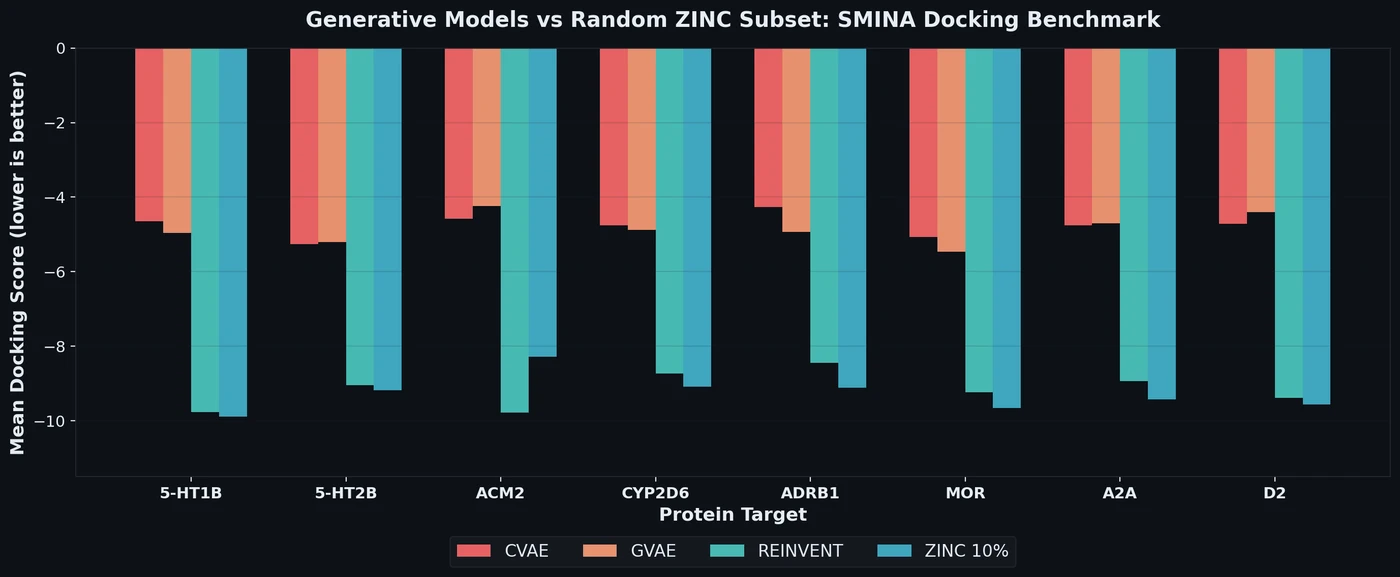
Bar chart comparing SMINA docking scores of CVAE, GVAE, and REINVENT against a random ZINC 10% baseline across eight protein targets

SMINA Docking Benchmark for De Novo Drug Design Models

Proposes a benchmark for de novo drug design using SMINA docking scores across eight drug targets, revealing that popular generative models fail to outperform random ZINC subsets.

Molecular Generation
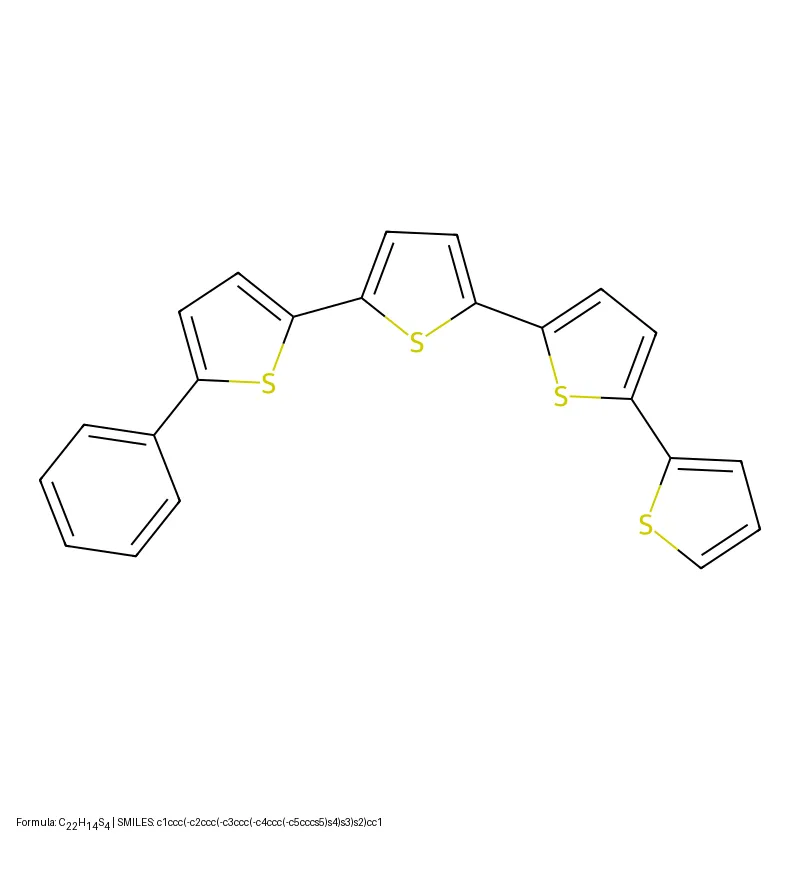
2D structure of a phenyl-quaterthiophene, a conjugated organic molecule representative of the photovoltaic donor materials benchmarked in the Tartarus platform

Tartarus: Realistic Inverse Molecular Design Benchmarks

Tartarus introduces a modular suite of realistic molecular design benchmarks grounded in computational chemistry simulations. Benchmarking eight generative models reveals that no single algorithm dominates all tasks, and simple genetic algorithms often outperform deep generative models.

Predictive Chemistry
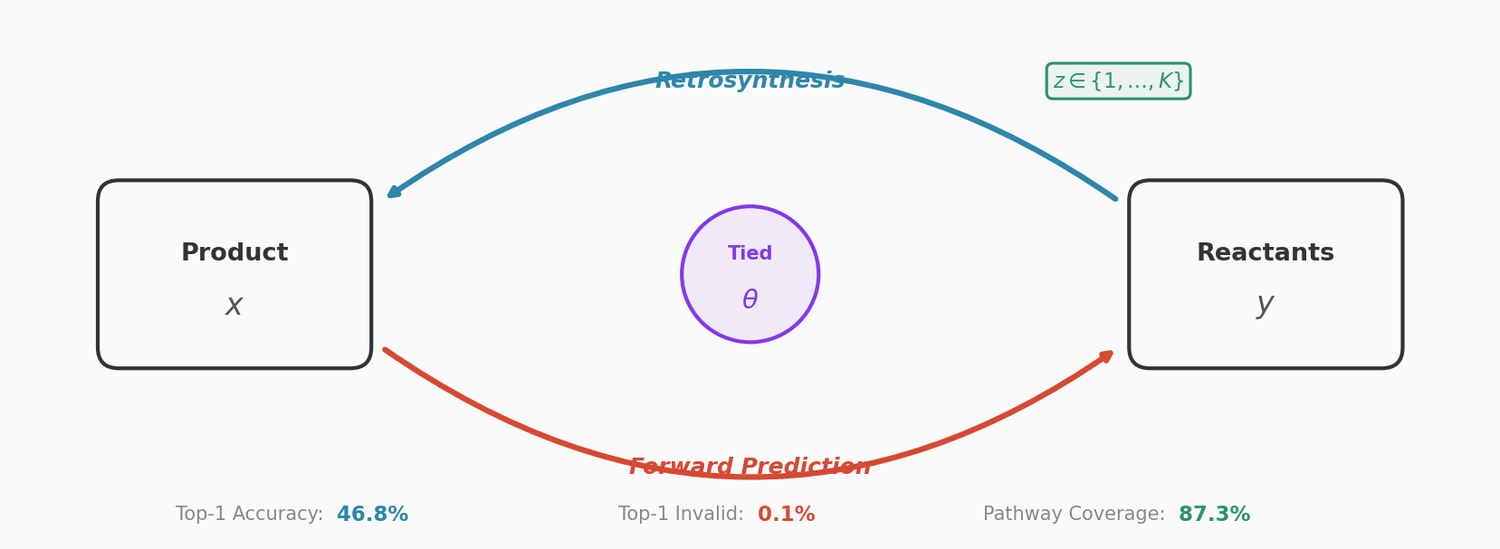
Diagram of the tied two-way transformer architecture with shared encoder, retro and forward decoders, latent variables, and cycle consistency, alongside USPTO-50K accuracy and validity results

Tied Two-Way Transformers for Diverse Retrosynthesis

This paper couples a retrosynthesis transformer with a forward reaction transformer through parameter sharing, cycle consistency checks, and multinomial latent variables. The combined approach reduces top-1 SMILES invalidity to 0.1% on USPTO-50K, improves top-10 accuracy to 78.5%, and achieves 87.3% pathway coverage on a multi-pathway in-house dataset.