What kind of paper is this?
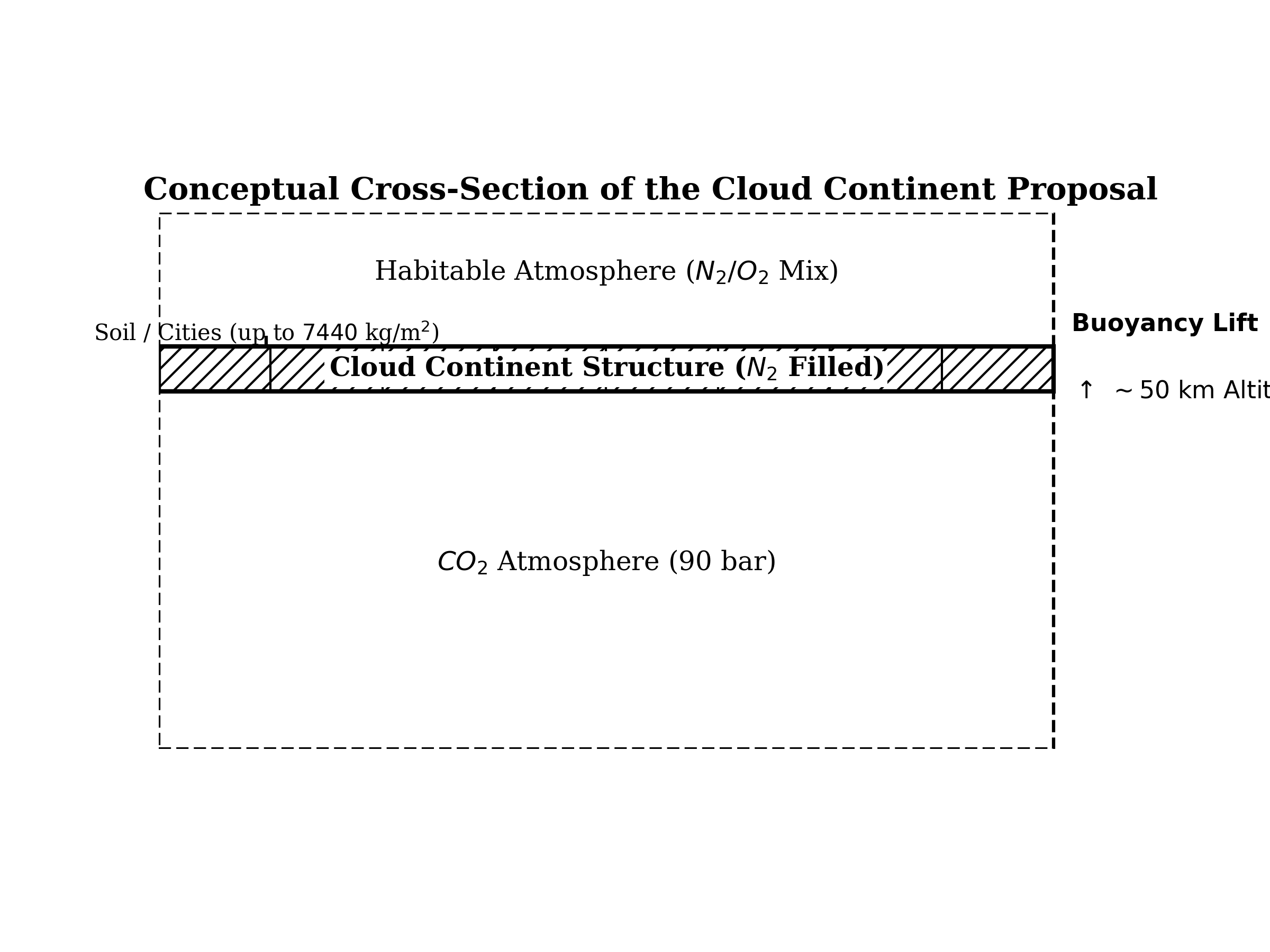
This is a speculative engineering proposal that outlines a method for terraforming Venus by constructing a floating artificial surface at approximately 50 km altitude, avoiding the need to remove the planet’s massive CO₂ atmosphere.
What is the motivation?
While Mars is the typical candidate for terraforming, Venus possesses specific advantages for colonization:
- Gravity: Near-Earth surface gravity (0.9g), avoiding the health complications of long-term low-gravity exposure.
- Atmosphere: A thick atmosphere provides robust protection from cosmic rays and UV radiation.
- Proximity: Shorter travel time from Earth compared to Mars.
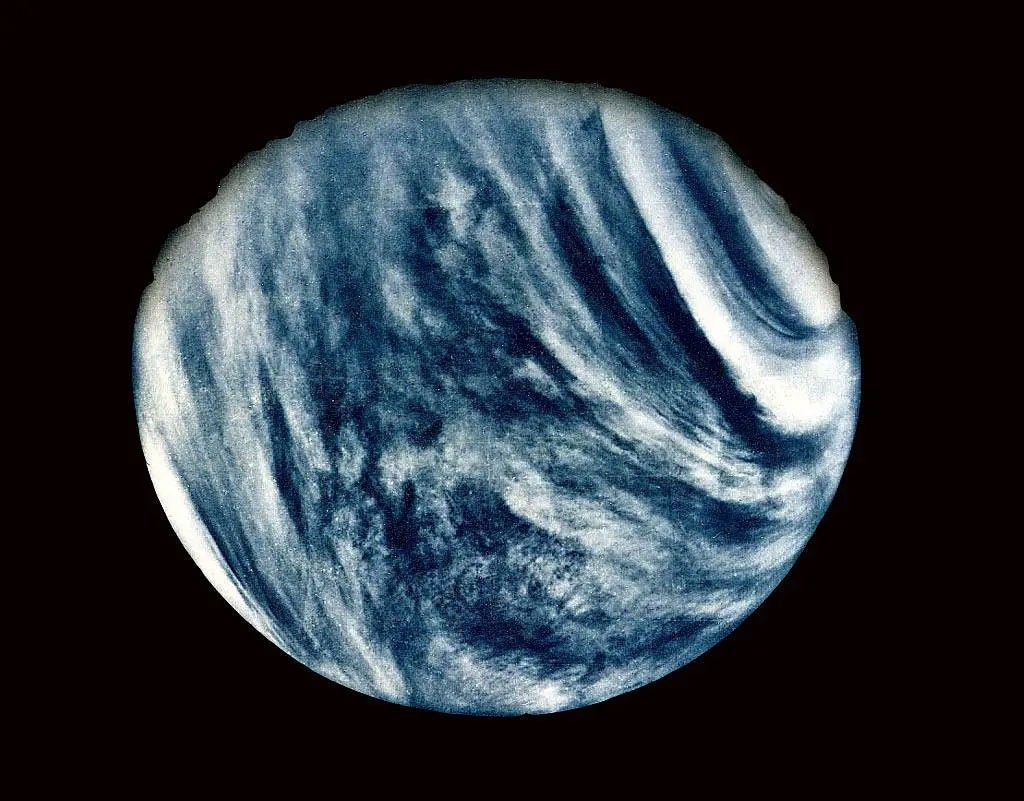
The challenge is that Venus’s surface is utterly hostile: 90 bars of CO₂ pressure and temperatures of 735 K (see surface geology). Previous terraforming proposals have focused on removing this atmosphere, which requires extreme amounts of energy or mass transport.
What is the novelty here?
Howe proposes utilizing the existing atmospheric conditions for support. The core insight is that at ~50 km altitude, Venus’s temperature and pressure are already Earth-like. By building a sealed floating surface at this altitude, a habitable environment can be engineered above it without needing to remove the lower atmosphere.
The key advantages claimed include:
- In-situ resource utilization: The surface structure is built from atmospheric carbon (extracted from CO₂), and nitrogen (3.5 bars available) serves as the lifting gas.
- No mass export required: Unlike proposals that require exporting Venus’s atmosphere to space, this method leaves the CO₂ in place below the surface.
- Comparable timeline: The project could theoretically be completed in ~200 years, similar to other terraforming proposals but with significantly lower resource costs.
Theoretical Framework & Methodology
This is a theoretical engineering proposal without experimental validation. The analysis relies on:
- Atmospheric modeling: Using known Venusian atmospheric composition and pressure gradients to calculate buoyancy and structural requirements.
- Energy budget calculations: Estimating the energy required for CO₂ electrolysis and nitrogen separation using thermodynamic principles.
- Materials analysis: Proposing carbon nanostructures based on existing laboratory-scale synthesis methods, extrapolated to industrial scales.
- Comparative analysis: Evaluating this approach against previous terraforming proposals (Sagan 1961, Adelman 1982, Birch 1991, Landis 2011) to demonstrate efficiency advantages.
What outcomes/conclusions?
The paper concludes that the Cloud Continent approach is theoretically feasible and more efficient than atmosphere-removal methods:
- Timeline: ~200 years for completion (comparable to other proposals)
- Energy efficiency: Works with existing atmospheric pressure gradient
- Resource efficiency: Uses in-situ resources (carbon and nitrogen from Venus’s atmosphere)
- Key limitation: Requires industrial-scale carbon nanostructure production (currently only achievable at laboratory scales)
- Water requirement: Significant water import needed (~$2.30 x10^{17}$ kg), as Venus lost most of its primordial water (see evolutionary history), with Mars identified as the optimal source
Engineering Logistics & Macro-Architecture
Critique of Previous Proposals
Howe reviews past terraforming methods to contextualize the efficiency of the Cloud Continent approach:
| Proposal | Method | Key Problem |
|---|---|---|
| Sagan (1961) | Seed clouds with algae to convert CO₂ | Venus is too dry; would produce tens of bars of O₂ requiring removal |
| Adelman (1982) | Asteroid impacts to strip atmosphere | Requires impactor mass exceeding the atmosphere ($> 5 x10^{20}$ kg) |
| Birch (1991) | Sunshade to freeze and bury atmosphere | Requires importing water equivalent to dismantling Enceladus |
| Landis (2011) | Floating cloud cities | Howe argues this should be expanded to a continuous planetary surface |
The Two-Phase Construction Model
The proposal involves two construction phases using locally sourced carbon and nitrogen.

Phase 1: The Shell (Sealing the Atmosphere)
The first phase creates a planetary-scale seal at ~50 km altitude to separate the hostile lower atmosphere from the habitable upper region.
- Structure: Interlocking hexagonal tiles, approximately 100 meters wide.
- Quantity: ~$7.2 x10^{10}$ tiles required to cover Venus’s surface area.
- Dynamics: Flexible joints are needed to accommodate zonal wind shears of 40-60 m/s at this altitude.
- Maintenance: Tears must be repaired quickly. A 1 km² tear would leak CO₂ at a rate of $8.04 x10^{11}$ kg/day, raising the CO₂ concentration in the habitable atmosphere by 0.101 ppm/day.
Phase 2: The Honeycomb (Floating Landmasses)
Once the surface is sealed, a “honeycomb” structure several kilometers high is built on top to provide buoyancy and support for habitable land.
- Height: Approximately 6.86 km.
- Material: Carbon nanotubes or aggregated diamond nanorods, synthesized from atmospheric carbon via CO₂ electrolysis. The author uses the density of diamond as a worst-case scenario for calculating structural mass, determining the fill fraction required to withstand compressive loads.
- Lifting Gas: N₂ (nitrogen), extracted from Venus’s atmosphere (3.5 bars available).
- Buoyancy Mechanism: The honeycomb cells are filled with N₂ and displace the heavier CO₂ outside the structure. The structure is built in discrete layers, with each layer pressurized to the ambient external pressure to prevent destructive pressure differentials.
- Load Capacity: A “Standard” design consumes 0.32 bar of CO₂ for construction and provides a net lift of 7,440 kg/m² (after accounting for structural mass and lifting gas), sufficient for soil, infrastructure, and cities.
Design Variations
Howe provides three distinct design models to offer engineering flexibility:
- Standard: Uses all available atmospheric nitrogen for lift to maximize load capacity.
- Heavy: Uses extra processed oxygen as a lifting gas, allowing the entire honeycomb to be filled with breathable air. This internal pressurization significantly reduces the compressive stress on the structure from 10.8 GPa to approximately 5.5 GPa.
- Light: Provides the bare minimum lift needed to support a viable biosphere, requiring significantly less column height (3700 m vs 6860 m).
The Terraformed Environment
Once the surface is built, the environment above the shell is engineered to resemble Earth.
Atmosphere
A breathable nitrogen-oxygen atmosphere is created above the surface. Oxygen is a byproduct of the CO₂ electrolysis used to extract carbon for construction.
Temperature Control
The project targets a surface Bond albedo of 0.62 to achieve Earth-like equilibrium temperatures. Counter-intuitively, Venus’s current high albedo (0.76) means its radiative equilibrium temperature is actually lower than Earth’s. To match Earth’s temperature, the planet needs to absorb more solar energy, requiring the albedo to be lowered.
However, a standard Earth-like biological surface typically has a much lower albedo (~0.30), which would extend too far in the other direction (absorbing too much heat). To balance these factors and maintain the exact 0.62 target, roughly half the artificial surface must be covered with highly reflective mirrors.
Heat Balance
A critical challenge is that the honeycomb structure physically cuts off convection in the top several kilometers of the atmosphere. This sealing effect prevents solar heating from reaching the lower atmosphere, which could cause it to cool, contract, and lose the pressure required to support the shell. Howe proposes installing “windows” of transparent material throughout the surface to allow sufficient sunlight to penetrate and maintain the lower atmosphere’s thermal balance. These windows dictate the physical geography of the floating world: the massive floating landmasses (the continents) literally cannot be built over these windows.
Day/Night Cycle
Venus rotates extremely slowly (117 Earth days per solar day at the surface). However, the floating crust would move with the super-rotating atmosphere (~50 m/s at 50 km altitude), resulting in a day/night cycle of approximately 9 Earth days.
Topography
Hills and valleys can be sculpted by varying the height of the honeycomb structure, allowing for diverse landscapes.
Resource and Energy Requirements
The project relies heavily on in-situ resource utilization (ISRU), requiring external imports only for water.
Energy Budget
| Process | Energy Requirement | Time (using all solar flux at 20% efficiency) |
|---|---|---|
| CO₂ Electrolysis (carbon + oxygen) | $3.33 x10^{10}$ J/m² | ~30 years |
| Nitrogen Separation | $\sim2 x10^{11}$ J/m² | ~170 years |
Nitrogen separation is the primary energy sink. The proposal suggests a condenser running at the sublimation point of CO₂ (195 K). While this temperature occurs at the 1-bar level (~50 km), the author notes that to increase efficiency (to a COP of ~3), the condenser should be positioned higher in the atmosphere at an altitude of ~75 km where temperatures naturally drop to these levels.
Regolith and Soil
Creating arable land requires more than just the structure. The paper specifies that 1,500 kg/m² of regolith must be mined from the Venusian surface and mechanically lifted 50 km to the floating continent. This massive logistical undertaking represents a significant energy cost of approximately 665 MJ/m².
The Water Problem
Venus is extremely dry (~20 ppm water vapor). Arable land requires significant water imports.
- Requirement: $2.30 x10^{17}$ kg of water (equivalent to a layer of 500 kg/m²).
- Earth: Rejected due to high energy cost for export and the environmental impact of the necessary massive launch infrastructure.
- Ceres: Has water but lacks the angular momentum to support a space elevator for export. Exporting mass via a tether would transfer angular momentum to the payload, slowing Ceres’s rotation to a standstill before the necessary water volume could be transferred.
- Mars: The optimal source. Water can be exported via space elevator with lower energy cost than from Earth (12.58 MJ/kg). Energy is only required to lift the payload to synchronous orbit; beyond that, centrifugal forces derived from the planet’s rotation accelerate the payload outward. The tether tip velocity of 3,810 m/s induces tensile stresses of 25-35 GPa, which is high but within the same theoretical limits of the carbon nanotubes required for the Venusian honeycomb itself. Delivery can occur gradually after the surface is constructed.
Feasibility Assessment
Timeline
In a best-case scenario (energy-limited), the project could be completed in approximately 200 years. However, this timeline essentially requires building a planetary-scale solar capture array (a localized Dyson swarm or total planetary surface coverage). It utilizes all of the solar energy falling on Venus at a 20% efficiency rate, which highlights that while the materials (carbon nanotubes) might be a solvable industrial scaling problem, the energy capture borders on Kardashev Type I civilization requirements.
Parallel Colonization
Habitation can begin during the 200-year construction phase. Howe suggests that “conventional” aerostat colonies (floating habitat domes) can be established immediately. As the atmosphere remains unbreathable during this initial phase, these early habitat domes would be built on small floating islands and rely on helium for initial lift. These would utilize the exact same aerostat tiles intended for the final shell. Connecting these tiles allows for much larger enclosed volumes compared to simple free-floating balloons. This creates a phased approach where a growing population oversees the terraforming process.
Technical Challenges
- Materials Science: Requires industrial-scale production of carbon nanostructures. The base of the 6.86 km honeycomb endures 3.002 bar of pressure, resulting in a compressive stress of 10.8 GPa on load-bearing walls. While extreme, this is well within the theoretical limit of diamond nanorods (compressive strength ~250 GPa), turning this from a sci-fi dream into a solvable materials science problem.
- Maintenance: The floating surface requires continuous monitoring and repair to maintain atmospheric separation.
- Coordination: A project of this scale requires unprecedented levels of interplanetary coordination and sustained effort over centuries.
Key Advantage
The method offers efficiency advantages over atmosphere-removal approaches by working with the existing pressure gradient. While the dense CO₂ atmosphere below provides the medium, the captured nitrogen gas within the honeycomb structure acts as the active lifting mechanism, displacing the heavier carbon dioxide to keep the habitable layer aloft.
By The Numbers
A summary of the sheer scale required for the Cloud Continent proposal:
| Metric | Value | Note |
|---|---|---|
| Tile Count | $7.2 x10^{10}$ | Hexagonal tiles needed to seal the planet |
| Water Import | $2.3 x10^5 \text{ km}^3$ | Total volume imported from Mars (cube 61.3 km on a side) |
| Mars Energy | ~22 years | Time to export using total solar flux at 20% efficiency |
| Load Bearing | 7,440 kg/m² | Net lifting capacity for the standard design |
| Regolith Lift | 1,500 kg/m² | Surface rock lifted 50 km for soil creation |
| Structure Stress | 10.8 GPa | Compressive stress on standard design walls |
Paper Information
Citation: Howe, A. R. (2022). Cloud Continents: Terraforming Venus Efficiently by Means of a Floating Artificial Surface. arXiv preprint arXiv:2203.06722. https://doi.org/10.48550/arXiv.2203.06722
Publication: arXiv 2022
@article{howe2022cloud,
  title={Cloud Continents: Terraforming Venus Efficiently by Means of a Floating Artificial Surface},
  author={Howe, Alex R},
  journal={arXiv preprint arXiv:2203.06722},
  year={2022}
}