What kind of paper is this?
This is a Method paper. It proposes a novel neural architecture that modifies how bill embeddings are constructed by explicitly incorporating sponsor metadata alongside text. The authors validate this method by comparing it against state-of-the-art baselines (MWE and CNN text-only models) and demonstrating superior performance in a newly defined “out-of-session” evaluation setting.
What is the motivation?
Existing models for predicting legislative roll-call votes rely heavily on text or voting history within a single session. However, these models fail to generalize across sessions because the underlying data generation process changes. Specifically, the ideological position of bills on similar topics shifts depending on which party is in power. A model trained on a single session learns an implicit ideological prior that becomes inaccurate when the political context changes in subsequent sessions.
What is the novelty here?
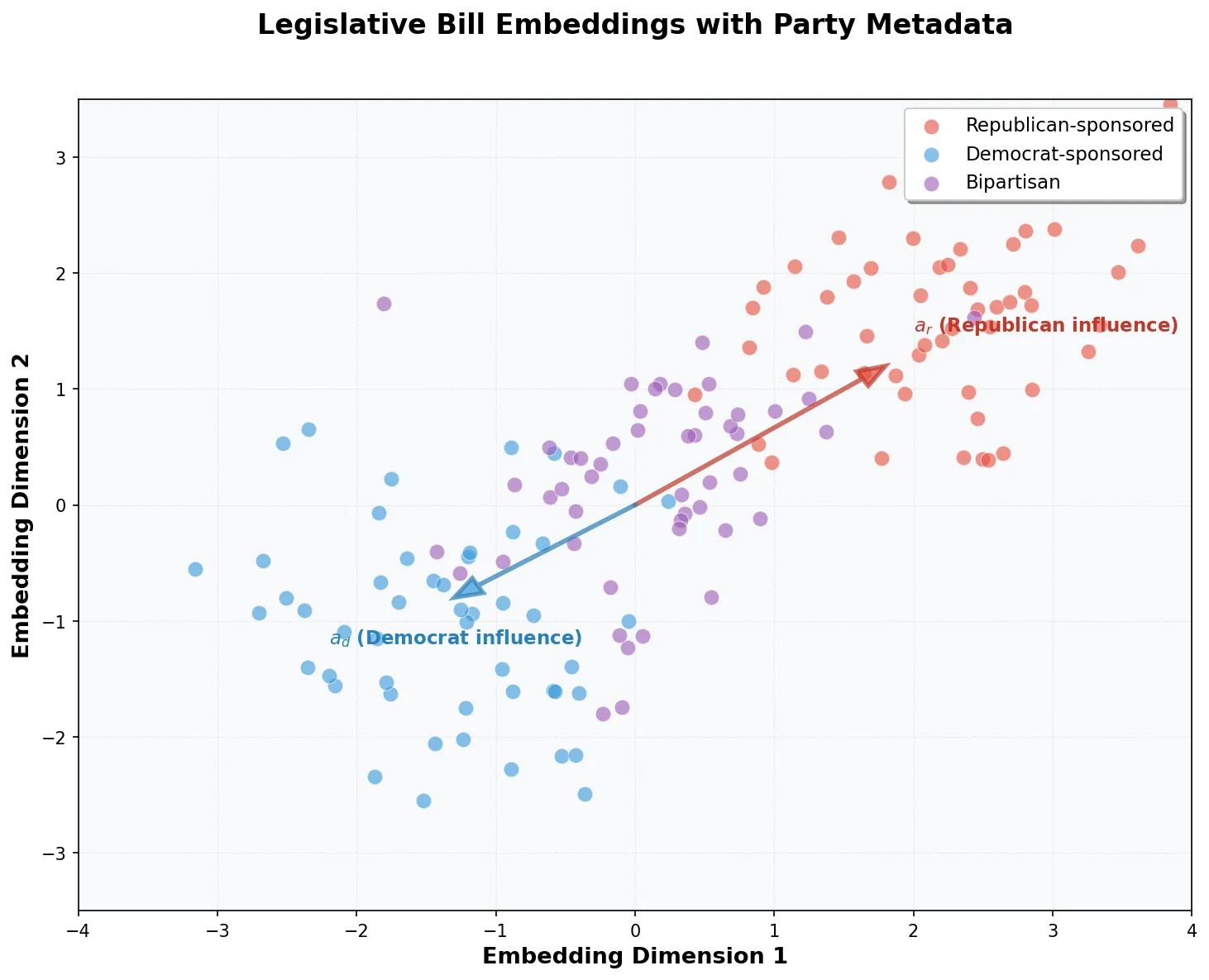
The core novelty is a neural architecture that augments bill text representations with sponsor ideology, specifically the percentage of Republican vs. Democrat sponsors.
- Sponsor-Weighted Embeddings: They compute a composite embedding where the text representation is weighted by party sponsorship percentages ($p_{r}, p_{d}$) and party-specific influence vectors ($a_{r}, a_{d}$).
- Out-of-Session Evaluation: They introduce a rigorous evaluation setting where models trained on past sessions (e.g., 2005-2012) are tested on future sessions (e.g., 2013-2014) to test generalization, which previous work had ignored.
What experiments were performed?
The authors evaluated their models using a dataset of U.S. Congressional bills from 2005 to 2016.
- Models Tested: They compared text-only models (MWE, CNN) against metadata-augmented versions (MWE+Meta, CNN+Meta) and a “Meta-Only” baseline (using dummy text).
- Settings:
- In-Session: 5-fold cross-validation on 2005-2012 data.
- Out-of-Session: Training on 2005-2012 and testing on 2013-2014 and 2015-2016.
- Baselines: Comparisons included a “Guess Yes” baseline and an SVM trained on bag-of-words summaries with sponsor indicators.
What outcomes/conclusions?
- Metadata is Critical: Augmenting text with sponsor metadata consistently outperformed text-only models. The
CNN+Metamodel achieved the highest accuracy in most settings (e.g., 86.21% in-session vs 83.24% for CNN). - Generalization: Text-only models degraded significantly in out-of-session testing (dropping from ~83% to ~77% or lower), confirming that text alone fails to capture shifting ideological contexts.
- Sponsor Signal: The
Meta-Onlymodel (using no text) outperformed text-only models in the 2013-2014 out-of-session test, suggesting that in some contexts, the author’s identity provides a stronger predictive signal than the bill’s content. - Performance Boost: The proposed architecture achieved an average 4% accuracy boost over the previous state-of-the-art.
Reproducibility Details
Data
- Source: Collected from GovTrack, covering the 106th to 111th Congressional sessions.
- Content: Non-unanimous roll call votes, full text of bills/resolutions, and Congressional Research Service (CRS) summaries.
- Filtering: Bills with unanimous votes (defined as <1% “no” votes) were excluded.
- Preprocessing:
- Text lowercased and stop-words removed.
- Summaries truncated to $N=400$ words; full text truncated to $N=2000$ words (80th percentile lengths).
- Splits:
- Training: Sessions 2005-2012 (1718 bills).
- Testing: Sessions 2013-2014 (360 bills) and 2015-2016 (382 bills).
Algorithms
- Bill Representation ($v_{B}$): $$v_{B}=((a_{r}p_{r})\cdot T_{r})+((a_{d}p_{d})\cdot T_{d})$$ Where $T$ is the text embedding (CNN or MWE), $p$ is the percentage of sponsors from a party, and $a$ is a learnable party influence vector.
- Vote Prediction:
- Project bill embedding to legislator space: $v_{BL}=W_{B}v_{B}+b_{B}$.
- Alignment score: $W_{v}(v_{BL}\odot v_{L})+b_{v}$ (using element-wise multiplication).
- Output: Sigmoid activation.
- Optimization: AdaMax algorithm with binary cross-entropy loss.
Models
- Text Encoders:
- CNN: 4-grams with 400 filter maps.
- MWE: Mean Word Embedding.
- Embeddings:
- Initialized with 50-dimensional GloVe vectors.
- Embeddings are non-static (updated during training).
- Legislator embedding size ($v_{L}$): 25 dimensions.
- Initialization: Weights initialized with Glorot uniform distribution.
Evaluation
- Metrics: Accuracy.
- Comparison:
- In-session: 5-fold cross-validation.
- Out-of-session: Train on past sessions, predict future sessions.
Hardware
- Training Config: Models trained for 50 epochs with mini-batches of size 50.
Paper Information
Citation: Kornilova, A., Argyle, D., & Eidelman, V. (2018). Party Matters: Enhancing Legislative Embeddings with Author Attributes for Vote Prediction. arXiv preprint arXiv:1805.08182. https://arxiv.org/abs/1805.08182
Publication: arXiv 2018
@misc{kornilovaPartyMattersEnhancing2018,
  title = {Party {{Matters}}: {{Enhancing Legislative Embeddings}} with {{Author Attributes}} for {{Vote Prediction}}},
  shorttitle = {Party {{Matters}}},
  author = {Kornilova, Anastassia and Argyle, Daniel and Eidelman, Vlad},
  year = 2018,
  month = may,
  number = {arXiv:1805.08182},
  eprint = {1805.08182},
  primaryclass = {cs},
  publisher = {arXiv},
  archiveprefix = {arXiv},
}