What kind of paper is this?
This is a Theory paper. It relies entirely on formal mathematical derivation to establish existence and uniqueness properties for energy functionals. It introduces a new mathematical structure (displacement interpolation) to analyze the geometry of probability measures.
What is the motivation?
The paper addresses the uniqueness of stationary configurations (ground states) for a gas model where particles interact via attractive forces while resisting compression.
The total energy functional $E(\rho)$ includes an interaction term $G(\rho)$ that lacks convexity under standard linear interpolation ($(1-t)\rho + t\rho’$), making it difficult to prove that a unique minimizer exists. Standard convexity tools and rearrangement inequalities are also insufficient for cases without specific symmetries (like spherical symmetry) or when convexity of the potential fails.
What is the novelty here?
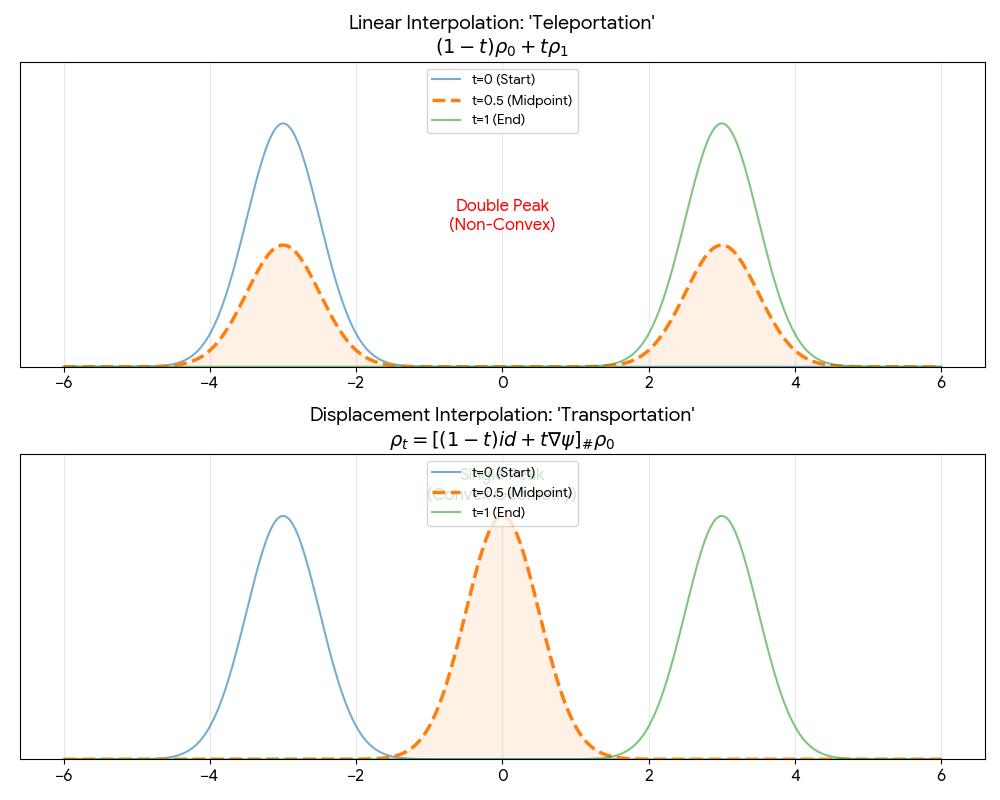
The core novelty is the introduction of Displacement Interpolation.
- New Interpolant: The paper defines an interpolant $\rho_t$ by moving mass along the gradient of a convex potential $\psi$ (transport map).
- Displacement Convexity: It proves that the internal energy $U(\rho)$ and potential energy $G(\rho)$ become convex functions of $t$ along this displacement path. This is a property specific to displacement interpolation.
- Generalization: This framework generalizes the classical Brunn-Minkowski inequality from sets to measures.
Theoretical Framework
Mathematical Setup
Probability Measures
The gas state is represented by absolutely continuous probability measures $\rho \in \mathcal{P}_{ac}(\mathbb{R}^d)$ with finite second moments.
Energy Functional
The gas model is defined by the total energy functional $E(\rho)$: $$E(\rho) := \underbrace{\int_{\mathbb{R}^d} A(\rho(x))dx}_{\text{Internal Energy } U(\rho)} + \underbrace{\frac{1}{2} \iint d\rho(x)V(x-y)d\rho(y)}_{\text{Potential Energy } G(\rho)}$$
Key Construction: Displacement Interpolation
The core theoretical tool is the construction of the interpolant $\rho_t$ between two probability measures $\rho$ and $\rho’$:
- Transport Map: By Brenier’s theorem, there exists a convex function $\psi$ such that $\nabla\psi_{#}\rho = \rho’$ (push-forward).
- Interpolation: The interpolant at time $t \in [0,1]$ is defined as the push-forward of $\rho$ under the linear interpolation of the identity and the transport map: $$\rho_t := [(1-t)\text{id} + t\nabla\psi]_{#}\rho$$
This is the “displacement interpolation” where mass moves along straight lines from initial to final positions.
Assumptions for Uniqueness
The main existence and uniqueness theorem (Theorem 3.1) requires one condition on the interaction potential, two conditions on the equation of state, and one regularity condition:
- Interaction: $V(x)$ is strictly convex.
- (P1) Equation of State: $P(\rho) / \rho^{(d-1)/d}$ is non-decreasing. This is equivalent to convexity of $U$ under mass-preserving dilations, and is satisfied by polytropic gases $P(\rho) = \rho^q$ with $q > 1$.
- (P2) Growth Condition: $P(\rho) \cdot \rho^{-2}$ is not integrable at $\infty$. This ensures the energy minimizer has no singular part with respect to Lebesgue measure.
- Regularity: $\rho \in \mathcal{P}_{ac}(\mathbb{R}^d)$ (absolutely continuous probability measures).
Main Results
Theorem 2.2 (Displacement Convexity of Internal Energy): Under condition (A1) (that $\lambda^d A(\lambda^{-d})$ is convex non-increasing on $(0, \infty)$ with $A(0) = 0$, ensuring internal energy decreases as the gas dilates), the internal energy $U(\rho)$ is convex along displacement interpolation paths. Strict convexity follows unless $\nabla^2\psi(x) = I$ holds $\rho$-a.e., i.e., $\rho’$ is a translate of $\rho$.
Theorem 3.1 (Existence and Uniqueness of Ground State): For any equation of state satisfying (P1) and (P2) with a strictly convex interaction potential $V$, the total energy $E(\rho)$ attains a unique minimizer up to translation. The minimizer can be taken to be even, meaning $\rho_g(x) = \rho_g(-x)$.
Theorem 3.3 (Uniqueness for Spherically Symmetric Potentials): When the strict convexity of $V(x)$ is relaxed to spherical symmetry (with $V$ not constant), uniqueness up to translation still holds provided (P1) holds strictly. This extends the main result to cases like Coulomb-type interactions.
Lemma 3.2: A decomposition lemma for convex functions. Let $\psi$ and $\phi$ be convex on $\mathbb{R}^d$, and let $\Omega \subset \mathbb{R}^d$ be an open convex set on which both are finite. Suppose $\phi$ is differentiable on $\Omega$ with a locally Lipschitz gradient. If their Aleksandrov second derivatives agree almost everywhere on $\Omega$, then $\psi - \phi$ is convex on $\Omega$. This underpins the proof of Theorem 3.3.
What experiments were performed?
The validation consists entirely of rigorous mathematical proofs:
- Convexity Proofs: Deriving inequalities to show $E(\rho_t) \le (1-t)E(\rho) + tE(\rho’)$.
- Existence/Uniqueness: Using the new convexity principle to prove that the energy minimizer is unique up to translation.
What outcomes/conclusions?
- Uniqueness of Ground State: For equations of state satisfying specific monotonicity conditions (e.g., polytropic gases), the energy minimizing state is unique up to translation.
- Brunn-Minkowski Extension: The internal energy convexity implies the Brunn-Minkowski inequality as a special case ($A(\rho) = -\rho^{(d-1)/d}$).
- Norm Concavity: The functional $|\rho_t|_q^{-p/d}$ is shown to be concave along the interpolation path for conjugate $p, q$ with $q \geq (d-1)/d$.
Relevance to Machine Learning
This 1997 paper establishes the mathematical foundations of displacement convexity in optimal transport theory, which underpins several modern generative modeling techniques. The displacement interpolation framework introduced here is used in:
- Flow Matching: Uses optimal transport probability paths (straight-line interpolations with constant speed) to generate samples. See the Flow Matching note for details on how OT paths differ from diffusion paths.
- Wasserstein GANs: Use the Wasserstein distance (optimal transport metric) for training stability.
- Continuous Normalizing Flows: Use OT-inspired transport maps for probability density transformation.
McCann’s convexity principle proves that energy functionals become convex along displacement paths, a mathematical structure that underpins the geometry used in flow matching and optimal transport-based generative modeling.
Paper Information
Citation: McCann, R. J. (1997). A Convexity Principle for Interacting Gases. Advances in Mathematics, 128(1), 153-179. https://doi.org/10.1006/aima.1997.1634
Publication: Advances in Mathematics 1997
@article{mccannConvexityPrincipleInteracting1997,
  title = {A {{Convexity Principle}} for {{Interacting Gases}}},
  author = {McCann, Robert J.},
  year = 1997,
  month = jun,
  journal = {Advances in Mathematics},
  volume = {128},
  number = {1},
  pages = {153--179},
  issn = {00018708},
  doi = {10.1006/aima.1997.1634},
  urldate = {2025-12-21}
}