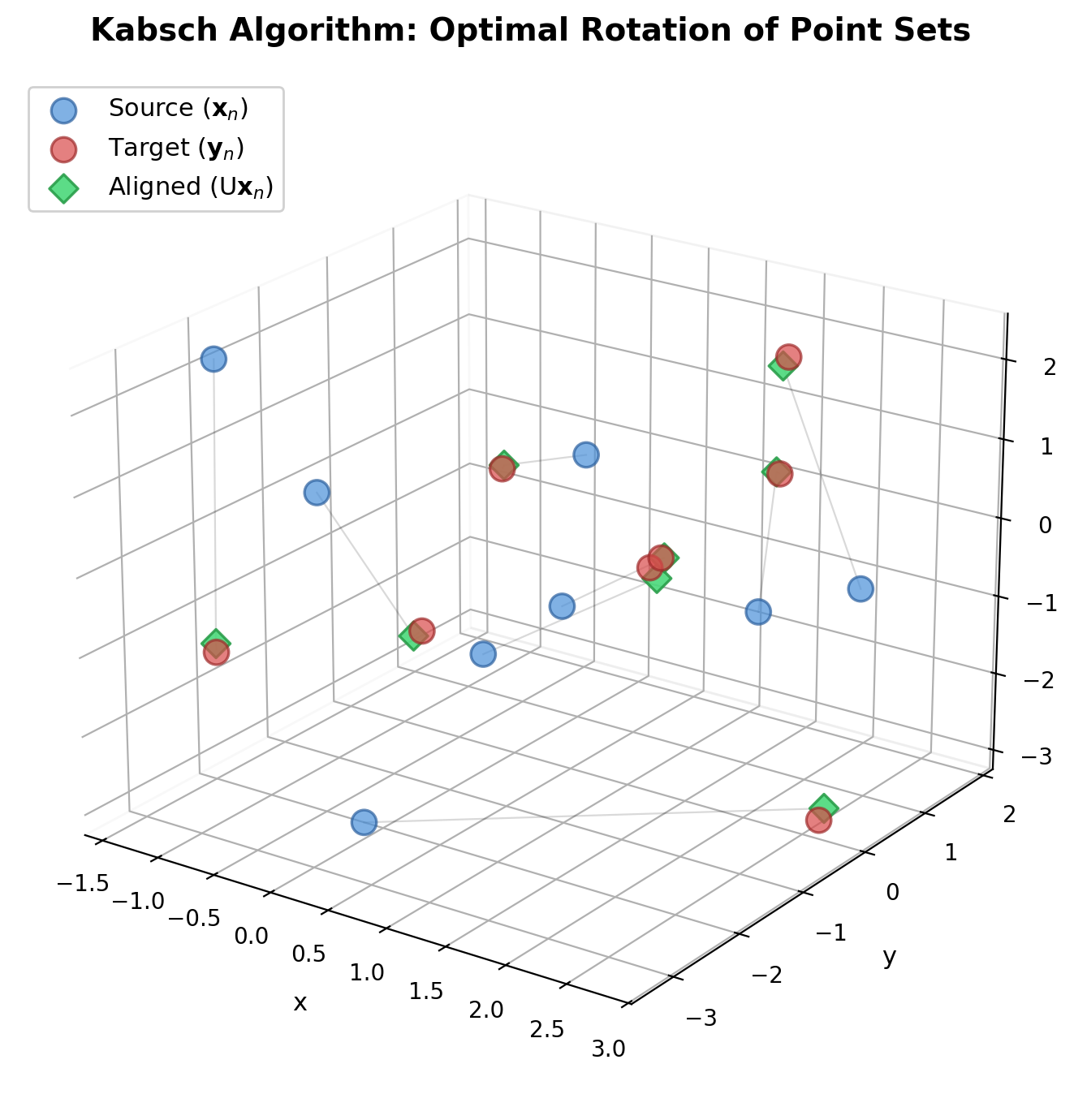
A Closed-Form Solution for Optimal Rotation
This short communication presents a Method paper: a direct, analytical solution to a constrained optimization problem. Given two sets of vectors, Kabsch derives the orthogonal matrix (rotation) that best superimposes one set onto the other by minimizing a weighted sum of squared deviations. Prior approaches either solved an unconstrained problem and factorized the result (Diamond, 1976) or used iterative methods (McLachlan, 1972). Kabsch shows that a direct, non-iterative solution exists despite the non-linear nature of the orthogonality constraint.
The Superposition Problem
The core problem arises frequently in crystallography and structural biology: given two sets of corresponding points (e.g., atomic coordinates from a known structure and experimentally measured coordinates), find the rigid rotation that best aligns them. Translations can be removed by centering both point sets at the origin, leaving only the rotational component.
Formally, given vector sets $\mathbf{x}_n$ and $\mathbf{y}_n$ ($n = 1, 2, \ldots, N$) with weights $w_n$, find the orthogonal matrix $\mathsf{U}$ minimizing:
$$ E = \frac{1}{2} \sum_{n} w_n (\mathsf{U} \mathbf{x}_n - \mathbf{y}_n)^2 $$
subject to orthogonality: $\tilde{\mathsf{U}} \mathsf{U} = \mathsf{I}$.
Derivation via Lagrange Multipliers
Kabsch introduces a symmetric matrix $\mathsf{L}$ of Lagrange multipliers to enforce orthogonality, forming the Lagrangian:
$$ G = E + \frac{1}{2} \sum_{i,j} l_{ij} \left( \sum_{k} u_{ki} u_{kj} - \delta_{ij} \right) $$
Setting $\partial G / \partial u_{ij} = 0$ and defining two key matrices:
$$ r_{ij} = \sum_{n} w_n , y_{ni} , x_{nj} \qquad s_{ij} = \sum_{n} w_n , x_{ni} , x_{nj} $$
where $\mathsf{R} = (r_{ij})$ is the weighted cross-covariance matrix and $\mathsf{S} = (s_{ij})$ is the weighted auto-covariance matrix, the stationarity condition becomes:
$$ \mathsf{U} \cdot (\mathsf{S} + \mathsf{L}) = \mathsf{R} $$
Eigendecomposition Solution
The key insight is that multiplying both sides by their transposes eliminates the unknown $\mathsf{U}$:
$$ (\mathsf{S} + \mathsf{L})(\mathsf{S} + \mathsf{L}) = \tilde{\mathsf{R}} \mathsf{R} $$
Since $\tilde{\mathsf{R}} \mathsf{R}$ is symmetric positive definite, it has positive eigenvalues $\mu_k$ and eigenvectors $\mathbf{a}_k$. The matrix $\mathsf{S} + \mathsf{L}$ shares the same eigenvectors with eigenvalues $\sqrt{\mu_k}$.
From the eigenvectors $\mathbf{a}_k$, a second set of unit vectors $\mathbf{b}_k$ is defined:
$$ \mathbf{b}_k = \frac{1}{\sqrt{\mu_k}} \mathsf{R} , \mathbf{a}_k $$
The optimal rotation matrix is then constructed directly:
$$ u_{ij} = \sum_{k} b_{ki} , a_{kj} $$
Handling Degeneracies and Generalizations
Kabsch addresses two extensions:
Planar point sets: When all vectors lie in a plane, one eigenvalue of $\tilde{\mathsf{R}} \mathsf{R}$ is zero. The missing eigenvectors are recovered via cross products: $\mathbf{a}_3 = \mathbf{a}_1 \times \mathbf{a}_2$ and $\mathbf{b}_3 = \mathbf{b}_1 \times \mathbf{b}_2$.
General metric constraints: The orthogonality constraint $\tilde{\mathsf{U}} \mathsf{U} = \mathsf{I}$ can be replaced by $\tilde{\mathsf{U}} \mathsf{U} = \mathsf{M}$ for any symmetric positive definite $\mathsf{M}$. By finding any specific solution $\mathsf{B}$ and transforming the input vectors as $\mathbf{x}’_n = \mathsf{B} \mathbf{x}_n$, the problem reduces back to the standard orthogonal case.
The method generalizes naturally to vector spaces of arbitrary dimension.
Legacy and Impact
This two-page communication became one of the most cited papers in structural biology. The “Kabsch algorithm” (or “Kabsch rotation”) is the standard method for computing the root-mean-square deviation (RMSD) between two molecular structures after optimal superposition. It underpins structure comparison tools across crystallography, NMR spectroscopy, cryo-EM, and computational chemistry.
Paper Information
Citation: Kabsch, W. (1976). A solution for the best rotation to relate two sets of vectors. Acta Crystallographica Section A, 32(5), 922-923. https://doi.org/10.1107/s0567739476001873
Publication: Acta Crystallographica Section A, 1976
Additional Resources:
- Kabsch Algorithm: NumPy, PyTorch, TensorFlow, and JAX (tutorial with differentiable implementations)
@article{kabsch1976solution,
  title={A solution for the best rotation to relate two sets of vectors},
  author={Kabsch, Wolfgang},
  journal={Acta Crystallographica Section A: Crystal Physics, Diffraction, Theoretical and General Crystallography},
  volume={32},
  number={5},
  pages={922--923},
  year={1976},
  publisher={International Union of Crystallography},
  doi={10.1107/s0567739476001873}
}