Paper Information
Citation: Sundaramoorthy, C., Kelvin, L. Z., Sarin, M., & Gupta, S. (2021). End-to-End Attention-based Image Captioning. arXiv preprint arXiv:2104.14721. https://doi.org/10.48550/arXiv.2104.14721
Publication: arXiv 2021 (preprint)
Note: This is an arXiv preprint and has not undergone formal peer review.
Methodological Contribution
This is a Methodological Paper. It proposes a novel architectural approach to molecular image translation by replacing the standard CNN encoder with a Vision Transformer (ViT). The authors validate this method through comparative benchmarking against standard CNN+RNN baselines (e.g., ResNet+LSTM) and provide optimizations for inference speed.
Motivation and Problem Statement
The core problem addressed is existing molecular translation methods (extracting chemical structure from images into computer-readable InChI format) rely heavily on rule-based systems or CNN+RNN architectures. These current approaches often underperform when handling noisy images (common in scanned old journals) or images with few distinguishable features. There is a significant need in drug discovery to digitize and analyze legacy experimental data locked in image format within scientific publications.
Core Innovations: End-to-End ViT Encoder
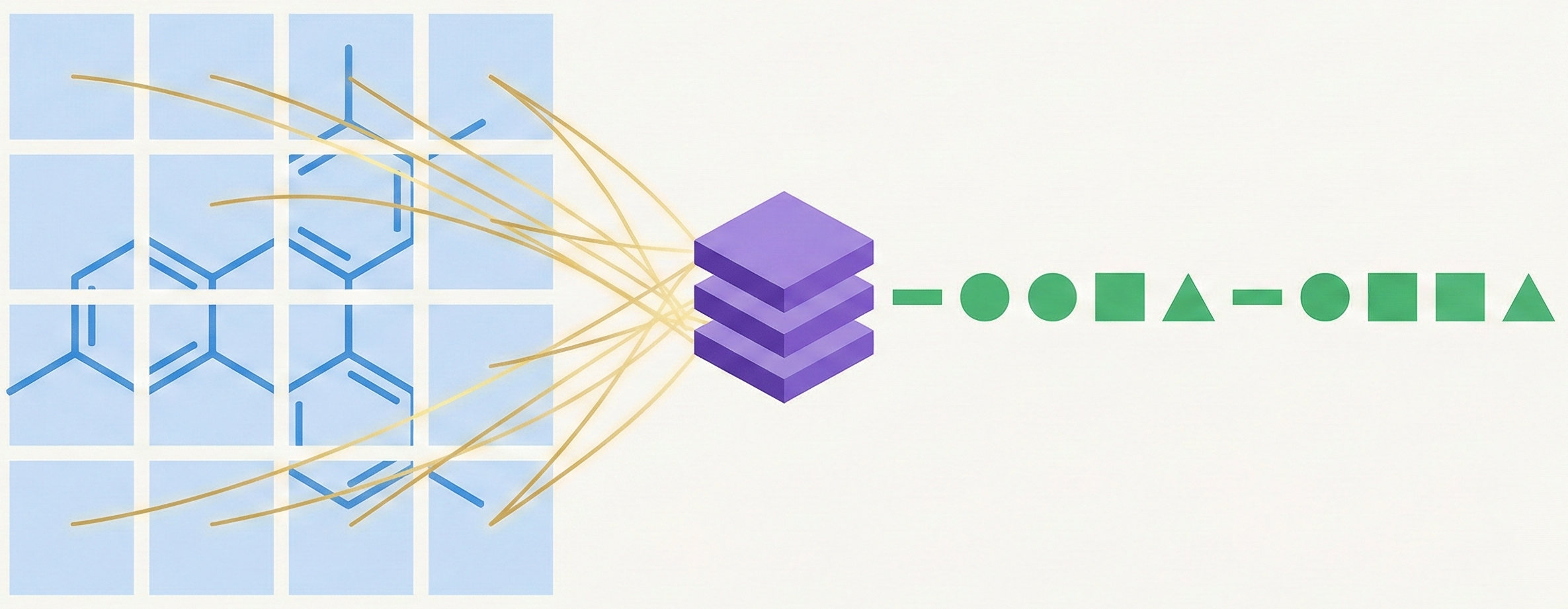
The primary contribution is the use of a completely convolution-free Vision Transformer (ViT) as the encoder, allowing the model to utilize long-range dependencies among image patches from the very beginning via self-attention: $$ \text{Attention}(Q, K, V) = \text{softmax}\left(\frac{QK^T}{\sqrt{d_k}}\right)V $$ The architecture is a pure Transformer (Encoder-Decoder), treating the molecular image similarly to a sequence of tokens (patches). Furthermore, the authors implement a specific caching strategy for the decoder to avoid recomputing embeddings for previously decoded tokens, reducing the time complexity of the decoding step.
Experimental Setup and Baselines
The model was compared against standard CNN + RNN and ResNet (18, 34, 50) + LSTM with attention. Ablation studies were conducted varying the number of transformer layers (3, 6, 12, 24) and image resolution (224x224 vs 384x384). The model trained on a large combined dataset, including Bristol Myers Squibb data, SMILES, GDB-13, and synthetically augmented images containing noise and artifacts. Performance was evaluated using the Levenshtein distance metric, which computes the minimum number of single-character edits to transform the predicted string into the ground truth.
Performance Outcomes and Capabilities
The proposed 24-layer ViT model (input size 384) achieved the lowest Levenshtein distance of 6.95, significantly outperforming the ResNet50+LSTM baseline (7.49) and the standard CNN+RNN (103.7). Increasing the number of layers had a strong positive impact, with the 24-layer model becoming competitive with current approaches. The model demonstrated high robustness on datasets with low distinguishable features and noise. The proposed caching optimization reduced the decoding time complexity per timestep from $O(MN^2 + N^3)$ to $O(MN + N^2)$.
Reproducibility Details
Data
The model was trained on a combined dataset randomly split into 70% training, 10% test, and 20% validation.
| Dataset | Description | Notes |
|---|---|---|
| Bristol Myers Squibb | ~2.4 million synthetic images with InChI labels. | Provided by BMS global biopharmaceutical company. |
| SMILES | Kaggle contest data converted to InChI. | Images generated using RDKit. |
| GDB-13 | Subset of 977 million small organic molecules (up to 13 atoms). | Converted from SMILES using RDKit. |
| Augmented Images | Synthetic images with salt/pepper noise, dropped atoms, and bond modifications. | Used to improve robustness against noise. |
Algorithms
- Training Objective: Cross-entropy loss minimization.
- Inference Decoding: Autoregressive decoding predicting the next character of the InChI string.
- Positional Encoding: Standard sine and cosine functions of different frequencies.
- Optimization:
- Caching: Caches the output of each layer during decoding to avoid recomputing embeddings for already decoded tokens.
- JIT: PyTorch JIT compiler used for graph optimization.
- Self-Critical Training: Finetuning performed using self-critical sequence training (SCST).
Models
- Encoder (Vision Transformer):
- Input: Flattened 2D patches of the image. Patch size: $16 \x16$.
- Projection: Trainable linear projection to latent vector size $D$.
- Structure: Alternating layers of Multi-Head Self-Attention (MHSA) and MLP blocks.
- Decoder (Vanilla Transformer):
- Input: Tokenized InChI string + sinusoidal positional embedding.
- Vocabulary: 275 tokens (including
<SOS>,<PAD>,<EOS>).
- Hyperparameters (Best Model):
- Image Size: $384 \x384$.
- Layers: 24.
- Feature Dimension: 512.
- Attention Heads: 12.
- Optimizer: Adam.
- Learning Rate: $3 \x10^{-5}$ (decayed by 0.5 in last 2 epochs).
- Batch Size: Varied [64-512].
Evaluation
- Primary Metric: Levenshtein Distance (lower is better).
| Model | Image Size | Layers | Levenshtein Dist. |
|---|---|---|---|
| Standard CNN+RNN | 224 | 3 | 103.7 |
| ResNet50 + LSTM | 224 | 5 | 7.49 |
| ViT Transformers (Best) | 384 | 24 | 6.95 |
Hardware
- System: 70GB GPU system.
- Framework: PyTorch and PyTorch Lightning.
Citation
@misc{sundaramoorthyEndtoEndAttentionbasedImage2021,
  title = {End-to-{{End Attention-based Image Captioning}}},
  author = {Sundaramoorthy, Carola and Kelvin, Lin Ziwen and Sarin, Mahak and Gupta, Shubham},
  year = 2021,
  month = apr,
  number = {arXiv:2104.14721},
  eprint = {2104.14721},
  primaryclass = {cs},
  publisher = {arXiv},
  doi = {10.48550/arXiv.2104.14721},
  archiveprefix = {arXiv}
}