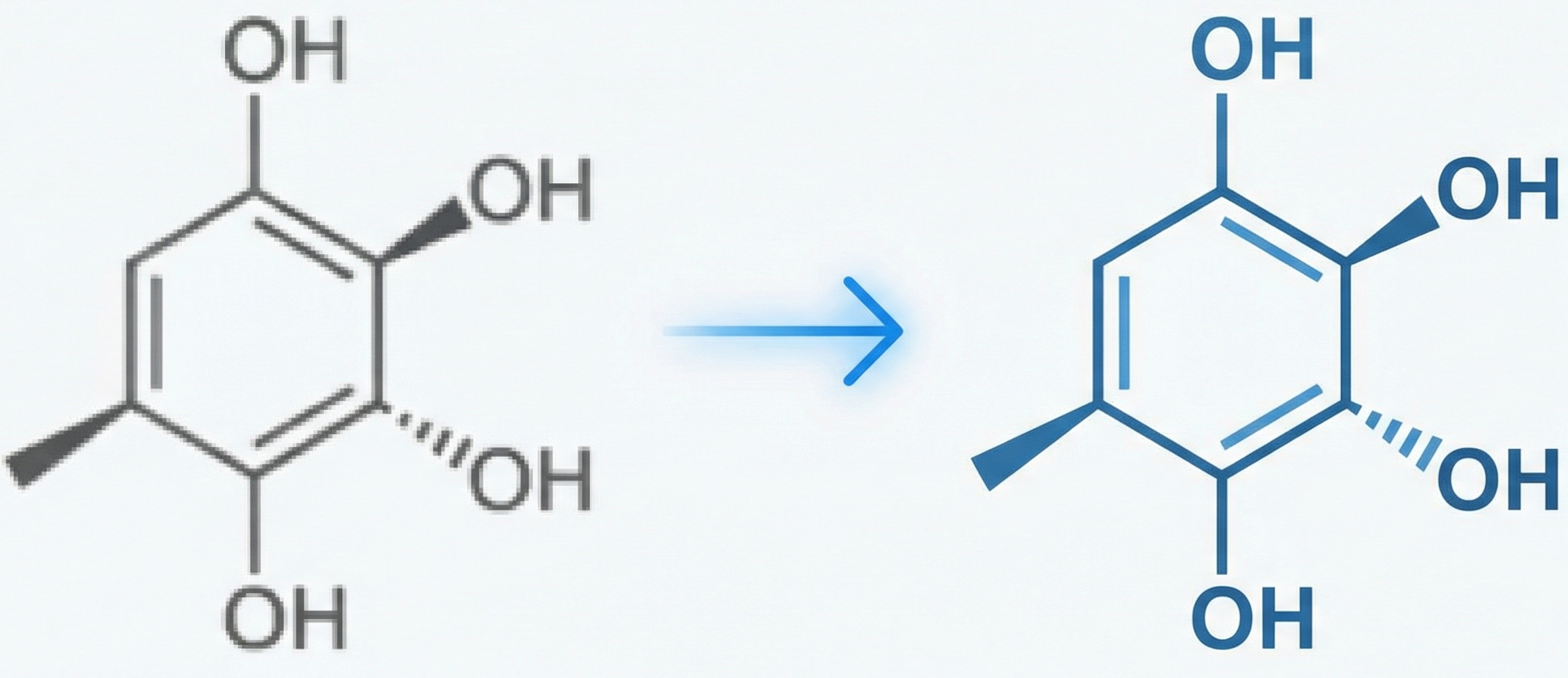
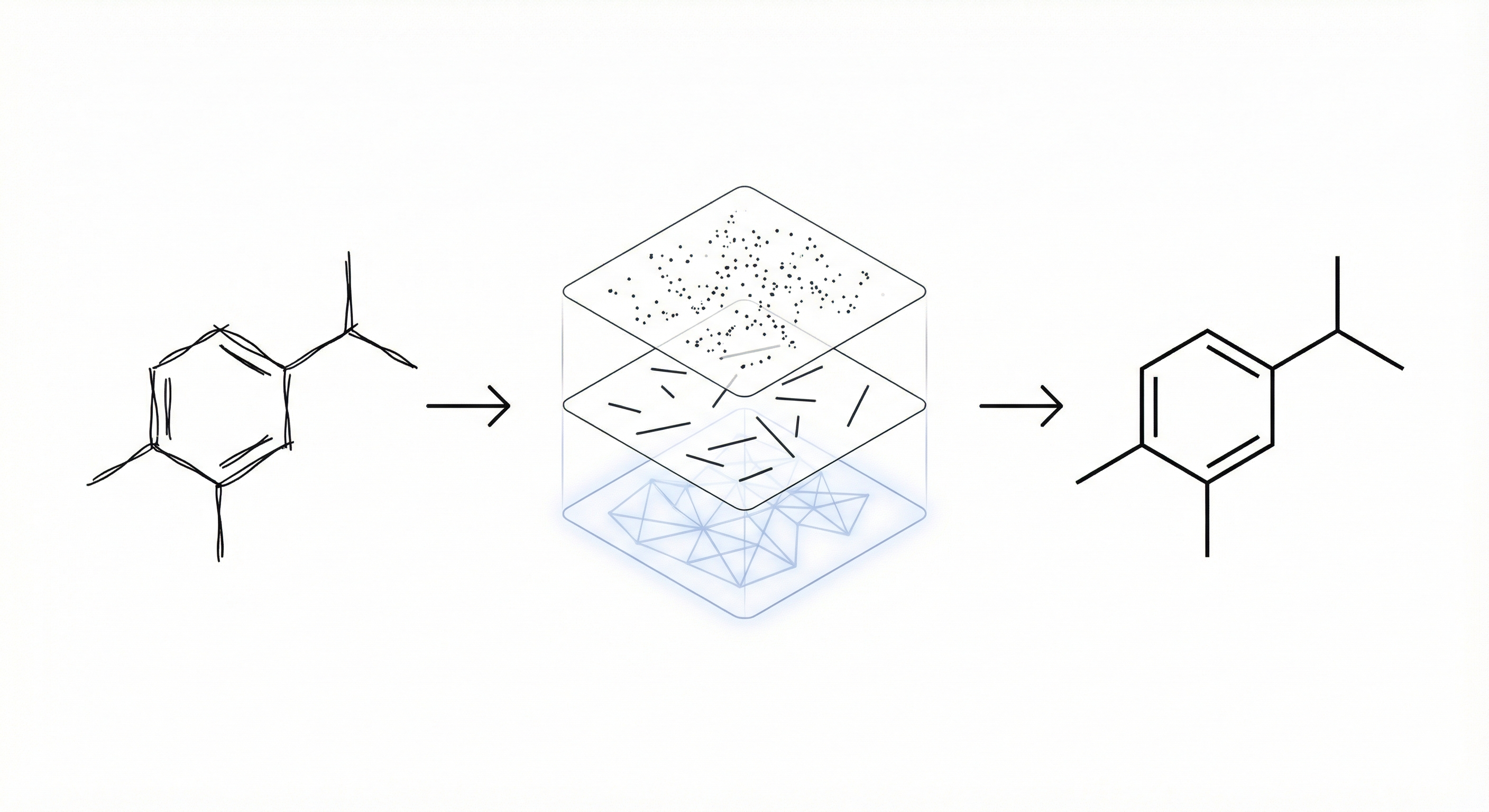
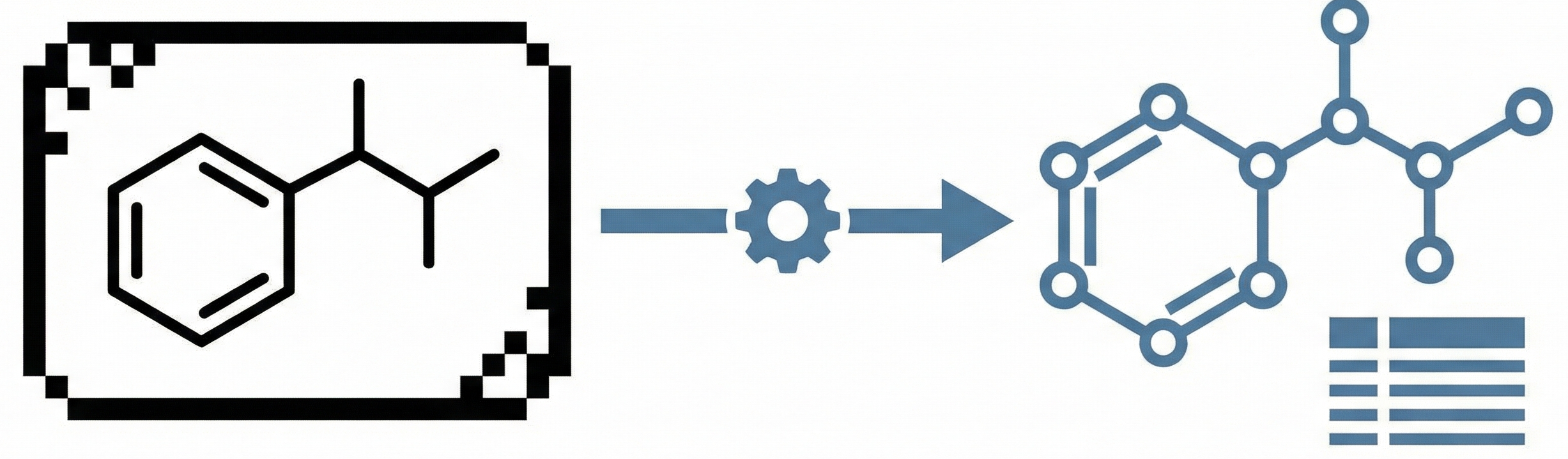
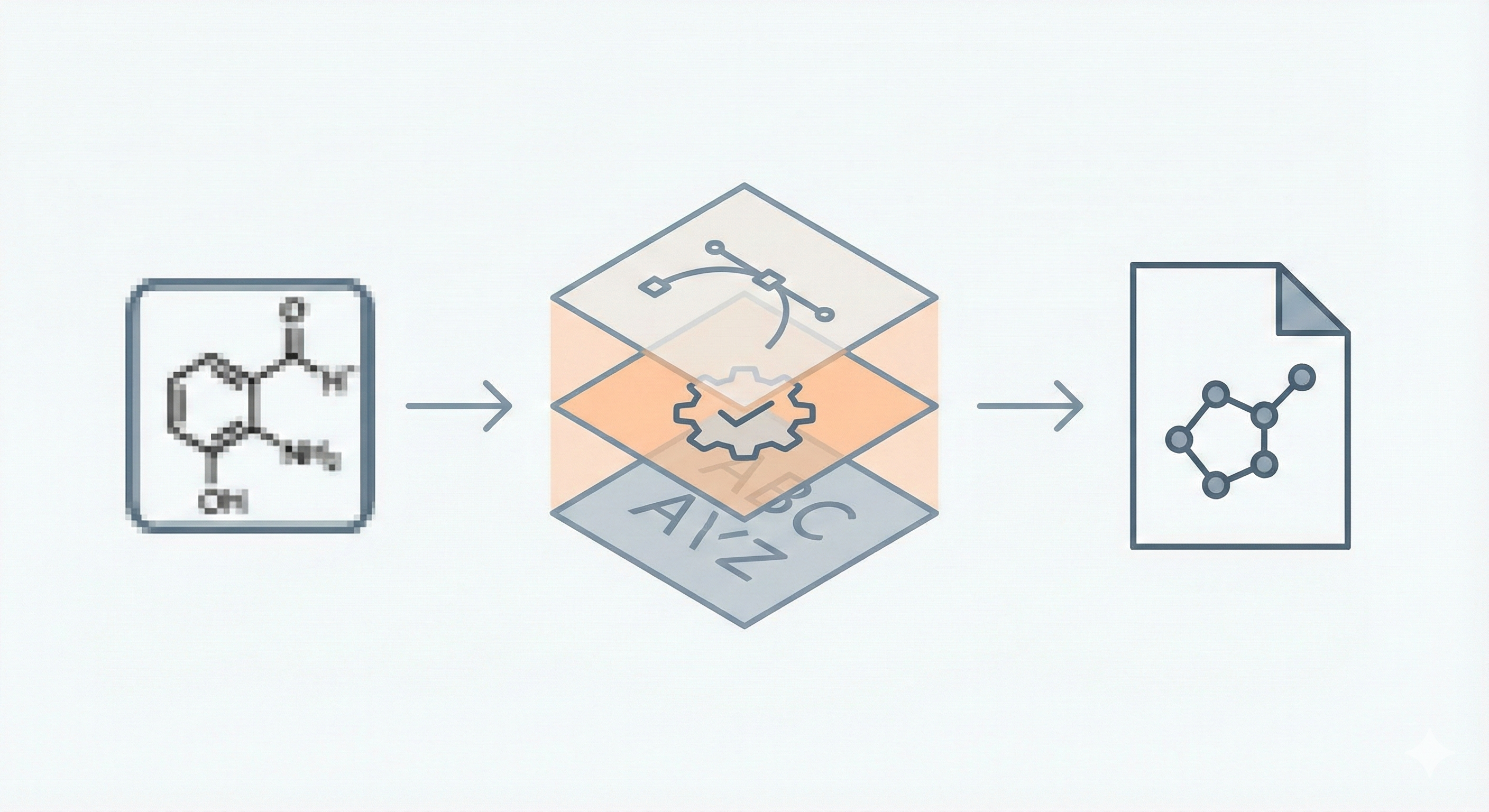
Notes on recognizing molecular structures from images, covering 35 years of methods: from rule-based vectorization to vision-language models.
A substantial fraction of chemical knowledge is recorded as 2D diagrams in journals, patents, and textbooks. Optical Chemical Structure Recognition (OCSR) is the task of extracting machine-readable molecular representations from those images: strings like SMILES (a compact text encoding of molecular structure) and InChI (a standardized identifier for chemical substances), or molecular graphs that encode atoms as nodes and bonds as edges. For a longer introduction to the field and its motivations, see the What is OCSR? post.
These notes trace the field from its origins in the early 1990s through to current vision-language approaches. Three broad eras give the collection its shape. The rule-based pioneers (1990s to mid-2010s), including tools like OSRA, MolVec, CLiDE, and Imago, vectorized images and applied hand-coded rules to classify bonds and atoms; their brittleness came from the difficulty of encoding every edge case explicitly. The deep learning transition (roughly 2015 to 2020) replaced those hand-coded rules with models that learned recognition patterns from large synthetic datasets, yielding both image-to-sequence architectures (DECIMER, Img2Mol, Image2SMILES) and image-to-graph architectures (MolGrapher, MolScribe). The current vision-language era (2021 onward), with models like MolParser, GTR-Mol-VLM, and Subgrapher, builds on large pretrained vision-language models to improve generalization across diverse diagram styles and chemical notation conventions.
Beyond the core recognition systems, the collection includes review papers, benchmark and competition write-ups (TREC-Chem 2011, CLEF-IP 2012), and notes on specialized sub-tasks: hand-drawn structure recognition, Markush structure detection, and component-level problems like ring and bond parsing.
For orientation, the two survey papers are the best starting points: rajan-ocsr-review-2020 covers the rule-based era and benchmarks the transition period, while musazade-ocsr-review-2022 picks up the thread with deep learning methods.
This resource paper details the third TREC Chemical IR campaign, introducing a novel Image-to-Structure task and analyzing 36 runs from 9 groups to benchmark chemical information retrieval.
This paper introduces MLOCSR, a system that pipelines low-level image vectorization with a high-level probabilistic Markov Logic Network to recognize chemical structures. It replaces brittle heuristics with weighted logic rules, significantly outperforming state-of-the-art systems like OSRA on degraded or low-resolution images.
Research on Chemical Expression Images Recognition
Proposes a new OCSR workflow that improves recognition rates by separating adhesive chemical symbols and specifically handling virtual/real wedge bonds using vectorization, achieving 90% exact match vs 82.2% for OSRA baseline.
This paper introduces MolRec, a rule-based system for Optical Chemical Structure Recognition (OCSR). It defines a set of 18 geometric rewrite rules to disambiguate bonds and atoms in vectorised diagram images, demonstrating higher accuracy than the contemporary state-of-the-art (OSRA).
ChemInk: Real-Time Recognition for Chemical Drawings
ChemInk introduces a sketch recognition system for chemical diagrams that combines multi-level visual features via a joint Conditional Random Field (CRF), achieving 97.4% accuracy and outperforming CAD tools in user speed.
CLiDE Pro: Optical Chemical Structure Recognition Tool
This paper introduces CLiDE Pro, an advanced OCSR system that segments document images and reconstructs chemical connection tables. It features novel handling for crossing bonds and generic structures, validating performance on a publicly released benchmark of 454 scanned images.
Imago is an open-source, cross-platform C++ toolkit designed to recognize 2D chemical structure images from scientific papers and convert them into machine-readable molecule formats using a rule-based pipeline.
Kekulé-1 System for Chemical Structure Recognition
This paper introduces Kekulé-1, one of the first successful Optical Chemical Structure Recognition (OCSR) systems. It details a hybrid approach using neural networks for character recognition and heuristic vectorization for bond detection, achieving 98.9% accuracy on a test set of 524 structures.
This paper details the algorithmic pipeline of OSRA, an open-source tool that converts raster images of chemical diagrams into connection tables (SMILES/SDF). It outlines specific heuristics for page segmentation, vectorization, and atom recognition used in the TREC-CHEM Image2Structure task.
Structural Analysis of Handwritten Chemical Formulas
This paper proposes a strategy for interpreting handwritten chemical formulas by converting bitmap images into a dynamic structural graph of quadrilaterals. It achieves ~97% recognition on graphical elements by using recursive ‘specialists’ to identify chemical bonds and rings.
This methodological paper presents a system for digitizing chemical images into SDF files. It utilizes a custom vectorization algorithm and chemical rule validation, achieving 94% accuracy on benchmark datasets compared to 50% for commercial tools.