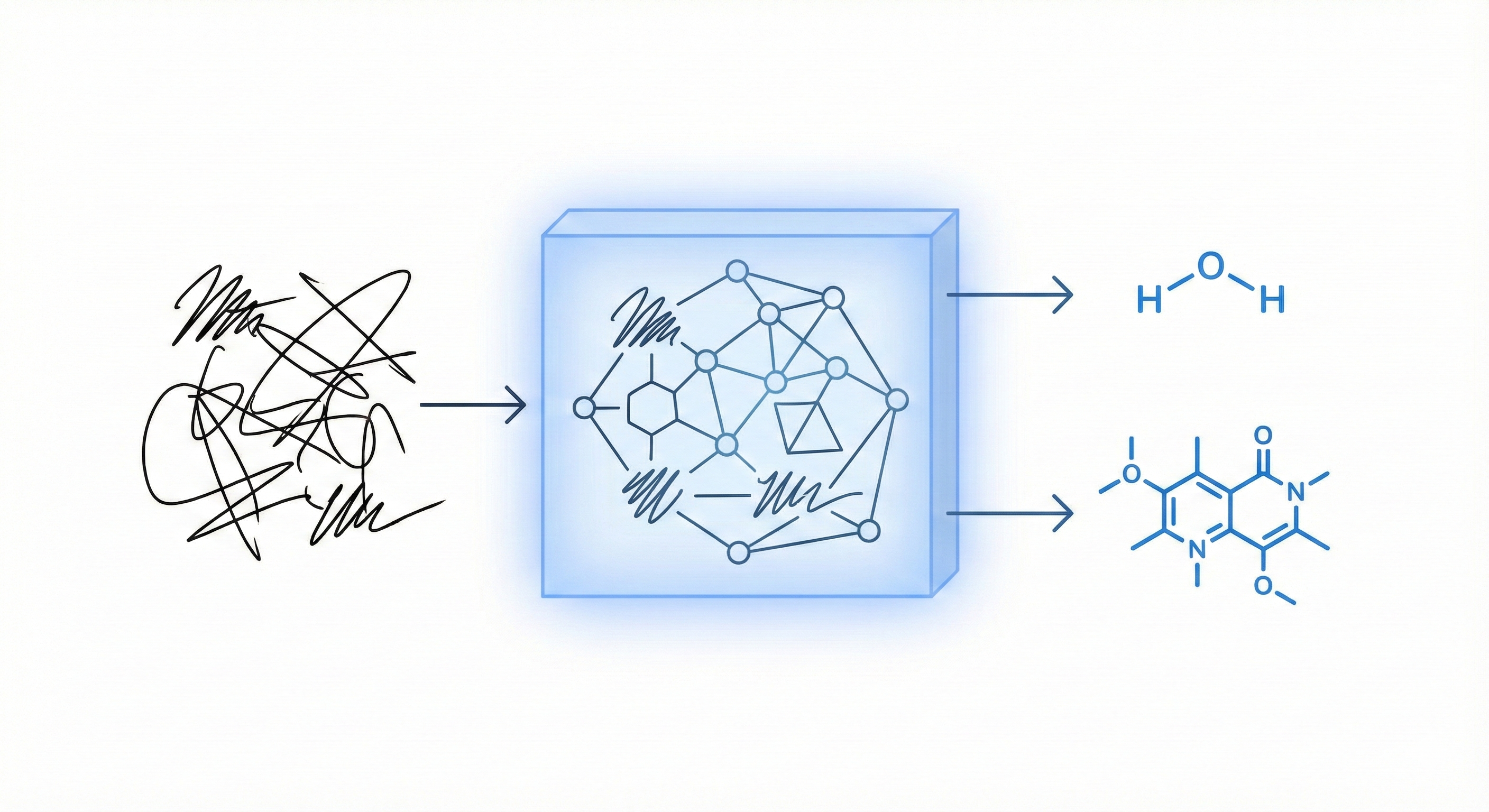
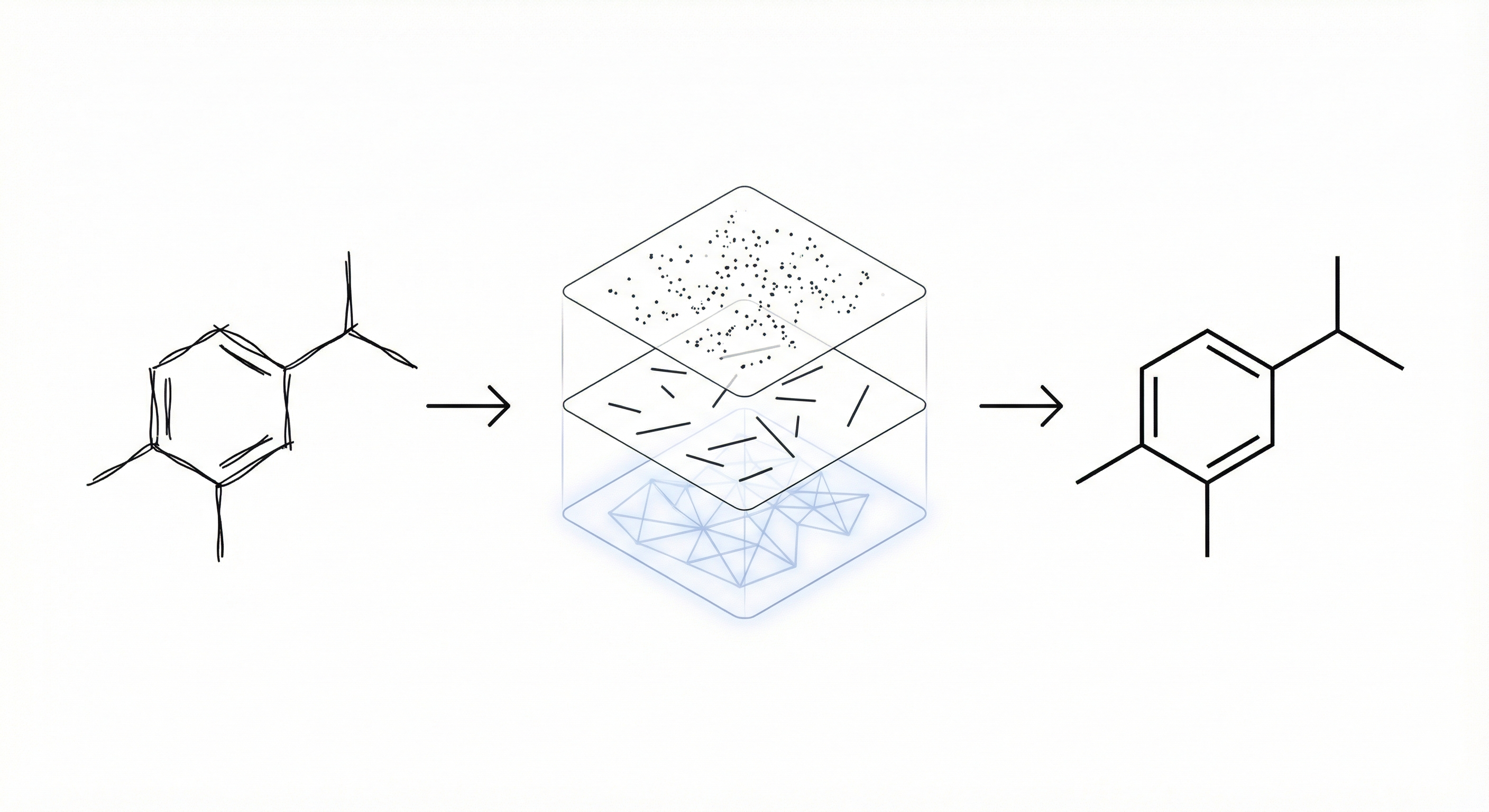
Real-time recognition of chemical structures and symbols from pen strokes on tablets and touch devices, using stroke order and timing.
Online chemical structure recognition processes temporal sequences of pen strokes rather than static images, enabling real-time interpretation on tablets and touch devices. This sub-problem differs from hand-drawn image recognition in that the system has access to stroke order, timing, and velocity, providing richer signal for disambiguation. The notes here cover symbol-level classifiers (HMM and SVM-HMM approaches from Zhang et al., SVM with elastic matching from Tang et al.) and expression-level systems that parse full chemical formulas from stroke input (Yang et al.’s structural analysis, Wang et al.’s hierarchical grammar, Chang et al.’s unified framework for inorganic and organic expressions, and ChemInk’s joint CRF model).
Handwritten Chemical Symbol Recognition Using SVMs
A 2013 paper introducing a hybrid recognition system for handwritten chemical symbols on touch devices. Combines Support Vector Machines (SVM) for classification with elastic matching for geometric verification, achieving 89.7% top-1 accuracy on pen-based input for chemical structure drawing applications.
HMM-based method for recognizing online handwritten chemical symbols using 11-dimensional local features including derivatives, curvature, and linearity. Achieves 89.5% top-1 accuracy and 98.7% top-3 accuracy on a custom dataset of 64 chemical symbols.
On-line Handwritten Chemical Expression Recognition
Yang et al. propose a two-level recognition system for handwritten chemical formulas, combining global structural analysis to identify substances with local character recognition using ANNs, achieving ~96% accuracy on a dataset of 1197 expressions.
Online Handwritten Chemical Formula Structure Analysis
A three-level grammatical framework (formula, molecule, text) for parsing online handwritten chemical formulas, generating semantic graphs that capture both connectivity and layout using context-free grammars and HMMs.
Recognition of On-line Handwritten Chemical Expressions
Proposes a novel two-level algorithm for on-line handwritten chemical expression recognition, combining substance-level matching with character-level segmentation to achieve 96% accuracy.
This paper proposes a double-stage architecture using SVM for rough classification and HMM for fine recognition. It features a novel Point Sequence Reordering (PSR) algorithm that significantly improves accuracy on organic ring structures.
Unified Framework for Handwritten Chemical Expressions
Proposes a unified statistical framework for recognizing both inorganic and organic handwritten chemical expressions. Introduces the Chemical Expression Structure Graph (CESG) and uses a weighted direction graph search for structural analysis, achieving 83.1% top-5 accuracy on a large proprietary dataset.
ChemInk: Real-Time Recognition for Chemical Drawings
ChemInk introduces a sketch recognition system for chemical diagrams that combines multi-level visual features via a joint Conditional Random Field (CRF), achieving 97.4% accuracy and outperforming CAD tools in user speed.