Paper Information
Citation: Kim, J. H., & Choi, J. (2025). OCSAug: diffusion-based optical chemical structure data augmentation for improved hand-drawn chemical structure image recognition. The Journal of Supercomputing, 81, 926.
Publication: The Journal of Supercomputing 2025
Additional Resources:
Document Taxonomy: OCSAug as a Novel Method
This is a Method paper according to the taxonomy. It proposes a novel data augmentation pipeline (OCSAug) that integrates Denoising Diffusion Probabilistic Models (DDPM) and the RePaint algorithm to address the data scarcity problem in hand-drawn optical chemical structure recognition (OCSR). The contribution is validated through systematic benchmarking against existing augmentation techniques (RDKit, Randepict) and ablation studies on mask design.
Expanding Hand-Drawn Training Data for OCSR
A vast amount of molecular structure data exists in analog formats, such as hand-drawn diagrams in research notes or older literature. While OCSR models perform well on digitally rendered images, they struggle significantly with hand-drawn images due to noise, varying handwriting styles, and distortions. Current datasets for hand-drawn images (e.g., DECIMER) are too small to train robust models effectively, and existing augmentation tools (RDKit, Randepict) fail to generate sufficiently realistic hand-drawn variations.
OCSAug Pipeline: Masked RePaint via Generative AI
The core novelty is OCSAug, a three-phase pipeline that uses generative AI to synthesize training data:
- DDPM + RePaint: It utilizes a DDPM to learn the distribution of hand-drawn images and the RePaint algorithm for inpainting.
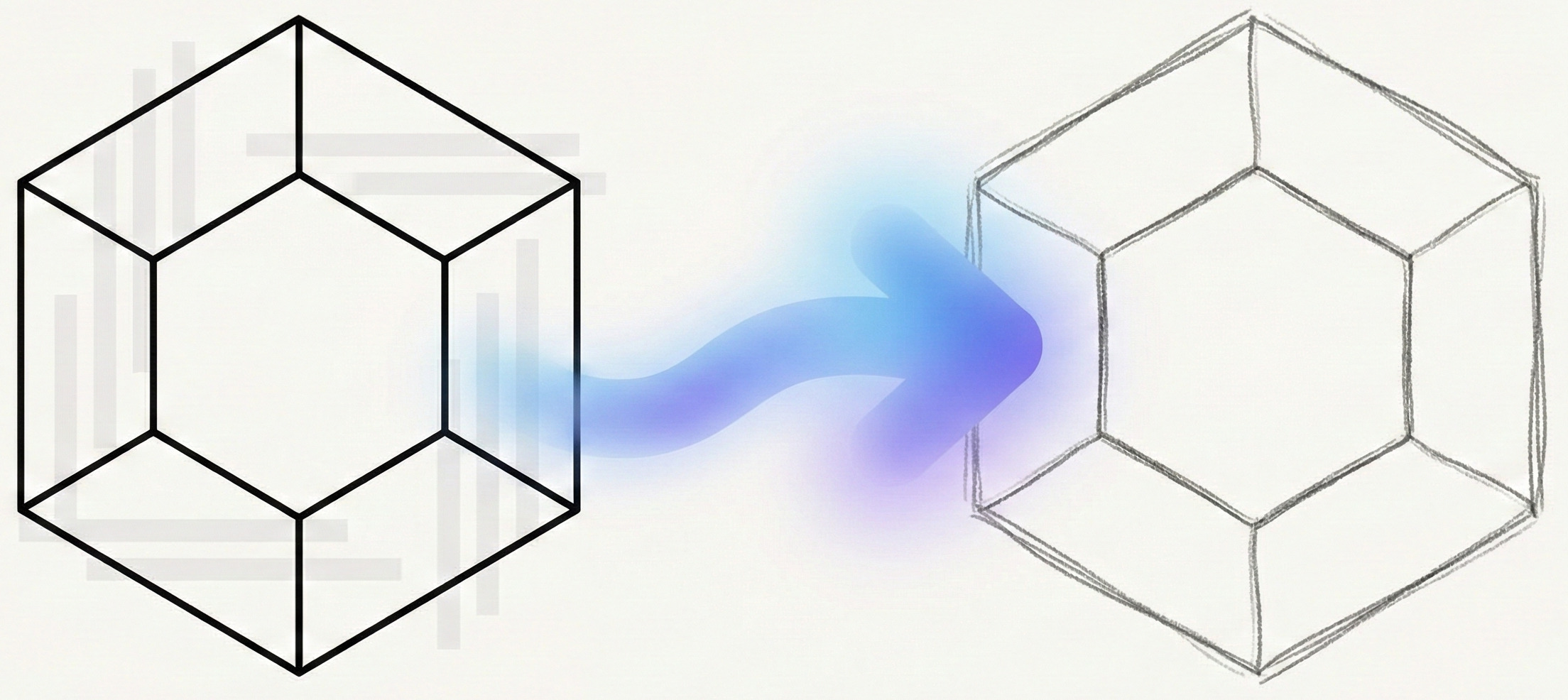
- Structural Masking: It introduces vertical and horizontal stripe pattern masks. These masks selectively obscure parts of atoms or bonds, forcing the diffusion model to reconstruct them with irregular “hand-drawn” styles while preserving the underlying chemical topology.
- Label Transfer: Because the chemical structure is preserved during inpainting, the SMILES label from the original image is directly transferred to the augmented image, bypassing the need for re-annotation.
Benchmarking Diffusion Augmentations on DECIMER
The authors evaluated OCSAug using the DECIMER dataset, specifically a “drug-likeness” subset filtered by Lipinski’s and Veber’s rules.
- Baselines: The method was compared against RDKit (digital generation) and Randepict (rule-based augmentation).
- Models: Four state-of-the-art OCSR models were fine-tuned: MolScribe, Image2SMILES (I2S), MolNexTR, and MPOCSR.
- Metrics:
- Tanimoto Similarity: To measure prediction accuracy against ground truth.
- Fréchet Inception Distance (FID): To measure the distributional similarity between generated and real hand-drawn images.
- RMSE: To quantify pixel-level structural preservation across different mask thicknesses.
Improved Generalization Capabilities and FID Scores
- Performance Boost: OCSAug improved recognition accuracy (Tanimoto similarity) by 1.918 to 3.820 times compared to non-augmented baselines, significantly outperforming RDKit and Randepict.
- Data Quality: OCSAug achieved the lowest FID score (0.471) compared to Randepict (4.054) and RDKit (10.581), indicating its generated images are much closer to the real hand-drawn distribution.
- Generalization: The method showed improved generalization on a newly collected real-world dataset of 463 images from 6 volunteers.
- Limitations: The generation process is slow (3 weeks for 10k images on a single GPU) and the fixed stripe masks may struggle with highly complex, non-drug-like geometries.
Reproducibility Details
Data
- Source: DECIMER dataset (hand-drawn images).
- Filtering: A “drug-likeness” filter was applied (Lipinski’s rule of 5 + Veber’s rules) along with an atom filter (C, H, O, S, F, Cl, Br, N, P only).
- Final Size: 3,194 samples, split into:
- Training: 2,604 samples.
- Validation: 290 samples.
- Test: 300 samples.
- Resolution: All images resized to $256 \times 256$ pixels.
Algorithms
- Framework: DDPM implemented using
guided-diffusion. - RePaint Settings:
- Total time steps: 250.
- Jump length: 10.
- Resampling counts: 10.
- Masking Strategy:
- Vertical Stripes: Obscure atom symbols to vary handwriting style.
- Horizontal Stripes: Obscure bonds to vary length/thickness/alignment.
- Optimal Thickness: A stripe thickness of 4 pixels was found to be optimal for balancing diversity and structural preservation.
Models
The OCSR models were pretrained on PubChem (digital images) and then fine-tuned on the OCSAug dataset.
- MolScribe: Swin Transformer encoder, Transformer decoder. Fine-tuned (all layers) for 30 epochs, batch size 16-128, LR 2e-5.
- I2S: Inception V3 encoder (frozen), FC/Decoder fine-tuned. 25 epochs, batch size 64, LR 1e-5.
- MolNexTR: Dual-stream encoder (Swin + CNN). Fine-tuned (all layers) for 30 epochs, batch size 16-64, LR 2e-5.
- MPOCSR: MPVIT backbone. Fine-tuned (all layers) for 25 epochs, batch size 16-32, LR 4e-5.
Evaluation
Metric: Improvement Ratio (IR) of Tanimoto Similarity (TS), calculated iteratively or defined as:
$$ \text{IR} = \frac{\text{TS}{\text{finetuned}}}{\text{TS}{\text{non-finetuned}}} $$
Validation: Cross-validation on the split DECIMER dataset.
Hardware
- GPU: NVIDIA GeForce RTX 4090.
- Training Time: DDPM training took ~6 days.
- Generation Time: Generating 2,600 augmented images took ~70 hours.
Citation
@article{kimOCSAugDiffusionbasedOptical2025,
  title = {OCSAug: Diffusion-Based Optical Chemical Structure Data Augmentation for Improved Hand-Drawn Chemical Structure Image Recognition},
  shorttitle = {OCSAug},
  author = {Kim, Jin Hyuk and Choi, Jonghwan},
  year = 2025,
  month = may,
  journal = {The Journal of Supercomputing},
  volume = {81},
  number = {8},
  pages = {926},
  doi = {10.1007/s11227-025-07406-4}
}