Paper Information
Citation: Weir, H., Thompson, K., Woodward, A., Choi, B., Braun, A., & Martínez, T. J. (2021). ChemPix: Automated Recognition of Hand-Drawn Hydrocarbon Structures Using Deep Learning. Chemical Science, 12(31), 10622-10633. https://doi.org/10.1039/D1SC02957F
Publication: Chemical Science 2021
Additional Resources:
Paper Classification and Core Contribution
This is primarily a Method paper, with a secondary contribution as a Resource paper.
The paper’s core contribution is the ChemPix architecture and training strategy using neural image captioning (CNN-LSTM) to convert hand-drawn chemical structures to SMILES. The extensive ablation studies on synthetic data generation (augmentation, degradation, backgrounds) and ensemble learning strategies confirm the methodological focus. The secondary resource contribution includes releasing a curated dataset of hand-drawn hydrocarbons and code for generating synthetic training data.
The Structural Input Bottleneck in Computational Chemistry
Inputting molecular structures into computational chemistry software for quantum calculations is often a bottleneck, requiring domain expertise and cumbersome manual entry in drawing software. While optical chemical structure recognition (OCSR) tools exist, they typically struggle with the noise and variability of hand-drawn sketches. There is a practical need for a tool that allows chemists to simply photograph a hand-drawn sketch and immediately convert it into a machine-readable format (SMILES), making computational workflows more accessible.
CNN-LSTM Image Captioning and Synthetic Generalization
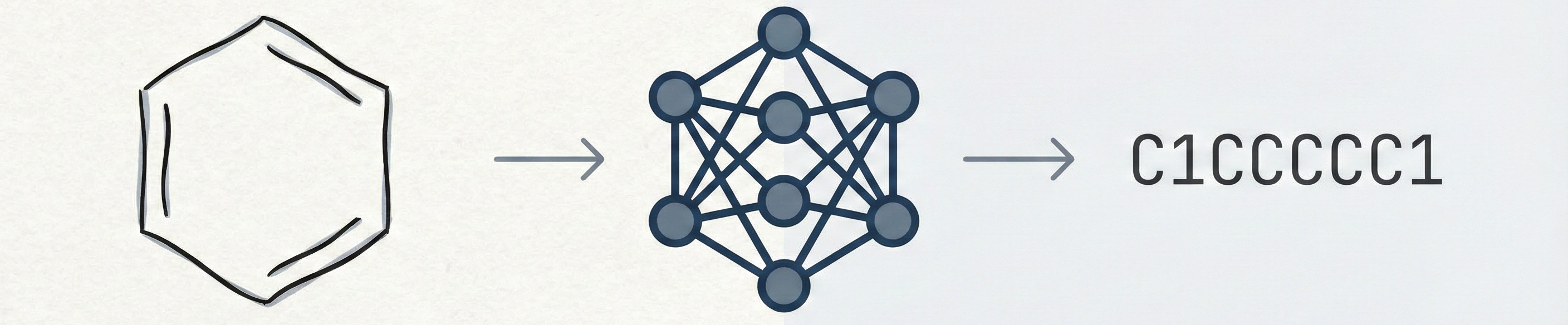
- Image Captioning Paradigm: The authors treat the problem as neural image captioning, using an encoder-decoder (CNN-LSTM) framework to “translate” an image directly to a SMILES string. This avoids the complexity of explicit atom/bond detection and graph assembly.
- Synthetic Data Engineering: The paper introduces a rigorous synthetic data generation pipeline that transforms clean RDKit-generated images into “pseudo-hand-drawn” images via randomized backgrounds, degradation, and heavy augmentation. This allows the model to achieve >50% accuracy on real hand-drawn data without ever seeing it during training.
- Ensemble Uncertainty Estimation: The method utilizes a “committee” (ensemble) of networks to improve accuracy and estimate confidence based on vote agreement, providing users with reliability indicators for predictions.
Extensive Ablation and Real-World Evaluation
- Ablation Studies on Data Pipeline: The authors trained models on datasets generated at different stages of the pipeline (Clean RDKit $\rightarrow$ Augmented $\rightarrow$ Backgrounds $\rightarrow$ Degraded) to quantify the value of each transformation in bridging the synthetic-to-real domain gap.
- Sample Size Scaling: They analyzed performance scaling by training on synthetic dataset sizes ranging from 10,000 to 500,000 images to understand data requirements.
- Real-world Validation: The model was evaluated on a held-out test set of hand-drawn images collected via a custom web app, providing genuine out-of-distribution testing.
- Fine-tuning Experiments: Comparisons of synthetic-only training versus fine-tuning with a small fraction of real hand-drawn data to assess the value of limited real-world supervision.
State-of-the-Art Hand-Drawn OCSR Performance
Pipeline Efficacy: Augmentation and image degradation were the most critical factors for generalization, achieving over 50% accuracy on hand-drawn data when training with 500,000 synthetic images. Adding backgrounds had a negligible effect on accuracy compared to degradation.
State-of-the-Art Performance: The final ensemble model (5 out of 17 trained NNs, selected for achieving >50% individual accuracy) achieved 76% accuracy (top-1) and 85.5% accuracy (top-3) on the hand-drawn test set, a significant improvement over the best single model’s 67.5%.
Synthetic Generalization: A model trained on 500,000 synthetic images achieved >50% accuracy on real hand-drawn data without any fine-tuning, validating the synthetic data generation strategy as a viable alternative to expensive manual labeling.
Ensemble Benefits: The voting committee approach improved accuracy and provided interpretable uncertainty estimates through vote distributions. When all five committee members agree ($V=5$), the confidence value reaches 98%.
Limitations
The authors acknowledge several limitations of the current system:
- Hydrocarbons only: The model is restricted to hydrocarbon structures and does not handle heteroatoms or functional groups.
- No conjoined rings: Molecules with multiple conjoined rings are excluded due to limitations of RDKit’s image generation, which depicts bridges differently from standard chemistry drawing conventions.
- Resonance hybrid notation: The network struggles with benzene rings drawn in the resonance hybrid style (with a circle) compared to the Kekule structure, since the RDKit training images use exclusively Kekule representations.
- Challenging backgrounds: Lined and squared paper increase recognition difficulty, and structures bleeding through from the opposite side of the page can confuse the network.
Reproducibility Details
Data
The study relies on two primary data sources: a massive synthetic dataset generated procedurally and a smaller collected dataset of real drawings.
| Purpose | Dataset | Size | Notes |
|---|---|---|---|
| Training | Synthetic (RDKit) | 500,000 images | Generated via RDKit with “heavy” augmentation: rotation ($0-360°$), blur, salt+pepper noise, and background texture addition. |
| Fine-tuning | Hand-Drawn (Real) | 613 images | Crowdsourced via a web app from over 100 unique users; split into 200-image test set and 413 training/validation images. |
| Backgrounds | Texture Images | 1,052 images | A pool of unlabeled texture photos (paper, desks, shadows) used to generate synthetic backgrounds. |
Data Generation Parameters:
- Augmentations: Rotation, Resize ($200-300px$), Blur, Dilate, Erode, Aspect Ratio, Affine transform ($\pm 20px$), Contrast, Quantize, Sharpness
- Backgrounds: Randomly translated $\pm 100$ pixels and reflected
Algorithms
Ensemble Voting
A committee of networks casts votes for the predicted SMILES string. The final prediction is the one with the highest vote count. Validity of SMILES is checked using RDKit.
Beam Search
Used in the decoding layer with a beam width of $k=5$ to explore multiple potential SMILES strings. It approximates the sequence $\mathbf{\hat{y}}$ that maximizes the joint probability:
$$ \mathbf{\hat{y}} = \arg\max_{\mathbf{y}} \sum_{t=1}^{T} \log P(y_t \mid y_{<t}, \mathbf{x}) $$
Optimization:
Optimizer: Adam
Learning Rate: $1 \times 10^{-4}$
Batch Size: 20
Loss Function: Cross-entropy loss across the sequence of $T$ tokens, computed as:
$$ \mathcal{L} = -\sum_{t=1}^{T} \log P(y_t \mid y_{<t}, \mathbf{x}) $$
where $\mathbf{x}$ is the image representation and $y_t$ is the predicted SMILES character. This is calculated as perplexity for validation.
Models
The architecture is a standard image captioning model (Show, Attend and Tell style) adapted for chemical structures.
Encoder (CNN):
- Input: 256x256 pixel PNG images
- Structure: 4 blocks of Conv2D + MaxPool
- Block 1: 64 filters, (3,3) kernel
- Block 2: 128 filters, (3,3) kernel
- Block 3: 256 filters, (3,3) kernel
- Block 4: 512 filters, (3,3) kernel
- Activation: ReLU throughout
Decoder (LSTM):
- Hidden Units: 512
- Embedding Dimension: 80
- Attention: Mechanism with intermediary vector dimension of 512
Evaluation
- Primary Metric: Exact SMILES match accuracy (character-by-character identity between predicted and ground truth SMILES)
- Perplexity: Used for saving model checkpoints (minimizing uncertainty)
- Top-k Accuracy: Reported for $k=1$ (76%) and $k=3$ (85.5%)
Artifacts
| Artifact | Type | License | Notes |
|---|---|---|---|
| ChemPixCH | Code + Dataset | Apache-2.0 | Official implementation with synthetic data generation pipeline and collected hand-drawn dataset |
Citation
@article{weir2021chempix,
  title={ChemPix: Automated Recognition of Hand-Drawn Hydrocarbon Structures Using Deep Learning},
  author={Weir, Hayley and Thompson, Keiran and Woodward, Amelia and Choi, Benjamin and Braun, Augustin and Mart{\'i}nez, Todd J.},
  journal={Chemical Science},
  volume={12},
  number={31},
  pages={10622--10633},
  year={2021},
  publisher={Royal Society of Chemistry},
  doi={10.1039/D1SC02957F}
}