Paper Information
Citation: Park, J., Li, Y., Rosania, G. R., & Saitou, K. (2011). Image-to-Structure Task by ChemReader. TREC 2011 Chemical IR Track Report.
Publication: TREC 2011 Chemical IR Track
Additional Resources:
Methodological Application: Applying ChemReader to Chemical OCR
This is a Methodological Paper ($\Psi_{\text{Method}}$).
The dominant vector is $\Psi_{\text{Method}}$ because the paper’s core contribution is the development and empirical evaluation of a novel software/algorithm (ChemReader) to solve a specific technical challenge: the Image-to-Structure (I2S) task. The rhetorical indicators align with this classification through the reporting of quantitative performance metrics, detailed error analysis, and a focus on how well the system works and how its underlying algorithms need refinement.
Motivation: Bridging the Gap in Image-to-Structure Tasks
The motivation is two-fold:
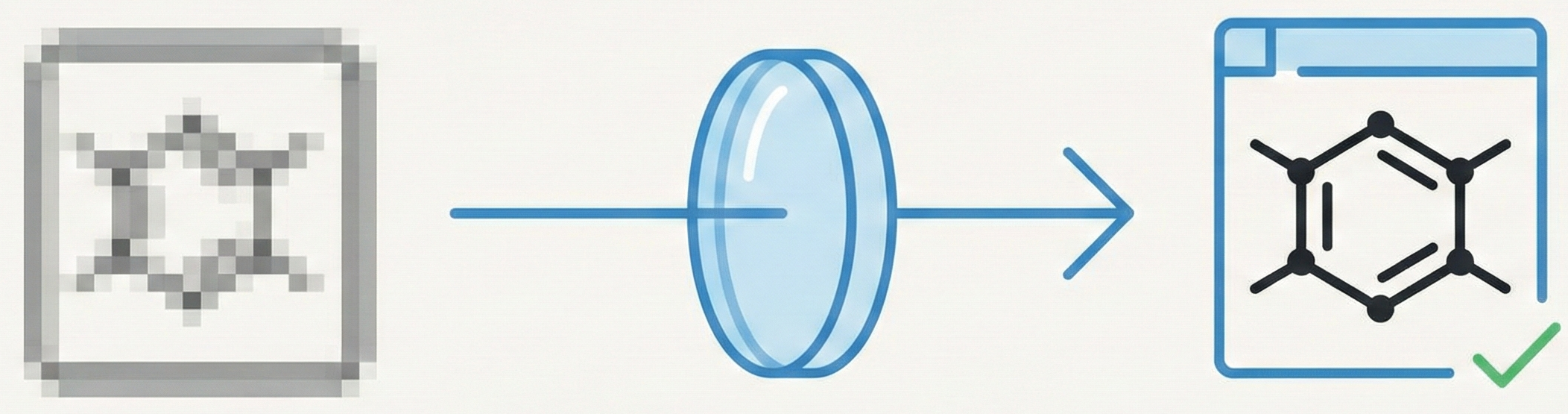
Scientific Need: Traditional text-based chemical mining methods cannot utilize image data in scientific literature. Chemical OCR software is required to extract 2D chemical structure diagrams from raster images and convert them into a machine-readable chemical file format, paving the way for advanced chemical literature mining.
Benchmark Participation: The immediate motivation was participation in the TREC Chemical IR campaign’s Image-to-Structure (I2S) task, which was designed to evaluate existing chemical OCR software and establish a platform for developing chemical information retrieval techniques utilizing image data.
Novelty: A Tailored Architecture for Scientific Literature Mining
The core novelty is the development of ChemReader, a new chemical OCR software specifically tailored to the unique requirements and format of chemical database mining. While chemical OCR is not a new field, the paper’s novelty lies in presenting this specific system’s architecture and its initial quantitative performance within the formal I2S benchmark setting, demonstrating a high degree of fidelity in chemical diagram recognition.
Experimental Setup: The TREC 2011 I2S Challenge
The experiment was the application of the ChemReader software to the Image-to-Structure (I2S) task of the TREC Chemical IR campaign.
- Setup: The software was used to process image data provided for the I2S task.
- Evaluation: The system was initially evaluated, leading to the identification and fixing of a bond issue and a bug in the corner detection component.
- Analysis: A final evaluation was conducted on a test set (referred to as Test III, specifically 20 samples for error analysis), where results were quantified by accuracy and a detailed breakdown of failure modes.
Outcomes: High Accuracy Hindered by Complex Connectivity Rules
Key Finding: After fixing initial issues, ChemReader achieved 93% accuracy on the I2S task.
Limitation/Future Direction: A detailed error analysis (Table 2) showed that the software requires the incorporation of more chemical intelligence in its algorithms to address remaining systematic errors. The most frequent errors were:
- Wrongly merged nodes (30%)
- Missed bonds (20%)
- Incorrect bond stereo type (15%)
- 3D crossing bonds/Noise symbols around structure (25%)
Reproducibility Details
Data
| Purpose | Dataset | Size | Notes |
|---|---|---|---|
| Evaluation | TREC 2011 Chemical IR Image-to-Structure Task | Test III: 20 samples for error analysis | Overall test set size for 93% accuracy not specified. Data from TREC 2011 Chemical IR campaign. |
Algorithms
ChemReader is a chemical Optical Character Recognition (OCR) system. Key algorithmic components implied by the paper’s findings include:
- Corner Detection: A specific algorithm for detecting corners in the diagram was addressed and bug-fixed.
- Bond Recognition/Representation: Algorithms responsible for recognizing and representing chemical bonds, including stereo types (which generated 15% of the errors) and correctly interpreting bond connections (where “Wrongly merged nodes” and “Missed bonds” were major failure modes).
- Structure Translation: The final step involves converting the processed image information into a standard, machine-readable chemical file format.
Models
The paper describes ChemReader as an OCR software and does not explicitly reference specific deep learning or machine learning model architectures (e.g., CNNs, Transformers, GNNs), suggesting it relies on traditional computer vision, image processing, and rule-based cheminformatics logic.
Evaluation
| Metric | Value | Baseline | Notes |
|---|---|---|---|
| Accuracy | 93% | Not specified | Achieved after fixing initial bugs in bond issue and corner detection. |
Error Breakdown (from 20-sample analysis):
- Wrongly merged nodes: 30%
- Missed bonds: 20%
- Incorrect bond stereo type: 15%
- 3D crossing bonds/Noise symbols: 25%
- Other errors: 10%
Citation
@techreport{parkImagetoStructureTaskChemReader2011,
  title = {Image-to-Structure Task by {ChemReader}},
  author = {Park, Jungkap and Li, Ye and Rosania, Gus R. and Saitou, Kazuhiro},
  year = {2011},
  month = oct,
  institution = {University of Michigan},
  type = {TREC 2011 Chemical IR Track Report}
}