Paper Information
Citation: Zimmermann, M. (2011). Chemical Structure Reconstruction with chemoCR. TREC 2011 Proceedings.
Publication: Text REtrieval Conference (TREC) 2011
Contribution: The chemoCR Architecture
Methodological Paper ($\Psi_{\text{Method}}$)
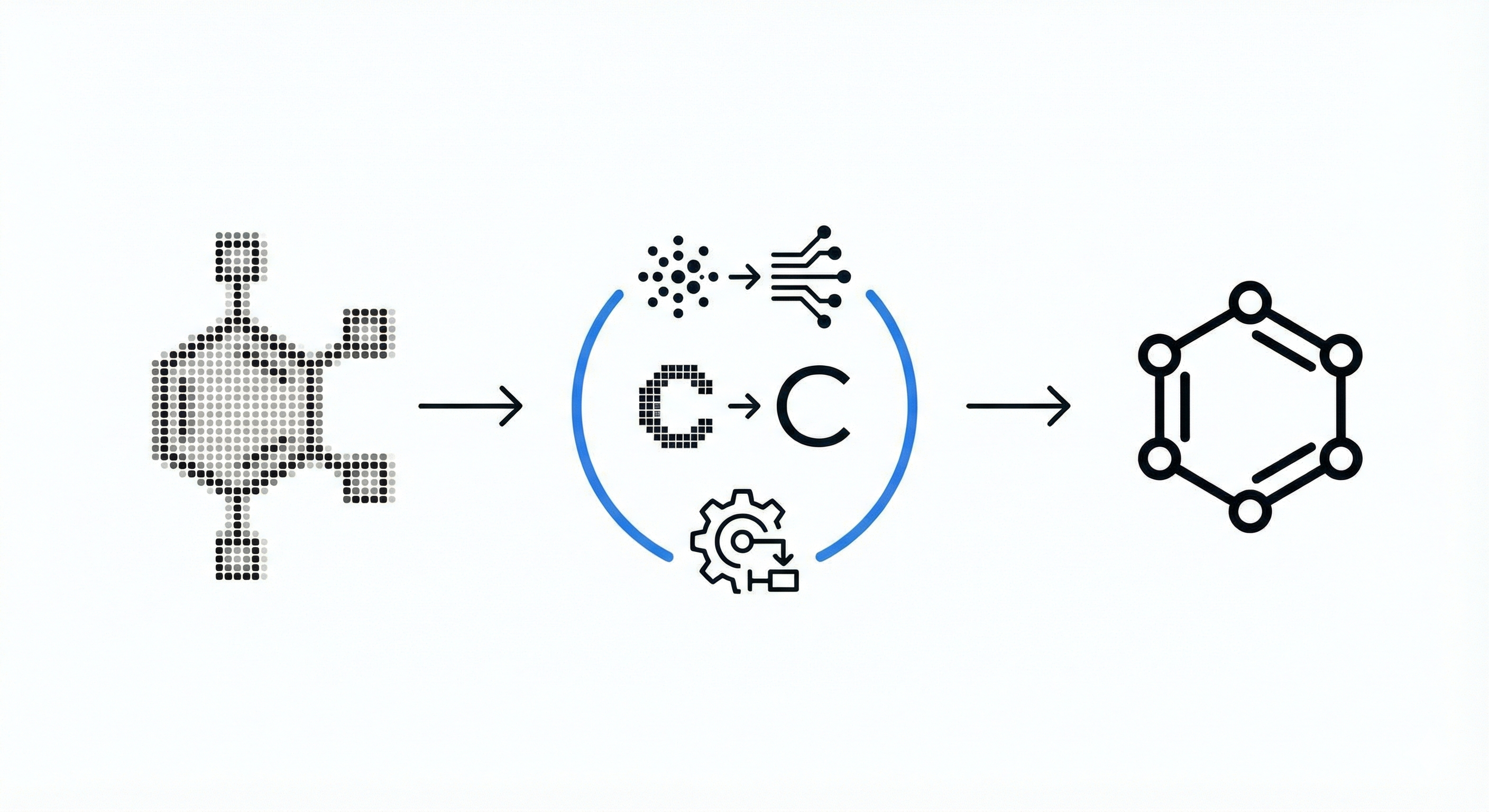
This paper focuses entirely on the architecture and workflow of the chemoCR system. It proposes specific algorithmic innovations (texture-based vectorization, graph constraint exploration) and defines a comprehensive pipeline for converting raster images into semantic chemical graphs. The primary contribution is the system design and its operational efficacy.
Motivation: Digitizing Image-Locked Chemical Structures
Chemical structures are the preferred language of chemistry, yet they are frequently locked in non-machine-readable formats (bitmap images like GIF, BMP) within patents and journals.
- The Problem: Once published as images, chemical structure information is “dead” to analysis software.
- The Gap: Manual reconstruction is slow and error-prone. Existing tools struggled with the diversity of drawing styles (e.g., varying line thickness, font types, and non-standard bond representations).
- The Goal: To automate the conversion of these depictions into connection tables (SDF/MOL files) to make the data accessible for computational chemistry applications.
Core Innovation: Rule-Based Semantic Object Identification
The system is based on a “Semantic Entity” approach that identifies chemically significant objects (chiral bonds, superatoms, reaction arrows) from structural formula depictions. Key technical innovations include:
- Texture-based Vectorization: A new algorithm that computes local directions to vectorize lines, robust against varying drawing styles.
- Expert System Integration: A graph constraint exploration algorithm that applies an XML-based rule set to classify geometric primitives into chemical classes such as
BOND,DOUBLEBOND,TRIPLEBOND,BONDSET,DOTTED CHIRAL,STRINGASSOCIATION,DOT,RADICAL,REACTION,REACTION ARROW,REACTION PLUS,CHARGE, andUNKNOWN. - Validation Scoring: A built-in validation module that tests valences, bond lengths and angles, typical atom types, and fragments to assign a confidence score (0 to 1) to the reconstruction.
Experiments: The TREC 2011 Image-to-Structure Task
The system was evaluated as part of the TREC 2011 Image-to-Structure (I2S) Task.
- Dataset: 1,000 unique chemical structure images provided by USPTO.
- Configuration: The authors used chemoCR v0.93 in batch mode with a single pre-configured parameter set (“Houben-Weyl”), originally developed for the Houben-Weyl book series of organic chemistry reactions published by Thieme.
- Process: The workflow included image binarization, connected component analysis, OCR for atom labels, and final molecule assembly.
- Metric: Perfect match recall against ground-truth MOL files.
Results and Conclusions: Expert Systems vs. “Dirty” Data
- Performance: The system achieved a perfect match for 656 out of 1,000 structures (65.6%).
- Error Analysis: Failures were primarily attributed to “unclear semantics” in drawing styles, such as:
- Overlapping objects (e.g., atom labels clashing with bonds).
- Ambiguous primitives (dots interpreted as both radicals and chiral centers).
- Markush structures (variable groups), which were excluded from the I2S task definition. A prototype for Markush detection existed but was not used.
- Limitations: The vectorizer cannot recognize curves and circles, only straight lines. Aromatic ring detection (via a heuristic that looks for a large “O” character in the center of a ring system) was switched off for the I2S task. The system maintained 12 different parameter sets for various drawing styles, and selecting the correct set was critical.
- Impact: Demonstrated that rule-based expert systems combined with standard pattern recognition could handle high-quality datasets effectively, though non-standard drawing styles remain a challenge.
Reproducibility Details
Data
The paper relies on the TREC 2011 I2S dataset, comprising images extracted from USPTO patents.
| Purpose | Dataset | Size | Notes |
|---|---|---|---|
| Evaluation | TREC 2011 I2S | 1,000 images | Binarized bitmaps from USPTO patents. |
| Training | Internal Training Set | Unknown | Used to optimize parameter sets (e.g., “Houben-Weyl” set). |
Algorithms
The paper describes three main workflow phases (preprocessing, semantic entity recognition, and molecule reconstruction plus validation), organized into four pipeline sections:
Preprocessing:
- Vaporizer Unit: Erases parts of the image that are presumably not structure diagrams (e.g., text or other human-readable information), isolating the chemical depictions.
- Connected Components: Groups all foreground pixels that are 8-connected into components.
- Text Tagging and OCR: Identifies components that map to text areas and converts bitmap letters into characters.
Vectorization:
- Algorithm: Compute Local Directions. It analyzes segment clusters to detect ascending, descending, horizontal, and vertical trends in pixel data, converting them into vectors.
- Feature: Explicitly handles “thick chirals” (wedges) by computing orientation.
Reconstruction (Expert System):
- Core Logic: Graph Constraint Exploration. It visits connected components and evaluates them against an XML Rule Set.
- Classification: Objects are tagged with chemical keywords (e.g.,
BONDSETfor ring systems and chains,STRINGASSOCIATIONfor atom labels,DOTTED CHIRALfor chiral bonds). - Rules: Configurable via
chemoCRSettings.xml. The successful rule with the highest priority value defines the annotation for each component.
Assembly & Validation:
- Combines classified vectors and OCR text into a semantic graph.
- Superatoms: Matches text groups against a loaded superatom database (e.g., “COOH”, “Boc”).
- Validation: Calculates a score (0-1) based on chemical feasibility (valences, bond lengths and angles, typical atom types, and fragments).
Models
The system is primarily rule-based but utilizes machine learning components for specific sub-tasks:
- OCR: A trainable OCR module using supervised machine learning to recognize atom labels ($H, C, N, O$). The specific classifier is not detailed in the paper.
- Rule Base: An XML file containing the expert system logic. This is the “model” for structural interpretation.
Evaluation
Evaluation was performed strictly within the context of the TREC competition.
| Metric | Value | Baseline | Notes |
|---|---|---|---|
| Recall (Perfect Match) | 656 / 1000 | N/A | Strict structural identity required. |
Hardware
- Software Stack: Platform-independent JAVA libraries.
- Compute: Batch mode processing supported; specific hardware requirements (CPU/RAM) were not disclosed.
Artifacts
| Artifact | Type | License | Notes |
|---|---|---|---|
| chemoCR (Fraunhofer SCAI) | Software | Unknown | Project page defunct; tool was proprietary |
| TREC 2011 Proceedings Paper | Paper | Public | Official NIST proceedings |
No source code was publicly released. The chemoCR system was a proprietary tool from Fraunhofer SCAI. The TREC 2011 I2S dataset was distributed to competition participants and is not independently hosted.
Citation
@inproceedings{zimmermannChemicalStructureReconstruction2011,
  title = {Chemical Structure Reconstruction with {{chemoCR}}},
  booktitle = {Text {{REtrieval Conference}} ({{TREC}}) 2011},
  author = {Zimmermann, Marc},
  year = {2011},
  langid = {english}
}