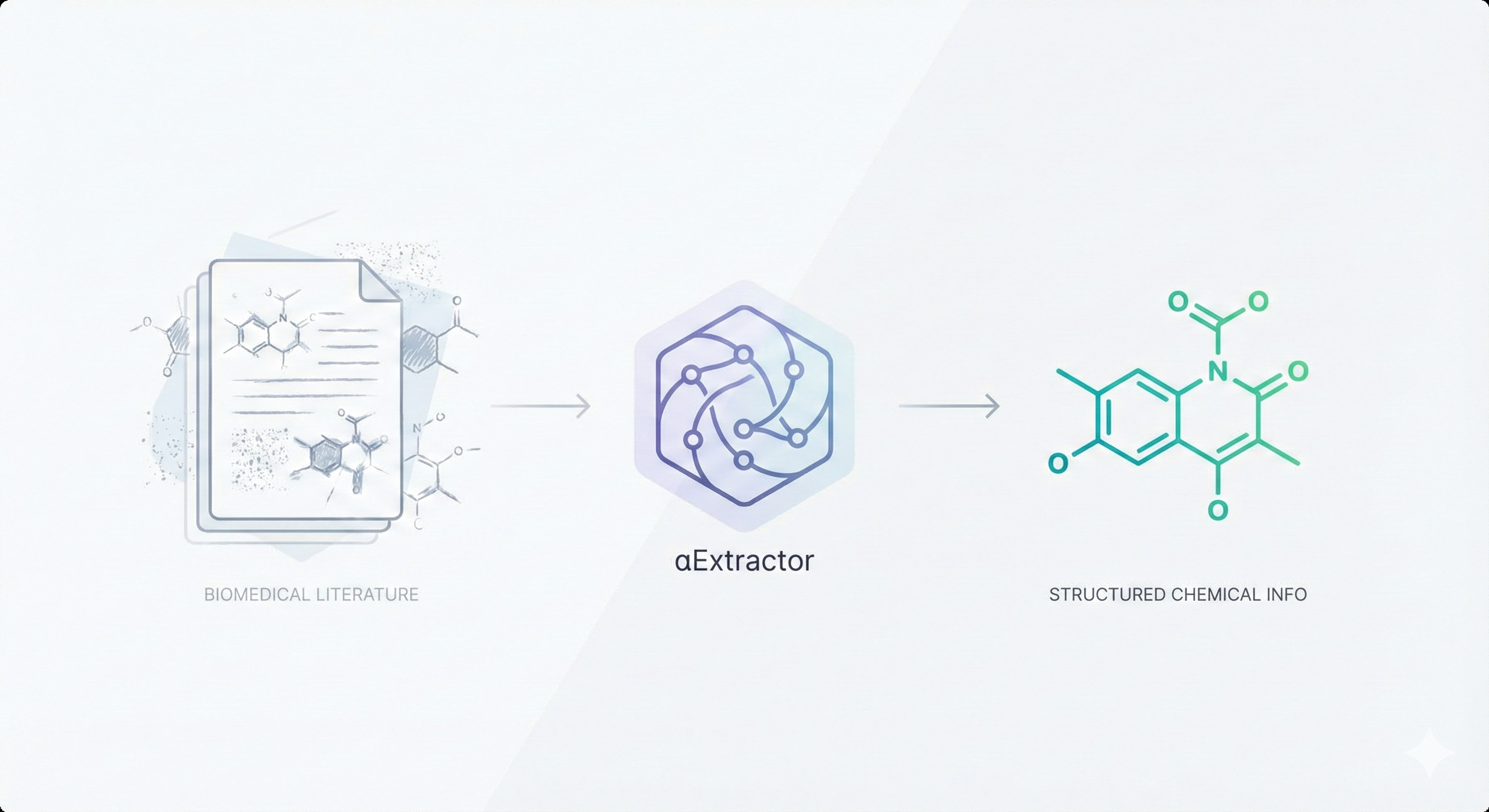
Methodological Contribution: A Robust Optical Recognition System
This is primarily a Method ($\Psi_{\text{Method}}$) paper with a significant secondary Resource ($\Psi_{\text{Resource}}$) contribution (see the AI and Physical Sciences paper taxonomy for more on these categories).
The dominant methodological contribution is the ResNet-Transformer recognition architecture that achieves state-of-the-art performance through robustness engineering. It specifically focuses on training on 20 million synthetic images with aggressive augmentation to handle degraded image conditions. The work answers the core methodological question “How well does this work?” through extensive benchmarking against existing OCSR tools and ablation studies validating architectural choices.
The secondary resource contribution comes from releasing αExtractor as a freely available web service, correcting labeling errors in standard benchmarks (CLEF, UOB, JPO), and providing an end-to-end document processing pipeline for biomedical literature mining.
Motivation: Unlocking Visual Chemical Knowledge in Biomedical Literature
The motivation addresses a familiar pain point in chemical informatics within a biomedical context. Vast amounts of chemical knowledge in biomedical literature exist only as images, such as molecular structures embedded in figures, chemical synthesis schemes, and compound diagrams. This visual knowledge remains effectively invisible to computational methods, which creates a massive bottleneck for drug discovery research, systematic reviews, and large-scale chemical database construction.
Existing OCSR tools face two critical problems when applied to biomedical literature:
Real-world image quality: Biomedical papers often contain low-resolution figures, images with complex backgrounds, noise from scanning/digitization, and inconsistent drawing styles across different journals and decades of publications.
End-to-end extraction: Most OCSR systems assume the presence of clean, cropped molecular images. In practice, you need to first find the molecular structures within multi-panel figures, reaction schemes, and dense document layouts before you can recognize them.
The authors argue that a practical literature mining system needs to solve both problems simultaneously via robust recognition under noisy conditions and automated detection of molecular images within complex documents.
Core Innovation: Robust ResNet-Transformer Architecture
The core innovation lies in combining a competition-winning recognition architecture with extensive robustness engineering and end-to-end document processing. The key contributions include:
ResNet-Transformer Recognition Model: The core recognition system uses a Residual Neural Network (ResNet) encoder paired with a Transformer decoder in an image-captioning framework. This architecture won first place in a Kaggle molecular translation competition, which provided a strong foundation for the recognition task. Let the input image be $I$. The model maximizes the joint likelihood of the SMILES tokens $T$ and coordinate sequences $X, Y$: $$ \begin{aligned} \mathcal{L}_{\text{total}} = - \sum_{i=1}^{L} \log P(T_i \mid I, T_{<i}) - \lambda \sum_{i=1}^{L} \big(\log P(X_i \mid I, X_{<i}) + \log P(Y_i \mid I, Y_{<i})\big) \end{aligned} $$ Here, continuous $X$ and $Y$ atom coordinates are mapped strictly to 200 discrete bins to formulate the coordinate prediction as a standard classification task alongside SMILES generation.
Enhanced Molecular Representation: The model produces an augmented representation that encompasses:
- Standard molecular connectivity information
- Bond type tokens (solid wedge bonds, dashed bonds, etc.) that preserve 3D stereochemical information
- Atom coordinate predictions that allow reconstruction of the exact molecular pose from the original image
This dual prediction of discrete structure and continuous coordinates makes the output strictly faithful to the source material and enables better quality assessment.
Massive Synthetic Training Dataset: The model was trained on approximately 20 million synthetic molecular images generated from PubChem SMILES with aggressive data augmentation. The augmentation strategy randomized visual styles, image quality, and rendering parameters to create maximum diversity, ensuring the network rarely saw the same molecular depiction twice. This forces the model to learn robust, style-invariant features.
End-to-End Document Processing Pipeline: αExtractor integrates object detection and structure recognition into a complete document mining system:
- An object detection model automatically locates molecular images within PDF documents
- The recognition model converts detected images to structured representations
- A web service interface makes the entire pipeline accessible to researchers without machine learning expertise
Robustness-First Design: The system was explicitly designed to handle degraded image conditions that break traditional OCSR tools, including low resolution, background interference, color variations, and scanning artifacts commonly found in legacy biomedical literature.
Experimental Methodology: Stress Testing under Real-World Conditions
The evaluation focused on demonstrating robust performance across diverse image conditions, from pristine benchmarks to challenging real-world scenarios:
Benchmark Dataset Evaluation: αExtractor was tested on four standard OCSR benchmarks:
- CLEF: Chemical structure recognition challenge dataset
- UOB: University of Birmingham patent images
- JPO: Japan Patent Office molecular diagrams
- USPTO: US Patent and Trademark Office structures
Performance was measured using exact SMILES match accuracy.
Error Analysis and Dataset Correction: During evaluation, the researchers discovered numerous labeling errors in the original benchmark datasets. They systematically identified and corrected these errors, then re-evaluated all methods on the cleaned datasets to get more accurate performance measurements.
Robustness Stress Testing: The system was evaluated on two challenging datasets specifically designed to test robustness:
- Color background images (200 samples): Molecular structures on complex, colorful backgrounds that simulate real figure conditions
- Low-quality images (200 samples): Degraded images with noise, blur, and artifacts typical of scanned documents
These tests compared αExtractor against open-source alternatives under realistic degradation conditions.
Generalization Testing: In the most challenging experiment, αExtractor was tested on hand-drawn molecular structures, representing a completely different visual domain not represented in the training data. This tested whether the learned features could generalize beyond digital rendering styles to human-drawn chemistry.
End-to-End Document Extraction: The complete pipeline was evaluated on 50 PDF files containing 2,336 molecular images. This tested both the object detection component (finding molecules in complex documents) and the recognition component (converting them to SMILES) in a realistic literature mining scenario.
Speed Benchmarking: Inference time was measured to demonstrate the practical efficiency needed for large-scale document processing.
Results & Conclusions: Breakthrough in Degraded Image Performance
Substantial Accuracy Gains: On the four benchmark datasets, αExtractor achieved accuracies of 91.83% (CLEF), 98.47% (UOB), 88.67% (JPO), and 93.64% (USPTO), significantly outperforming existing methods. After correcting dataset labeling errors, the true accuracies were even higher, reaching 95.77% on CLEF, 99.86% on UOB, and 92.44% on JPO.
Exceptional Robustness: Open-source competitors struggled on degraded images (achieving 5.5% accuracy at best). αExtractor maintained over 90% accuracy on both color background and low-quality image datasets, demonstrating the effectiveness of the massive synthetic training strategy.
Remarkable Generalization: On hand-drawn molecules, a domain completely absent from training data, αExtractor achieved 61.4% accuracy while other tools scored below 3%. This suggests the model learned genuinely chemical features.
Practical End-to-End Performance: In the complete document processing evaluation, αExtractor detected 95.1% of molecular images (2,221 out of 2,336) and correctly recognized 94.5% of detected structures (2,098 correct predictions). This demonstrates the system’s readiness for real-world literature mining applications.
Dataset Quality Issues: The systematic discovery of labeling errors in standard benchmarks highlights a broader problem in OCSR evaluation. The corrected datasets provide more reliable baselines for future method development.
Spatial Layout Limitation: αExtractor correctly identifies molecular connectivity; however, the re-rendered structures may have different spatial layouts than the originals. This could complicate visual verification for complex molecules, even if the chemical information remains accurate.
The work establishes αExtractor as a significant advance in practical OCSR for biomedical applications. The combination of robust recognition, end-to-end document processing, and exceptional generalization makes it suitable for large-scale literature mining tasks where previous tools would fail. The focus on real-world robustness over benchmark optimization represents a mature approach to deploying machine learning in scientific workflows.
Reproducibility Details
This paper is Partially Reproducible. While the authors detail the model architectures and training techniques, the source code, training dataset (20M synthetic images), and pre-trained weights remain closed-source and proprietary. The authors released a sample of their test data and host an online web server for running inference.
| Artifact | Type | License | Notes |
|---|---|---|---|
| Corrected CLEF Dataset | Dataset | Unknown | Authors’ corrected version of the CLEF benchmark. |
| Corrected UOB Dataset | Dataset | Unknown | Authors’ corrected version of the UOB benchmark. |
| Corrected JPO Dataset | Dataset | Unknown | Authors’ corrected version of the JPO benchmark. |
| Color Background Dataset | Dataset | Unknown | 200 samples of molecular structures on complex, colorful backgrounds. |
| Low Quality Dataset | Dataset | Unknown | 200 samples of degraded images with noise, blur, and artifacts. |
| PDF Test Set | Dataset | Unknown | Sample PDF files for end-to-end document extraction evaluation. |
| αExtractor Web Server | Other | Unknown | Online service for running inference using the proprietary system. |
Models
Image Recognition Model:
- Backbone: ResNet50 producing output of shape $2048 \times 19 \times 19$, projected to 512 channels via a feed-forward layer
- Transformer Architecture: 3 encoder layers and 3 decoder layers with hidden dimension of 512
- Output Format: Generates SMILES tokens plus two auxiliary coordinate sequences (X-axis and Y-axis) that are length-aligned with the SMILES tokens via padding
Object Detection Model:
- Architecture: DETR (Detection Transformer) with ResNet101 backbone
- Transformer Architecture: 6 encoder layers and 6 decoder layers with hidden dimension of 256
- Purpose: Locates molecular images within PDF pages before recognition
Coordinate Prediction:
- Continuous X/Y coordinates are discretized into 200 discrete bins
- Padding tokens added to coordinate sequences to align perfectly with SMILES token sequence, enabling simultaneous structure and pose prediction
Data
Training Data:
- Synthetic Generation: Python script rendering PubChem SMILES into 2D images
- Dataset Size: Approximately 20.3 million synthetic molecular images from PubChem
- Superatom Handling: 50% of molecules had functional groups replaced with superatoms (e.g., “COOH”) or generic labels (R1, X1) to match literature drawing conventions
- Rendering Augmentation: Randomized bond thickness, bond spacing, font size, font color, and padding size
Geometric Augmentation:
- Shear along x-axis: $\pm 15^\circ$
- Rotation: $\pm 15^\circ$
- Piecewise affine scaling
Noise Injection:
- Pepper noise: 0-2%
- Salt noise: 0-40%
- Gaussian noise: scale 0-0.16
Destructive Augmentation:
- JPEG compression: severity levels 2-5
- Random masking
Evaluation Datasets:
- CLEF: Chemical structure recognition challenge dataset
- UOB: University of Birmingham patent images
- JPO: Japan Patent Office molecular diagrams
- USPTO: US Patent and Trademark Office structures
- Color background images: 200 samples
- Low-quality images: 200 samples
- Hand-drawn structures: Test set for generalization
- End-to-end document extraction: 50 PDFs (567 pages, 2,336 molecular images)
Training
Image Recognition Model:
- Optimizer: Adam with learning rate of 1e-4
- Batch Size: 100
- Epochs: 5
- Loss Function: Cross-entropy loss for both SMILES prediction and coordinate prediction
Object Detection Model:
- Optimizer: Adam with learning rate of 1e-4
- Batch Size: 24
- Training Strategy: Pre-trained on synthetic “Lower Quality” data for 5 epochs, then fine-tuned on annotated real “High Quality” data for 30 epochs
Evaluation
Metrics:
- Recognition: SMILES accuracy (exact match)
- End-to-End Pipeline:
- Recall: 95.1% for detection
- Accuracy: 94.5% for recognition
Hardware
Inference Hardware:
- Cloud CPU server (8 CPUs, 64 GB RAM)
- Throughput: Processed 50 PDFs (567 pages) in 40 minutes
Paper Information
Citation: Xiong, J., Liu, X., Li, Z., Xiao, H., Wang, G., Niu, Z., Fei, C., Zhong, F., Wang, G., Zhang, W., Fu, Z., Liu, Z., Chen, K., Jiang, H., & Zheng, M. (2024). αExtractor: A system for automatic extraction of chemical information from biomedical literature. Science China Life Sciences, 67(3), 618-621. https://doi.org/10.1007/s11427-023-2388-x
Publication: Science China Life Sciences (2024)
Additional Resources: