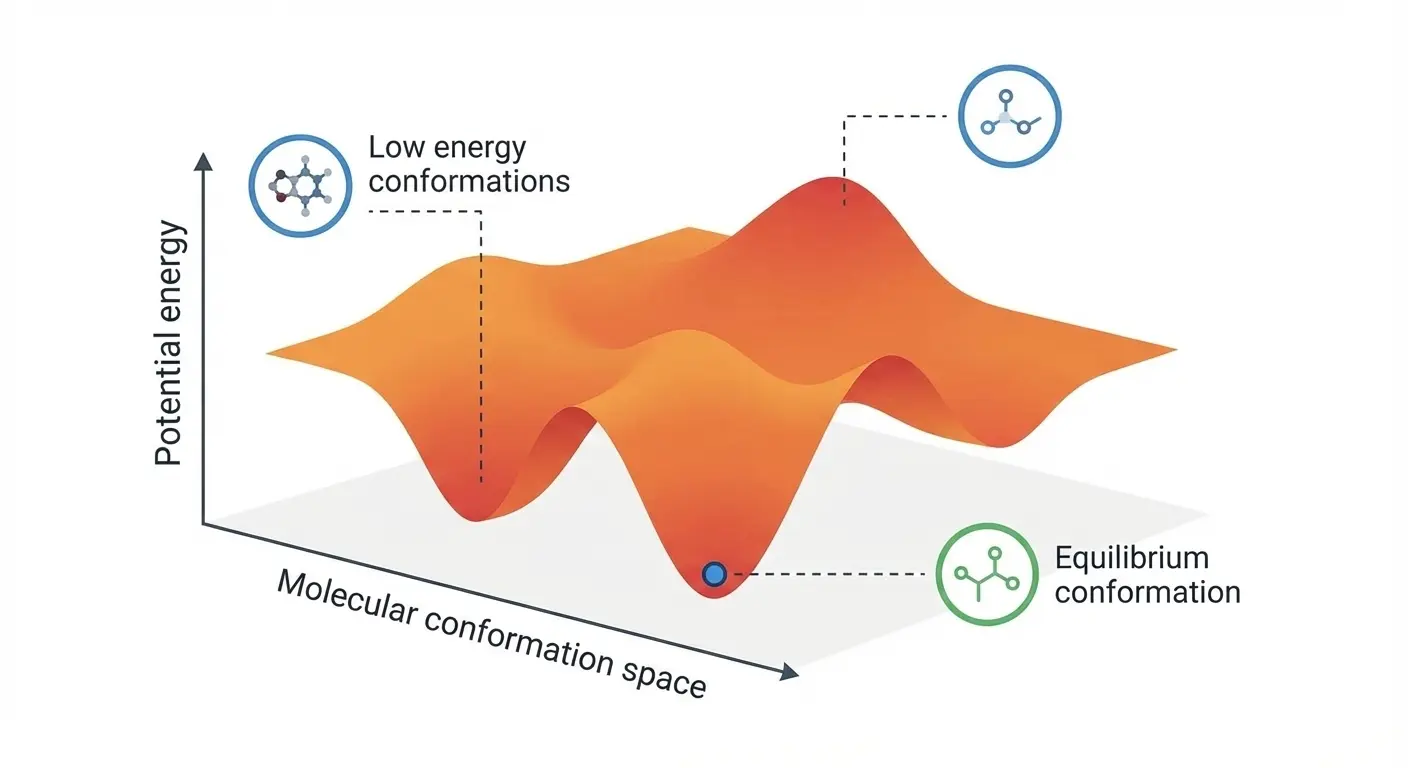
Contribution: Systematic Assessment of Non-Conservative ML Force Models
This is a Systematization paper. It systematically catalogs the exact failure modes of existing non-conservative force approaches, quantifies them with a new diagnostic metric, and proposes a hybrid Multiple Time-Stepping solution combining the speed benefits of direct force prediction with the physical correctness of conservative models.
Motivation: The Speed-Accuracy Trade-off in ML Force Fields
Many recent machine learning interatomic potential (MLIP) architectures predict forces directly ($F_\theta(r)$). This “non-conservative” approach avoids the computational overhead of automatic differentiation, yielding faster inference (typically 2-3x speedup) and faster training (up to 3x). However, it sacrifices energy conservation and rotational constraints, potentially destabilizing molecular dynamics simulations. The field lacks rigorous quantification of when this trade-off breaks down and how to mitigate the failures.
Novelty: Jacobian Asymmetry and Hybrid Architectures
Four key contributions:
Jacobian Asymmetry Metric ($\lambda$): A quantitative diagnostic for non-conservation. Since conservative forces derive from a scalar field, their Jacobian (the Hessian of energy) must be symmetric. The normalized norm of the antisymmetric part quantifies the degree of violation: $$ \lambda = \frac{|| \mathbf{J}_{\text{anti}} ||_F}{|| \mathbf{J} ||_F} $$ where $\mathbf{J}_{\text{anti}} = (\mathbf{J} - \mathbf{J}^\top)/2$. Measured values range from $\lambda \approx 0.004$ (PET-NC) to $\lambda \approx 0.032$ (SOAP-BPNN-NC), with ORB at 0.015 and EquiformerV2 at 0.017. Notably, the pairwise $\lambda_{ij}$ approaches 1 at large interatomic distances, meaning non-conservative artifacts disproportionately affect long-range and collective interactions.
Systematic Failure Mode Catalog: First comprehensive demonstration that non-conservative models cause runaway heating in NVE ensembles (temperature drifts of ~7,000 billion K/s for PET-NC and ~10x larger for ORB) and equipartition violations in NVT ensembles where different atom types equilibrate to different temperatures, a physical impossibility.
Theoretical Analysis of Force vs. Energy Training: Force-only training overemphasizes high-frequency vibrational modes because force labels carry per-atom gradients that are dominated by stiff, short-range interactions. Energy labels provide a more balanced representation across the frequency spectrum. Additionally, conservative models benefit from backpropagation extending the effective receptive field to approximately 2x the interaction cutoff, while direct-force models are limited to the nominal cutoff radius.
Hybrid Training and Inference Protocol: A practical workflow that combines fast direct-force prediction with conservative corrections:
- Training: Pre-train on direct forces, then fine-tune on energy gradients (2-4x faster than training conservative models from scratch)
- Inference: Multiple Time-Stepping (MTS) where fast non-conservative forces are periodically corrected by slower conservative forces
Methodology: Systematic Failure Mode Analysis
The evaluation systematically tests multiple state-of-the-art models across diverse simulation scenarios:
Models tested:
- PET-C/PET-NC (Point Edge Transformer, conservative and non-conservative variants)
- PET-M (hybrid variant jointly predicting both conservative and non-conservative forces)
- ORB-v2 (non-conservative, trained on Alexandria/MPtrj)
- EquiformerV2 (non-conservative equivariant Transformer)
- MACE-MP-0 (conservative message-passing)
- SevenNet (conservative message-passing)
- SOAP-BPNN-C/SOAP-BPNN-NC (descriptor-based baseline, both conservative and non-conservative variants)
Test scenarios:
- NVE stability tests on bulk liquid water, graphene, amorphous carbon, and FCC aluminum
- Thermostat artifact analysis with Langevin and GLE thermostats
- Geometry optimization on water snapshots and QM9 molecules using FIRE and L-BFGS
- MTS validation on OC20 catalysis dataset
- Species-resolved temperature measurements for equipartition testing
Key metrics:
- Jacobian asymmetry ($\lambda$)
- Kinetic temperature drift in NVE
- Velocity-velocity correlations
- Radial distribution functions
- Species-resolved temperatures
- Inference speed benchmarks
Results: Simulation Instability and Hybrid Solutions
Purely non-conservative models are unsuitable for production simulations due to uncontrollable unphysical artifacts that no thermostat can correct. Key findings:
Performance failures:
- Non-conservative models exhibited catastrophic temperature drift in NVE simulations: ~7,000 billion K/s for PET-NC and ~70,000 billion K/s for ORB, with EquiformerV2 comparable to PET-NC
- Strong Langevin thermostats ($\tau=10$ fs) damped diffusion by ~5x, negating the speed benefits of non-conservative models
- Advanced GLE thermostats also failed to control non-conservative drift (ORB reached 1181 K vs. 300 K target)
- Equipartition violations: under stochastic velocity rescaling, O and H atoms equilibrated at different temperatures. For ORB, H atoms reached 336 K and O atoms 230 K against a 300 K target. For PET-NC, deviations were smaller but still significant (H at 296 K, O at 310 K).
- Geometry optimization was more fragile with non-conservative forces: inaccurate NC models (SOAP-BPNN-NC) failed catastrophically, while more accurate ones (PET-NC) could converge with FIRE but showed large force fluctuations with L-BFGS. Non-conservative models consistently had lower success rates across water and QM9 benchmarks.
Hybrid solution success:
- MTS with non-conservative forces corrected every 8 steps ($M=8$) achieved conservative stability with only ~20% overhead compared to a purely non-conservative trajectory. Results were essentially indistinguishable from fully conservative simulations. Higher stride values ($M=16$) became unstable due to resonances between fast degrees of freedom and integration errors.
- Conservative fine-tuning achieved the accuracy of from-scratch training in about 1/3 the total training time (2-4x resource reduction)
- Validated on OC20 catalysis benchmark
Scaling caveat: The authors note that as training datasets grow and models become more expressive, non-conservative artifacts should diminish because accurate models naturally exhibit less non-conservative behavior. However, they argue the best path forward is hybrid approaches rather than waiting for scale to solve the problem.
Recommendation: The optimal production path is hybrid architectures using direct forces for acceleration (via MTS and pre-training) while anchoring models in conservative energy surfaces. This captures computational benefits without sacrificing physical reliability.
Reproducibility Details
Data
Primary training/evaluation:
- Bulk Liquid Water (Cheng et al., 2019): revPBE0-D3 calculations with over 250,000 force/energy targets, chosen for rigorous thermodynamic testing
Generalization tests:
- Graphene, amorphous carbon, FCC aluminum (tested with general-purpose foundation models)
Benchmarks:
- QM9: Geometry optimization tests
- OC20 (Open Catalyst): Oxygen on alloy surfaces for MTS validation
All datasets publicly available through cited sources.
Models
Point Edge Transformer (PET) variants:
- PET-C (Conservative): Forces via energy backpropagation
- PET-NC (Non-Conservative): Direct force prediction head, slightly higher parameter count
- PET-M (Hybrid): Jointly predicts both conservative and non-conservative forces, accuracy within ~10% of the best single-task models
Baseline comparisons:
| Model | Type | Training Data | Notes |
|---|---|---|---|
| ORB-v2 | Non-conservative | Alexandria/MPtrj | Rotationally unconstrained |
| EquiformerV2 | Non-conservative | Alexandria/MPtrj | Equivariant Transformer |
| MACE-MP-0 | Conservative | MPtrj | Equivariant message-passing |
| SevenNet | Conservative | MPtrj | Equivariant message-passing |
| SOAP-BPNN-C | Conservative | Bulk water | Descriptor-based baseline |
| SOAP-BPNN-NC | Non-conservative | Bulk water | Descriptor-based baseline |
Training details:
- Loss functions: PET-C uses joint Energy + Force $L^2$ loss; PET-NC uses Force-only $L^2$ loss
- Fine-tuning protocol: PET-NC converted to conservative via energy head fine-tuning
- MTS configuration: Non-conservative forces with conservative corrections every 8 steps ($M=8$)
Evaluation
Metrics & Software: Molecular dynamics evaluations were performed using i-PI, while geometry optimizations used ASE (Atomic Simulation Environment). Note that primary code reproducibility is provided via an archived Zenodo snapshot; the authors did not link a live, public GitHub repository.
- Jacobian asymmetry ($\lambda$): Quantifies non-conservation via antisymmetric component
- Temperature drift: NVE ensemble stability
- Velocity-velocity correlation ($\hat{c}_{vv}(\omega)$): Thermostat artifact detection
- Radial distribution functions ($g(r)$): Structural accuracy
- Species-resolved temperature: Equipartition testing
- Inference speed: Wall-clock time per MD step
Key results:
| Model | Speed (ms/step) | NVE Stability | Notes |
|---|---|---|---|
| PET-NC | 8.58 | Failed | ~7,000 billion K/s drift |
| PET-C | 19.4 | Stable | 2.3x slower than PET-NC |
| SevenNet | 52.8 | Stable | Conservative baseline |
| PET Hybrid (MTS) | ~10.3 | Stable | ~20% overhead vs. pure NC |
Thermostat artifacts:
- Langevin ($\tau=10$ fs) dampened diffusion by ~5x (weaker coupling at $\tau=100$ fs reduced diffusion by ~1.5x)
- GLE thermostats also failed to control non-conservative drift
- Equipartition violations under SVR: ORB showed H at 336 K and O at 230 K (target 300 K); PET-NC showed smaller but significant species-resolved deviations
Optimization failures:
- Non-conservative models showed lower geometry optimization success rates across water and QM9 benchmarks, with inaccurate NC models failing catastrophically
Hardware
Compute resources:
- Training: From-scratch baseline models were trained using 4x Nvidia H100 GPUs (over a duration of around two days).
- Fine-Tuning: Conservative fine-tuning was performed using a single (1x) Nvidia H100 GPU for a duration of one day.
- This hybrid fine-tuning approach achieved a 2-4x reduction in computational resources compared to training conservative models from scratch.
Reproduction resources:
| Artifact | Type | License | Notes |
|---|---|---|---|
| Zenodo repository | Code/Data | Unknown | Code and data to reproduce all results |
| MTS inference tutorial | Other | Unknown | Multiple time-stepping dynamics tutorial |
| Conservative fine-tuning tutorial | Other | Unknown | Fine-tuning workflow tutorial |
Paper Information
Citation: Bigi, F., Langer, M. F., & Ceriotti, M. (2025). The dark side of the forces: assessing non-conservative force models for atomistic machine learning. Proceedings of the 42nd International Conference on Machine Learning (ICML).
Publication: ICML 2025
@inproceedings{bigi2025dark,
  title={The dark side of the forces: assessing non-conservative force models for atomistic machine learning},
  author={Bigi, Filippo and Langer, Marcel F and Ceriotti, Michele},
  booktitle={Proceedings of the 42nd International Conference on Machine Learning},
  year={2025}
}
Additional Resources: