Scientific Typology: Computational Discovery
This is primarily a Discovery ($\Psi_{\text{Discovery}}$) paper, with strong supporting contributions as a Method ($\Psi_{\text{Method}}$) evaluation. The primary contribution is the validation and mechanistic visualization of the “exchange mechanism” for surface diffusion using computational methods (Molecular Dynamics with many-body potentials). This physical phenomenon was previously observed in Field Ion Microscope (FIM) experiments but difficult to characterize dynamically. The paper focuses on determining how atoms move, specifically distinguishing between hopping and exchange mechanisms.
The Field Ion Microscope (FIM) Observation Gap
Surface diffusion is critical for understanding phenomena like crystal growth, epitaxy, and catalysis. Experimental evidence from FIM on fcc(001) surfaces (specifically Pt and Ir) suggested an “exchange mechanism” where an adatom replaces a substrate atom, challenging the conventional wisdom that adatoms migrate by hopping over potential barriers (bridge sites) between binding sites. The authors sought to:
- Investigate whether this exchange mechanism could be reproduced dynamically in simulation.
- Determine which interatomic potentials (EAM, Sutton-Chen, R-G-L) accurately describe these surface behaviors compared to bulk properties.
Dynamic Visualization of Atomic Exchange
The study provides a direct dynamic visualization of the “concerted motion” involved in exchange diffusion events, which happens on timescales too fast for experimental imaging. By comparing three different many-body potentials, the authors demonstrate that the choice of potential is critical for capturing surface phenomena; specifically, identifying that “bulk” derived potentials (like Sutton-Chen) may fail to capture specific surface exchange events that EAM and R-G-L potentials successfully model.
Simulation Protocol & Evaluated Potentials
The authors performed Molecular Dynamics (MD) simulations on Iridium (Ir) surfaces:
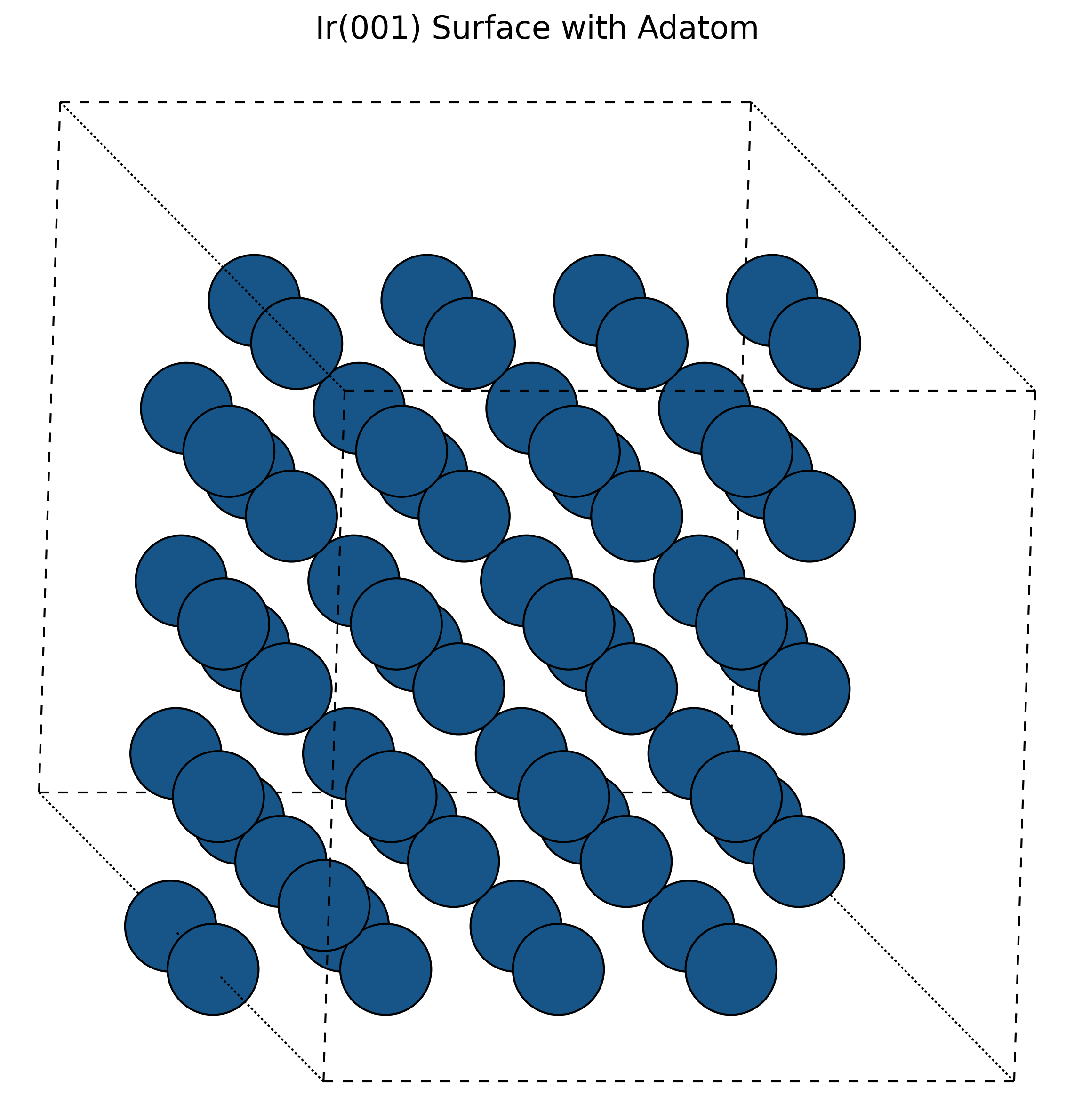
- Surfaces: Channeled (110), densely packed (111), and loosely packed (001).
- Potentials: Three many-body models were tested: Embedded Atom Method (EAM), Sutton-Chen (S-C), and Rosato-Guillope-Legrand (R-G-L).
- Conditions: Simulations were primarily run at $T=800$ K to ensure sufficient sampling of diffusion events.
- Cross-Validation: The study extended the analysis to Cu, Rh, and Pt systems to verify the universality of the exchange mechanism against experimental data.
Confirmation of Concerted Motion Mechanisms
- Mechanism Confirmation: The study confirmed that diffusion on Ir(001) proceeds via an atomic exchange mechanism (concerted motion). The activation energy for exchange ($0.77$ eV) was found to be significantly lower than for hopping over bridge sites ($1.57$ eV).
- Surface Structure Dependence:
- Ir(111): Diffusion is rapid (activation energy $V_a = 0.17$ eV from R-G-L Arrhenius plot) and occurs exclusively via hopping; no exchange events were observed due to the close-packed nature of the surface.
- Ir(110): Diffusion is anisotropic; atoms hop along channels but use the exchange mechanism to move across channels.
- Potential Validity: The R-G-L and EAM potentials successfully reproduced experimental exchange behaviors, whereas the Sutton-Chen potential failed to predict exchange on Ir(001). The authors attribute the S-C failure primarily to the use of “bulk” potential parameters to describe interactions at the surface.
- Cross-System Comparison: The study extended the analysis to Cu, Rh, and Pt systems. Both S-C and R-G-L potentials correctly predicted the absence of exchange on all three Rh surfaces and on (111) surfaces of Cu and Pt. Exchange events were correctly predicted on Cu(001), Cu(110), Pt(001), and Pt(110) by both potentials. The sole discrepancy was S-C failing to predict exchange on Ir(001), where R-G-L and EAM succeeded in agreement with experiment.
Reproducibility Details
Algorithms
- Integration: “Velocity” form of the Verlet algorithm.
- Time Step: $\Delta t = 0.01$ ps ($10^{-14}$ s).
- Simulation Protocol:
- Quenching: System relaxed to 0 K by zeroing velocities when $v \cdot F < 0$.
- Equilibration: 5 ps constant-temperature run (renormalizing velocities every step).
- Production: 15 ps constant-energy (microcanonical) run where trajectories are collected.
Models
The study relies on three specific many-body potential formulations:
- Embedded Atom Method (EAM):
- Total energy: $$U_{tot} = \sum_i F_i(\rho_i) + \frac{1}{2} \sum_{j \neq i} \phi_{ij}(r_{ij})$$
- Sutton-Chen (S-C):
- Uses a square root density dependence and power-law pair repulsion $(a/r)^{n}$: $$F(\rho) \propto \rho^{1/2}$$
- Rosato-Guillope-Legrand (R-G-L):
- Born-Mayer type repulsion: $$\phi_{ij}(r) = A \exp[-p(r/r_0 - 1)]$$
- Attractive band energy: $$F_i(\rho) = -\left(\sum \xi^2 \exp[-2q(r/r_0 - 1)]\right)^{1/2}$$
Data
- System Size: 648 classical atoms.
- Geometry:
- Cubic box with fixed volume.
- Periodic boundary conditions in $x$ and $y$ (parallel to surface), free motion in $z$.
- Substrate depth: 8, 12, or 9 atomic layers depending on orientation [(001), (110), (111)].
- Cutoff Radius: 14 bohr ($\sim 7.4$ Å).
- Initial Conditions: Velocities initialized from a Maxwellian distribution.
Evaluation
- Diffusion Constant ($D$): Calculated using the Einstein relation via Mean Square Displacement (MSD): $$D = \lim_{t \to \infty} \frac{\langle \Delta r^2(t) \rangle}{2td}$$ where $d=2$ for surface diffusion.
- Activation Energy ($V_a$): Extracted from the slope of Arrhenius plots ($\ln D$ vs $1/T$).
- Attempt Frequency ($\nu$): Estimated via harmonic approximation: $\nu = \frac{1}{2\pi}\sqrt{c/M}$.
Paper Information
Citation: Shiang, K.-D., Wei, C. M., & Tsong, T. T. (1994). A molecular dynamics study of self-diffusion on metal surfaces. Surface Science, 301(1-3), 136-150. https://doi.org/10.1016/0039-6028(94)91295-5
Publication: Surface Science 1994
@article{shiang1994molecular,
  title={A molecular dynamics study of self-diffusion on metal surfaces},
  author={Shiang, Keh-Dong and Wei, C.M. and Tsong, Tien T.},
  journal={Surface Science},
  volume={301},
  number={1-3},
  pages={136--150},
  year={1994},
  publisher={Elsevier},
  doi={10.1016/0039-6028(94)91295-5}
}