Classification: Discovery of Diffusion Mechanisms
Discovery (Translational Basis)
This paper applies a computational method (Molecular Dynamics) to observe and characterize a physical phenomenon: the specific diffusion mechanisms of adatom dimers on a crystal surface. It focuses on the “what was found” (simultaneous multiple jumps).
Based on the AI for Physical Sciences Paper Taxonomy, this is best classified as $\Psi_{\text{Discovery}}$ with a minor superposition of $\Psi_{\text{Method}}$ (approximately 80% Discovery, 20% Method). The dominant contribution is the application of computational tools to observe physical phenomena, while secondarily demonstrating MD’s capability for surface diffusion problems in an era when the technique was still developing.
Bridging the Intermediate Temperature Data Gap
The study aims to investigate the behavior of adatom dimers in an intermediate temperature range ($0.3T_m$ to $0.6T_m$). At the time, Field Ion Microscopy (FIM) provided data at low temperatures ($T \le 0.2T_m$), and previous simulations had studied single adatoms on various surfaces including (111), (110), and (100), but not dimers on (111). The authors sought to compare dimer mobility with single adatom mobility on the (111) surface, where single adatoms move almost like free particles.
Observation of Simultaneous Multiple Jumps
The core contribution is the observation of simultaneous multiple jumps for dimers on the (111) surface at intermediate temperatures. The study reveals that:
- Dimers migrate as a whole entity, with both atoms jumping simultaneously
- The mobility of dimers (center of mass) is very close to that of single adatoms in this regime.
Molecular Dynamics Simulation Design
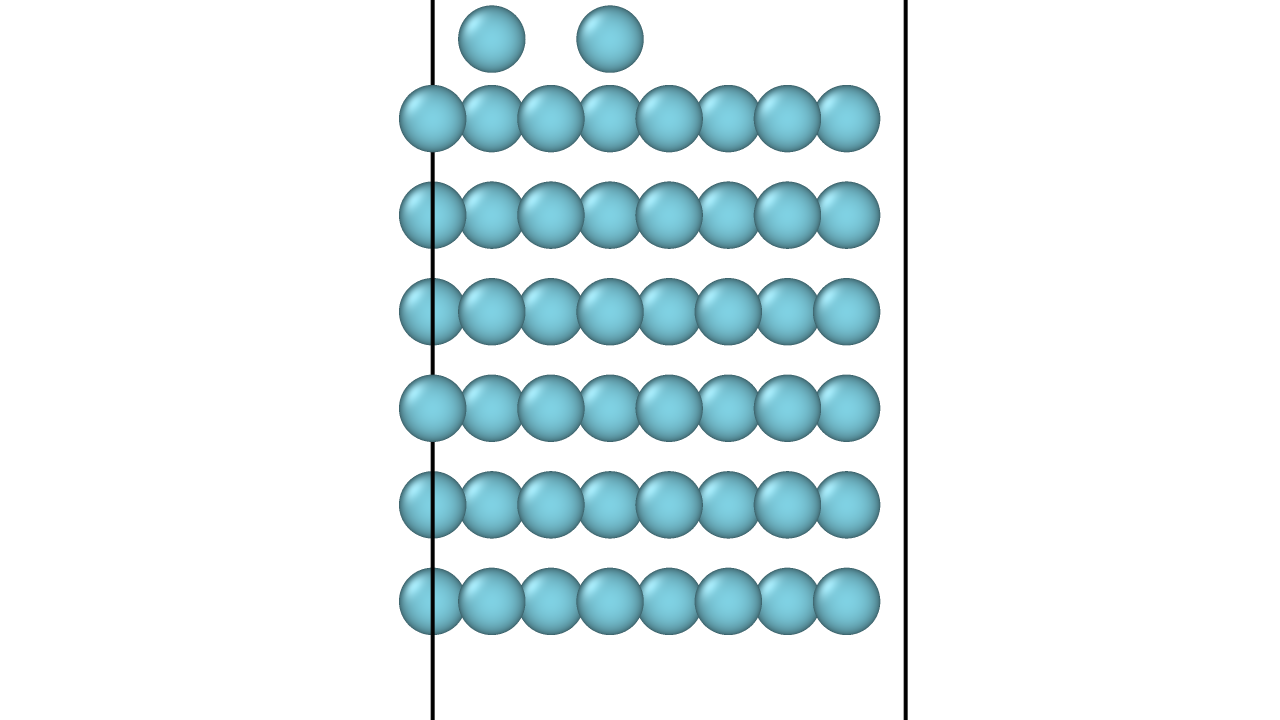
The authors performed Molecular Dynamics (MD) simulations of a face-centred cubic (fcc) crystallite:
- System: A single crystallite of 192 atoms bounded by two free (111) surfaces
- Temperature Range: $0.22 \epsilon/k$ to $0.40 \epsilon/k$ (approximately $0.3T_m$ to $0.6T_m$)
- Duration: Integration over 50,000 time steps
- Comparison: Results were compared against single adatom diffusion data and Einstein’s diffusion relation
Outcomes on Mobility and Migration Dynamics
- Mechanism Transition: At low temperatures ($T^\ast=0.22$), diffusion occurs via discrete single jumps where adatoms rotate or extend bonds. At higher temperatures, the “multiple jump” mechanism becomes preponderant.
- Migration Style: The dimer migrates essentially by extending its bond along the $\langle 110 \rangle$ direction.
- Mobility: The diffusion coefficient of dimers is quantitatively similar to single adatoms.
- Qualitative Support: The results support Bonzel’s hypothesis of delocalized diffusion involving energy transfer between translation and rotation. The authors attempted to quantify the coupling using the cross-correlation function:
$$g(t) = C \langle E_T(t) , E_R(t + t’) \rangle$$
where $C$ is a normalization constant, $E_T$ is the translational energy of the center of mass, and $E_R$ is the rotational energy of the dimer. However, the average lifetime of a dimer (2% to 15% of the total calculation time in the studied temperature range) was too short to allow a statistically significant study of this coupling.
- Dimer Concentration: The contribution of dimers to mass transport depends on their concentration. As a first approximation, the dimer concentration is expressed as:
$$C = C_0 \exp\left[\frac{-2E_f - E_d}{k_B T}\right]$$
where $E_f$ is the formation energy of adatoms and $E_d$ is the binding energy of a dimer. If the binding energy is sufficiently strong, dimer contributions should be accounted for even in the intermediate temperature range ($0.3T_m$ to $0.6T_m$).
Reproducibility Details
Data (Simulation Setup)
Because this is an early computational study, “data” refers to the initial structural configuration. The simulation begins with an algorithmically generated generic fcc(111) lattice containing two adatoms as the initial state.

| Parameter | Value | Notes |
|---|---|---|
| Particles | 192 atoms | Single fcc crystallite |
| Dimensions | $4[110] \times 4[112]$ | Thickness of 6 planes |
| Boundary | Periodic (x, y) | Free surface in z-direction |
| Initial State | Dimer on neighbor sites | Starts with 2 adatoms |
Algorithms
The simulation relies on standard Molecular Dynamics integration techniques. Historical source code is absent. Complete reproducibility is achievable today utilizing modern open-source tools like LAMMPS with standard lj/cut pair styles and NVE/NVT ensembles.
- Integration Scheme: Central difference algorithm (Verlet algorithm)
- Time Step: $\Delta t^\ast = 0.01$ (reduced units)
- Total Steps: 50,000 integration steps
- Dimer Definition: Two adatoms are considered a dimer if their distance $r \le r_c = 2\sigma$
Models (Analytic Potential)
The physics are modeled using a classic Lennard-Jones potential.
Potential Form: (12, 6) Lennard-Jones $$ V(r) = 4\epsilon \left[ \left(\frac{\sigma}{r}\right)^{12} - \left(\frac{\sigma}{r}\right)^6 \right] $$
Parameters (Argon-like):
- $\epsilon/k = 119.5$ K
- $\sigma = 3.4478$ Å
- $m = 39.948$ a.u.
- Cut-off radius: $2\sigma$
Evaluation
Metrics used to quantify the diffusion behavior:
| Metric | Formula | Notes |
|---|---|---|
| Diffusion Coefficient | $D = \frac{\langle R^2 \rangle}{4t}$ | Calculated from Mean Square Displacement of center of mass |
| Trajectory Analysis | Visual inspection | Categorized into “fast migration” (multiple jumps) or “discrete jumps” |
Hardware
- Specifics: Unspecified in the original text.
- Scale: 192 particles simulated for 50,000 steps is extremely lightweight by modern standards. A standard laptop CPU executes this workload in under a second, providing a strong contrast to the mainframe computing resources required in 1984.
Paper Information
Citation: Ghaleb, D. (1984). Diffusion of adatom dimers on (111) surface of face centred crystals: A molecular dynamics study. Surface Science, 137(2), L103-L108. https://doi.org/10.1016/0039-6028(84)90515-6
Publication: Surface Science 1984
@article{ghalebDiffusionAdatomDimers1984,
  title = {Diffusion of Adatom Dimers on (111) Surface of Face Centred Crystals: A Molecular Dynamics Study},
  author = {Ghaleb, Dominique},
  year = {1984},
  journal = {Surface Science},
  volume = {137},
  number = {2},
  pages = {L103-L108},
  doi = {10.1016/0039-6028(84)90515-6}
}