Natural Language Processing
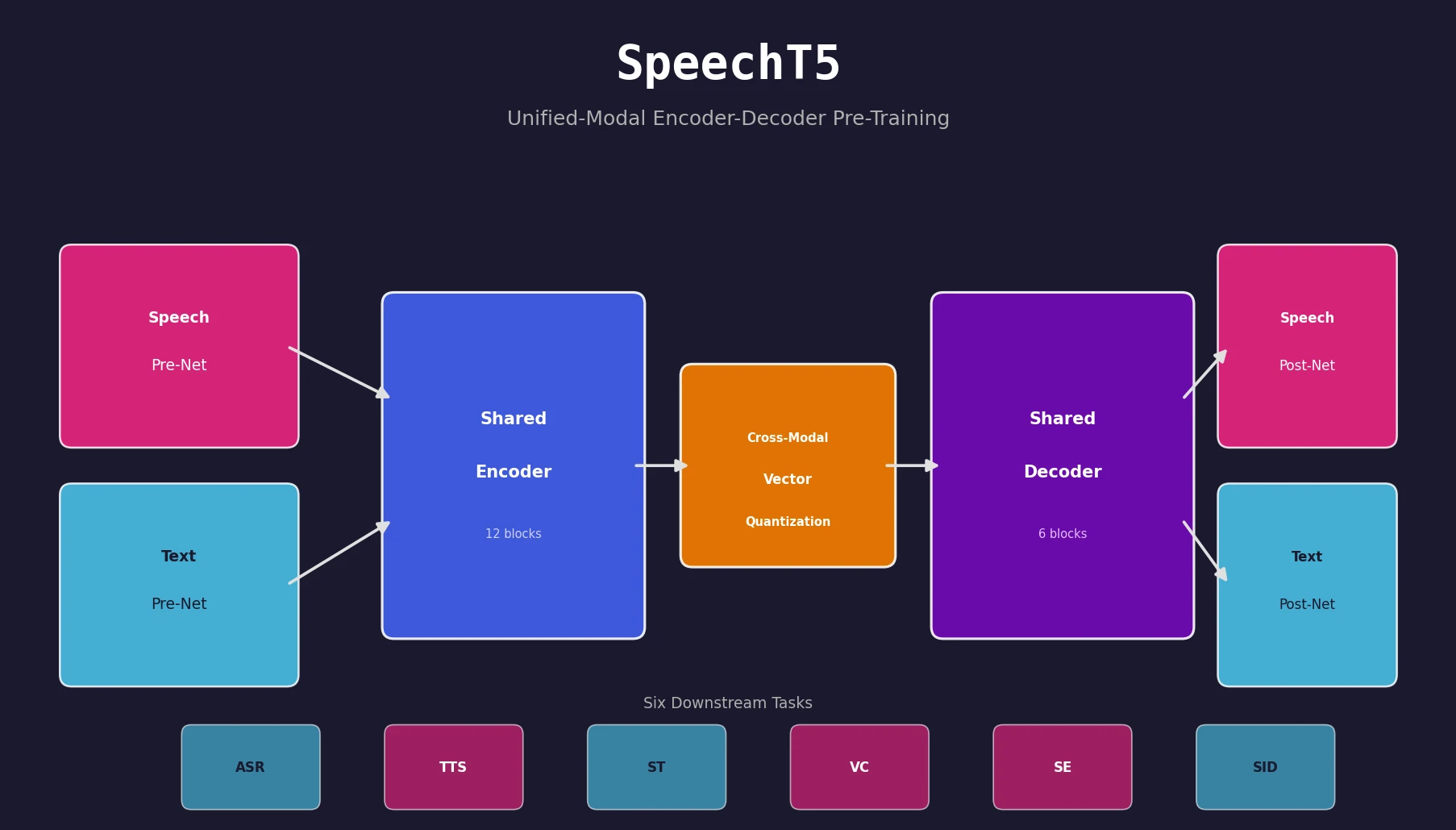
SpeechT5 architecture diagram showing shared encoder-decoder with speech and text pre/post-nets

SpeechT5: Unified Speech-Text Pre-Training Framework

SpeechT5 proposes a unified encoder-decoder pre-training framework that jointly learns from unlabeled speech and text data, achieving strong results on ASR, TTS, speech translation, voice conversion, speech enhancement, and speaker identification.
Natural Language Processing
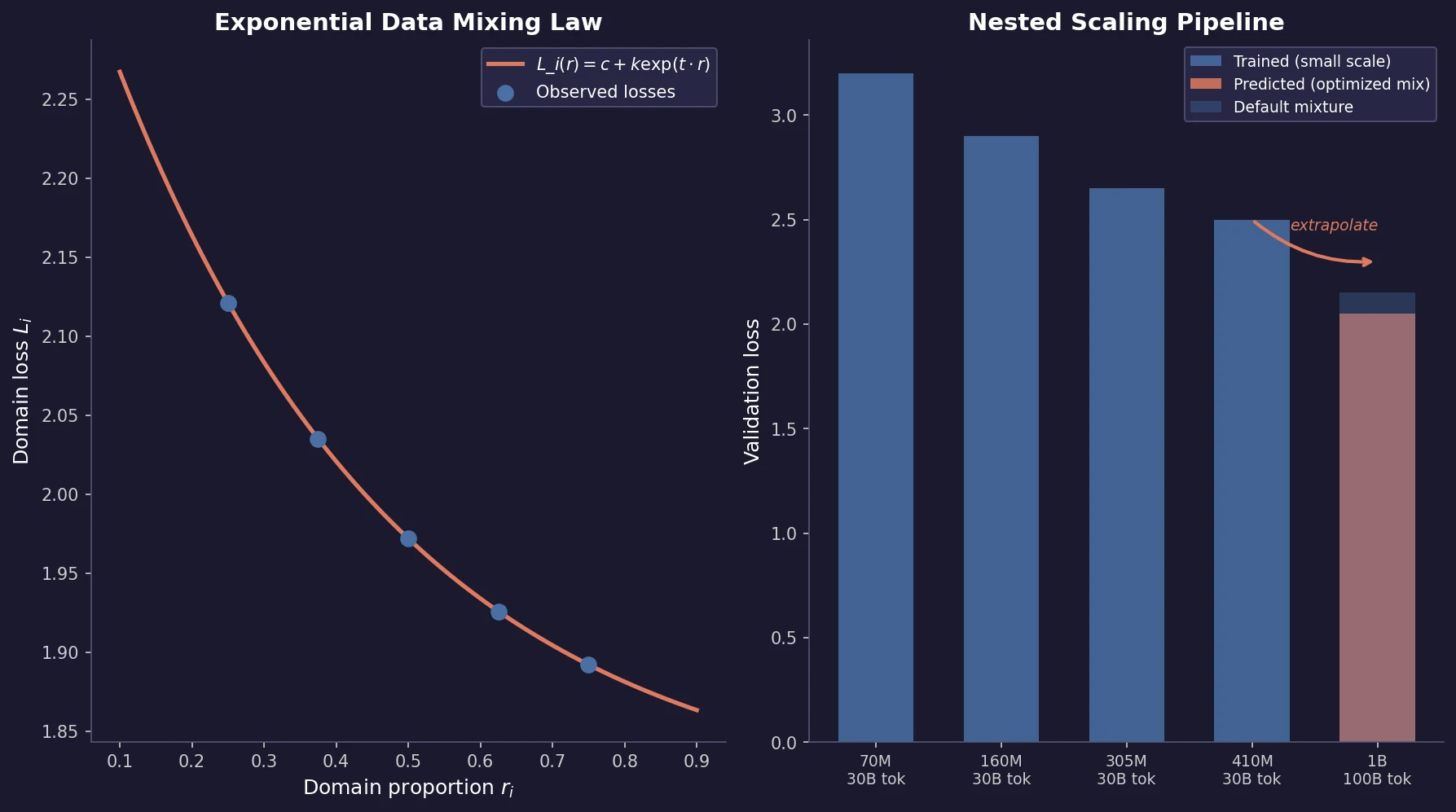
Diagram showing the three-step nested pipeline from small-scale training to large-model loss prediction across data mixtures

Data Mixing Laws for LM Pretraining Optimization

Ye et al. find that language model loss on each domain follows an exponential function of training mixture proportions. By nesting data mixing laws with scaling laws for steps and model size, small-scale experiments can predict and optimize mixtures for large models, achieving 48% training efficiency gains.

Natural Language Processing
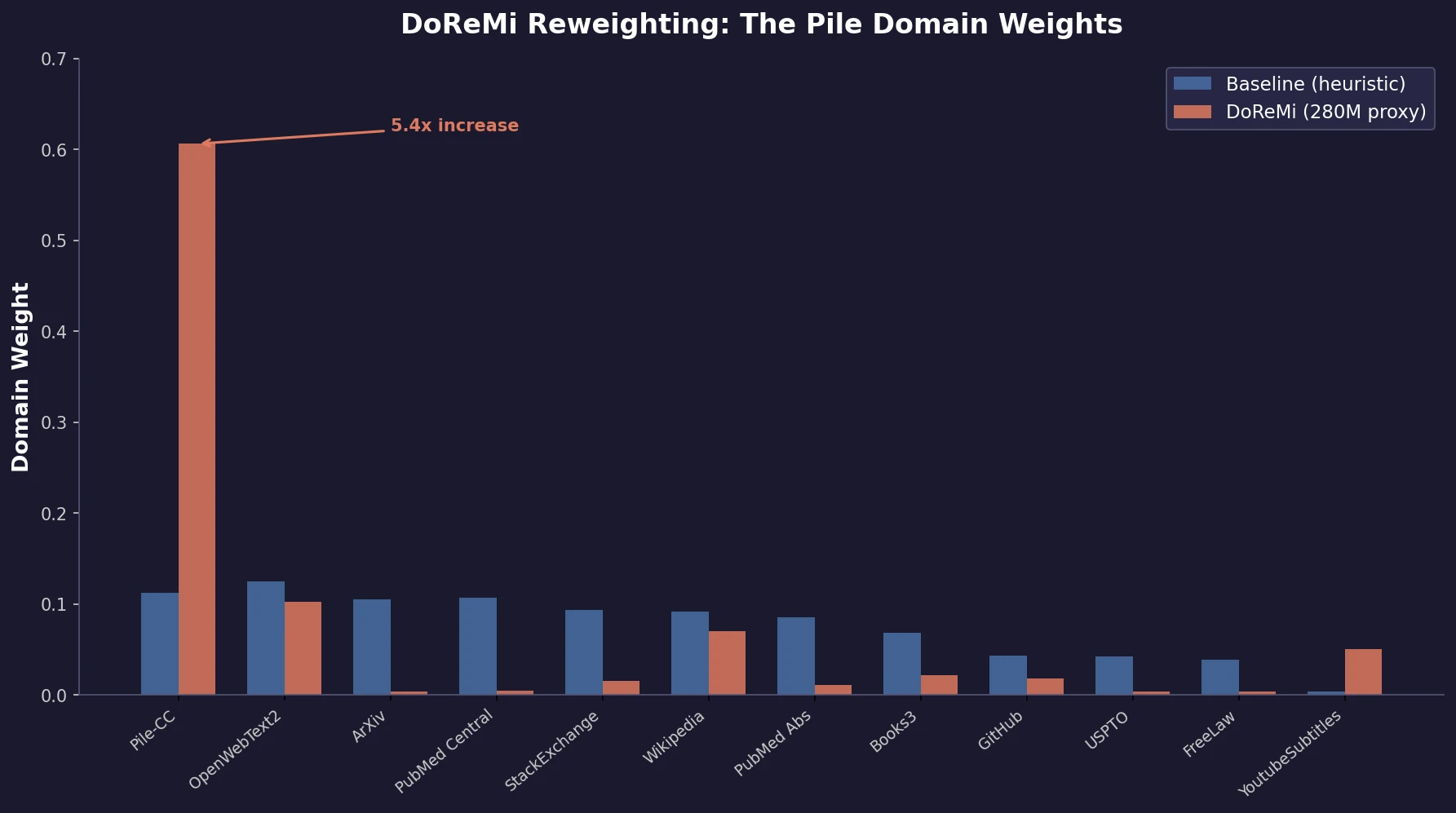
Bar chart comparing baseline and DoReMi domain weights across 12 Pile domains, showing Pile-CC upweighted 5.4x

DoReMi: Optimizing Data Mixtures for LM Pretraining

Xie et al. propose DoReMi, which trains a 280M proxy model using Group DRO to find optimal domain mixture weights, then uses those weights to train an 8B model 2.6x faster with 6.5% better downstream accuracy.

Natural Language Processing
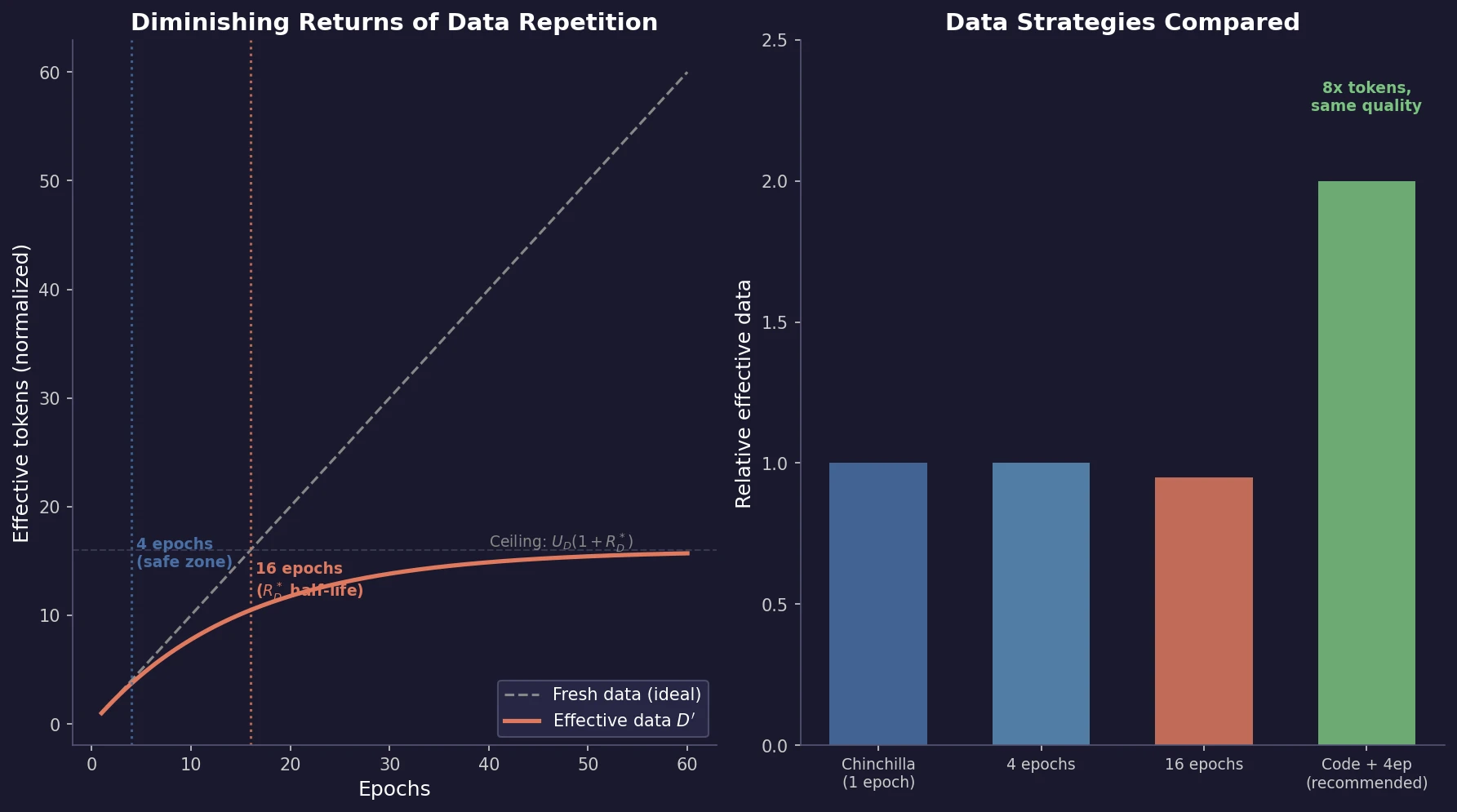
Chart showing effective data as a function of epochs with exponential decay, with the 4-epoch safe zone and 16-epoch half-life marked

Scaling Data-Constrained Language Models

Muennighoff et al. train 400+ models to study how data repetition affects scaling. They propose a data-constrained scaling law with exponential decay for repeated tokens, finding that up to 4 epochs have negligible impact on loss, returns diminish around 16 epochs, and code augmentation provides a 2x effective data boost.

Natural Language Processing
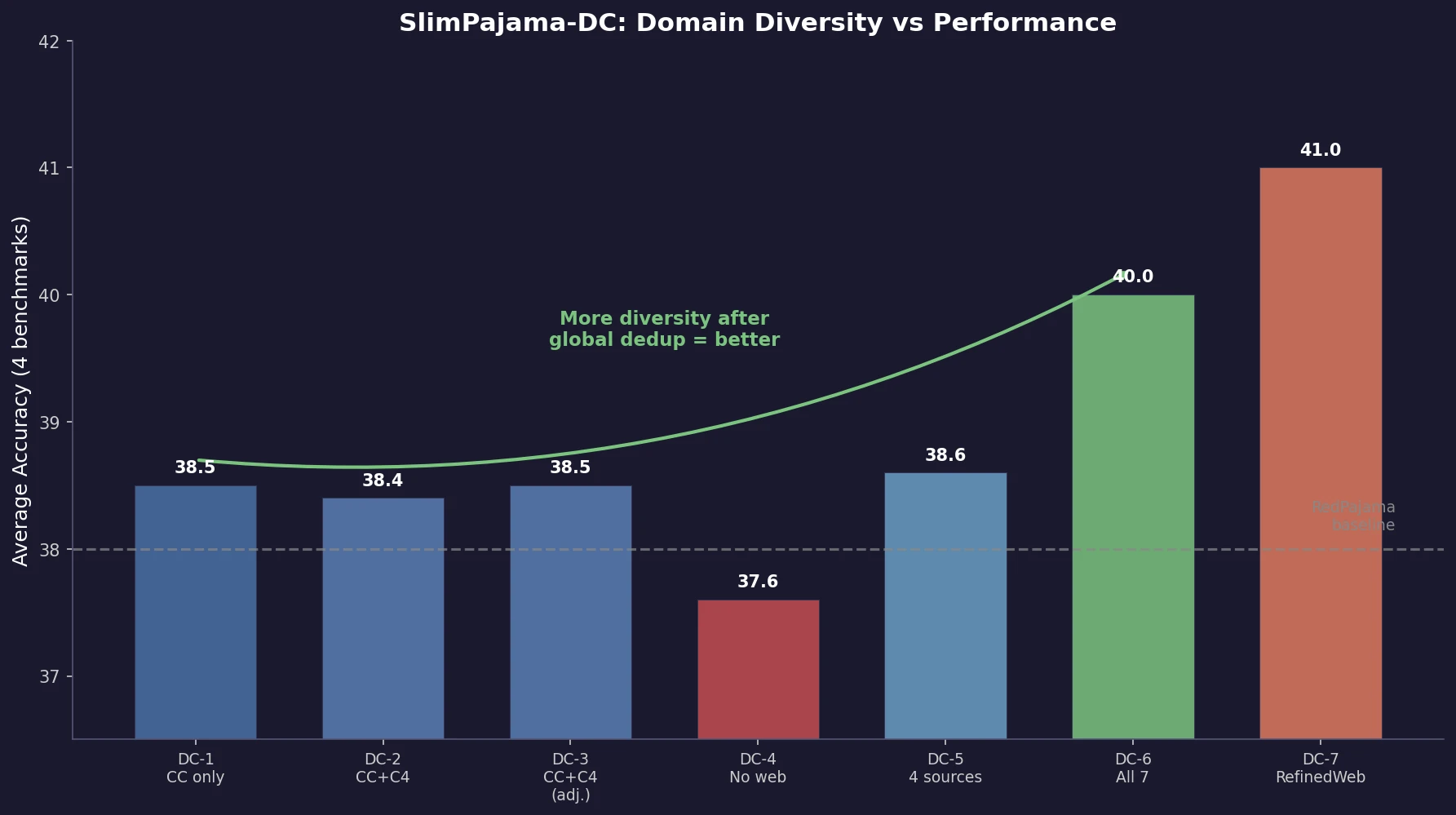
Bar chart comparing average benchmark accuracy across seven domain combination configurations showing diversity improves performance

SlimPajama-DC: Data Combinations for LLM Training

Shen et al. empirically analyze how different domain combinations and deduplication strategies in the SlimPajama dataset affect 1.3B model performance. Global deduplication across sources outperforms local deduplication, and increasing domain diversity consistently improves average accuracy, with findings transferring to 7B scale.

Natural Language Processing
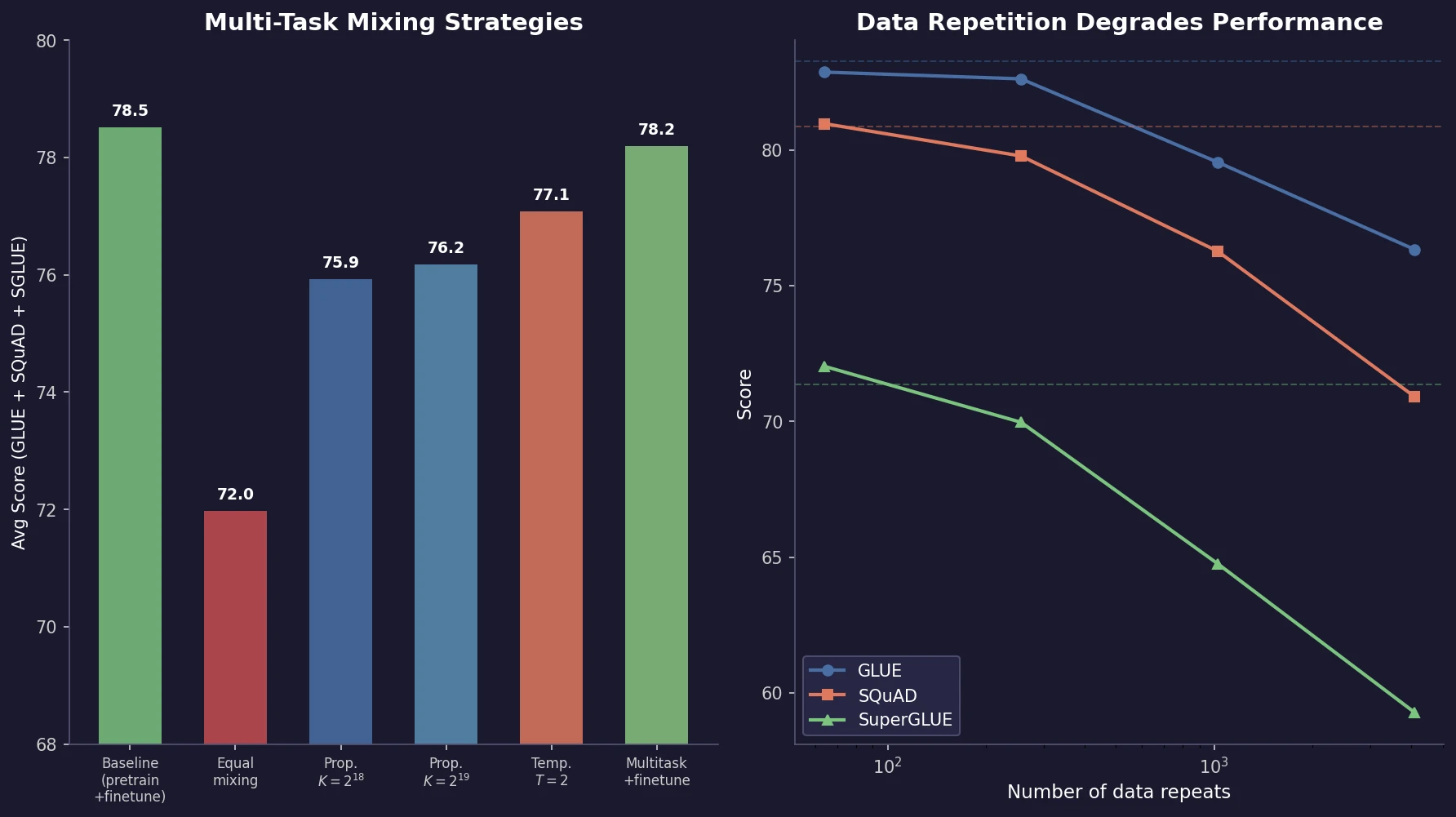
Table comparing multi-task mixing strategies showing examples-proportional and temperature-scaled mixing results

T5: Exploring Transfer Learning Limits

Raffel et al. introduce T5, a unified text-to-text framework for NLP transfer learning. Through systematic ablation of architectures, pre-training objectives, datasets, and multi-task mixing strategies, they identify best practices and scale to 11B parameters, achieving state-of-the-art results across multiple benchmarks.

Natural Language Processing
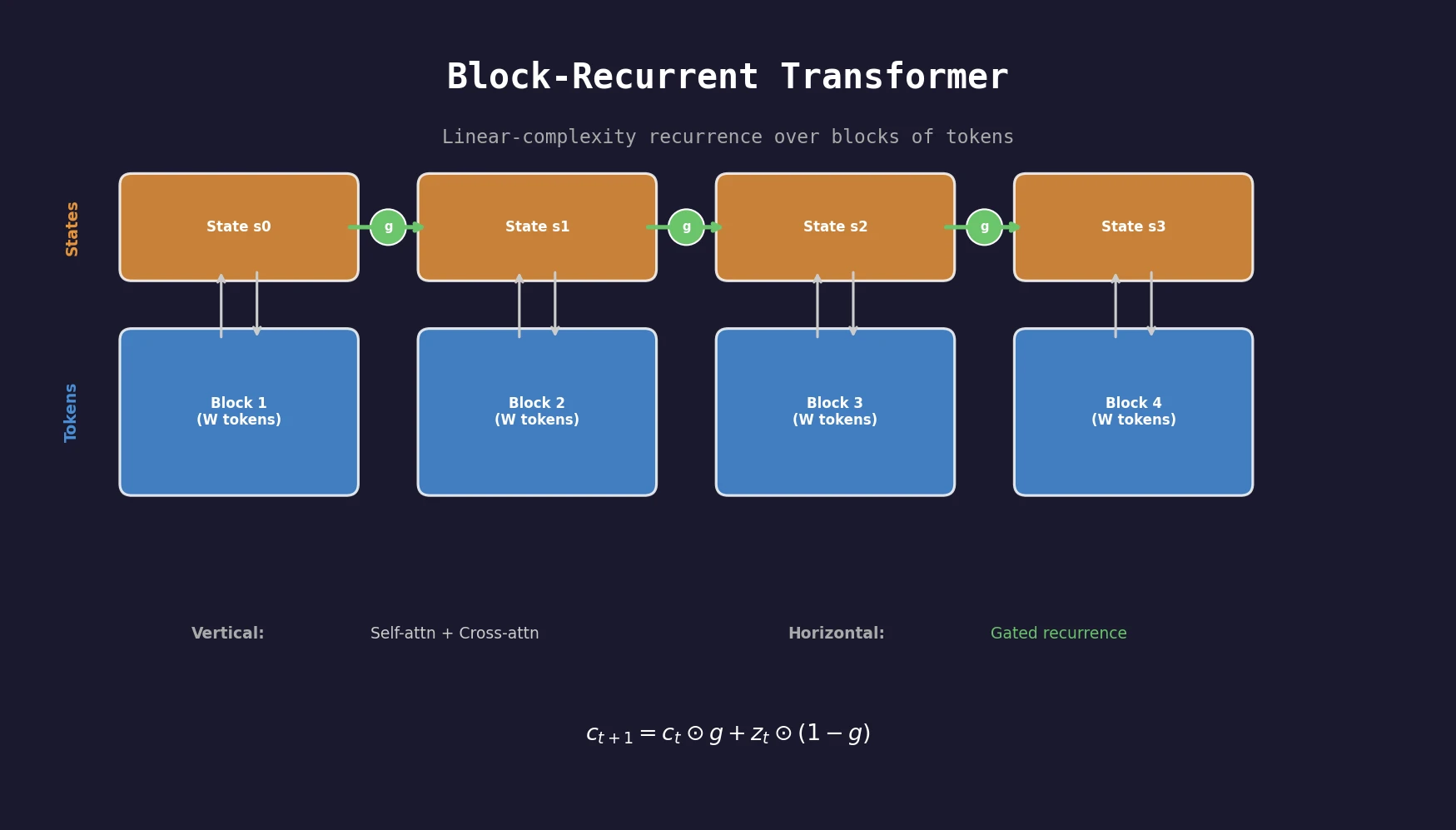
Diagram showing block-recurrent transformer architecture with vertical and horizontal processing directions

Block-Recurrent Transformers for Long Sequences

A transformer architecture that applies a recurrent cell over blocks of tokens, achieving linear complexity in sequence length while outperforming Transformer-XL baselines on PG19, arXiv, and GitHub datasets.

Natural Language Processing
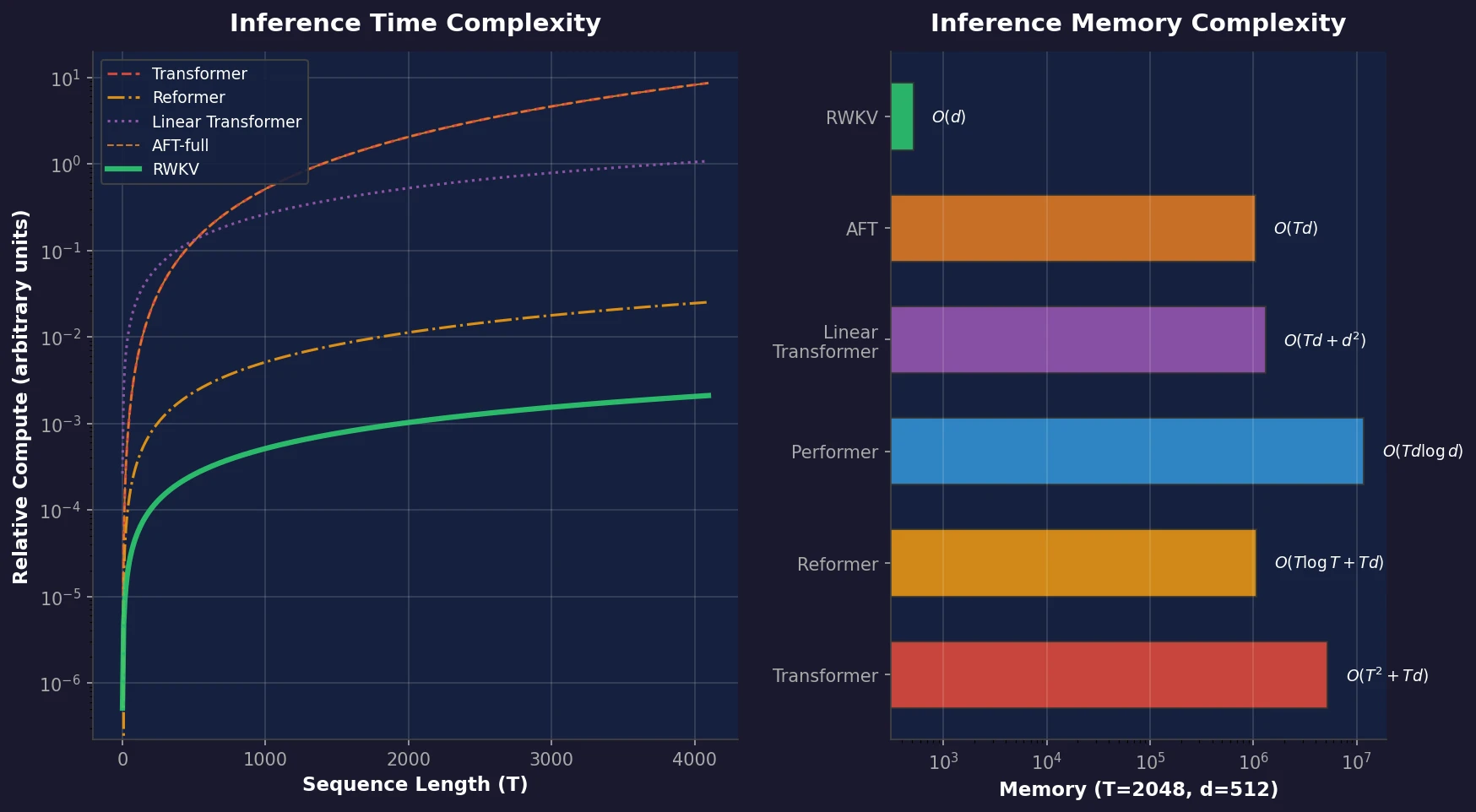
Diagram comparing RWKV inference complexity against Transformers and efficient variants

RWKV: Linear-Cost RNN with Transformer Training

RWKV is a novel sequence model that achieves transformer-level performance while maintaining linear time and constant memory complexity during inference, scaled up to 14 billion parameters.

Natural Language Processing
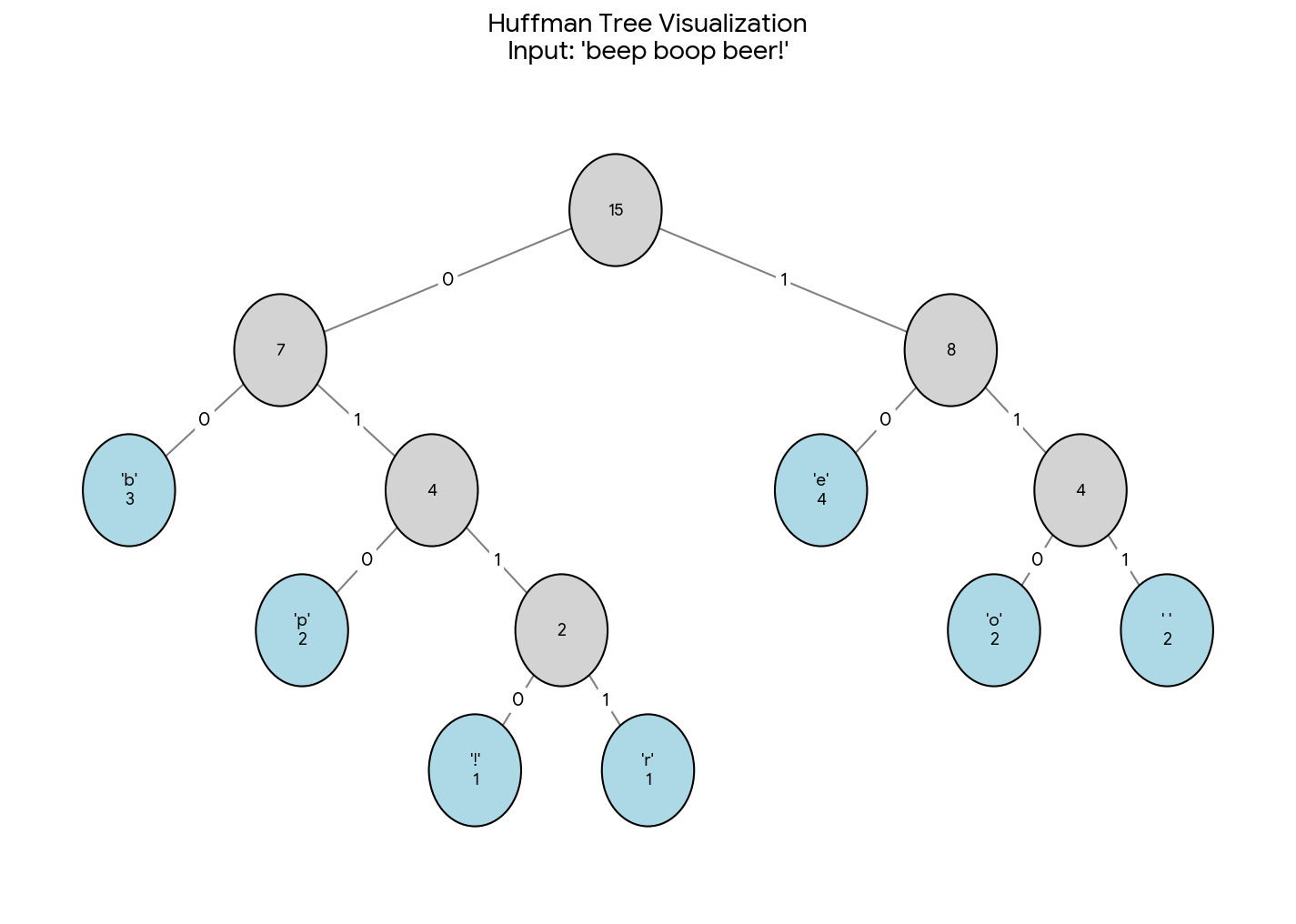
Huffman Tree visualization for the input 'beep boop beer!' showing internal nodes with frequency counts and leaf nodes with characters

High-Performance Word2Vec in Pure PyTorch

A ground-up PyTorch implementation of Word2Vec treating it as a systems engineering challenge, with “tensorized tree” architecture converting pointer-chasing Hierarchical Softmax into dense GPU operations, infinite streaming datasets with Zipfian subsampling, and torch.compile compatibility for production-grade efficiency.

Natural Language Processing
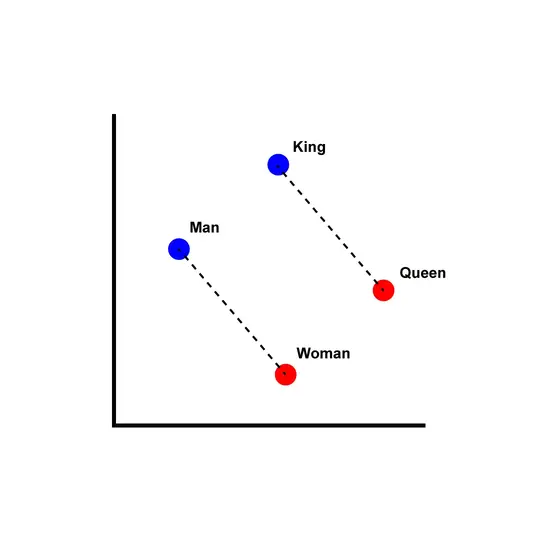
Word vector illustration showing text classification and NLP concepts

Sarcasm Detection with Transformers: A Cautionary Tale

What happens when you achieve 99.8% accuracy on sarcasm detection? You might have accidentally built a domain classifier. A cautionary ML tale about dataset bias.

Natural Language Processing
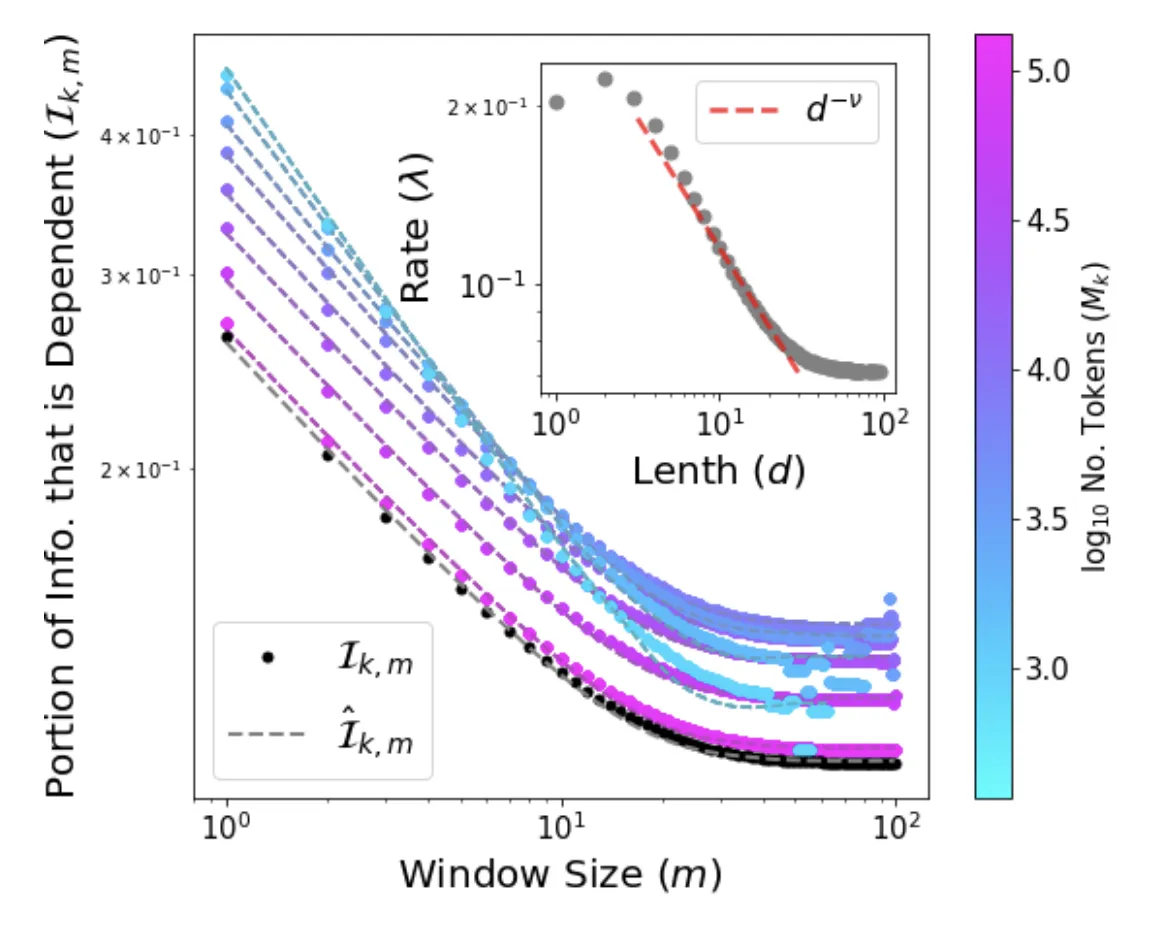
Information Quality Ratio plot showing statistical dependencies decay as window size increases

Analytical Solution to Word2Vec Softmax & Bias Probing

We provide the first analytical solution to Word2Vec’s softmax skip-gram objective, introducing the Independent Frequencies Model and deriving a low-cost, training-free method for measuring semantic bias directly from corpus statistics.

Natural Language Processing
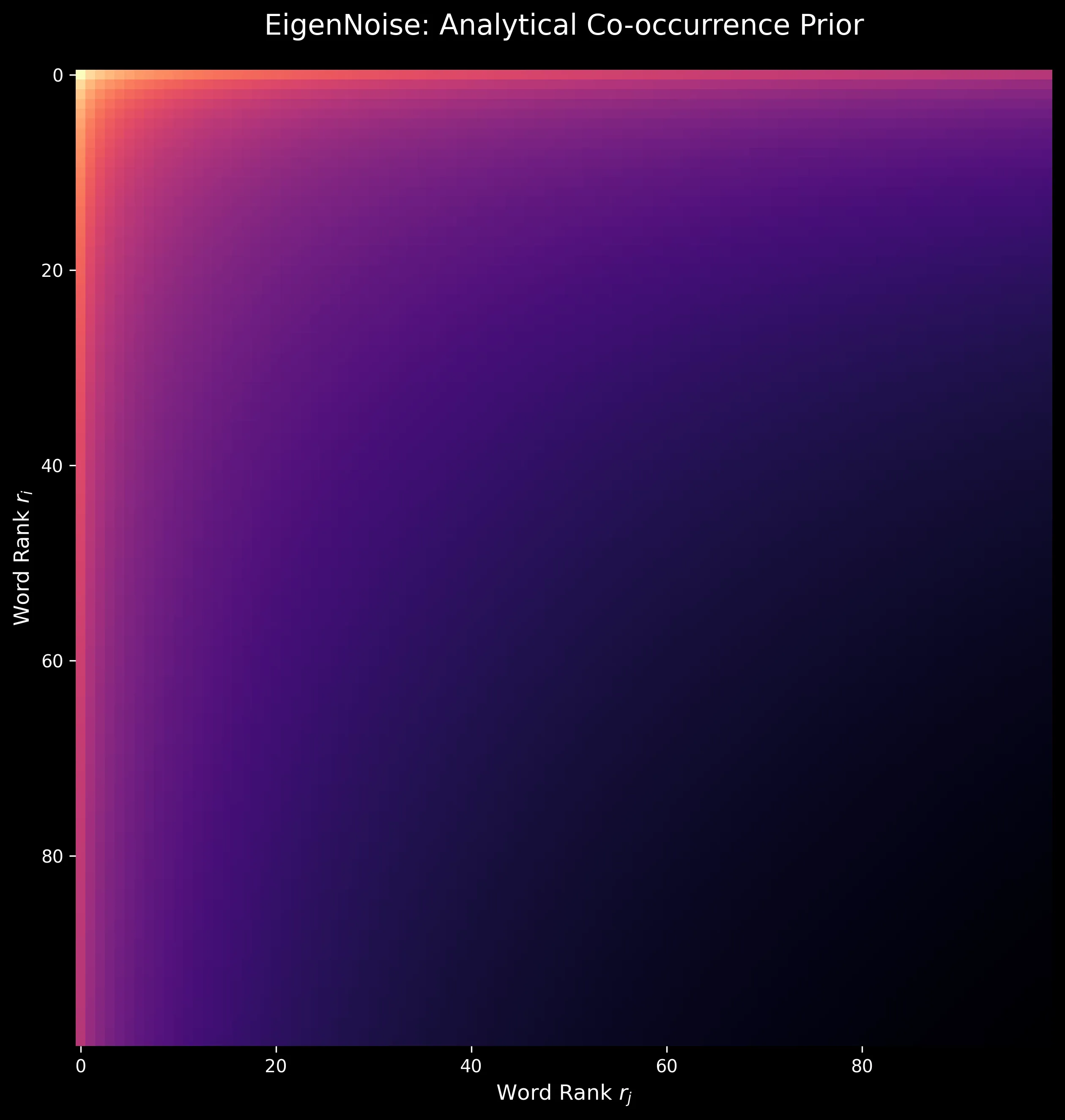
Heatmap visualization of the EigenNoise analytical co-occurrence prior matrix showing word rank relationships

EigenNoise: Data-Free Word Vector Initialization

We develop EigenNoise, a zero-data initialization method for word vectors that synthesizes representations from Zipf’s Law alone, demonstrating competitive performance to GloVe after fine-tuning without requiring any pre-training corpus.