Molecular Simulation
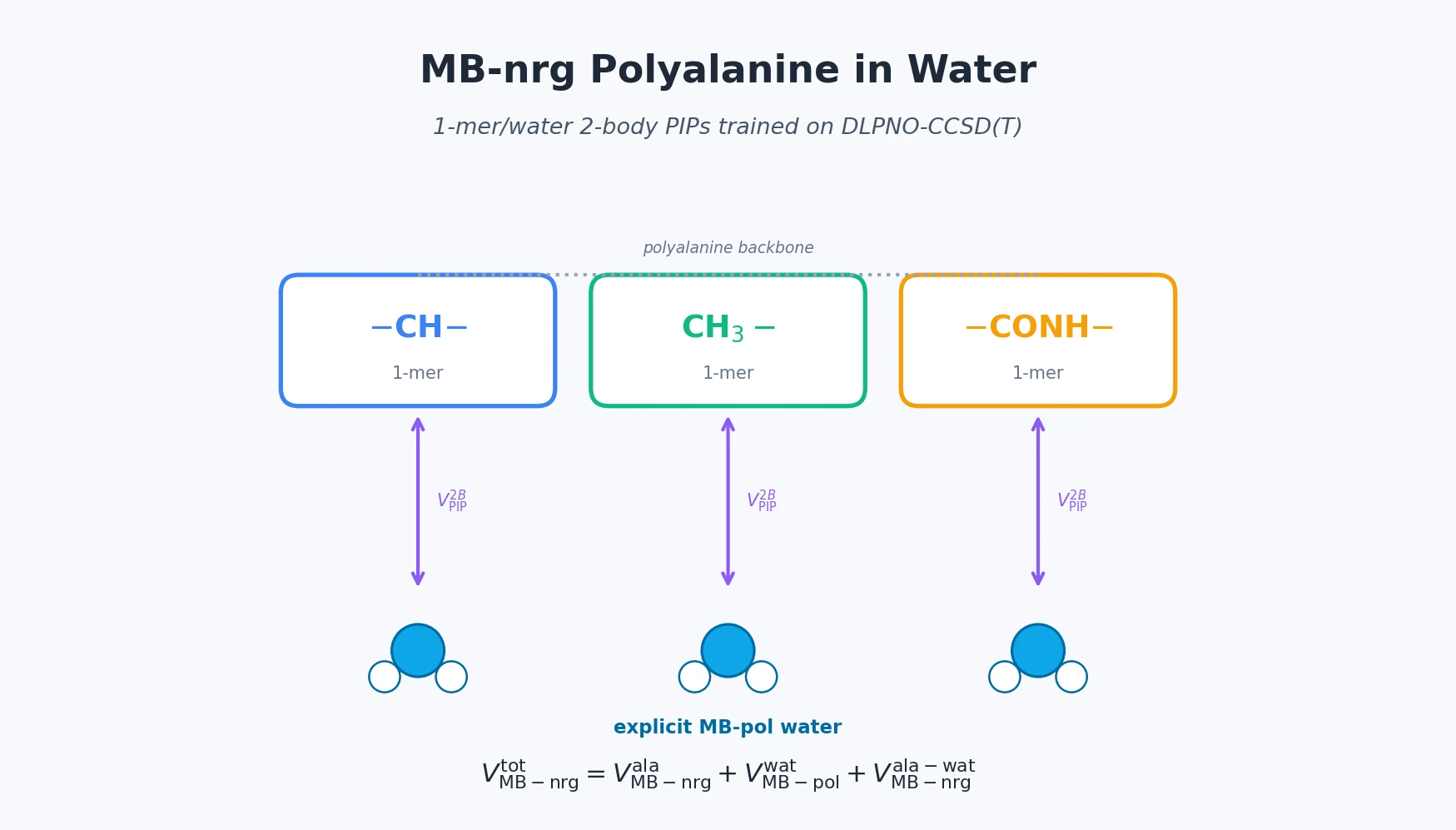
Schematic of polyalanine 1-mer functional groups interacting with water through CCSD(T)-fit 2-body PIPs.

MB-nrg in Solution: Polyalanine in Water with CCSD(T) PEFs

Building on the gas-phase MB-nrg PEF for polyalanine, Ruihan Zhou and Francesco Paesani add machine-learned 2-body terms for each backbone functional group interacting with water, fit to BSSE-corrected DLPNO-CCSD(T)/aug-cc-pVTZ data, then validate the resulting potential against alanine dipeptide-water dimer scans, free-energy surfaces in explicit MB-pol water, and hydration radial distribution functions.
Molecular Simulation
Schematic of polyalanine decomposed into overlapping n-mer building blocks fit to CCSD(T) energies.

MB-nrg: CCSD(T)-Accurate Potentials for Polyalanine

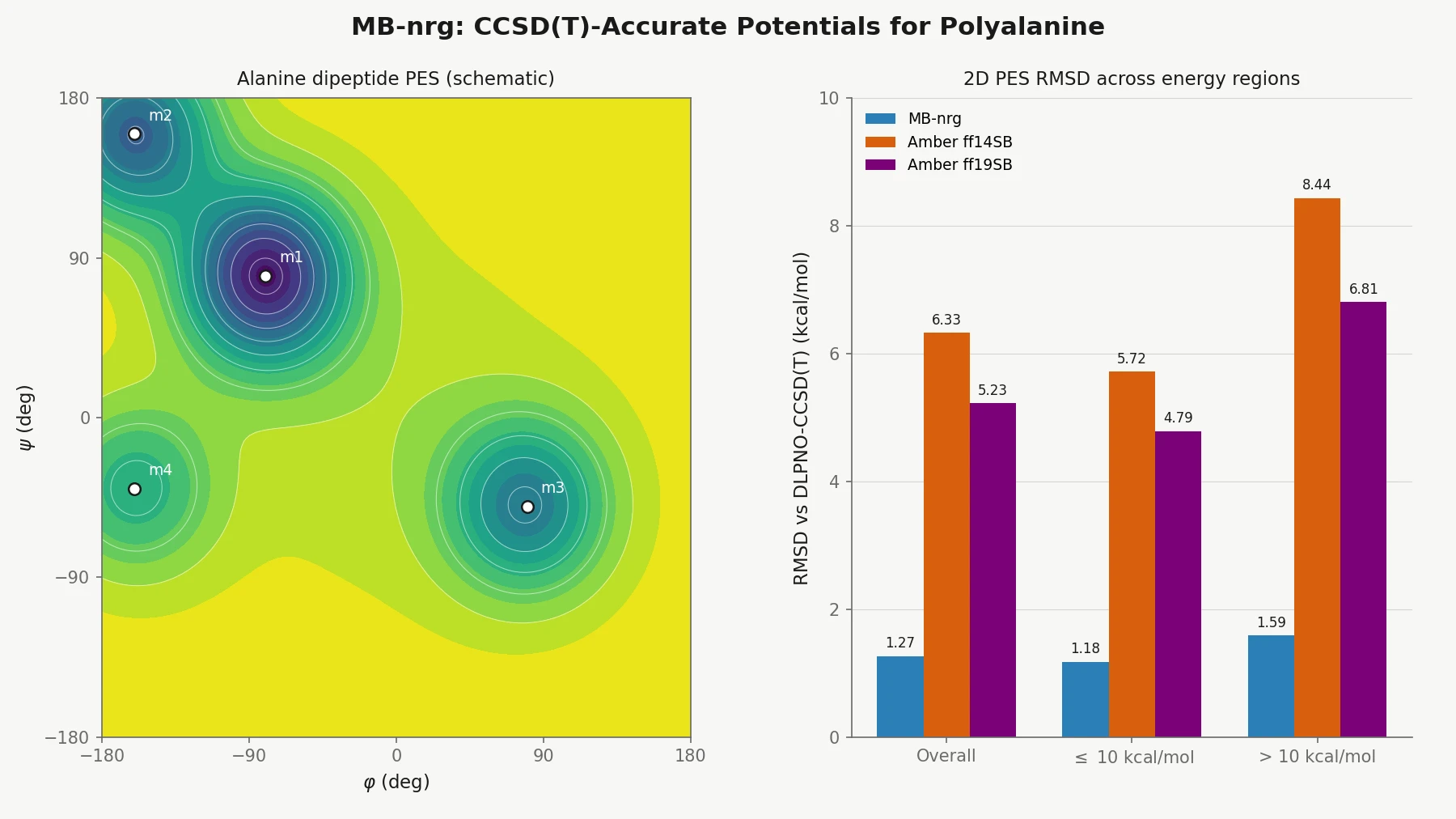
Ruihan Zhou and co-authors extend the MB-nrg many-body formalism to covalently bonded biomolecules by fragmenting polyalanine into functional-group n-mers, fitting permutationally invariant polynomials to DLPNO-CCSD(T)/aug-cc-pVTZ reference energies, and reproducing alanine dipeptide Ramachandran surfaces, harmonic frequencies, and AceAla9Nme secondary-structure dynamics more faithfully than Amber ff14SB and ff19SB.

Molecular Simulation
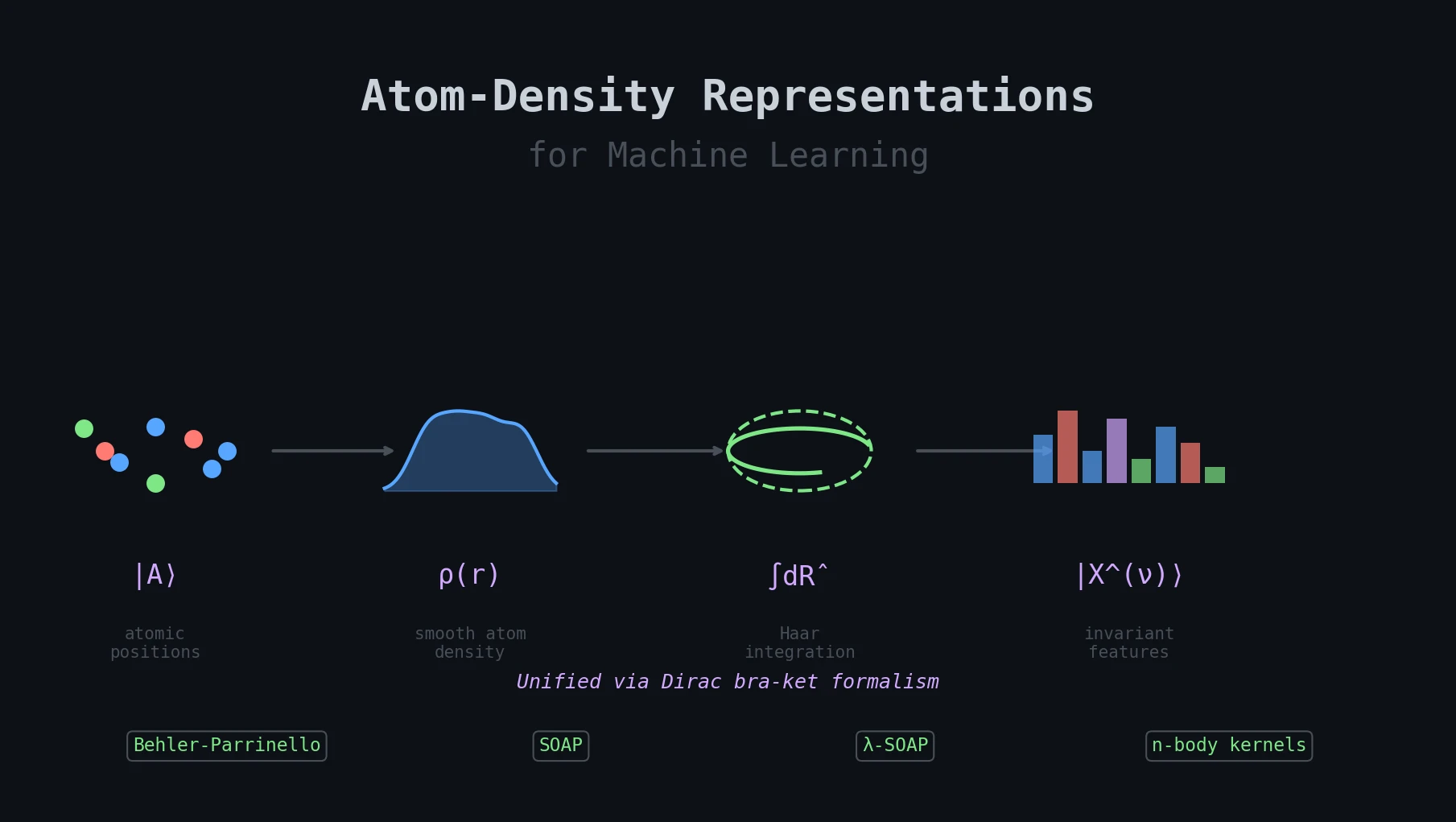
Pipeline showing atoms converted to smooth density, symmetrized via Haar integration, and projected to invariant features

Atom-Density Representations for Machine Learning

Introduces a Dirac notation formalism for atomic environments that unifies SOAP power spectra, Behler-Parrinello symmetry functions, and other density-based structural representations under a single theoretical framework.

Molecular Simulation
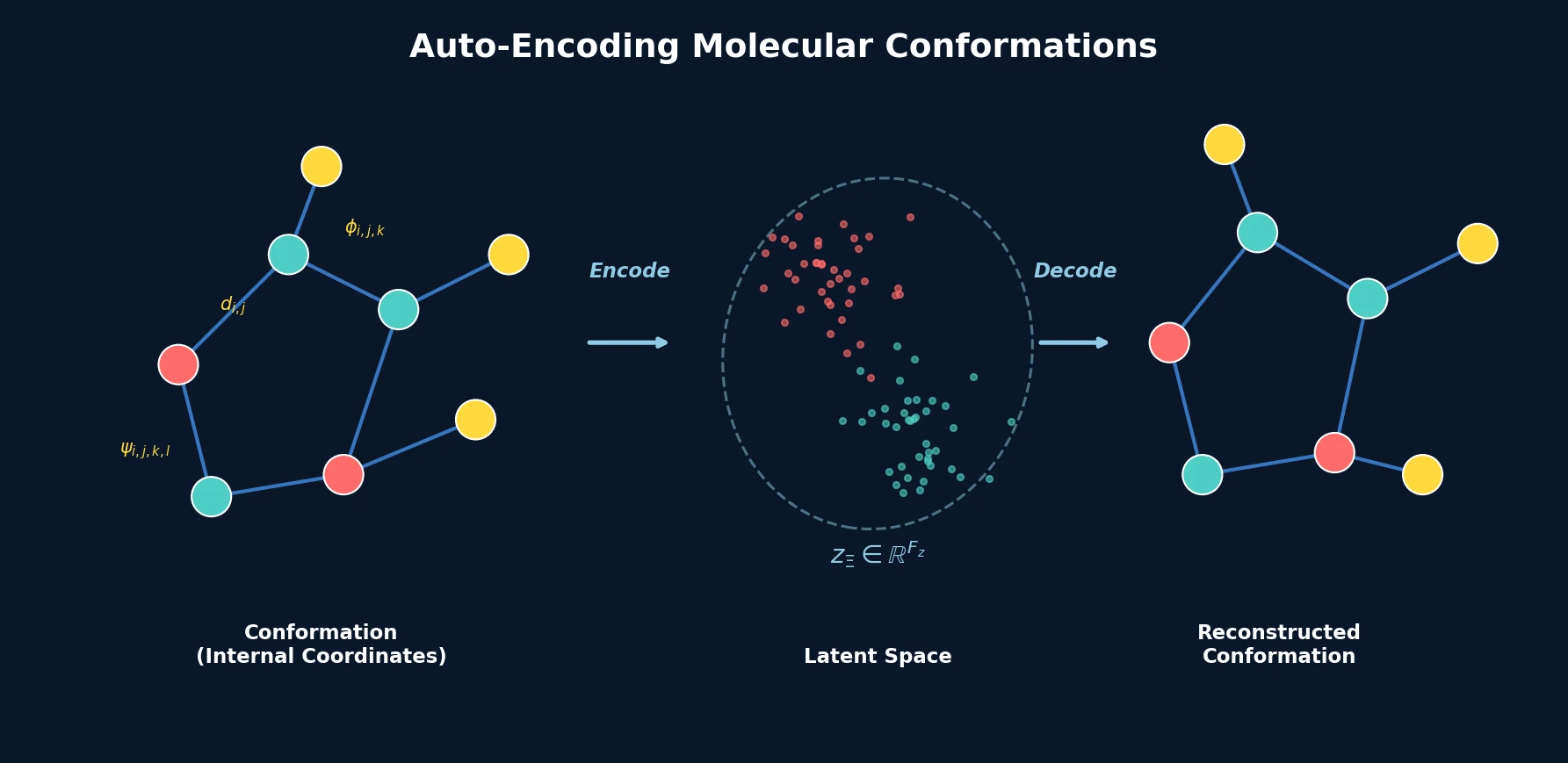
Diagram showing conformation autoencoder architecture with internal coordinate encoding and decoding

Conformation Autoencoder for 3D Molecules

A conformation autoencoder converts molecular 3D arrangements into fixed-size latent representations using internal coordinates and graph neural networks, enabling conformer generation and spatial property optimization.

Molecular Simulation
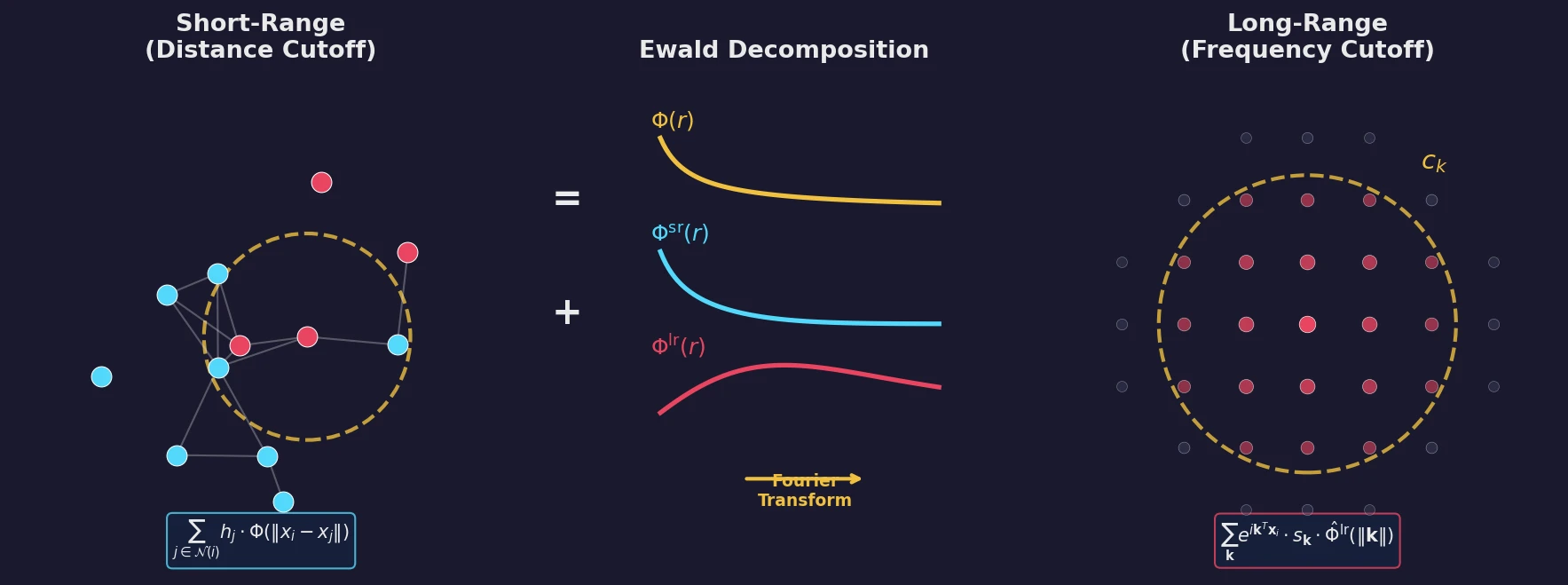
Diagram showing the Ewald decomposition of long-range interactions into short-range and Fourier-space components for molecular graph neural networks

Ewald Message Passing for Molecular Graphs

Proposes Ewald message passing, a Fourier-space scheme inspired by Ewald summation that captures long-range interactions in molecular graphs. The method is architecture-agnostic and improves energy MAEs by 10% on OC20 and 16% on OE62 across four baseline GNN models.

Molecular Simulation
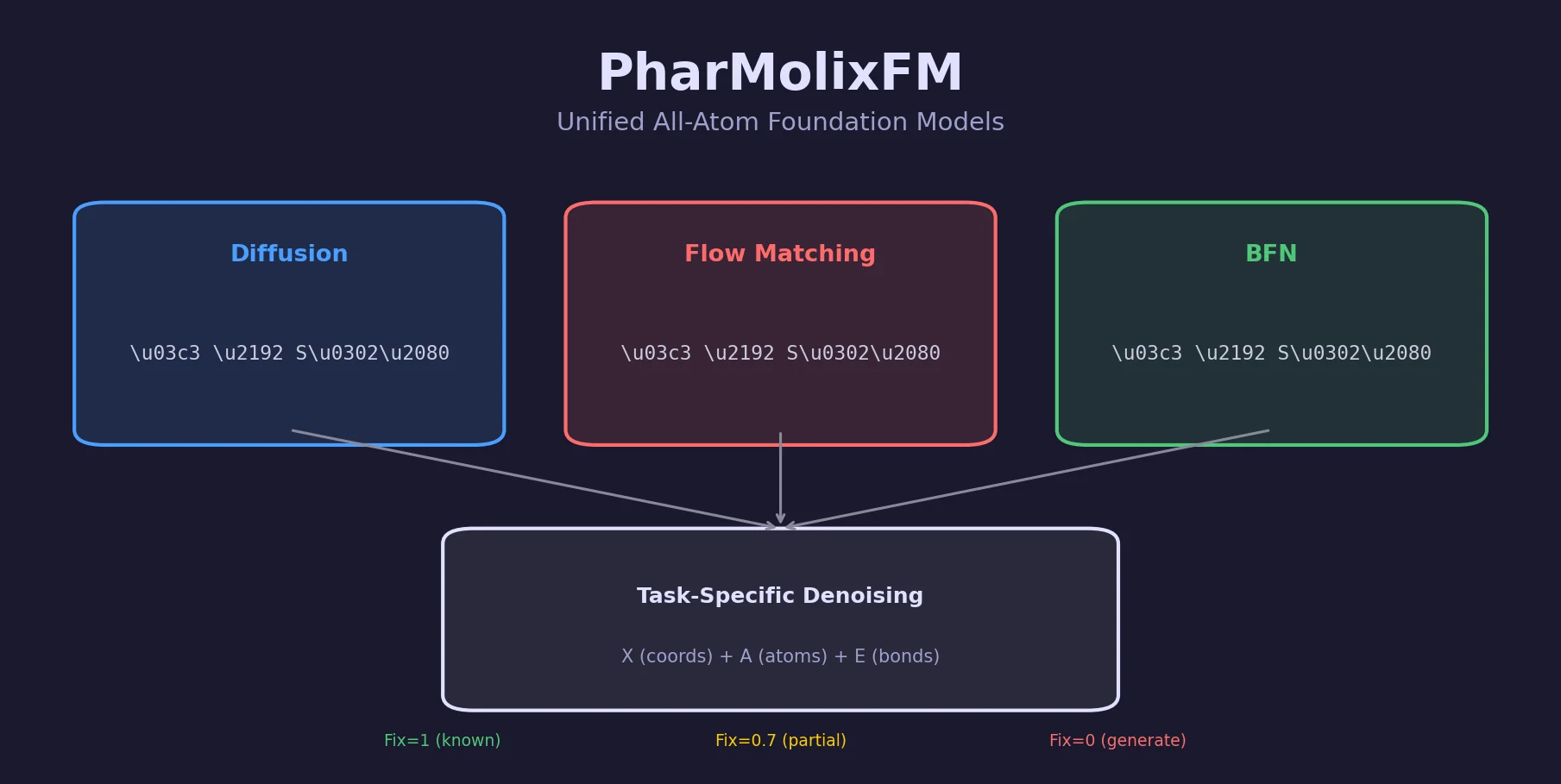
Schematic overview of three multi-modal generative model variants for all-atom molecular denoising

PharMolixFM: Multi-Modal All-Atom Molecular Models

PharMolixFM proposes a unified framework for all-atom foundation models using three multi-modal generative approaches (diffusion, flow matching, BFN) and demonstrates competitive docking accuracy with fast inference.

Molecular Simulation
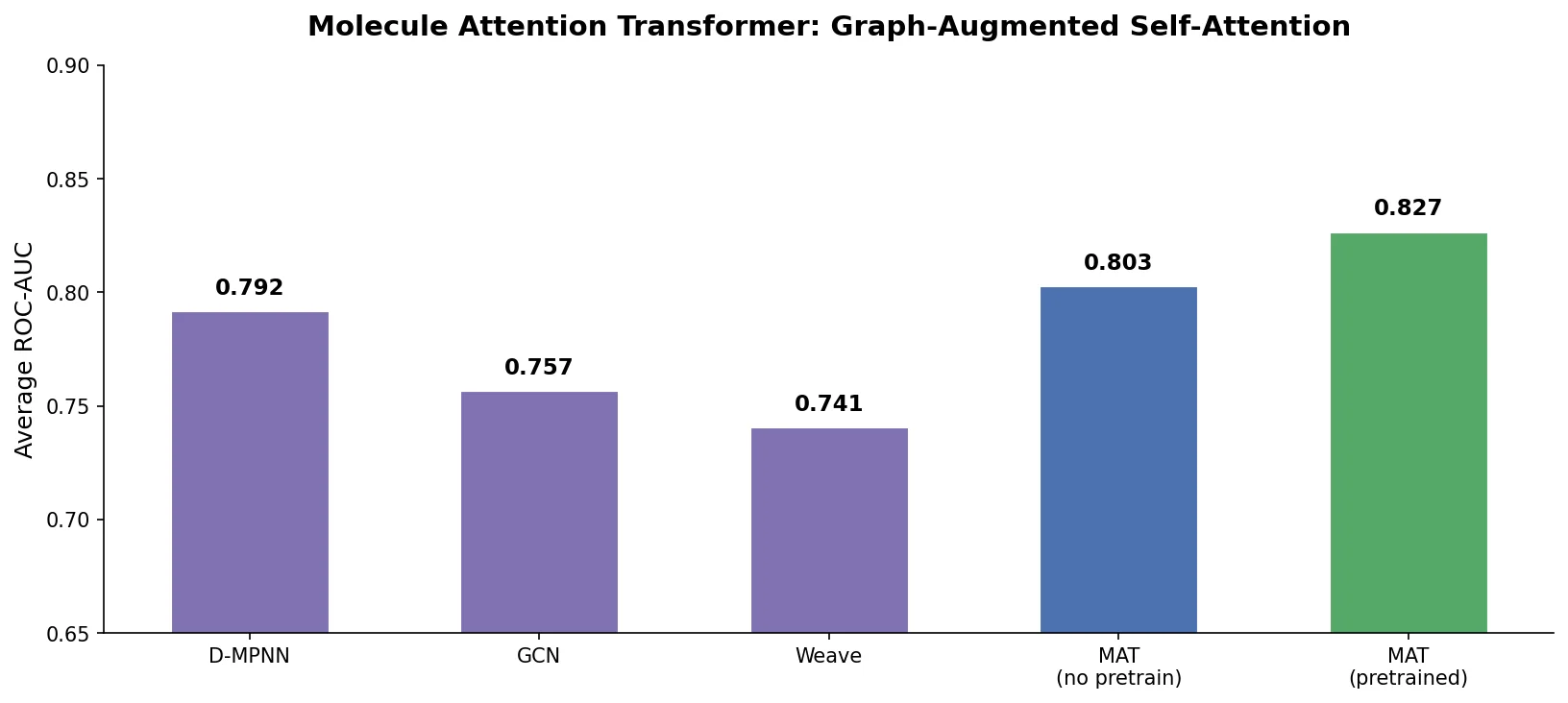
Bar chart comparing MAT average ROC-AUC against D-MPNN, GCN, and Weave baselines

MAT: Graph-Augmented Transformer for Molecules (2020)

Molecule Attention Transformer (MAT) augments Transformer self-attention with inter-atomic distances and graph adjacency, achieving strong property prediction across diverse molecular tasks with minimal hyperparameter tuning after self-supervised pretraining.

Molecular Simulation
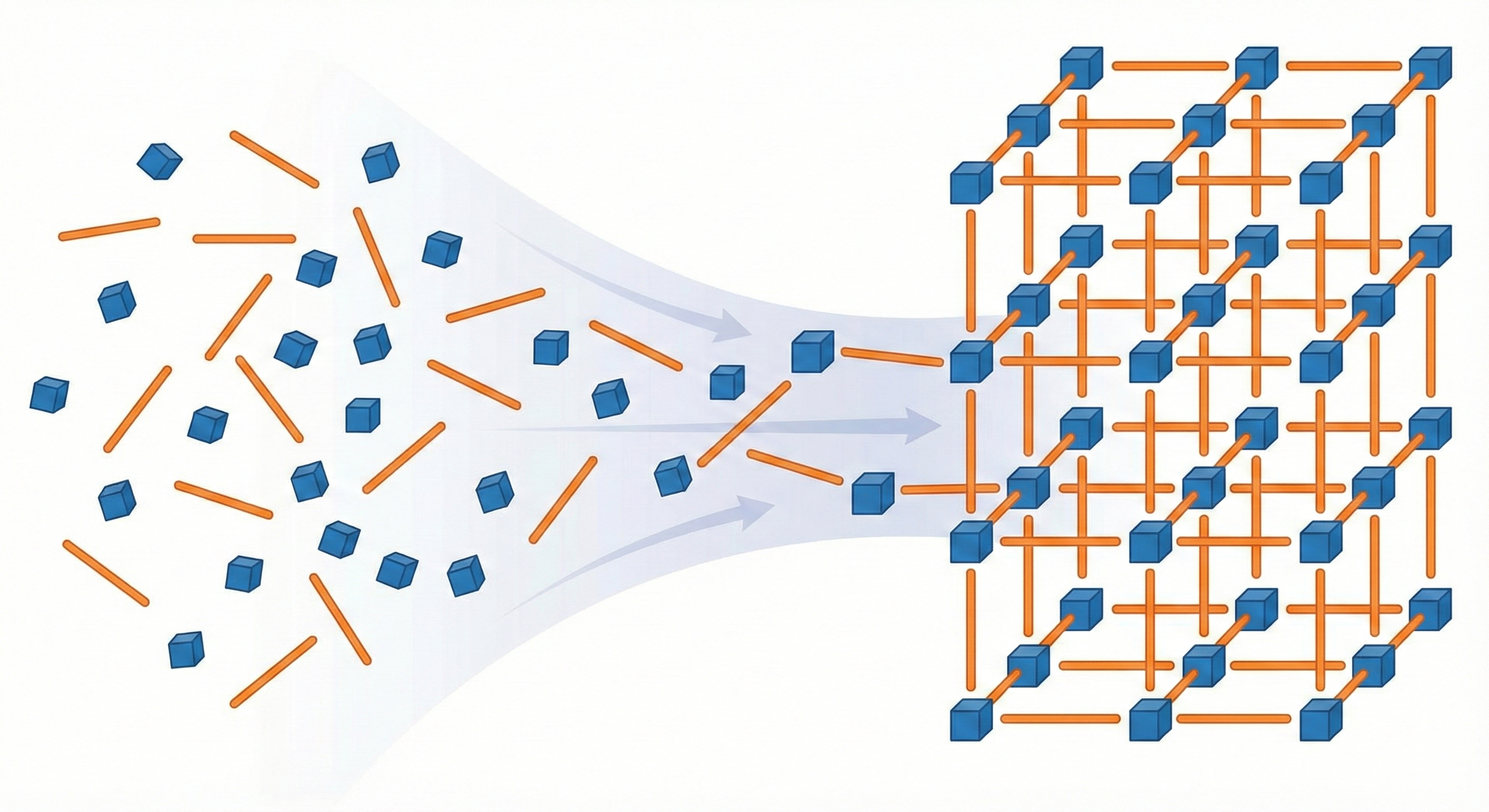
MOFFlow assembles metal nodes and organic linkers into Metal-Organic Framework structures

MOFFlow: Flow Matching for MOF Structure Prediction

MOFFlow is the first deep generative model tailored for Metal-Organic Framework (MOF) structure prediction. It utilizes Riemannian flow matching on SE(3) to assemble rigid building blocks (metal nodes and organic linkers), achieving higher accuracy and scalability than atom-based methods on large systems.

Molecular Simulation
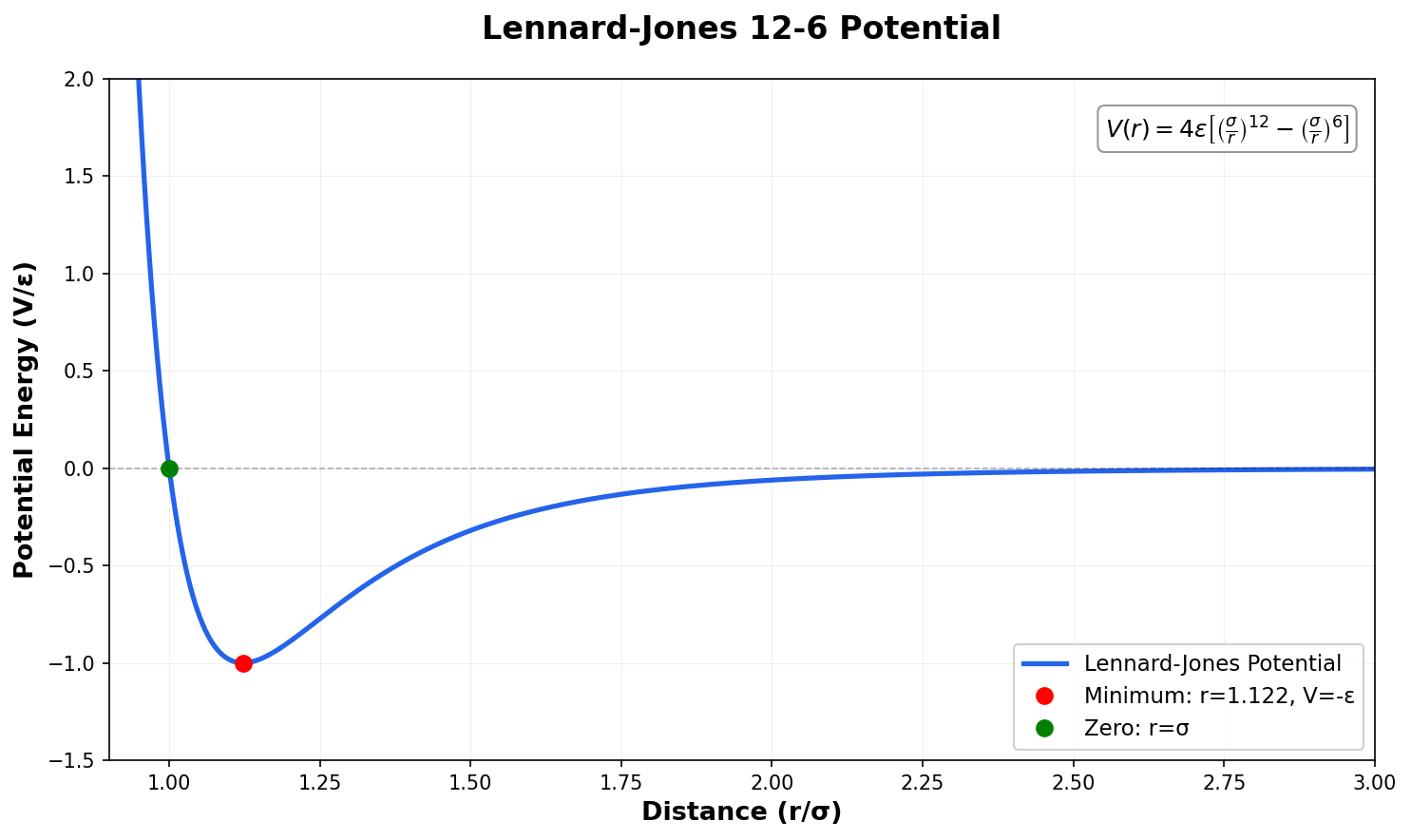
Graph of the Lennard-Jones 12-6 potential showing the characteristic attractive and repulsive forces

Dynamical Corrections to TST for Surface Diffusion

This paper bridges Molecular Dynamics and Transition State Theory by applying a dynamical corrections formalism to surface diffusion, identifying a low-temperature bounce-back mechanism causing non-Arrhenius behavior.

Molecular Simulation
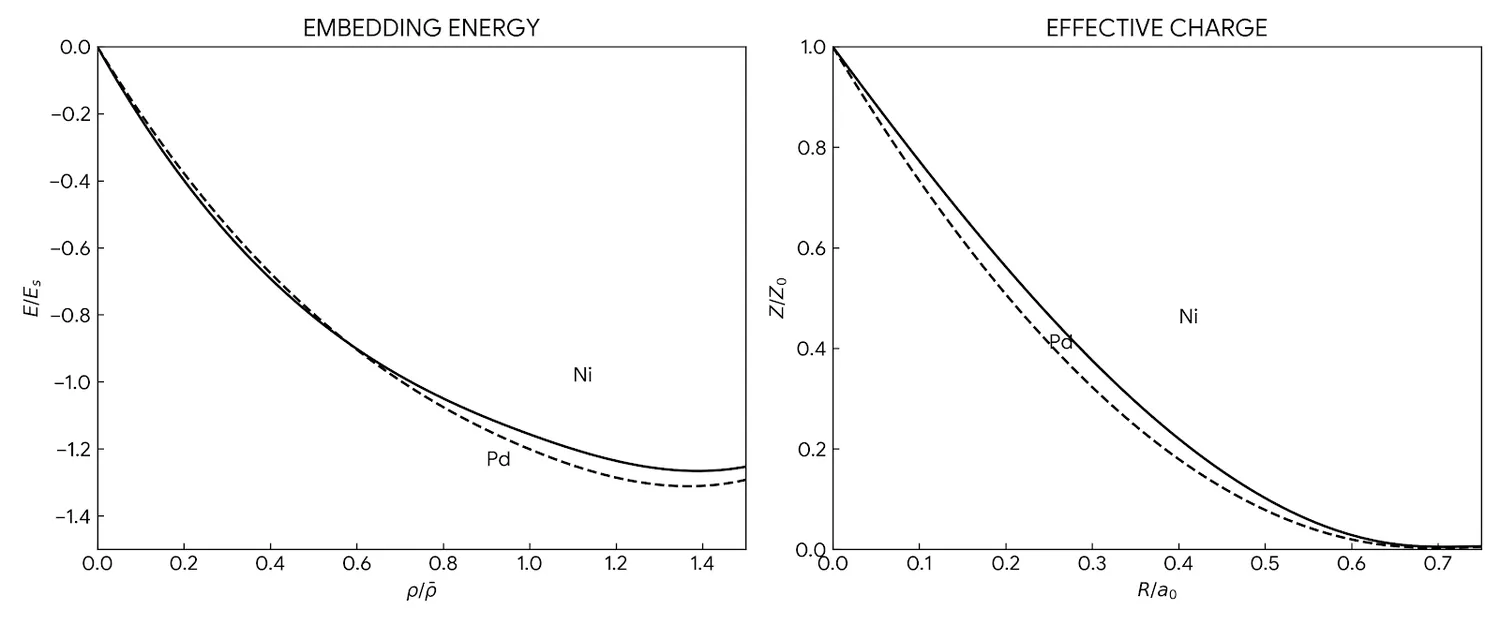
Embedding energy and effective charge functions for Ni and Pd from the original EAM paper

Embedded-Atom Method User Guide: Voter's 1994 Chapter

This 1994 handbook chapter serves as a practical user guide for the Embedded-Atom Method (EAM). It details the theoretical derivation from density-functional theory, synthesizes related methods like the Glue Model, and provides a complete tutorial on fitting potentials, illustrated with a specific implementation for the Ni-Al-B system.

Molecular Simulation
Embedding energy and effective charge functions for Ni and Pd from the original EAM paper

Embedded-Atom Method: Theory and Applications Review

This 1993 review systematizes the Embedded-Atom Method (EAM) as a practical semi-empirical approach for metallic systems. It synthesizes theory, applications, and connections to related methods while addressing the limitations of pair potentials.

Molecular Simulation
Graph of the Lennard-Jones 12-6 potential showing the characteristic attractive and repulsive forces

Evans 1986: Thermal Conductivity of Lennard-Jones Fluid

This paper validates the homogeneous Evans method for calculating thermal conductivity against experimental Argon data. It demonstrates broad agreement across the phase diagram but identifies significant non-monotonic behavior and enhanced long-time tails near the critical point.