Molecular Generation
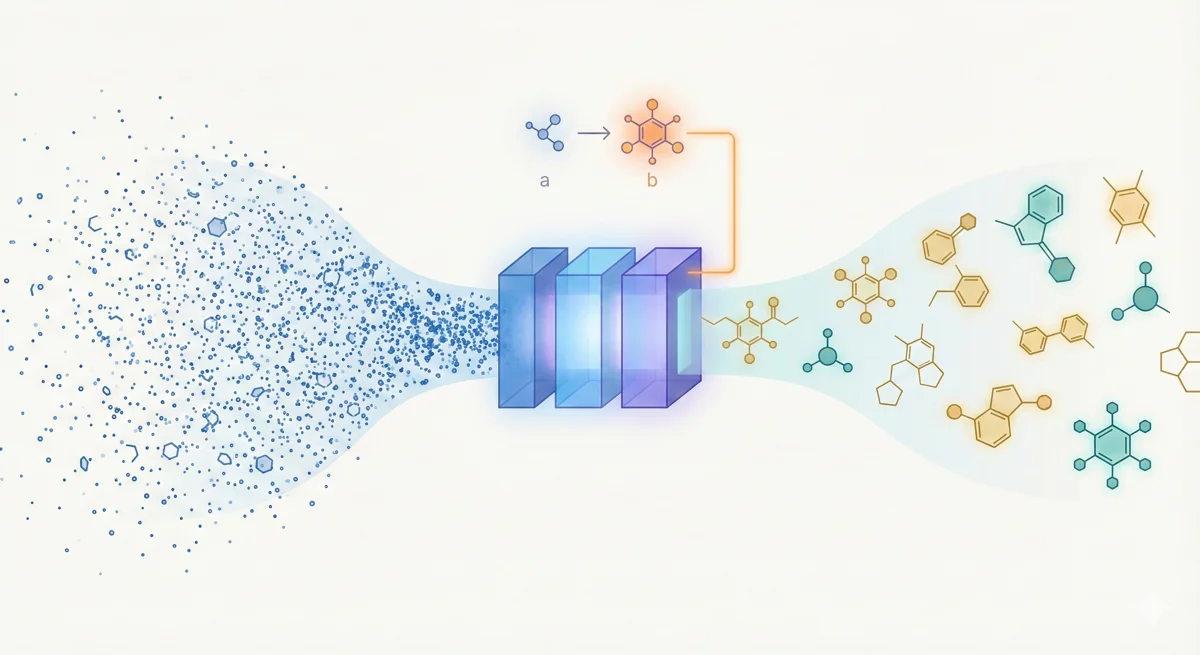
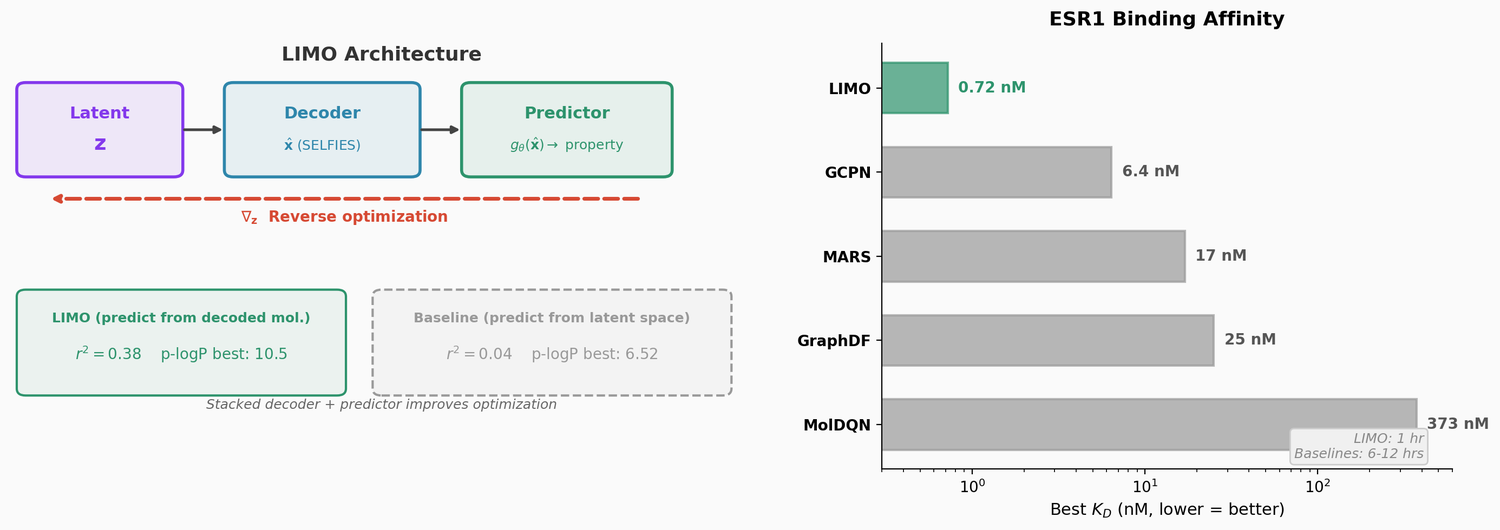
Diagram of the LIMO pipeline showing gradient-based reverse optimization flowing backward through a frozen property predictor and VAE decoder to optimize the latent space z

LIMO: Latent Inceptionism for Targeted Molecule Generation

LIMO combines a SELFIES-based VAE with a novel stacked property predictor architecture (decoder output as predictor input) and gradient-based reverse optimization on the latent space. It is 6-8x faster than RL baselines and 12x faster than sampling methods while generating molecules with nanomolar binding affinities, including a predicted KD of 6e-14 M against the human estrogen receptor.
Molecular Generation
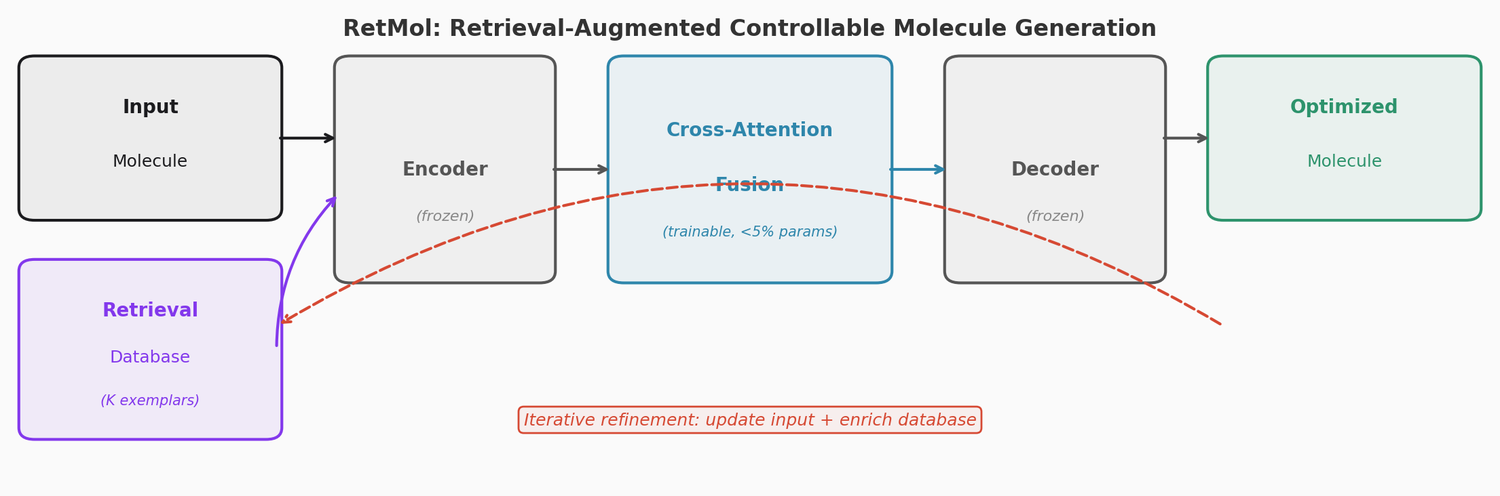
Diagram of the RetMol pipeline showing input molecule and retrieval database feeding into a frozen encoder, cross-attention fusion module, and frozen decoder to produce optimized molecules with iterative refinement

RetMol: Retrieval-Based Controllable Molecule Generation

RetMol plugs a lightweight cross-attention retrieval module into a pre-trained Chemformer backbone to guide molecule generation toward multi-property design criteria. It requires no task-specific fine-tuning and works with as few as 23 exemplar molecules. It achieves 94.5% success on QED optimization, 96.9% on GSK3b/JNK3 dual inhibitor design, and 2.84 kcal/mol average binding affinity improvement on SARS-CoV-2 main protease inhibitor optimization.

Molecular Generation
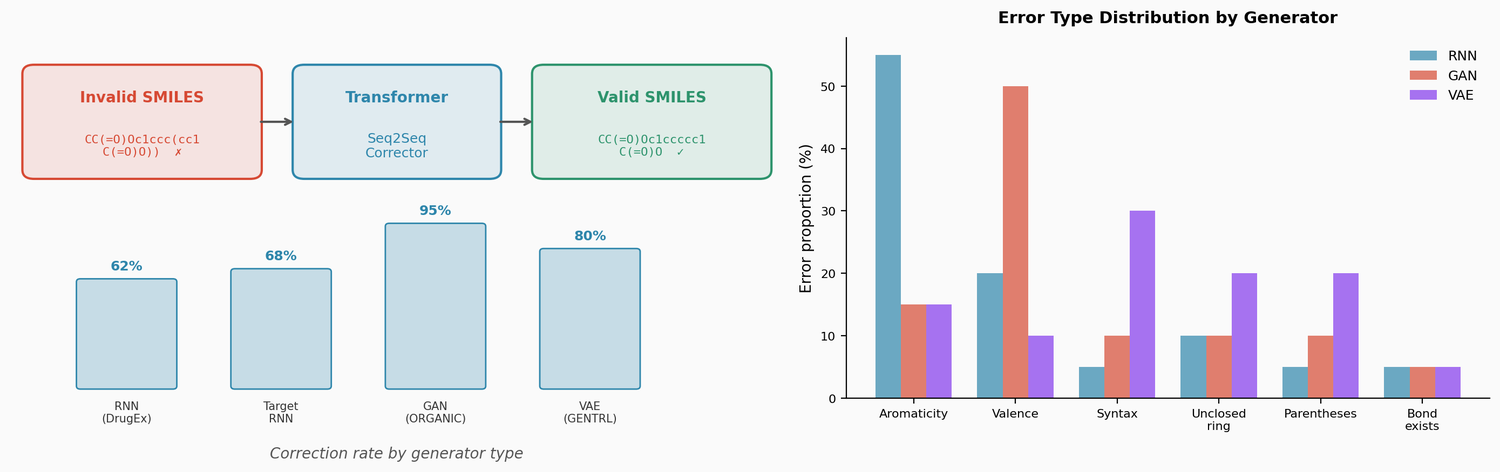
Diagram showing the UnCorrupt SMILES pipeline: invalid SMILES are corrected by a transformer seq2seq model into valid SMILES, with correction rates of 62-95% across generator types

UnCorrupt SMILES: Post Hoc Correction for De Novo Design

This paper trains a transformer model to correct invalid SMILES produced by de novo molecular generators (RNN, VAE, GAN). The corrector fixes 60-95% of invalid outputs, and the fixed molecules are comparable in novelty and similarity to valid generator outputs. The approach also enables local chemical space exploration by introducing and correcting errors in existing molecules.

Molecular Generation
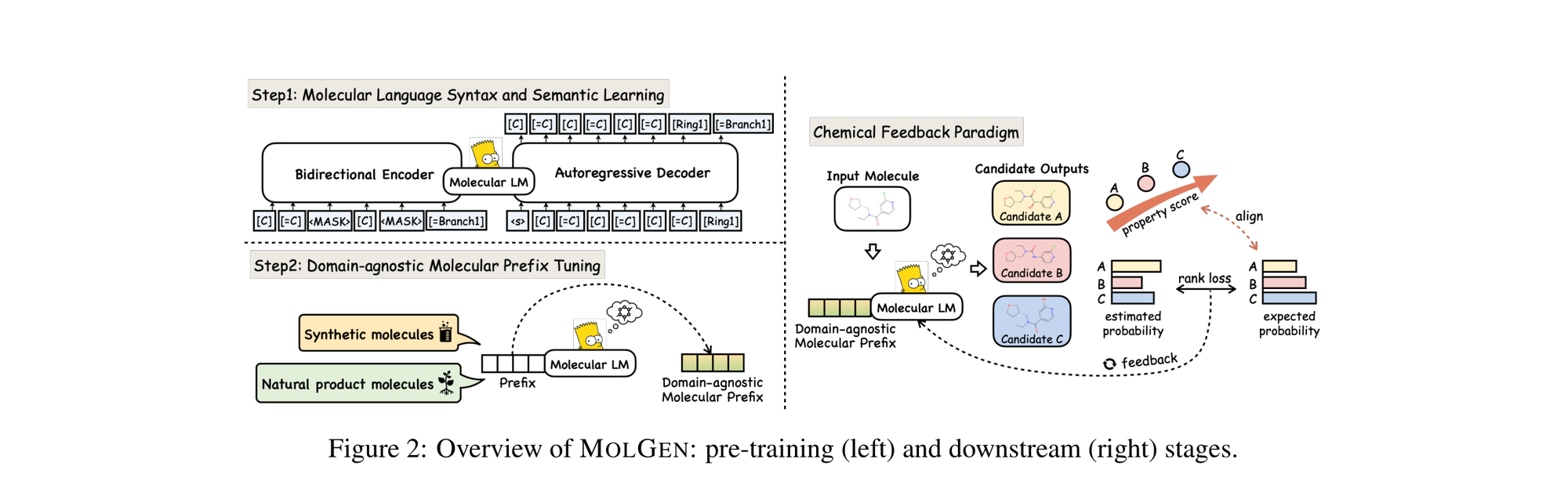
MolGen overview showing two-stage pre-training (molecular language syntax learning and domain-agnostic prefix tuning) and chemical feedback paradigm

MolGen: Molecular Generation with Chemical Feedback

MolGen pre-trains on 100M+ SELFIES molecules, introduces domain-agnostic prefix tuning for cross-domain transfer, and applies a chemical feedback paradigm to reduce molecular hallucinations.

Molecular Generation
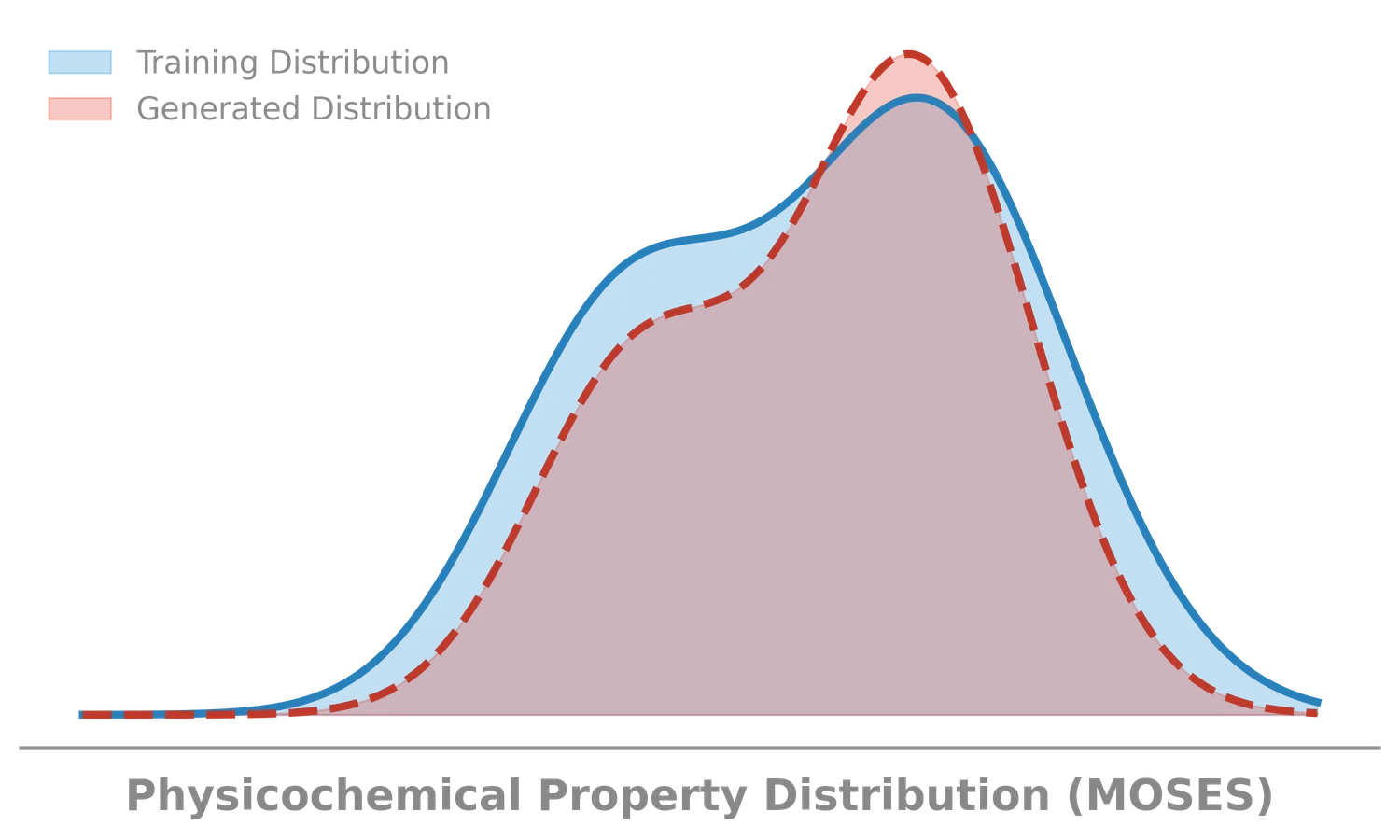
Density plot showing training vs generated physicochemical property distribution

Molecular Sets (MOSES): A Generative Modeling Benchmark

MOSES introduces a comprehensive benchmarking platform for molecular generative models, offering standardized datasets, evaluation metrics, and baselines. By providing a unified measuring stick, it aims to resolve reproducibility challenges in chemical distribution learning.

Molecular Generation
GP-MoLFormer architecture showing large-scale SMILES input, linear-attention transformer decoder, and property optimization via pair-tuning soft prompts

GP-MoLFormer: Molecular Generation via Transformers

This methodological paper proposes a linear-attention transformer decoder trained on 1.1 billion molecules. It introduces pair-tuning for efficient property optimization and establishes empirical scaling laws relating inference compute to generation novelty.

Molecular Generation
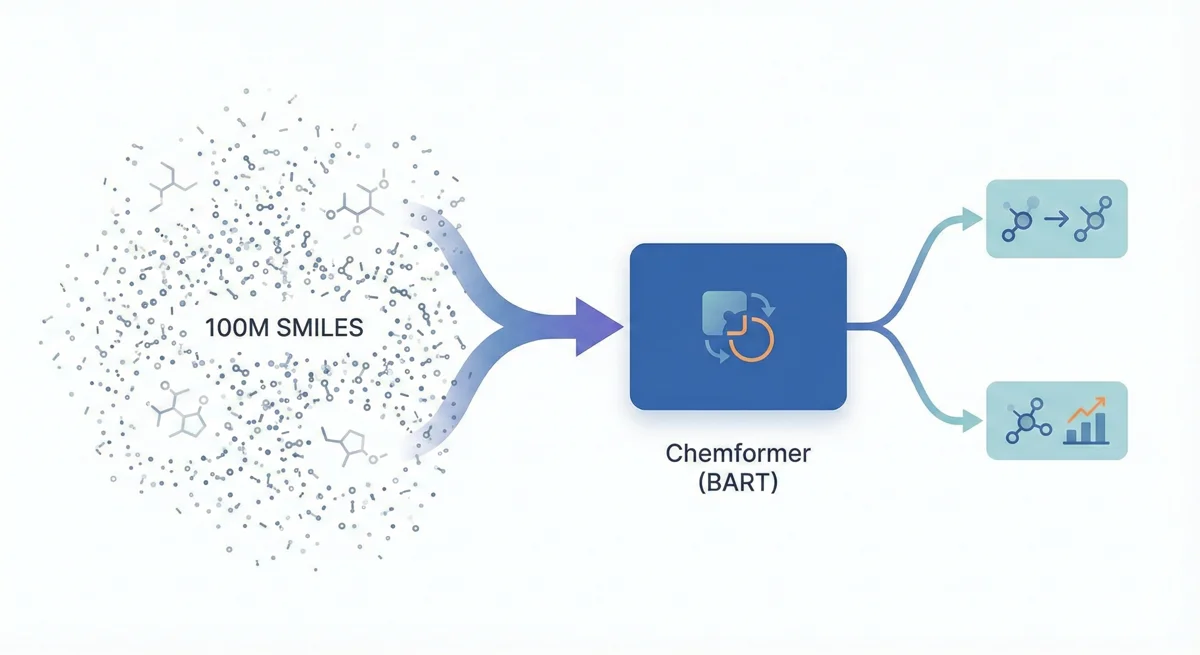
Chemformer pre-training on 100M SMILES strings flowing into BART model, which then enables reaction prediction and property prediction tasks

Chemformer: A Pre-trained Transformer for Comp Chem

This paper introduces Chemformer, a BART-based sequence-to-sequence model pre-trained on 100M molecules using a ‘combined’ masking and augmentation task. It achieves top-1 accuracy on reaction prediction benchmarks while significantly reducing training time through transfer learning.

Molecular Generation
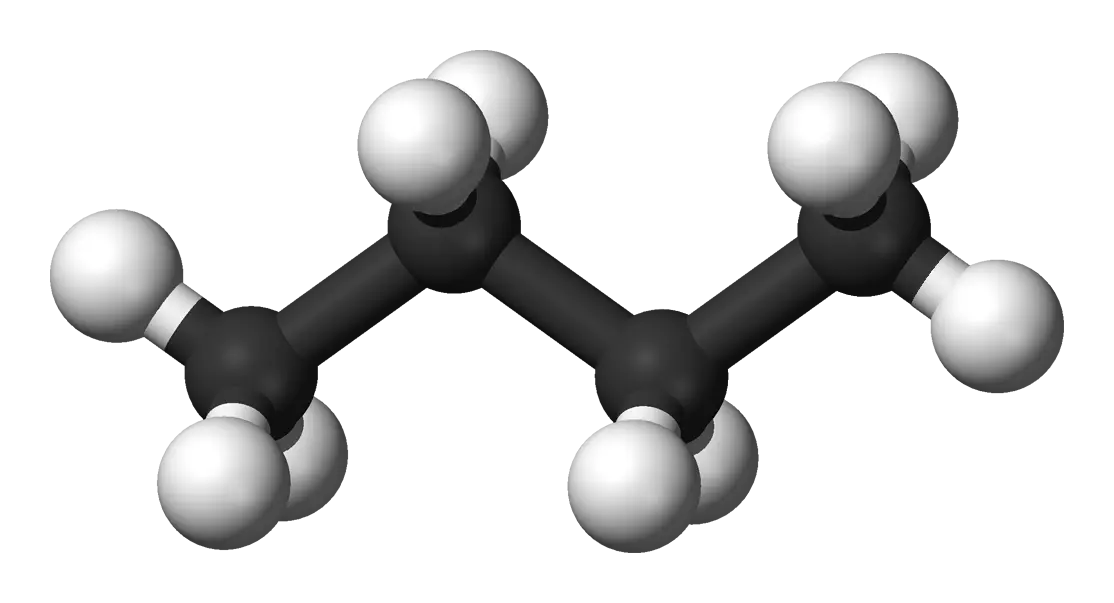
3D ball-and-stick model of butane molecule representing the structural isomer generation process

Synthetic Isomer Data Generation Pipeline

An end-to-end data factory for molecular machine learning that transforms raw chemical formulas (e.g., C6H14) into labeled 3D conformer datasets, using MAYGEN for structural isomer enumeration, RDKit for 3D embedding, and physics-based featurization to address data scarcity in computational drug discovery.